

The Role of Reference Checks in Fire Hiring: A Recruiter’s Guide
Reference checks are a defining step in fire department hiring, serving as the primary method for verifying a candidate’s employment history, behavioral patterns, and suitability for a high-trust public safety role. The role of reference checks in fire hiring extends well beyond confirming job titles and dates. They surface behavioral indicators that predict how a candidate will perform under pressure, alongside colleagues, and in service to the public. For recruiters and hiring managers in public safety, understanding how to conduct reference checks with precision and structure is not optional. It is the foundation of a defensible, evidence-based hiring decision.
What are reference checks and how do they fit into fire department background investigations?
Reference checks are structured interviews conducted with a candidate’s former supervisors, colleagues, or employers to verify employment facts and assess behavioral history. In fire department hiring, they are one component of a multi-layered background investigation that also includes criminal history, driving records, financial status, social media review, and sometimes community canvassing.
Fire department background investigations are comprehensive multi-week audits that span criminal history, driving records, financial status, social media activity, and employment verification. That scope reflects the depth of trust placed in every firefighter who enters a home, responds to a medical emergency, or operates in a life-or-death environment.
Reference interviews typically cover five core areas:
- Reliability and punctuality: Did the candidate show up consistently and on time?
- Interpersonal conduct: How did the candidate interact with supervisors, peers, and the public?
- Disciplinary history: Were there formal or informal disciplinary actions during employment?
- Reason for departure: Did the candidate leave voluntarily, or was the separation involuntary?
- Rehire eligibility: Would the former employer hire this person again, and under what conditions?
Fire background investigations typically span 5–10 years of a candidate’s history. That window captures patterns, not isolated incidents. A single reference may confirm a candidate’s strengths. Multiple references across different employers reveal whether those strengths are consistent or situational.
Background investigations also include polygraph examinations and psychological evaluations in addition to reference checks. Reference interviews feed directly into that broader picture, providing human context that records alone cannot supply.
Pro Tip: Request references from direct supervisors rather than HR departments alone. Supervisors can speak to day-to-day conduct, judgment under pressure, and team dynamics in ways that HR records rarely capture.

Why are reference checks especially important in fire hiring compared to other industries?
Fire departments hold candidates to the highest standards of integrity, judgment, and trustworthiness because their decisions directly affect public safety. A background investigation for a firefighter is one of the most thorough personal audits conducted for any profession. That standard exists because the cost of a bad hire in public safety is not measured in lost revenue. It is measured in lives, liability, and institutional trust.
The behavioral science behind this standard is compelling. A study of over 6,000 police officers found that pre-hire behavioral indicators such as occupational instability and interpersonal conflicts predicted future misconduct, with hazard ratios reaching as high as 14.59. That figure means a candidate showing those warning signs before hire was nearly 15 times more likely to commit misconduct on the job. The same principle applies directly to fire hiring.
Pre-hire behaviors such as occupational instability and interpersonal conflicts are among the strongest predictors of future misconduct in public safety roles. Identifying these patterns during reference checks is not a procedural formality. It is a risk management decision with measurable consequences for agency safety and public trust.
Reference checks in fire hiring carry weight that generic employment verification does not. A recruiter who asks only “Did this person work here from this date to that date?” misses the behavioral layer entirely. The goal is to understand how a candidate behaved across multiple work environments, how they handled conflict, and whether their self-reported history aligns with what their former employers actually observed.
The stakes are also legal. Agencies that skip thorough reference verification expose themselves to negligent hiring claims. If a firefighter causes harm and the agency failed to uncover a documented history of misconduct, the liability falls on the department. Rigorous reference verification is both a safety measure and a legal defense.
How to conduct effective reference checks in fire hiring: best practices and pitfalls to avoid
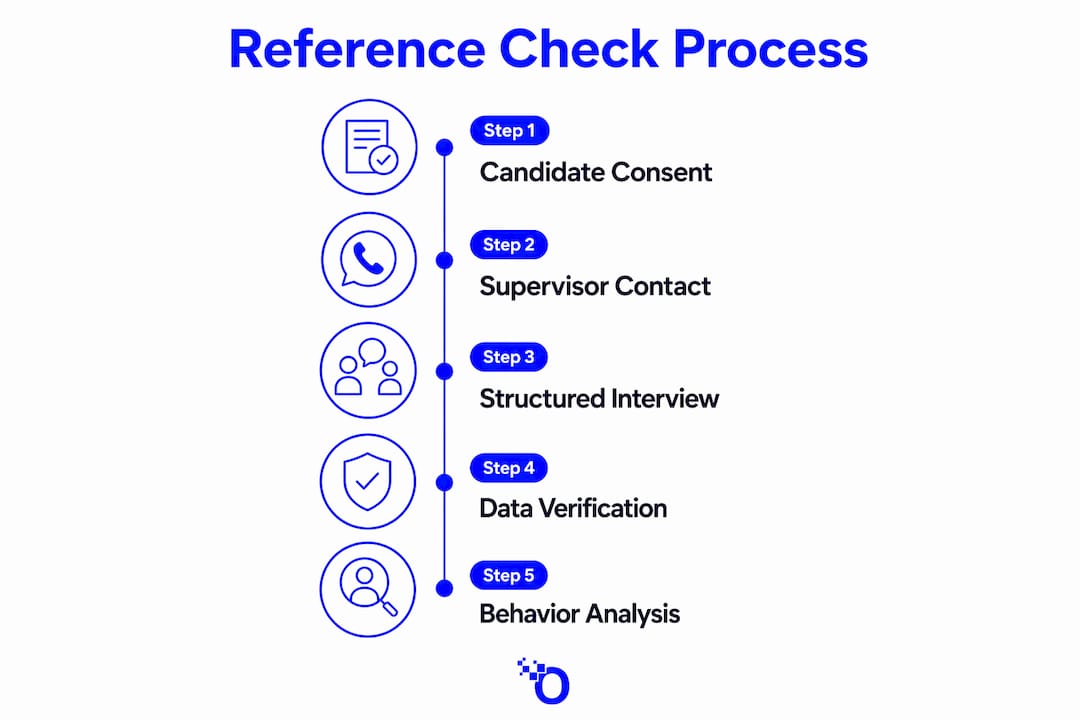
Effective reference checks follow a structured process. Ad hoc phone calls with no prepared questions produce inconsistent data and miss critical behavioral indicators. The best practices for reference checks in fire hiring require preparation, documentation, and a willingness to pursue sources beyond the candidate’s own list.
A structured reference check process
- Prepare a standardized interview guide. Use the same core questions for every reference to allow direct comparison across candidates. Include both factual questions (dates, titles, responsibilities) and behavioral questions (how the candidate handled conflict, pressure, or failure).
- Verify employment not listed by the candidate. Investigators contact employers not listed by candidates using Social Security and credit records to ensure completeness. Omissions, including terminations, end applications immediately when discovered.
- Ask directly about terminations and conflicts. Do not accept vague answers. Ask whether the candidate was ever placed on a performance improvement plan, suspended, or asked to resign.
- Pursue multiple reference sources. Do not rely solely on the three names a candidate provides. Contact former supervisors independently, reach out to colleagues, and where appropriate, conduct community canvassing.
- Document every conversation. Record the date, time, name, title, and specific responses from each reference. This documentation supports FCRA compliance and protects the agency in any dispute.
- Communicate the transparency requirement to candidates. Candidates must understand that any omission or misrepresentation discovered during reference verification is grounds for immediate disqualification.
Pro Tip: Tell candidates at the start of the process that investigators will contact employers they did not list. This single step dramatically reduces omissions and sets the tone for the transparency required throughout the investigation.
Reference check documentation standards
| Element | Requirement |
|---|---|
| Reference identity | Full name, title, employer, and relationship to candidate |
| Contact record | Date, time, and method of contact (phone, email, in person) |
| Questions asked | Standardized guide with verbatim or close-paraphrase responses |
| Behavioral indicators | Specific notes on any red flags or inconsistencies observed |
| FCRA compliance | Candidate authorization obtained before contacting references |
| Dispute rights | Candidate notified of right to dispute factual errors under FCRA |
FCRA compliance requires that candidates authorize reference checks before they are conducted and that they receive notice of any adverse action taken based on the findings. Keeping detailed, organized records is not bureaucratic overhead. It is the legal foundation of a defensible hiring decision.
Common reference check questions and how to interpret responses for fire candidates
The questions you ask determine the quality of information you receive. Generic questions produce generic answers. Behavioral questions tied to the specific demands of fire service produce the detailed, predictive responses that make reference checks worth conducting.
Typical reference check questions are designed to assess a candidate’s suitability for high-trust positions, covering reliability, punctuality, coworker interactions, and rehire eligibility. For fire candidates, those categories need to go deeper.
Strong reference check questions for fire hiring include:
- “Can you describe a situation where this candidate had to work under significant pressure or in a crisis? How did they respond?”
- “Were there any documented attendance or punctuality issues during their time with your organization?”
- “How did this candidate handle disagreements with supervisors or peers? Can you give a specific example?”
- “Were there any formal or informal disciplinary actions taken against this candidate during their employment?”
- “Would you rehire this person for a role that required high trust, independent judgment, and physical risk? Why or why not?”
- “Did this candidate ever misrepresent their responsibilities, qualifications, or conduct to you or others in the organization?”
Interpreting responses requires attention to what is not said as much as what is. A reference who pauses before answering a question about rehire eligibility, gives a vague answer about “moving on to other opportunities,” or declines to comment on disciplinary history is signaling a concern. Experienced investigators treat hesitation and deflection as data points.
Consistency across references matters as much as any single answer. If a candidate describes themselves as a strong team player but two of three references describe interpersonal friction, that gap requires follow-up. Alignment between the candidate’s self-report and reference responses is a measure of honesty, which is the single most critical trait in fire service hiring.
Behavioral warning signs to document and escalate include occupational instability (frequent job changes with unclear reasons), patterns of interpersonal conflict across multiple employers, unexplained gaps in employment, and any reference who declines to confirm basic employment facts. Each of these indicators connects directly to the pre-hire misconduct predictors identified in public safety research.
Key Takeaways
Reference checks in fire hiring are the most direct method for identifying behavioral risk before a candidate joins your agency, and no other screening step replaces the predictive value of structured reference interviews.
| Point | Details |
|---|---|
| Reference checks predict conduct | Pre-hire behavioral indicators predict future misconduct with hazard ratios up to 14.59 in public safety research. |
| Verify undisclosed employment | Investigators use Social Security and credit records to find employers candidates omit; omissions end applications. |
| Use structured interview guides | Standardized questions across all references allow direct comparison and reduce interviewer bias. |
| Document for FCRA compliance | Record every reference contact with dates, responses, and candidate authorization before any adverse action. |
| Transparency is non-negotiable | Candidates who omit or misrepresent employment history are disqualified; communicate this standard at the start. |
What I’ve learned about reference checks that most fire hiring guides miss
Reference checks are treated as a formality in too many agencies. A recruiter calls two names from the candidate’s list, gets polite answers, and checks the box. That approach does not protect the department. It creates the illusion of due diligence while leaving real risk unexamined.
The most valuable reference conversations I have seen come from sources the candidate did not provide. When an investigator contacts a former supervisor independently, that person has no reason to perform for the candidate. The answers are more candid, more specific, and far more predictive. Agencies that limit reference checks to candidate-provided names are, in effect, letting the candidate curate their own evaluation.
The transparency requirement is the second most underused tool in this process. When candidates know that investigators will contact employers they did not list, the quality of their self-disclosure improves immediately. Candidates who have something to hide either disclose it proactively or remove themselves from the process. Both outcomes serve the agency.
Behavioral red flags deserve more weight than employment confirmation. Confirming that a candidate worked somewhere from one date to another adds almost no predictive value. Understanding how that candidate behaved under stress, how they treated colleagues, and whether they were trusted with responsibility tells you everything about how they will perform in a firehouse. Structured, evidence-based reference interviews are the only way to get that information reliably.
Agencies that invest time in thorough reference verification reduce future misconduct, reduce liability, and build stronger teams. The pre-employment investigation process is not a cost center. It is the most cost-effective risk management tool available to any public safety recruiter.
— Matt
How OMNI Intel supports fire department hiring with thorough pre-employment screening
Public safety agencies need more than a checklist. They need a screening process built around the specific demands of fire, EMS, law enforcement, and dispatch hiring, where a missed red flag carries real consequences.

OMNI Intel delivers pre-employment screening services designed specifically for public safety agencies, integrating reference verification within a full background investigation that covers criminal history, driving records, financial status, social media, and behavioral assessment. Every investigation follows FCRA-compliant documentation standards and applies investigator-driven methodology to surface the behavioral indicators that matter most. Agencies that work with OMNI Intel reduce hiring risk, shorten investigation timelines, and build a defensible record for every hiring decision. Contact OMNI Intel to learn how structured reference checks fit into a complete background investigation program for your department.
FAQ
What is the role of reference checks in fire hiring?
Reference checks verify a candidate’s employment history and behavioral patterns, providing predictive data on reliability, integrity, and conduct in high-trust roles. They are a required component of fire department background investigations.
How far back do fire department reference checks go?
Fire background investigations typically cover 5–10 years of employment history. Investigators contact both listed and unlisted employers to verify the full record.
What questions should recruiters ask during fire candidate reference checks?
Recruiters should ask about attendance, disciplinary history, conflict resolution, performance under pressure, and rehire eligibility. Behavioral questions tied to specific incidents produce the most useful responses.
Can a candidate be disqualified for omitting an employer during reference verification?
Yes. Omissions discovered during reference verification end applications immediately. Investigators use Social Security and credit records to identify employers candidates do not disclose.
What rights do candidates have if a reference check leads to disqualification?
Candidates have the right under the Fair Credit Reporting Act (FCRA) to dispute factual errors that affect their application. Most fire departments also allow reapplication after 1–3 years if disqualification results from background investigation findings.