

The Role of Union Agreements in Background Checks
Union agreements define the procedural framework for background checks in public safety agencies, governing how checks are implemented, what protections employees receive, and which aspects of the process require collective bargaining. The role of union agreements in background checks is not about whether agencies can screen applicants. It is about how they must do so. Collective bargaining agreements (CBAs) establish notification rights, record review procedures, and privacy safeguards that carry real legal weight. For HR professionals and labor relations specialists in public safety, understanding these obligations is the difference between a defensible hiring process and an unfair labor practice charge.
What are the mandatory subjects of bargaining related to background checks?
The decision to conduct background checks is a management prerogative. The procedures surrounding that decision are not. Labor board rulings from june 2026 confirm that implementation procedures, including advance notice to employees and the opportunity to contest records before release, are mandatory subjects of bargaining under labor law. That distinction is the foundation of every compliant background check policy in a unionized public safety agency.
Under the National Labor Relations Act (NLRA) and parallel state public sector statutes, mandatory subjects of bargaining include all terms and conditions of employment. Background check procedures directly affect employment conditions. They determine whether an officer can challenge an inaccurate record before it influences a hiring or retention decision. They set timelines for disclosure and define who has access to sensitive personnel data.
Typical CBA provisions related to background investigations include:
- Advance written notice to the employee before any background check is initiated or records are released to a third party
- Review rights allowing the employee to examine records and identify errors before the agency acts on them
- Opportunity to respond in writing or in person before a final employment decision is made
- Privacy safeguards limiting which agency personnel can access background check results
- Defined timelines for each stage of the process, reducing ambiguity and the risk of procedural violations
These provisions are not optional add-ons. Misclassifying background check policies as permissive rather than mandatory bargaining subjects is one of the most common failures among public safety agencies, and it reliably produces labor disputes.
Pro Tip: Review your agency’s existing CBA language against your state’s public sector bargaining statute before implementing any new background check policy. What qualifies as a mandatory subject varies by jurisdiction, and the cost of getting it wrong is a formal unfair labor practice charge.
How do recent state laws and labor board decisions affect union agreements and background checks?
State legislatures and labor boards have significantly reshaped the relationship between collective bargaining and background checks in public safety. The most consequential recent development is Illinois’s Sonya Massey Act, which took effect january 1, 2026. The Act requires law enforcement agencies to obtain signed releases from applicants and mandates that prior employers produce records within 14 days. That timeline overrides conflicting CBA provisions for any contract entered or renewed after the effective date.
The practical implication is significant. CBAs that previously allowed longer disclosure windows or required additional procedural steps before records were released must now conform to the Act’s 14-day mandate. Existing CBAs conflicting with the Act cannot be renewed or modified to ignore its background check requirements. Agencies operating under grandfathered contracts must plan for compliance at the next negotiation cycle.
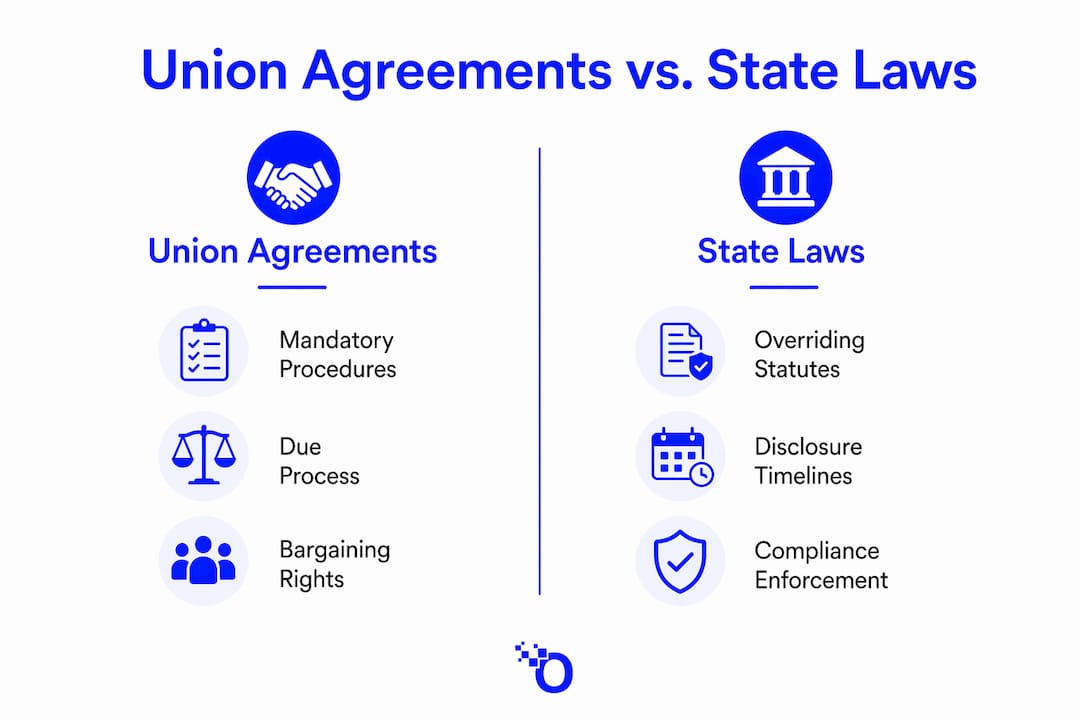
Labor board decisions have reinforced the same principle from a different angle. A may 2026 labor law ruling affirmed that changing mandatory subjects of bargaining without negotiating to impasse constitutes an unfair labor practice, requiring restoration of prior conditions and back pay remedies. That ruling applies directly to agencies that unilaterally updated background check procedures to comply with new statutes without first bargaining over the effects of those changes.
The table below compares statutory mandates with collective bargaining rights on key background check protocols:
| Protocol | Statutory mandate | Collective bargaining right |
|---|---|---|
| Records production timeline | 14 days (Sonya Massey Act, Illinois) | May not extend beyond statutory floor in renewed CBAs |
| Signed release requirement | Mandatory for law enforcement applicants | Procedural details (form, timing) remain bargainable |
| Advance employee notice | Required per june 2026 labor board rulings | Specific notice format and timing are mandatory bargaining subjects |
| Opportunity to contest records | Required per june 2026 labor board rulings | Scope and process of contest rights are bargainable |
| Access to records by agency personnel | Governed by state privacy statutes | CBA may add restrictions beyond statutory minimums |
The key takeaway from this legal landscape is that statutory mandates set the floor. CBAs can build additional protections on top of that floor, but they cannot fall below it once a new statute takes effect.
Key compliance risks agencies face in this environment include:
- Failing to bargain over the effects of a new statute, even when the statute itself is non-negotiable
- Assuming a grandfathered CBA provides permanent protection from new legal requirements
- Treating the Sonya Massey Act’s 14-day window as a ceiling rather than a floor
- Neglecting to update bargaining proposals when state law changes mid-negotiation cycle
Understanding background check laws for agencies at the state level is not optional for HR professionals managing unionized workforces. It is the baseline for every bargaining conversation.
What are the enhanced due process protections negotiated by public safety unions?
Public safety unions negotiate due process protections during background investigations that are simply not available in most private sector employment. Police unions secure enhanced due process rights in investigation and background check procedures that reflect the unique legal exposure officers face. These protections exist because the consequences of a flawed background check in public safety are severe. An officer wrongly flagged by an inaccurate record can lose a career, not just a job.
The most significant protections negotiated through collective bargaining in this sector include:
- Pre-release notification: The employee receives written notice before any personnel record is disclosed to a hiring agency or third party
- Record review period: The employee has a defined window to review the record for accuracy and completeness
- Written response right: The employee may submit a written statement addressing any disputed information before the record is released
- Representation rights: The employee may have union representation present during any meeting related to the background check process
- Confidentiality provisions: Records are shared only with personnel who have a direct, documented need for the information
These protections serve two purposes simultaneously. They protect the individual employee from reputational harm caused by inaccurate or incomplete records. They also protect the agency from liability arising from decisions based on flawed data.
The duty to bargain over these procedures gives agencies a practical mechanism to improve the accuracy of their own background investigations. When employees can flag errors before records are released, agencies receive cleaner data. That is a direct operational benefit, not just a legal obligation.

The contrast with private sector employment is stark. Private sector employers operating under the Fair Credit Reporting Act (FCRA) must provide pre-adverse action notices, but they have no obligation to bargain over the procedures surrounding that notice. Public safety agencies in unionized environments carry both the FCRA obligation and the collective bargaining obligation. Both apply, and neither excuses compliance with the other.
Pro Tip: Document every step of the due process procedure in writing, including the date notice was sent, the employee’s response, and the final disposition. That documentation is your first line of defense in any grievance or unfair labor practice proceeding.
Agencies that treat these protections as administrative burdens miss the point. Integrating them into a well-designed background investigation process reduces the risk of a bad hire based on bad data. That outcome serves the agency’s public safety mission directly. For a detailed look at how due process intersects with public safety hiring, the procedural requirements deserve close attention.
What are best practices for balancing union agreements with background check requirements?
Aligning background check policies with union agreements and legal mandates requires deliberate process design, not reactive compliance. The agencies that manage this well treat bargaining as a planning tool, not a legal obstacle. The ones that struggle treat it as an afterthought and pay for it in grievances, unfair labor practice charges, and delayed hiring cycles.
Attempting to implement stricter screening standards without bargaining can trigger unfair labor practice charges even when the agency’s safety rationale is sound. Good intentions do not substitute for good faith bargaining. The legal standard requires the agency to negotiate to genuine impasse before implementing a change, and even minor unilateral changes to background check policies affecting employment terms can constitute unfair labor practices. The “de minimis” defense rarely succeeds in these cases.
The following steps provide a practical framework for implementing compliant background check procedures within a unionized public safety environment:
-
Audit your current CBA. Identify every provision that touches background check procedures, including notice requirements, timelines, access restrictions, and grievance rights. Map those provisions against your state’s current public sector bargaining statute.
-
Classify each policy element correctly. Separate management prerogatives (the decision to conduct checks, the types of checks used) from mandatory bargaining subjects (notification procedures, review rights, timelines, confidentiality). Misclassification is the single most common trigger for labor disputes in this area.
-
Initiate effects bargaining early. When a new statute like the Sonya Massey Act changes your legal obligations, notify the union promptly and open bargaining over the procedural effects. Do not wait for the contract renewal cycle.
-
Document all bargaining sessions. Maintain written records of proposals, counterproposals, and the basis for any impasse declaration. This documentation protects the agency if a charge is filed.
-
Integrate statutory mandates into your next CBA. Draft contract language that meets or exceeds the statutory floor and reflects the outcomes of effects bargaining. Avoid language that could be read as waiving statutory rights, since courts and labor boards will not enforce such waivers.
-
Train HR staff and supervisors. The people who administer background check procedures daily must understand which steps require union notification and which do not. Procedural errors at the operational level are the most common source of grievances.
-
Build a review cycle into your policy. State laws and labor board interpretations change. Schedule an annual review of your background check procedures against current legal requirements and CBA language.
Agencies that follow this framework reduce their legal exposure and improve the quality of their background investigations. Clear procedures produce consistent results. Consistent results support defensible hiring decisions. That is the operational case for getting collective bargaining and background checks right. For a practical guide on conducting employee background checks within these legal constraints, the procedural detail matters at every step.
Maintaining clear communication with union representatives throughout the process is equally important. Agencies that share the rationale for policy changes, even when those changes are legally required, build the kind of bargaining relationship that resolves disputes before they become formal charges. That relationship is an asset, and it is built through consistent, transparent conduct over time. Consulting resources on background checks in public safety can help HR teams frame those conversations with the right level of specificity.
Key Takeaways
Union agreements govern the procedural framework of background checks in public safety agencies, and failing to bargain over those procedures creates legal liability that no safety rationale can excuse.
| Point | Details |
|---|---|
| Procedures are mandatory bargaining subjects | Notification, review rights, and timelines must be bargained; only the decision to conduct checks is a management prerogative. |
| State laws override conflicting CBAs | The Sonya Massey Act’s 14-day records window applies to all contracts entered or renewed after january 1, 2026. |
| Effects bargaining is required | Agencies must bargain over the procedural effects of new statutes before implementing changes, even when the statute itself is non-negotiable. |
| Due process protections reduce agency risk | Union-negotiated review rights improve data accuracy and protect agencies from decisions based on flawed records. |
| Unilateral changes carry serious consequences | Even minor policy changes without bargaining can constitute unfair labor practices requiring restoration and back pay remedies. |
What I’ve learned from watching agencies get this wrong
The most consistent mistake I see in public safety labor relations is the assumption that a legitimate safety purpose excuses a procedural shortcut. An agency decides it needs faster background checks, or more thorough ones, or a new type of screening. Leadership concludes that the change is obviously necessary and implements it without bargaining. Six months later, the agency is defending an unfair labor practice charge, restoring prior procedures, and paying back pay, all while the underlying safety problem remains unresolved.
The legal framework here is not hostile to public safety goals. It is actually aligned with them. The duty to bargain over background check procedures forces agencies to design those procedures carefully, document them clearly, and explain them to the people they affect. That discipline produces better investigations. Employees who understand the process and trust that it is fair are more likely to cooperate fully. Investigators who follow a documented protocol produce results that hold up under scrutiny.
What I find underappreciated is the accuracy benefit of union-negotiated review rights. When an officer can flag an error in a personnel record before it is released, the agency receives corrected information. That is not a concession to the union. It is a quality control mechanism. Agencies that treat these protections as obstacles are leaving accuracy on the table.
The Sonya Massey Act and the june 2026 labor board rulings have clarified the legal landscape considerably. Agencies now have less room to argue that procedural changes are minor or permissive. The standard is clear: bargain first, implement second. The agencies that internalize that sequence will spend far less time in grievance proceedings and far more time building the kind of workforce public safety demands.
My recommendation to HR and labor relations professionals is direct. Build your bargaining calendar around your background check policy review cycle. Do not treat them as separate tracks. Every time a statute changes or a labor board issues a significant ruling, that is a bargaining event. Treat it as one.
— Matt
OMNI Intel’s approach to union-compliant background screening
Public safety agencies navigating the intersection of union agreements and background check requirements need a screening partner that understands both sides of that equation.

OMNI Intel’s pre-employment screening services are built specifically for law enforcement, fire and EMS, dispatch centers, and government entities operating in unionized environments. The platform supports FCRA-compliant, investigator-driven background investigations that align with CBA procedural requirements, including documented notification workflows, defined review periods, and audit-ready records. OMNI Intel’s law enforcement background investigations service integrates statutory mandates like the Sonya Massey Act’s 14-day production window directly into the screening process, so agencies stay compliant without rebuilding their procedures from scratch at every legislative cycle.
FAQ
What is the role of union agreements in background checks?
Union agreements govern the procedural aspects of background checks, including advance notice, employee review rights, and confidentiality protections. The decision to conduct checks remains a management prerogative, but the procedures surrounding that decision are mandatory subjects of collective bargaining.
Are background check procedures mandatory bargaining subjects?
Yes. Labor board rulings from june 2026 confirm that implementation procedures such as advance notice and the opportunity to contest records are mandatory subjects of bargaining, while the underlying decision to require checks is not.
Can a new state law override CBA provisions on background checks?
Yes. The Sonya Massey Act, effective january 1, 2026, overrides conflicting CBA provisions for contracts entered or renewed after that date. Agencies cannot renew or modify existing CBAs to avoid the Act’s requirements, including its 14-day records production mandate.
What happens if an agency changes background check procedures without bargaining?
Unilateral changes to mandatory bargaining subjects constitute unfair labor practices. Remedies include restoration of prior procedures and back pay, as confirmed by a may 2026 labor ruling in Juvenile Justice Probation Officers Association v. Clark County.
How do union agreements affect background check accuracy?
Union-negotiated review rights allow employees to identify and correct errors in personnel records before release. That process improves data accuracy and reduces the risk of employment decisions based on flawed background information, which protects both the employee and the agency.