

The Role of Compliance in Dispatch for Public Safety
Regulatory compliance in dispatch is defined as the systematic adherence to federal, state, and agency-level standards that govern how dispatch personnel assign resources, manage documentation, and maintain safety records. The role of compliance in dispatch extends far beyond avoiding fines. It determines whether a public safety agency can sustain operations, pass federal audits, and maintain the trust of the communities it serves. Regulatory bodies including the Federal Motor Carrier Safety Administration (FMCSA) and the Department of Transportation (DOT) set binding standards that apply from day one of operations. Compliance officers and dispatch managers who treat these standards as daily operational discipline, rather than periodic audit preparation, consistently outperform those who do not.
What are the primary compliance requirements dispatch must fulfill?
Dispatch compliance requirements fall into four distinct categories: driver qualification, hours of service, equipment certification, and documentation integrity. Each category carries specific obligations under FMCSA and DOT frameworks, and failure in any one area creates cascading risk across the others.
New carriers face no grace period for FMCSA compliance. Driver qualification files, drug and alcohol testing programs, and vehicle maintenance records must all be active and accurate from the first day of operations. That requirement eliminates any assumption that a ramp-up period exists for compliance.
The core compliance obligations dispatchers must manage include:
- Hours of Service (HOS) compliance. Dispatchers must verify that drivers have sufficient available hours before assigning any trip. Mid-level dispatch positions now require 1–3 years of documented experience managing HOS compliance and Electronic Logging Device (ELD) data interpretation. That shift reflects how central HOS management has become to the dispatcher role itself.
- Driver qualification files. Each driver’s medical certification, license endorsements, and training records must be current and accessible. Dispatching a driver with an expired medical certificate is a direct FMCSA violation.
- Vehicle maintenance and equipment certification. Dispatch must confirm that assigned vehicles have passed inspection and that any reported defects have been resolved before the next trip.
- Real-time monitoring and reporting. Dispatchers carry responsibility for tracking active trips against compliance data, flagging exceptions, and escalating issues through defined channels.
- Documentation integrity. Every assignment, exception, and approval must be recorded with a traceable audit trail. Verbal approvals and undocumented overrides are compliance failures, regardless of intent.
The Compliance, Safety, Accountability (CSA) program administered by FMCSA scores carriers on seven Behavior Analysis and Safety Improvement Categories (BASICs). Dispatch decisions directly affect scores in the Hours of Service Compliance, Vehicle Maintenance, and Driver Fitness BASICs. A dispatcher who assigns a fatigued driver or dispatches a vehicle with an unresolved defect report does not just create a safety risk. That dispatcher generates a scored violation that follows the carrier for 24 months.
Pro Tip: Build a pre-dispatch checklist that pulls HOS availability, driver qualification status, and vehicle inspection results into a single view before any assignment is confirmed. Catching a disqualifying condition at the planning stage costs nothing. Catching it after an accident costs everything.
How does dispatch compliance influence daily operations and safety performance?
Dispatch decisions are the point where regulatory requirements meet real-world operations. Every assignment a dispatcher makes either reinforces or undermines the agency’s compliance posture. That connection is direct, measurable, and consequential.
Daily dispatcher checks of Driver Vehicle Inspection Reports (DVIR) and confirmed defect resolution before the next dispatch directly affect CSA scores and carrier liability. A defect that is documented and repaired before dispatch is a compliance improvement event. The same defect ignored or deferred becomes a scored violation and a potential liability anchor in litigation.

The 24-month rolling window for CSA scores means that prioritizing repair over load urgency has a measurable long-term effect on insurance premiums. Carriers with lower CSA scores pay less for coverage. Dispatch managers who understand this connection make better decisions when a driver reports a mechanical issue and a load is waiting.
The operational consequences of non-compliance compound quickly:
- Audit exposure. Missing or falsified documentation triggers corrective action requests during FMCSA compliance reviews. Auditors cross-reference dispatch records against ELD data, and discrepancies are treated as intentional falsification until proven otherwise.
- Insurance liability. A pattern of HOS violations or unresolved DVIR defects signals systemic negligence to insurers, which directly affects coverage terms and premiums.
- Contract risk. Non-compliance may lead to lost contracts and diminished employee morale. Clients and partner agencies conduct their own compliance reviews, and a poor safety rating is often disqualifying.
- Workforce impact. Dispatchers who are pressured to override compliance rules experience higher stress and lower job satisfaction. That pressure also creates personal liability exposure for individual employees.
Proper dispatch workflows connect trips, drivers, and equipment to compliance data, preventing last-minute corrections during audits. Real-time visibility between operational records and compliance data is not a technical luxury. It is the mechanism that keeps an agency’s documented practices aligned with its actual practices.
Pro Tip: Treat every DVIR defect entry as a compliance event requiring a closed-loop response. Log the defect, confirm the repair, and record the clearance before the vehicle is reassigned. That three-step sequence is what auditors look for, and it is what protects the agency when a claim is filed.
What are common compliance pitfalls in dispatch and how can they be avoided?
The most dangerous compliance failures in dispatch are not the obvious ones. They are the quiet, habitual shortcuts that accumulate over time until an audit or incident makes them visible.
The four most common pitfalls, and the corrective action for each, are:
- Relying on dispatcher memory instead of system validation. A dispatcher who knows the rules is not a substitute for a system that enforces them. Human memory fails under pressure, during shift changes, and when workload spikes. Rule validation must be embedded in the dispatch system itself, not carried in someone’s head.
- Allowing permission overrides without audit trails. Dispatchers must not have permissions to overwrite safety records without generating an immutable log entry. When an auditor finds a modified record with no corresponding approval trail, the agency has no defense. Least-privilege access controls prevent unauthorized edits and preserve the credibility of compliance records.
- Managing exceptions informally. Real-time exceptions, such as a driver requesting an HOS extension or a vehicle flagged for a minor defect, are handled verbally in many dispatch centers. That practice is a compliance failure. Every exception must be logged, reviewed by an authorized approver, and documented with a timestamp.
- Delaying compliance rule updates after regulatory changes. FMCSA and DOT issue guidance updates, and dispatch systems must reflect those changes before they take effect. Agencies that rely on manual policy distribution and dispatcher awareness to implement rule changes consistently fall behind.
Compliance should be embedded in dispatch planning with system logic enforcing assignment rules, not after-the-fact manual checks. Planning-time validation reduces expensive late corrections. That principle applies whether the agency uses a transportation management system (TMS), a computer-aided dispatch (CAD) platform, or a hybrid workflow.
Pro Tip: Conduct a quarterly internal audit of your exception log. If exceptions are being approved faster than they can be reviewed, or if the same dispatcher is approving their own exceptions, your access control structure has a gap. Fix the structure before an external auditor finds it.
What best practices and technologies enhance compliance in dispatch operations?
Compliance in dispatch is most effective when it is built into the workflow rather than layered on top of it. Agencies that treat compliance as a parallel process, separate from daily dispatch operations, consistently struggle with documentation gaps and audit findings.
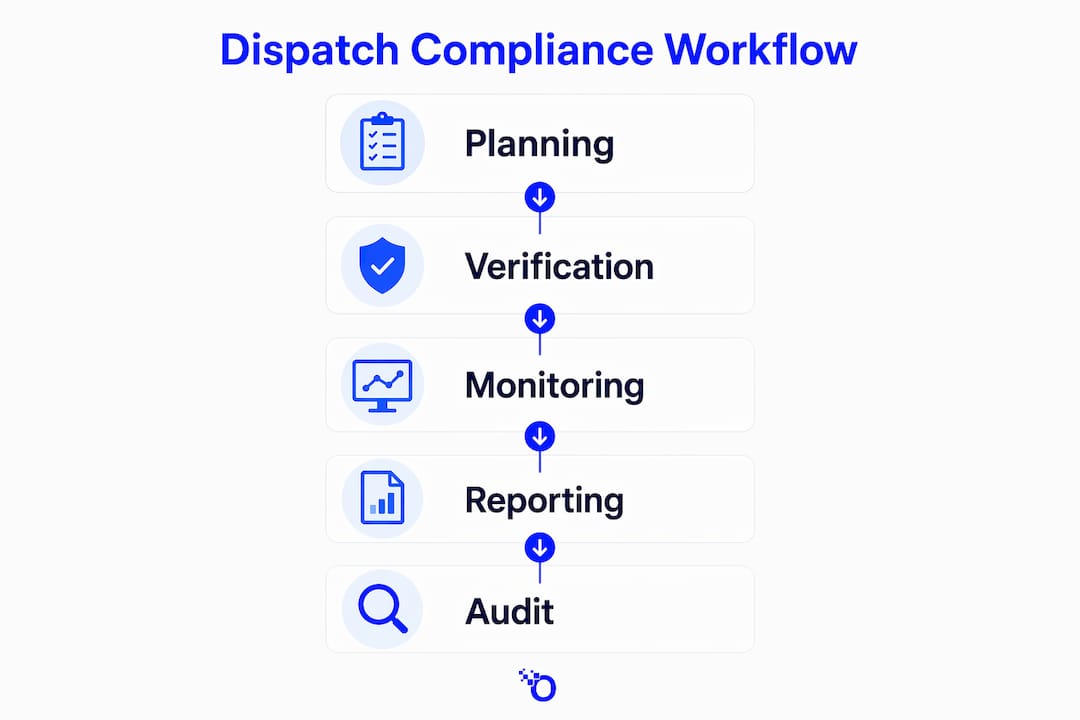
Mock USDOT safety audits using FMCSA methods help carriers prepare for compliance reviews and support safety rating upgrades. Agencies that conduct internal mock audits at least twice per year identify documentation gaps before external reviewers do. That preparation converts reactive compliance into a managed, predictable process.
The table below compares compliance integration approaches across different operational maturity levels:
| Approach | Compliance validation method | Audit trail quality | Exception handling |
|---|---|---|---|
| Manual / paper-based | Dispatcher memory and paper logs | Incomplete, easily altered | Verbal, undocumented |
| Basic digital tools | Spreadsheets and email approvals | Partial, requires manual entry | Logged inconsistently |
| Integrated TMS / CAD platform | Automated rule enforcement at assignment | Complete, immutable, timestamped | Structured workflow with approvals |
| Advanced platform with monitoring | Real-time compliance validation and alerts | Full audit trail with role-based access | Automated escalation and documentation |
Role-based access controls are a non-negotiable element of any compliant dispatch system. The principle of least privilege, meaning each user can only access and modify what their role requires, prevents unauthorized record changes and supports credible audit trails. Multi-factor authentication adds a second layer of identity verification, which is particularly important for systems that contain driver qualification files and HOS records.
Training is the other pillar of sustained compliance. Dispatchers who understand why a rule exists, not just what it requires, make better judgment calls during exceptions. Compliance training for dispatch staff should cover HOS rule interpretation, DVIR review procedures, exception escalation protocols, and the consequences of documentation failures. Training records themselves are a compliance artifact and must be maintained with the same rigor as operational records.
For agencies focused on dispatch center recruitment, compliance competency should be a hiring criterion, not an onboarding afterthought. Candidates with documented experience managing ELD data and HOS compliance bring immediate operational value and reduce training time.
Communication protocols between dispatch and field personnel also require standardization. When a driver reports a mechanical issue mid-route, the dispatcher’s response must follow a defined procedure: log the report, assess the defect against DVIR criteria, determine whether the vehicle can continue, and document the decision with a timestamp. Improvised responses to field exceptions are where compliance records break down.
Key Takeaways
Dispatch compliance is an operational discipline that directly determines audit outcomes, safety performance, and organizational reputation in public safety agencies.
| Point | Details |
|---|---|
| Compliance starts at planning | Embed rule validation in the dispatch system before assignments are confirmed, not after. |
| DVIR resolution affects CSA scores | Confirm defect repairs and log clearances before reassigning any vehicle to protect your 24-month score window. |
| Audit trails are non-negotiable | Least-privilege access and immutable logs are the foundation of credible compliance records during FMCSA reviews. |
| Mock audits reduce audit risk | Conducting internal mock audits twice per year identifies documentation gaps before external reviewers do. |
| Non-compliance costs more than fines | Lost contracts, higher insurance premiums, and workforce morale damage are the real long-term costs of compliance failures. |
Compliance is a daily discipline, not an audit event
The agencies I have seen struggle most with dispatch compliance share a common pattern. They treat compliance as something that happens before an audit, not something that happens every shift. The result is a gap between what their policies say and what their records show. Auditors are trained to find that gap, and they usually do.
The more durable approach is to design compliance into the dispatch workflow itself. When a system prevents a dispatcher from confirming an assignment without first validating HOS availability and DVIR status, compliance becomes automatic. It does not depend on a dispatcher remembering the rule under pressure at 2 a.m. during a staffing shortage.
Dispatch compliance extends beyond fines to protecting employee morale and client trust. That observation carries more weight than most compliance officers give it. A dispatcher who is pressured to override safety rules does not just create a legal risk. That dispatcher loses confidence in the agency’s integrity, and that erosion is hard to reverse.
The future of dispatch compliance is moving toward continuous monitoring rather than periodic review. Agencies that build real-time compliance visibility into their operations now will be better positioned as FMCSA and DOT increase their use of data-driven enforcement. The agencies that wait for a compliance event to prompt change will pay a higher price for the same lesson.
Compliance in public safety hiring follows the same logic. The importance of compliance in EMS hiring mirrors what dispatch managers face operationally: the cost of a bad hire or a missed qualification check compounds over time in ways that are difficult to reverse.
— Matt
How OMNI Intel supports dispatch compliance officers
Dispatch compliance does not begin when a driver logs into an ELD. It begins when an agency decides who to hire. Personnel who lack the integrity, qualifications, or background to meet public safety standards create compliance risk before they ever take a call or confirm an assignment.

OMNI Intel provides pre-employment screening services built specifically for public safety agencies, including dispatch centers. Its investigator-driven background investigations verify driver qualifications, employment history, and behavioral records with the same rigor that FMCSA auditors apply to carrier compliance files. OMNI Intel also supports ongoing monitoring for dispatch personnel, so agencies maintain compliance confidence beyond the hiring decision. For compliance officers who need a defensible, FCRA-compliant screening process, OMNI Intel delivers the documentation and audit trail that holds up under review.
FAQ
What is the role of compliance in dispatch operations?
Compliance in dispatch is the systematic enforcement of regulatory standards, including FMCSA Hours of Service rules, driver qualification requirements, and vehicle inspection protocols, at every stage of the assignment process. It protects agencies from audit findings, liability, and contract loss.
What does FMCSA require from dispatch personnel?
FMCSA requires dispatchers to verify HOS availability, confirm driver qualification status, and ensure vehicles have cleared DVIR defect reports before any assignment is confirmed. New carriers face these requirements from day one with no grace period.
How do CSA scores connect to dispatch decisions?
CSA scores reflect violations in categories that dispatch directly controls, including HOS compliance, vehicle maintenance, and driver fitness. Violations remain on the 24-month rolling record and affect insurance premiums and carrier safety ratings.
What is the biggest compliance risk in dispatch?
The biggest risk is relying on dispatcher memory and informal processes instead of system-enforced rule validation. Manual compliance checks fail under workload pressure and leave no audit trail when records are reviewed.
How often should dispatch compliance training occur?
Compliance training for dispatch staff should occur at minimum annually, with additional sessions following any regulatory update or internal audit finding. Training records must be maintained as compliance documentation in their own right.