

How to Ensure Data Security in 2026: A Field Guide
Data security is defined as the set of policies, controls, and technologies that protect sensitive information from unauthorized access, corruption, or loss throughout its entire lifecycle. For public safety agencies, the stakes in 2026 are higher than ever. Threat actors are deploying AI-generated phishing campaigns, SIM-swapping attacks increased 400% between 2021 and 2024, and regulators are tightening compliance requirements under frameworks like HIPAA and CJIS. Knowing how to ensure data security in 2026 means building a layered defense that starts with governance and ends with a culture of accountability across every department.
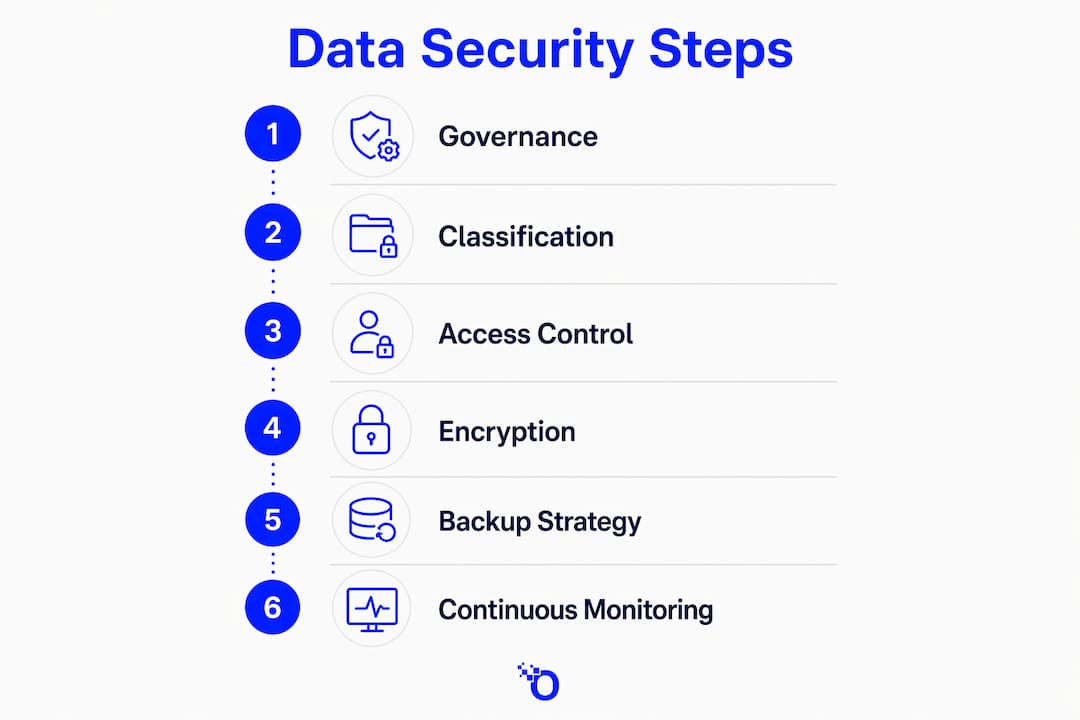
How to ensure data security in 2026: start with governance
Security strategy starts with data governance and classification before any technical tool is deployed. This is the step most agencies skip, and it is the reason compliance audits uncover blind spots that should have been closed years earlier. You cannot protect data you have not inventoried.

Why a data inventory comes first
A comprehensive data inventory maps every data store, file share, database, and cloud repository your agency touches. Without it, access controls protect the wrong assets, encryption policies miss critical records, and incident response teams waste time tracing data flows during a breach. Public safety agencies typically hold criminal justice information, personnel records, medical data from EMS operations, and dispatch logs. Each category carries distinct regulatory obligations.
A comprehensive data inventory is the prerequisite to every technical control that follows. Skipping it does not save time. It creates compliance blind spots that surface at the worst possible moment.
Using ai-assisted classification at scale
Manual classification fails at the volume modern agencies generate. AI-assisted classification tools have become the practical standard for consistent sensitivity labeling across large data environments. Tools in this category scan repositories automatically, apply sensitivity labels based on content patterns, and flag anomalies for human review. This approach scales in ways that manual tagging never will.
The key steps for building a governance foundation include:
- Conduct a full data inventory across on-premises servers, cloud platforms, and endpoint devices before writing a single access policy.
- Assign data ownership to specific roles, not just departments, so accountability is traceable.
- Define protect surfaces by identifying the most critical data sets and prioritizing controls around them first.
- Align classification tiers to compliance mandates. CJIS, HIPAA, and state privacy laws each require specific handling procedures for different data types.
- Review and update the inventory on a defined schedule, at minimum quarterly, as data environments change continuously.
Pro Tip: Use your data inventory results to build a protect surface map. A protect surface is the smallest possible perimeter around your most critical data. Shrinking the protect surface reduces the attack surface without requiring additional budget.
Aligning data governance with data privacy in hiring and operational compliance is not a one-time project. It is an ongoing program that requires ownership at the leadership level, not just the IT team.
How can you implement resilient access controls?
Access control is the single most effective technical control available to public safety IT teams. The goal is simple: every user, system, and application should access only what it needs to perform its function, nothing more.
Role-based access control aligned to function
Role-Based Access Control (RBAC) assigns permissions based on job function rather than seniority or hierarchy. A patrol officer needs access to incident reports. A dispatcher needs access to CAD systems. Neither needs access to HR records or financial data. RBAC enforces this separation systematically, reducing the blast radius of any compromised credential.
The steps below represent the minimum standard for access management in 2026:
- Map all roles to specific data access requirements before provisioning any accounts. Document the justification for each permission granted.
- Audit all active accounts quarterly. Access sprawl is a top-tier security threat. Stale credentials from former employees or transferred personnel remain active in many agency environments long after they should have been revoked.
- Revoke unused permissions immediately upon role change, transfer, or separation. Automate this process wherever your identity management platform allows.
- Replace SMS-based two-factor authentication (2FA) with phishing-resistant methods. SIM-swapping attacks increased 400% between 2021 and 2024, making SMS codes an unreliable second factor. Authenticator apps like Google Authenticator or Microsoft Authenticator, and hardware keys such as YubiKey, provide significantly stronger protection.
- Deploy FIDO2-compliant hardware keys for privileged accounts. Phishing-resistant MFA methods like FIDO2 represent the current gold standard for high-value account protection.
- Implement conditional access policies that evaluate device health, location, and behavioral signals before granting session access. A login from an unmanaged device at 2 a.m. should trigger additional verification, not automatic approval.
Pro Tip: Run a quarterly “ghost account” audit by cross-referencing your active directory against your HR system. Accounts that exist in IT but not in HR are immediate revocation candidates. This single step closes more attack surface than most technical controls.
Behavioral analytics platforms can flag anomalous access patterns in real time, such as a user downloading large volumes of records outside normal hours. Integrating these signals into your Security Information and Event Management (SIEM) platform allows automated responses, including session termination and alert escalation, before damage occurs.
What encryption and backup strategies protect your data?
Encryption is the last line of defense when access controls fail. Without it, a stolen drive or intercepted transmission exposes raw data. With it, the attacker gets ciphertext that is computationally useless without the key.
Encryption standards for 2026
AES-256 for stored data and TLS 1.3 with perfect forward secrecy for data in transit are the current mandatory standards. Perfect forward secrecy means that even if a session key is later compromised, past sessions remain protected. This matters for agencies retaining sensitive communications logs. Key management discipline is equally critical. Encryption without controlled key rotation and secure key storage is incomplete protection.
The table below compares the two primary encryption contexts and their requirements:
| Context | Standard | Key Requirement | Primary Risk if Skipped |
|---|---|---|---|
| Data at rest | AES-256 | Secure key storage, annual rotation | Exposed records from stolen media |
| Data in transit | TLS 1.3 with PFS | Certificate management, no legacy protocols | Intercepted transmissions |
| Backup data | AES-256 | Separate key from production | Ransomware decryption of backup files |
| Endpoint devices | Full-disk encryption | Device-level key tied to user auth | Data exposure from lost or stolen devices |
The 3-2-1 backup strategy and why cloud sync is not enough
The 3-2-1 backup strategy is the minimum standard for ransomware resilience: three copies of data, on two different media types, with one copy stored off-site or air-gapped. This architecture ensures that a ransomware event encrypting your primary systems and cloud-connected backups does not destroy your recovery path.
Cloud sync services are not backups. When ransomware encrypts files on a workstation, those encrypted files sync immediately to the cloud, overwriting the clean versions. An air-gapped or offline backup, physically disconnected from the network, is the only copy ransomware cannot reach. For public safety agencies managing dispatch records, personnel files, and criminal justice data, losing that recovery path is operationally catastrophic.
How does continuous monitoring strengthen your security posture?
Detection speed determines breach severity. The faster an agency identifies anomalous activity, the smaller the window for data exfiltration or system damage. Continuous monitoring closes that window.
Deploying a SIEM platform integrated with Extended Detection and Response (XDR) capabilities gives your security team a unified view of identity telemetry, endpoint behavior, network traffic, and application logs. The most effective configurations include session risk scoring, which assigns a real-time risk value to each active session based on behavioral signals. High-risk sessions trigger automated responses without waiting for human review.
Key monitoring practices for public safety agencies include:
- Integrate identity telemetry into your SIEM. Authentication events, privilege escalations, and failed login attempts are the earliest indicators of credential compromise.
- Automate anomaly detection thresholds based on baseline behavior for each role. A records clerk accessing 500 files in an hour is anomalous. The system should flag it automatically.
- Conduct penetration testing at least annually, augmented by continuous threat intelligence feeds from sources like the Cybersecurity and Infrastructure Security Agency (CISA) and the Multi-State Information Sharing and Analysis Center (MS-ISAC). These feeds provide real-time indicators of compromise relevant to government and public safety environments.
- Verify third-party vendor security posture before granting any system access. Require SOC 2 Type II or ISO 27001 certification as a baseline. Supply chain attacks frequently enter through vendors with weaker controls than the primary agency.
- Review and update your incident response plan quarterly. A plan that has not been tested is a plan that will fail under pressure. Tabletop exercises with realistic scenarios build the muscle memory your team needs.
The AI in background checks space illustrates how AI-driven behavioral analysis is moving from hiring workflows into broader security monitoring. The same pattern recognition that flags anomalous candidate behavior can identify anomalous employee activity in real time.
What role does security culture play in reducing human error?
Human error is a primary vulnerability in every security program. No technical control eliminates the risk of a staff member clicking a phishing link, misconfiguring a system, or sharing credentials. Investing in security culture and continuous employee education is the most direct way to reduce that risk.
Security training in public safety agencies must go beyond annual compliance checkboxes. Effective programs deliver short, scenario-based training modules monthly, simulate phishing attacks to measure and improve staff response rates, and tie security behavior to performance accountability frameworks. When personnel understand why a policy exists, not just what it requires, compliance rates improve significantly.
“Security is not an IT problem. It is an organizational discipline. When leadership treats data protection as a core operational function, the entire agency follows.”
Privacy-by-design principles reinforce this culture at the process level. Every new workflow, system, or hiring process should be evaluated for data minimization and access restriction before deployment, not after. This approach reduces the volume of sensitive data in circulation and limits exposure by default.
Building a security-conscious hiring process is one practical application of this principle. Agencies that screen candidates for integrity and accountability before hire reduce the probability of insider threats before they enter the organization. Transparency in incident communication also builds internal trust. When staff understand how breaches are handled and what their role is in reporting suspicious activity, they become an active layer of defense rather than a passive vulnerability.
Key takeaways
Effective data protection in 2026 requires governance and classification first, followed by layered technical controls and a trained, accountable workforce.
| Point | Details |
|---|---|
| Governance precedes technology | Conduct a full data inventory and assign ownership before deploying any technical controls. |
| Access audits reduce risk immediately | Quarterly reviews of stale and excessive permissions close more attack surface than most tools. |
| Encryption requires key discipline | AES-256 and TLS 1.3 are the standards; key management and rotation are equally critical. |
| Cloud sync is not a backup | The 3-2-1 strategy with one air-gapped copy is the minimum defense against ransomware. |
| Culture is a technical control | Ongoing scenario-based training and accountability frameworks reduce human error at scale. |
What public safety IT leaders should prioritize right now
After working closely with public safety agencies on data security and hiring integrity, one pattern stands out clearly. Most organizations invest heavily in technical tools and significantly underinvest in the governance foundation those tools depend on. A SIEM platform is only as useful as the data classification and access policies feeding it. Without those, you are monitoring noise.
The single highest-return activity available to most public safety IT teams right now is a quarterly access audit. It costs almost nothing in budget, requires no new vendor contract, and consistently reveals credentials that should have been revoked months ago. I have seen agencies discover active accounts belonging to personnel who separated over a year prior. Those accounts represent open doors. Closing them is not glamorous work, but it is the most direct risk reduction available.
The second priority I advocate for consistently is treating AI-assisted classification as a standard operational tool rather than a future investment. The volume of data public safety agencies generate has outpaced manual governance capacity. Agencies still relying on manual tagging are falling behind, and the compliance gap is widening every quarter.
The future of data security in public safety is not about acquiring more tools. It is about building the organizational discipline to use the tools you already have correctly. Governance, access hygiene, and a trained workforce are not exciting. They are, however, the foundation that every other control depends on. Start there, and the technical layers become significantly more effective.
— Matt
Strengthen your security posture with OMNI intel

Data security does not begin at the firewall. It begins at the point of hire. Every individual granted access to sensitive agency systems, records, or facilities represents a potential insider risk if not properly vetted. OMNI Intel’s pre-employment screening services are built specifically for public safety agencies, applying investigator-driven background investigation principles to verify candidate integrity before access is ever granted. From comprehensive background investigations to continuous post-hire monitoring, OMNI Intel supports the full personnel security lifecycle. Reducing insider risk starts with knowing exactly who you are hiring.
FAQ
What is data security in the context of public safety?
Data security in public safety is the practice of protecting sensitive operational, personnel, and criminal justice records from unauthorized access, loss, or corruption. It encompasses governance, access controls, encryption, monitoring, and compliance with frameworks like CJIS and HIPAA.
Why is sms-based 2fa no longer sufficient in 2026?
SIM-swapping attacks increased 400% between 2021 and 2024, making SMS codes vulnerable to interception before they reach the intended user. Phishing-resistant alternatives like FIDO2 hardware keys and authenticator apps provide substantially stronger protection.
What is the 3-2-1 backup strategy?
The 3-2-1 strategy requires three copies of data stored on two different media types, with one copy kept off-site or air-gapped from the network. This architecture ensures ransomware cannot reach all copies simultaneously, preserving a clean recovery path.
How often should access permissions be audited?
Access permissions should be audited at minimum quarterly, with immediate revocation triggered by role changes, transfers, or separations. Quarterly audits consistently surface stale credentials that expand the attack surface without providing any operational value.
How does hiring practice connect to data security?
Every employee granted system access is a potential insider threat if not properly vetted. Pre-employment background investigations and continuous post-hire monitoring reduce the probability that a bad actor gains authorized access to sensitive agency data.