

Risk Mitigation in Nonprofits: A Practical Leader’s Guide
Risk mitigation in nonprofits is the proactive, continuous process of identifying, evaluating, and managing threats to safeguard mission delivery and long-term organizational stability. The formal industry term for this discipline is nonprofit risk management, and it encompasses far more than insurance policies or compliance checklists. Frameworks like Enterprise Risk Management (ERM) and the 4 Ts strategy (Treat, Tolerate, Transfer, Terminate) give nonprofit leaders a structured road map for protecting programs, finances, and reputation. Organizations that embed these practices into governance and daily operations gain a measurable advantage: stronger donor confidence, more resilient operations, and the capacity to adapt when conditions shift.
What are the core steps in the risk mitigation process for nonprofits?
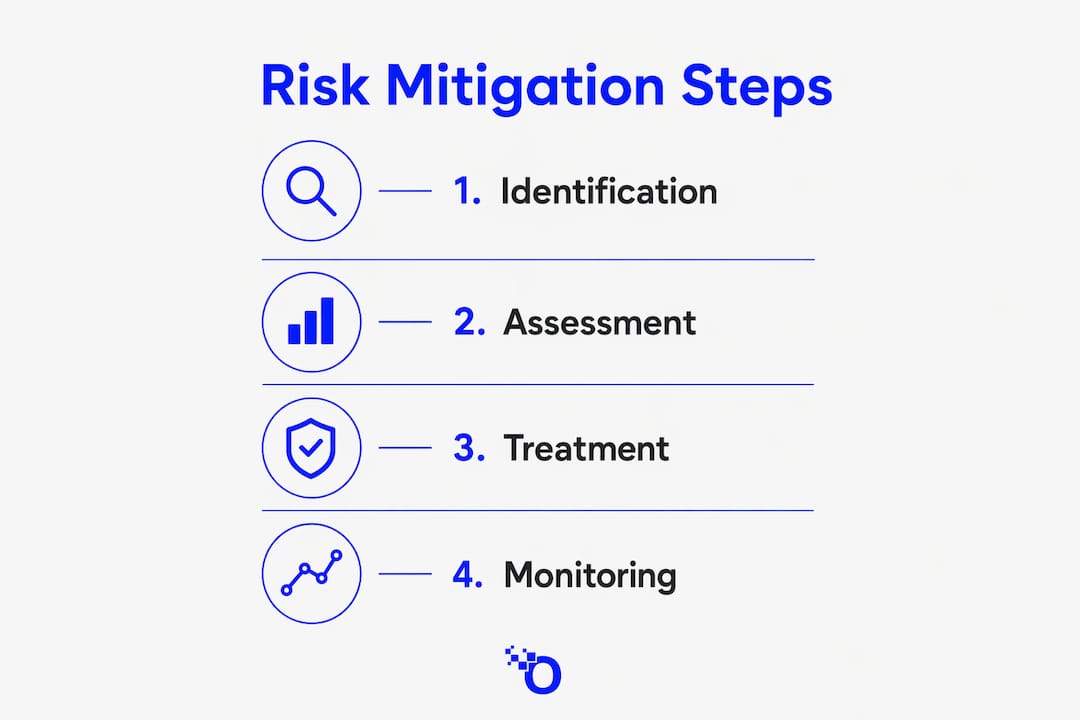
The risk management process consists of four essential, iterative steps: Identification, Assessment, Treatment, and Monitoring. Each stage builds on the previous one, and skipping any step leaves gaps that can compromise the entire effort.
Step 1: identification
Risk identification requires input from across the organization, not just the executive director or finance team. Program staff, volunteers, board members, and even key funders often surface risks that leadership never sees from the top. Common categories include financial risk in nonprofits (cash flow gaps, grant dependency), operational risk (staff turnover, data security), legal and compliance risk, and reputational risk tied to public trust.

Structured methods work best here. Annual surveys, facilitated workshops, and review of past incidents all generate a more complete picture than informal conversations alone. The goal is a documented inventory, not a mental list.
Step 2: assessment
Once risks are identified, each one requires evaluation by two dimensions: likelihood and impact. A risk matrix plots these two variables on a grid, allowing leaders to sort threats into priority tiers. A data breach at a nonprofit handling sensitive client records, for example, scores high on both dimensions and demands immediate attention. A minor vendor contract dispute may score low on both and warrant only periodic review.
Prioritizing risk by likelihood and impact allows nonprofits to focus limited resources on threats that most affect mission delivery, financial reporting, or public trust. This is not about eliminating all risk. It is about directing attention where it matters most.
Step 3: treatment using the 4 ts
Treatment is where strategy becomes action. The 4 Ts framework provides four distinct responses:
- Treat: Implement controls to reduce the likelihood or impact of the risk. Examples include staff training, updated financial policies, or cybersecurity protocols.
- Tolerate: Accept the risk when the cost of mitigation exceeds the potential harm. Document the decision and set a threshold for review.
- Transfer: Shift the financial consequence to a third party through insurance, contracts, or indemnification clauses.
- Terminate: Eliminate the activity that generates the risk entirely. If a program consistently exposes the organization to liability it cannot manage, discontinuing it may be the right call.
Step 4: monitoring
Risk monitoring is not a year-end exercise. Embedding risk management into daily operations builds organizational muscle memory that allows rapid response when conditions change. Key Risk Indicators (KRIs) function as early warning signals. Examples include tracking grant renewal rates, staff vacancy rates, or the number of unresolved compliance findings. Formal reporting to the board on a quarterly basis keeps risk visible at the governance level.
Pro Tip: Set a calendar reminder to review your top five KRIs at every board meeting. Consistency matters more than sophistication at this stage.
How does enterprise risk management (ERM) enhance nonprofit risk mitigation?
Enterprise Risk Management is defined as an integrated, organization-wide approach that connects risk oversight directly to strategic goals rather than treating risks as isolated departmental problems. The ERM approach integrates risk oversight into nonprofit governance, with boards and finance committees prioritizing mitigation based on mission impact rather than siloed departmental concerns.
The difference between traditional risk management and ERM is scope. Traditional approaches often assign risk ownership to a single department, typically finance or legal. ERM distributes ownership across the organization while maintaining centralized visibility. The board sets the risk appetite. Finance committees monitor financial exposures. Program directors own operational risks within their areas. Everyone operates from the same framework.
Why ERM works for nonprofits of all sizes
A common misconception is that ERM requires large budgets or dedicated risk staff. ERM is scalable and suitable for nonprofits of all sizes, and its effectiveness depends far more on leadership commitment than resource availability. A 10-person organization can implement ERM principles using a shared spreadsheet risk register, quarterly board discussions, and a documented risk appetite statement.
Key governance roles in a functional ERM structure include:
- Board of Directors: Sets risk appetite, approves the risk management policy, and receives regular risk reports.
- Executive Director: Owns the overall risk register and coordinates cross-departmental risk discussions.
- Finance Committee: Monitors financial exposures, reviews insurance coverage, and tracks budget variances as risk signals.
- Program Managers: Identify and report operational risks within their specific program areas.
- Audit or Risk Committee: Provides independent oversight and ensures the risk process is functioning as designed.
Setting risk appetite in alignment with mission
Risk appetite is the level of risk a nonprofit is willing to accept in pursuit of its mission. Setting it requires honest conversation at the board level. A nonprofit that serves vulnerable populations, for example, will set a very low risk appetite for reputational and safeguarding risks while accepting higher operational risk during periods of program expansion.
“Nonprofit leaders should view risk management as a strategic asset and catalyst for innovation and stability rather than simply a compliance exercise.” — Nonprofit Risk Management Center
This framing matters. When the board treats risk management as a strategic tool rather than a regulatory burden, the entire organization follows suit.
What practical tools and frameworks support effective risk mitigation?
The most effective tools for nonprofit risk management are not expensive software platforms. Nonprofit risk management relies more on leadership-driven processes and culture than on technology. Simple, well-maintained tools used consistently outperform complex systems that no one updates.
The risk register
A risk register is the foundational document of any nonprofit risk management program. It captures each identified risk, its category, likelihood, impact score, assigned owner, current mitigation measures, and review date. Risk registers allow categorizing risks by domain to find root causes and address them efficiently rather than treating each incident as an isolated problem.
Common risk domains for nonprofits include:
- Financial (grant dependency, cash reserves, audit findings)
- Operational (staff capacity, technology, supply chain)
- Legal and compliance (regulatory changes, contract disputes, licensing)
- Reputational (media coverage, donor relations, program outcomes)
- Governance (board composition, conflict of interest, succession planning)
Pro Tip: Build your risk register in a shared document that board members can access before each meeting. Visibility drives accountability.
Risk matrices and KRI dashboards
A risk matrix translates the register into a visual priority map. Risks in the high-likelihood, high-impact quadrant demand immediate treatment plans. Risks in the low-likelihood, low-impact quadrant may require only periodic monitoring. This visual format makes board conversations more productive because it focuses discussion on the threats that actually require decisions.
KRI dashboards extend this visibility into real time. Rather than waiting for an annual assessment, dashboards track leading indicators that signal when a risk is trending in the wrong direction. A nonprofit tracking volunteer retention, for example, might set a KRI threshold: if volunteer hours drop more than 20% quarter over quarter, a formal review is triggered.
Mitigation strategy comparison
The table below outlines common mitigation strategies and the conditions under which each applies most effectively.
| Strategy | When to Apply | Example |
|---|---|---|
| Treat (controls) | Risk is significant and manageable | Implement cybersecurity training for all staff |
| Tolerate (accept) | Cost of mitigation exceeds potential harm | Accept minor scheduling delays in low-stakes programs |
| Transfer (insurance) | Financial exposure is high but risk cannot be eliminated | Purchase directors and officers (D&O) liability insurance |
| Terminate (exit) | Risk is unacceptable and the activity is non-core | Discontinue a program with unmanageable legal exposure |
| Contingency planning | Risk is low probability but high consequence | Develop a crisis communication plan for reputational events |
Effective mitigation often involves straightforward actions like clearer role definitions, improved documentation, stronger internal communication, and regular reviews. Not every risk reduction effort requires a complex control system.
How can nonprofit leaders build a risk-aware culture?
A risk-aware culture is the condition in which staff at every level recognize risk as a shared responsibility and feel safe raising concerns without fear of blame. This is the hardest part of nonprofit risk management to build, and the most valuable.
Annual comprehensive risk assessments with readiness roadmaps improve nonprofit resilience by identifying the biggest threats and engaging cross-functional teams in the process. The key word is “engaging.” A risk assessment completed by one person in a back office and filed away does nothing for organizational culture.
Leadership behaviors that drive risk awareness
The behaviors that leaders model in meetings and decisions shape how staff think about risk. Specific practices that build a risk-aware culture include:
- Naming risk openly in leadership meetings. When the executive director regularly asks “What could go wrong here?” before launching a new initiative, staff learn to do the same.
- Rewarding early warning signals. Recognize staff who surface problems before they escalate. This behavior needs to be visibly valued, not just tolerated.
- Conducting candid post-incident reviews. After any significant disruption, hold a structured review focused on process improvement rather than blame assignment.
- Integrating risk into strategic planning. Every new program proposal should include a brief risk section identifying the top three threats and the planned response.
- Engaging the board as active risk partners. Boards that receive only polished reports miss the early signals. Share raw KRI data and invite board members to challenge assumptions.
Keeping risk management iterative, not static
Monitoring risk controls for effectiveness and adapting them to new threats is critical because static procedures become obsolete. The regulatory environment for nonprofits shifts. Funding landscapes change. Staff turn over. A risk register that was accurate 18 months ago may miss entirely new categories of exposure today.
Build a formal review cycle into your governance calendar. Quarterly KRI reviews, semi-annual risk register updates, and an annual comprehensive assessment create a rhythm that keeps risk management current without overwhelming staff. This rhythm, repeated consistently, is what builds the organizational muscle memory that allows rapid response to disruptions.
Pro Tip: When a risk discussion feels uncomfortable or contentious in a board meeting, treat that discomfort as a signal to go deeper rather than move on. Discomfort often marks the location of the real risk.
For nonprofits working to align safe hiring practices with their broader risk management framework, staffing decisions represent one of the most direct and controllable risk categories available.
Key takeaways
Effective risk mitigation in nonprofits requires a structured, iterative process anchored in governance, practical tools, and a leadership culture that treats risk awareness as a core organizational competency.
| Point | Details |
|---|---|
| Follow the four-step process | Identification, Assessment, Treatment, and Monitoring form the complete risk mitigation cycle. |
| Apply the 4 Ts for treatment | Treat, Tolerate, Transfer, or Terminate each risk based on its likelihood, impact, and strategic context. |
| Use ERM for governance alignment | Enterprise Risk Management connects risk oversight to mission strategy and scales to any nonprofit size. |
| Build and maintain a risk register | Categorize risks by domain to find root causes and assign clear ownership for each identified threat. |
| Embed risk into organizational culture | Consistent leadership behaviors and iterative review cycles build the muscle memory that enables rapid response. |
Why risk mitigation deserves a permanent seat at the leadership table
I have worked with enough nonprofit leaders to know that risk management is the first thing cut when budgets tighten and the last thing rebuilt when a crisis hits. That pattern is exactly backward.
The organizations I have seen weather serious disruptions, whether a sudden loss of a major grant, a data breach, or a leadership transition, share one trait. They had already built the habit of talking about risk before it became urgent. They had a risk register that was actually used. They had a board that asked hard questions and expected honest answers.
The common pitfall is treating risk management as a document rather than a discipline. A 40-page risk policy filed in a shared drive does nothing. A 10-row risk register reviewed at every board meeting does a great deal. The Nonprofit Risk Management Center makes this point directly: risk management must evolve beyond compliance into a strategic tool that enables organizations to adapt and innovate amid uncertainty.
I also want to push back on the assumption that ERM is only for large organizations with dedicated risk staff. Leadership commitment is the only real prerequisite. A small nonprofit with a committed executive director and an engaged board can implement a functional ERM structure in a single planning cycle. The tools are simple. The discipline is the hard part.
Finance committees are often underutilized in this work. They have the analytical capacity to track KRIs, review insurance coverage, and flag budget variances as early warning signals. Empowering them to own that function, rather than limiting their role to budget approval, materially strengthens the organization’s risk posture.
The organizations that treat risk mitigation as a mission enabler rather than a compliance obligation are the ones that survive disruption and grow through it. That mindset shift is available to every nonprofit leader. It costs nothing except the willingness to have honest conversations on a regular basis. Start there.
— Matt
Protect your nonprofit from hiring-related risks
Staffing decisions are one of the most direct and controllable risk categories in any nonprofit. A single bad hire in a role involving vulnerable populations, financial oversight, or public trust can generate liability, reputational damage, and regulatory scrutiny that no policy document can fully repair.

OMNI Intel provides pre-employment screening services built specifically for organizations where integrity and public trust are non-negotiable. From comprehensive background investigations to continuous post-hire monitoring, OMNI Intel’s investigator-driven process integrates directly into your recruiting workflow. For nonprofits working to align their nonprofit screening compliance with broader risk management goals, OMNI Intel delivers the verification depth your mission demands. Contact OMNI Intel to learn how thorough pre-employment vetting strengthens your organization’s risk posture from the first hire forward.
FAQ
What is risk mitigation in a nonprofit context?
Risk mitigation in nonprofits is the structured process of identifying, assessing, treating, and monitoring threats to mission delivery and organizational stability. It uses frameworks like the 4 Ts (Treat, Tolerate, Transfer, Terminate) to manage each risk proportionally.
How does ERM differ from standard risk management?
Enterprise Risk Management (ERM) takes an organization-wide view, connecting risk oversight to strategic goals and governance rather than managing risks in isolated departments. Boards set risk appetite, and all levels of leadership share ownership of the risk register.
What should a nonprofit risk register include?
A nonprofit risk register should document each identified risk, its category, likelihood and impact scores, the assigned owner, current mitigation measures, and the scheduled review date. Categorizing risks by domain helps identify root causes rather than treating each incident as a standalone problem.
How often should nonprofits review their risk management plans?
Nonprofits should conduct quarterly KRI reviews, semi-annual risk register updates, and a full annual risk assessment with a readiness roadmap. Regular risk register reviews and formal reporting maintain risk awareness and keep mitigation plans current as conditions change.
What is the biggest barrier to effective nonprofit risk management?
The biggest barrier is treating risk management as a compliance document rather than an active discipline. Simple, consistently used tools supported by leadership commitment outperform complex systems that are rarely reviewed, regardless of organizational size.