

Why Monitor Volunteers: A Nonprofit Leader’s Guide
Volunteer monitoring is defined as the ongoing process of tracking, screening, and supervising volunteers to protect your organization, its beneficiaries, and its mission. For nonprofits, this practice is not optional governance. It is the foundation of safe, compliant, and credible program delivery. Organizations that treat oversight as a strategic function rather than an administrative afterthought are better positioned to prevent harm, satisfy funders, and defend their reputation when scrutiny arrives. Tools like VolunteerHub and platforms like OMNI Intel exist precisely because the stakes of inadequate volunteer oversight are too high to manage with spreadsheets and good intentions.
Why monitor volunteers: the core reasons nonprofits cannot afford to skip it
Volunteer oversight, the recognized governance term for this practice, covers everything from initial background screening to ongoing performance tracking and compliance documentation. The reasons to supervise volunteers span safety, legal liability, program reliability, and organizational reputation. Each one carries real consequences if ignored.
Protecting vulnerable populations and staff
Nonprofits frequently place volunteers in direct contact with children, elderly individuals, people with disabilities, and other vulnerable groups. Without documented screening and supervision, organizations expose those populations to preventable harm. Background investigations at intake are the first line of defense. Ongoing monitoring is the second. Neither replaces the other.

Legal liability and compliance obligations
Nonprofits operating in the United States must navigate a web of federal and state requirements governing volunteer screening. The Fair Credit Reporting Act (FCRA) applies when third-party background check providers are used, requiring documented adverse action workflows whenever a screening result disqualifies a volunteer. Failure to follow FCRA procedures creates direct legal exposure for the organization and its leadership. Compliance with these standards is not a one-time event at onboarding. It is a continuous obligation.
Reputational risk and board-level governance
“Without visibility into who is acting as your volunteer, organizations expose themselves to leadership risk.” — ACEVO, 2026
Volunteer oversight is a governance issue that belongs on the board’s agenda alongside financial audits and strategic planning. A single incident involving an unvetted or unsupervised volunteer can generate media coverage, donor withdrawal, and regulatory scrutiny that takes years to recover from. Boards that treat volunteer data with the same rigor as financial records reduce this exposure significantly.
Funding and grant eligibility
Funders and grantmakers no longer accept rough estimates of volunteer contributions. Accurate volunteer impact data is now a competitive advantage in grant applications. Organizations that document volunteer hours, participation rates, and program outcomes with defensible records consistently outperform those that cannot. Monitoring is what makes that documentation possible.
The benefits of tracking volunteer work extend beyond compliance. They include stronger funder relationships, cleaner audits, and a program record that speaks for itself.
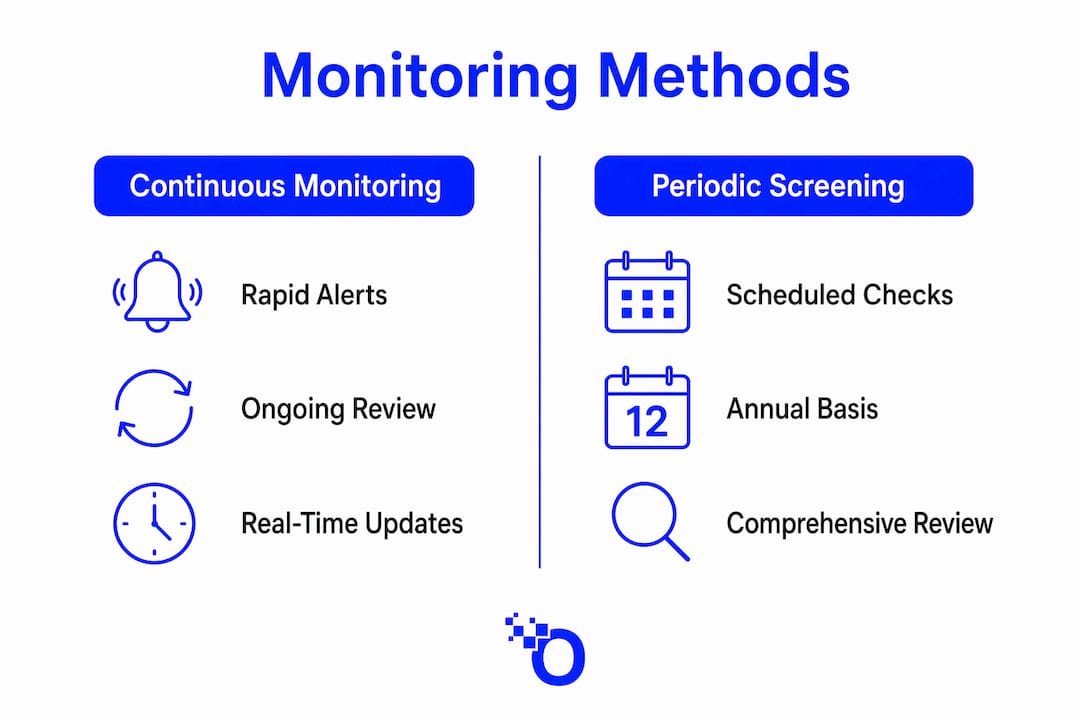
How do continuous monitoring and periodic screening compare?
The most common question nonprofit leaders ask about volunteer oversight is whether an annual background check is sufficient. The evidence says it is not. Understanding the difference between continuous monitoring and periodic re-screening is the starting point for building a defensible oversight program.
| Feature | Continuous Monitoring | Periodic Re-Screening |
|---|---|---|
| Detection speed | Alerts within days of new criminal filings | Up to 364-day gap between checks |
| Coverage scope | Flags new activity in monitored jurisdictions | Full multi-jurisdiction refresh at each cycle |
| FCRA compliance | Requires documented adverse action workflow | Requires documented adverse action workflow |
| Best use case | Ongoing risk detection between formal checks | Resetting clearance currency and coverage |
| Risk addressed | Time gaps in detection | Coverage gaps across jurisdictions |
The problem with annual re-screening alone
Annual re-screens can leave a 364-day gap during which a volunteer could accumulate new criminal charges without the organization’s knowledge. That gap is not theoretical. It is the window during which harm most often occurs in documented cases of volunteer misconduct. Relying solely on a once-per-year check is a governance posture that no board should accept.
How continuous monitoring closes the gap
Continuous background monitoring works by scanning court records and criminal databases on an ongoing basis and alerting the organization within days of a new filing. Continuous monitoring reduces detection latency from months or years to days. That speed matters when a volunteer works weekly with at-risk youth or operates in a position of financial trust.
Why both methods together mitigate risk
Continuous monitoring addresses time gaps. Annual or periodic re-screening addresses coverage gaps by refreshing the full background check across all relevant jurisdictions. Both together mitigate risk in ways that neither can achieve alone. The combined approach is the current best practice for nonprofits with meaningful volunteer programs.
Pro Tip: When building your monitoring policy, document the specific jurisdictions covered by your continuous monitoring provider. Coverage gaps in rural counties or out-of-state records are a known limitation. Pair continuous monitoring with a full re-screen every 12–24 months to close those gaps.
What volunteer engagement metrics should leaders track?
Monitoring volunteers is not limited to background checks. Engagement data tells you whether your program is healthy, whether volunteers are at risk of leaving, and whether your reported impact is credible. The importance of monitoring volunteers through engagement metrics is as significant as the safety screening side.
The following metrics form the foundation of a defensible volunteer reporting program:
- Volunteer hours logged per period. This is the primary input for calculating the monetary value of volunteer contributions, a figure funders use to assess program scale and efficiency.
- Attendance and participation rates by event or program. Declining attendance in a specific program signals a management or engagement problem before it becomes a retention crisis.
- 90-day inactivity flags. Volunteers not serving within 90 days signal a high risk of permanent attrition. Organizations that track this metric proactively can re-engage volunteers before they disengage entirely.
- Retention rates by cohort. Tracking which volunteer cohorts stay and which leave reveals patterns in your onboarding, training, or assignment practices.
- Engagement trend lines over time. Effective reports show attendance, event participation, and engagement trends with minimal manual work when the right software is in place.
The monetary value of volunteer time
The Independent Sector estimates the value of volunteer time in the United States at over $31 per hour. Multiply that figure by documented volunteer hours and you have a defensible impact number for grant applications and annual reports. Without accurate hour tracking, that number is a guess. Funders treat guesses as red flags.
Tools that make reporting manageable
Platforms like VolunteerHub automate the collection of attendance, hours, and participation data. They generate reports that satisfy auditors and funders without requiring program staff to manually compile spreadsheets. The impact of volunteer oversight improves dramatically when reporting is automated rather than dependent on individual staff memory or disconnected email chains.
What practical steps can nonprofits take to implement volunteer monitoring?
Knowing why oversight matters is the starting point. Building a system that delivers it consistently is the harder work. The following steps reflect monitoring volunteers best practices drawn from governance frameworks and operational experience.
- Centralize all volunteer data in one system. Disjointed communication channels create coordination debt that undermines oversight continuity. When volunteer records live in dispersed spreadsheets and email threads, institutional knowledge disappears when staff turn over. A single volunteer management platform eliminates that fragility.
- Develop a written re-screening and continuous monitoring policy. The policy should specify screening frequency, the jurisdictions covered, the adverse action workflow, and the staff roles responsible for each step. A written policy is also evidence of duty of care if your organization faces an investigation.
- Automate scheduling and reporting. Manual processes fail under volume. Volunteer management software that automates shift scheduling, hour tracking, and report generation frees program staff to focus on mission delivery rather than data entry.
- Train staff on oversight responsibilities. Every coordinator who manages volunteers must understand what they are required to document, when to escalate a concern, and how to follow the adverse action process under FCRA. Training records are part of your audit trail.
- Build an audit trail that demonstrates duty of care. Failure to maintain oversight records is a primary cause of reputational collapse during investigations. Every screening result, re-screen, inactivity flag, and corrective action should be documented and retained according to your record retention policy.
For organizations working with public safety volunteers specifically, the continuous monitoring steps used in law enforcement HR provide a useful framework adaptable to nonprofit contexts.
Pro Tip: Integrate volunteer monitoring into your annual board governance calendar. Present a volunteer program health report at least once per year, covering screening compliance rates, engagement metrics, and any adverse action taken. This elevates oversight from an administrative task to a strategic leadership function.
Nonprofits that treat volunteer governance with the same discipline as financial compliance also benefit from external resources. The nonprofit governance guidance available through legal and compliance consultants can help boards establish the policy frameworks that monitoring programs require.
Key takeaways
Effective volunteer monitoring requires combining continuous background screening, engagement tracking, and documented governance policies to protect your organization’s mission, people, and reputation.
| Point | Details |
|---|---|
| Continuous monitoring closes time gaps | Annual re-screens leave up to a 364-day window; continuous alerts reduce that to days. |
| Engagement metrics prevent attrition | Tracking 90-day inactivity flags lets coordinators re-engage volunteers before they leave permanently. |
| Accurate data wins funding | Funders require defensible volunteer impact records; rough estimates cost organizations grants. |
| Audit trails demonstrate duty of care | Documented oversight records protect organizations during investigations and board reviews. |
| Centralized data prevents oversight gaps | Dispersed spreadsheets create coordination debt; one platform preserves institutional knowledge. |
The governance shift nonprofits still resist
I have worked with enough nonprofit leaders to recognize a consistent pattern. Volunteer monitoring gets treated as an administrative burden until something goes wrong. Then it becomes a crisis management priority. The organizations that avoid the crisis are the ones that made the shift before they had to.
The uncomfortable truth is that most nonprofits undervalue volunteer oversight not because they do not care about safety, but because they have never been asked to account for it formally. Boards review financial statements every quarter. Volunteer program health reports are often presented once a year at best, and sometimes never. That asymmetry is a governance failure.
What I have found actually works is treating volunteer data with the same rigor as financial records. That means a written policy, a designated owner, a reporting cadence, and a board-level review. It means using continuous monitoring rather than relying on a once-per-year check that leaves a year-long blind spot. It means tracking engagement metrics not just to satisfy funders, but because a volunteer who has not shown up in 90 days is a signal worth acting on.
The organizations that get this right do not just reduce risk. They build a reputation for trustworthiness that attracts better volunteers, stronger funders, and more committed community partners. That is not a compliance outcome. It is a mission outcome. And it starts with deciding that volunteer oversight is a leadership responsibility, not a paperwork problem.
— Matt
How OMNI intel supports nonprofit volunteer monitoring
Nonprofits that are ready to move beyond annual checks and manual spreadsheets need a platform built for the compliance demands of public safety and community service organizations.

OMNI Intel provides FCRA-compliant volunteer screening and continuous background monitoring designed for nonprofits, government entities, and public safety organizations. The platform delivers faster alerts on new criminal activity, documented adverse action workflows, and audit-ready records that satisfy both funders and legal review. Whether you are building a monitoring program from scratch or strengthening an existing one, OMNI Intel’s nonprofit volunteer screening solutions give your organization the oversight infrastructure it needs to protect its people and its mission.
FAQ
What is volunteer monitoring in a nonprofit context?
Volunteer monitoring is the ongoing process of screening, tracking, and supervising volunteers to protect an organization’s beneficiaries, staff, and reputation. It includes background investigations, engagement tracking, and documented oversight policies.
How often should nonprofits re-screen volunteers?
Annual re-screening alone leaves up to a 364-day detection gap. The best practice combines continuous background monitoring for real-time alerts with a full re-screen every 12–24 months to refresh coverage across all jurisdictions.
Why does volunteer hour tracking matter for funders?
Funders require defensible, accurate volunteer impact data rather than rough estimates. Documented volunteer hours support grant applications, audit compliance, and annual reporting credibility.
What is the 90-day inactivity rule for volunteers?
Volunteers who have not served within 90 days are at high risk of permanent attrition. Organizations that flag and act on this metric proactively retain more volunteers and maintain stronger program continuity.
What legal standard governs volunteer background checks?
The Fair Credit Reporting Act (FCRA) applies when nonprofits use third-party providers for volunteer background checks. It requires a documented adverse action process whenever a screening result is used to disqualify a volunteer candidate.