

What Is Agency Reputation Protection for Public Safety Leaders
Agency reputation protection is defined as the proactive, ongoing discipline of monitoring, managing, and defending how a public safety agency is perceived by the communities it serves, the personnel it employs, and the partners it works with. For law enforcement agencies, fire departments, EMS units, and dispatch centers, this is not a marketing exercise. It is an operational imperative with direct consequences for public trust, officer recruitment, and institutional legitimacy. Platforms like Google Business Profile, review aggregators like Clutch, and internal compliance systems all feed into the same outcome: whether your agency is seen as trustworthy, competent, and accountable. Understanding agency reputation management at this level separates agencies that lead their communities from those that spend years recovering from preventable damage.
What is agency reputation protection and why does it matter?
Agency reputation protection is the structured practice of controlling and improving how an agency is perceived across every public-facing channel, from social media and news coverage to hiring records and community feedback. The industry term for the broader discipline is reputation management, but for public safety agencies, the stakes extend well beyond brand equity. A single high-profile misconduct incident, an unaddressed negative review, or a pattern of poor hiring decisions can erode years of community trust in weeks.
The importance of reputation protection for public safety agencies is not abstract. Agencies with strong reputations attract higher-quality recruits, retain experienced personnel, and maintain the community cooperation that makes their core mission possible. Agencies with damaged reputations face the opposite: recruitment shortfalls, reduced community reporting, and increased oversight scrutiny. The commercial and operational costs compound quickly.
What affects agency reputation spans both internal and external factors. Internally, hiring quality, officer conduct, training standards, and leadership behavior all shape public perception. Externally, media coverage, social media commentary, online reviews, and community relations determine how that internal reality is communicated. Reputation protection services address both dimensions simultaneously, not one at a time.

Pro Tip: Map your agency’s current online presence before building any protection strategy. Search your agency name on Google, review platforms, and social media. What you find in the first ten results is what the public, recruits, and oversight bodies see first.
What are the key components of agency reputation protection?
Effective agency reputation protection is built on six interconnected components. Each one reinforces the others, and weakness in any single area creates exposure across the entire system.
-
Continuous online monitoring. Agencies must track mentions across Google, social media platforms, local news outlets, and review sites in real time. Monitoring tools like GatherUp allow agencies to receive alerts when new reviews or mentions appear, preventing issues from compounding undetected. Reactive monitoring, checking periodically when something feels wrong, is not a protection strategy.
-
Timely response to feedback. Industry guidance recommends responding to all reviews within 24 hours, whether the feedback is positive or negative. For public safety agencies, a delayed response to a serious complaint signals indifference. A prompt, professional response signals accountability, which is the foundation of public trust.
-
Consistent messaging across all platforms. Brand guidelines, communication protocols, and approved messaging must be enforced across every channel where the agency has a presence. Inconsistent messaging, where one spokesperson says one thing and a social media post implies another, creates credibility gaps that critics exploit.
-
Case studies and testimonials. Documented evidence of positive outcomes, successful rescues, community programs, and resolved incidents builds a factual record that counterbalances negative coverage. This is not spin. It is the deliberate curation of verifiable truth.
-
Internal culture as a reputation driver. The conduct of every officer, dispatcher, and administrator shapes public perception. Agencies that invest in training, accountability, and ethical standards build reputations from the inside out. No external communications strategy can compensate for a toxic internal culture.
-
Operational consistency over marketing optics. Reputation is built in operational moments, including client conversations, crisis handling, and daily conduct, not in polished press releases or award nominations. Agencies that confuse marketing with reputation management consistently underperform on both.
Pro Tip: Assign a specific team member, not a committee, to own reputation monitoring and response. Shared responsibility in this area reliably produces no response at all.
How does agency reputation protection mitigate risks and manage crises?
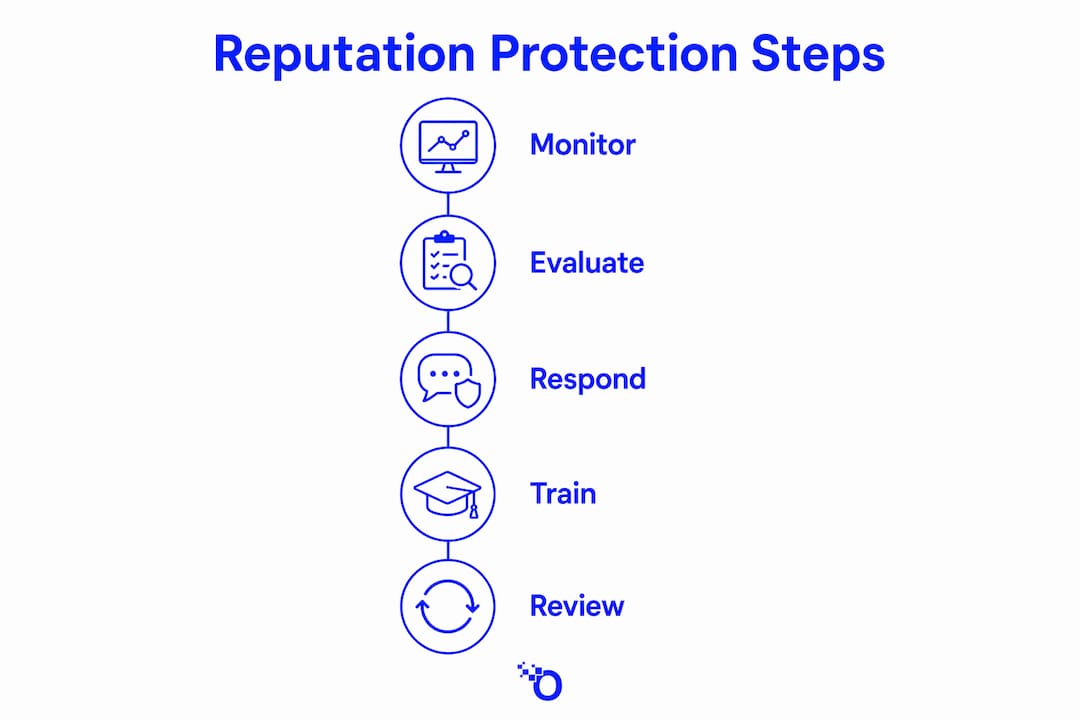
Agency reputation risk falls into two categories: direct risks and indirect risks. Direct risks include officer misconduct, use-of-force incidents, data breaches, and public complaints. Indirect risks include poor hiring decisions that result in misconduct, failure to respond to community feedback, and inconsistent public communications that create confusion or distrust. Both categories require structured mitigation protocols, not improvised responses.
Crisis management is where reputation protection systems are tested most severely. The following sequence defines best practice for public safety agencies facing an active reputational threat:
- Acknowledge the incident immediately. Silence is interpreted as guilt or indifference. A brief, factual acknowledgment that the agency is aware of the situation and is investigating buys time and demonstrates accountability.
- Avoid defensive public statements. Defensive responses escalate public concern and invite media scrutiny. The goal in the first 24 hours is to de-escalate, not to win a public argument.
- Move resolution offline. Direct affected parties to a private channel, a phone number, a dedicated email address, or an in-person meeting. Public forums are not the place to resolve complex complaints.
- Activate your crisis-response playbook. Every agency should maintain a written protocol that defines who speaks, what they say, which channels are used, and how escalation decisions are made. Improvising during a crisis produces inconsistent messaging and compounded damage.
- Document and review. After resolution, document what happened, how it was handled, and what systemic changes are needed to prevent recurrence. This documentation also serves as evidence of good-faith response if the matter escalates to formal review.
“Effective escalation protocols tier incidents by severity and define clear remediation and communication workflows, critical for agencies facing coordinated reputation risks.” — Agency reputation management system
Tiered approval workflows and strict brand guidelines reduce the risk of rogue content that damages reputation before leadership is even aware of it. This is particularly relevant for agencies where multiple personnel have social media access or public communication authority.
One critical distinction: reputation protection is not reputation laundering. Astroturfing or deceptive review suppression causes long-term damage when exposed, and exposure is increasingly likely given the scrutiny public safety agencies face. Sustainable reputation management is built on genuine engagement and ethical practices, not manufactured perception.
Pro Tip: Build your crisis-response playbook before you need it. A playbook written during a crisis reflects panic. A playbook written during calm reflects strategy.
What role do technology and service models play in sustaining agency reputation?
Technology does not replace judgment in reputation management, but it does make consistent execution possible at scale. The tools and service models available to agencies in 2026 fall into three distinct categories, each with different capabilities and limitations.
| Service model | What it includes | Best suited for | Key limitation |
|---|---|---|---|
| Software-only | Monitoring dashboards, review alerts, basic analytics | Agencies with dedicated internal staff | No managed response or crisis intervention |
| Managed service | Monitoring plus human-managed responses, removal requests, escalation | Agencies without dedicated communications staff | Higher cost, requires vendor trust |
| Hybrid model | Software tools combined with selective managed interventions | Mid-size agencies with partial internal capacity | Requires clear scope definition to avoid gaps |
Automated review request tools increase review volume by 2.3 times compared to unprompted feedback. For public safety agencies, this means that proactively soliciting feedback from community members, program participants, and partner organizations generates a substantially larger and more representative body of public opinion than waiting for feedback to arrive organically. More reviews also mean that individual negative reviews carry proportionally less weight.
The most common failure point in reputation technology adoption is not the monitoring platform. Pre-written brand-aligned response templates are often more critical than the data monitoring platform itself. Agencies that invest in sophisticated monitoring tools but have no structured response process consistently fail to act on the intelligence those tools provide.
Managed services combining removal and crisis response achieve higher retention outcomes than software-only models. For public safety agencies evaluating reputation protection services, the question is not which dashboard has the most features. The question is whether the service includes human-managed response, escalation protocols, and the capacity to intervene during an active reputational attack.
A study of 91 digital agencies found that integrating reputation management as a core service significantly improves client retention and margins. The same principle applies to public safety agencies: agencies that treat reputation management as a core operational function, rather than an occasional communications task, consistently outperform those that treat it as reactive damage control.
Pro Tip: When evaluating reputation protection services, ask specifically about escalation response time for active attacks or fake reviews. Speed of response directly influences outcomes during a reputational crisis. Measure success in days, not months.
What practical strategies can agency leaders implement today?
Agency leaders do not need to wait for a formal reputation management program to begin protecting their agency’s public standing. The following strategies are implementable immediately and form the operational foundation of any long-term reputation protection effort.
-
Conduct a full online audit. Search your agency name across Google, Bing, Facebook, Nextdoor, and local news archives. Document every result on the first two pages. This baseline tells you what the public currently sees and where the most urgent gaps exist.
-
Establish structured onboarding for communications personnel. Anyone who speaks for the agency, whether in person, on social media, or in writing, should receive formal orientation on brand voice, approved messaging, and escalation protocols. A well-structured reputation management system includes client onboarding with brand voice capture, asset version control, and escalation protocols.
-
Build and maintain a brand asset library. Approved logos, photos, biographical information, and boilerplate descriptions should be centrally stored and version-controlled. Outdated or inconsistent assets in public circulation create credibility gaps that are easily avoided.
-
Set up monitoring and response workflows. Assign monitoring responsibilities, establish response time targets, and create pre-approved response templates for the most common feedback scenarios. This preparation eliminates the hesitation that turns a manageable complaint into a public incident.
-
Invest in internal culture as a reputation asset. Personnel who feel respected, well-trained, and fairly treated represent the agency positively in every community interaction. Agencies that neglect internal culture while investing in external communications are building on an unstable foundation.
-
Leverage positive content strategically. Publish case studies, community program outcomes, and recognition of personnel achievements on a regular schedule. This creates a body of positive, indexed content that shapes search results and provides factual counterweight to negative coverage.
-
Avoid the most common mistakes. Neglecting negative reviews, allowing outdated content to remain indexed, and failing to monitor social media are the three most consistent contributors to preventable reputation damage. Each is correctable with basic operational discipline. Connecting background checks to agency reputation is also a frequently overlooked dimension: the quality of personnel hired directly determines the frequency and severity of reputation incidents.
Key takeaways
Agency reputation protection requires continuous operational discipline, not episodic marketing, to build and sustain public trust in public safety agencies.
| Point | Details |
|---|---|
| Define the discipline clearly | Agency reputation protection is proactive monitoring, response, and operational consistency, not reactive PR. |
| Respond within 24 hours | Timely response to all feedback signals accountability and prevents minor complaints from escalating. |
| Build a crisis playbook in advance | Pre-written protocols and tiered escalation workflows reduce damage during active reputational threats. |
| Technology requires human response capacity | Monitoring tools without managed response workflows consistently fail to protect agency reputation. |
| Hiring quality is a reputation variable | Personnel conduct drives public perception; background investigations are a direct input to reputation outcomes. |
Why reputation protection starts before the first hire
After years working at the intersection of public safety operations and personnel integrity, the most consistent observation is this: agencies that treat reputation protection as a communications problem are solving the wrong problem. The agencies with the strongest public standing are not the ones with the best social media presence. They are the ones with the most disciplined hiring practices, the clearest internal accountability structures, and the fastest response times when something goes wrong.
The uncomfortable reality is that most reputation incidents in public safety agencies are traceable to personnel decisions made months or years before the incident became public. An officer with a history of complaints at a previous agency. A dispatcher hired without a thorough background investigation. A supervisor promoted based on tenure rather than conduct record. These decisions create the conditions for reputation damage long before any monitoring tool can detect it.
What I have found actually works is treating reputation protection as an upstream discipline. That means public safety compliance strategies that are embedded in hiring, not bolted on afterward. It means using investigator-driven background checks that surface behavioral patterns, not just criminal records. It means building a culture where personnel understand that their conduct in every community interaction is the agency’s reputation in practice.
The agencies that recover fastest from reputation crises are also the ones that can demonstrate, with documentation, that they had rigorous hiring and oversight systems in place. That documentation does not eliminate public concern, but it does establish good faith. Good faith is the foundation on which trust is rebuilt.
Reactive reputation management, monitoring social media after an incident and issuing statements, is necessary but insufficient. The agencies that lead on reputation are the ones that have made it structurally difficult for reputation-damaging incidents to occur in the first place.
— Matt
How OMNI Intel supports agency reputation through safe hiring

OMNI Intel’s pre-employment screening services are built specifically for public safety agencies that understand reputation protection begins with who you hire. Every background investigation conducted through OMNI Intel applies law enforcement investigation principles to surface behavioral history, prior misconduct, and integrity concerns that standard screening misses. For law enforcement agencies, fire departments, EMS units, and dispatch centers, this level of scrutiny is not optional. It is the operational foundation of a trustworthy agency. Explore OMNI Intel’s background check programs to see how investigator-driven vetting directly reduces your agency’s exposure to personnel-driven reputation risk.
FAQ
What is agency reputation protection in simple terms?
Agency reputation protection is the ongoing practice of monitoring, managing, and defending how a public safety agency is perceived by the public, personnel, and partners. It combines technology, communication protocols, and operational discipline to prevent and respond to reputational threats.
How does hiring affect agency reputation?
Personnel conduct is the most direct driver of agency reputation incidents. Thorough pre-employment background investigations reduce the likelihood of hiring individuals whose behavior will damage public trust, making hiring quality a core component of any reputation protection strategy.
What is the difference between reputation management and reputation laundering?
Reputation management uses genuine engagement, transparent communication, and operational improvement to build public trust. Reputation laundering uses deceptive tactics like fake reviews or suppressed complaints, which cause long-term damage when exposed and undermine the ethical standards public safety agencies are held to.
How quickly should agencies respond to negative reviews or complaints?
Agencies should respond to all reviews and public complaints within 24 hours. A prompt, professional response demonstrates accountability and prevents minor issues from escalating into sustained public criticism.
What tools do agencies use for online reputation management?
Agencies use monitoring platforms like GatherUp for review tracking and alert systems, combined with pre-written response templates and escalation protocols. The most effective programs pair automated monitoring with human-managed response capacity for active incidents and crisis intervention.