

Why comprehensive screening matters in public safety hiring
Assuming a candidate with prior law enforcement experience is automatically a safer hire is one of the most persistent and costly misconceptions in public safety recruitment. The reality is more unsettling. Research consistently shows that prehire behaviors are among the strongest predictors of future misconduct, which is precisely why use comprehensive screening protocols have become non-negotiable for agencies that take their hiring obligations seriously. This article explains the evidence-based reasons thorough background investigations protect communities, the legal frameworks that govern them, and the practical steps hiring managers need to follow to build a defensible, compliant vetting process.
Table of Contents
- Understanding why comprehensive screening is essential for public safety
- Navigating legal frameworks and compliance requirements for background screening
- The risks of incomplete background checks and vetting gaps in public safety agencies
- Ensuring compliance and security: CJIS requirements and access controls
- Conducting individualized assessments to balance fairness and risk
- The inconvenient truth about screening and what most hiring managers miss
- Implement comprehensive public safety screening with OMNI Intel
- Frequently asked questions
Understanding why comprehensive screening is essential for public safety
The case for vetting critical for safe hiring goes far beyond regulatory checkboxes. It is rooted in hard data about what happens when agencies rely on surface-level checks or assume that a badge from a previous department is a character reference.
Research published in a peer-reviewed study found that prehire behaviors predict misconduct with hazard ratios as high as 14.59, and that roughly one in five officers receives a misconduct report within five years of being hired. That figure should stop every hiring manager cold. It means the personnel threat is not coming primarily from outside the agency. It is entering through the front door during recruitment.
The importance of screening becomes even clearer when you map out what prehire warning signs actually look like in practice:
- Prior civilian complaints at a previous agency that were dismissed or never formally investigated
- Financial instability including unresolved debts, wage garnishments, or patterns of irresponsible financial behavior
- Off-the-job misconduct such as domestic incidents, substance-related records, or restraining orders that did not result in criminal charges
- Inconsistencies in application materials, including gaps in employment history or discrepancies between stated credentials and verified records
- Behavioral patterns in reference interviews that reveal poor judgment, authority conflicts, or dishonesty
“The data is unambiguous: agencies that skip or abbreviate prehire investigations are not just cutting corners. They are accepting a measurable, quantifiable increase in the probability of future misconduct within their ranks.”
Ignoring these red flags does not only expose an agency to operational risk. It erodes the community trust that public safety institutions depend on to function. One high-profile misconduct case tied to a foreseeable prehire warning sign can set back years of relationship-building between an agency and the population it serves.
Navigating legal frameworks and compliance requirements for background screening
The benefits of comprehensive screening are inseparable from the legal landscape that shapes it. Two federal frameworks, in particular, define the boundaries within which every public safety agency must operate.
The Equal Employment Opportunity Commission (EEOC) requires that agencies using criminal history in hiring decisions apply what are commonly called the EEOC Green factors to avoid unlawful disparate impact. These factors guide hiring managers through an individualized assessment rather than a blanket exclusion policy. The three core factors are:
- The nature and gravity of the offense. Not all criminal history carries equal weight. A conviction for petty theft two decades ago is categorically different from a fraud conviction three years ago. The offense must be evaluated on its own terms.
- The time elapsed since the offense or the completion of the sentence. Recency matters. The further removed a candidate is from prior misconduct, the more weight rehabilitation evidence should receive.
- The nature of the job being sought. A role involving unescorted access to sensitive information, firearms, or vulnerable populations demands a higher level of scrutiny than one with limited public contact.
The Fair Credit Reporting Act (FCRA) adds procedural requirements that many agencies still underestimate. Under FCRA, disclosure and consent procedures must be completed before any background check is ordered, and a two-step adverse action process, including a pre-adverse action notice followed by a final adverse action notice, must be completed before any hiring decision based on a background report is finalized.
Pro Tip: Build your FCRA disclosure and consent forms as standalone documents rather than embedding them in general onboarding paperwork. Combining them with other materials is a common compliance error that courts have repeatedly flagged.
Agencies that comply with background regulations from the start avoid the far more expensive process of defending discrimination claims or FCRA violations after the fact. FCRA compliance in public safety is not optional. It is the legal floor beneath every hiring decision your agency makes.
The risks of incomplete background checks and vetting gaps in public safety agencies
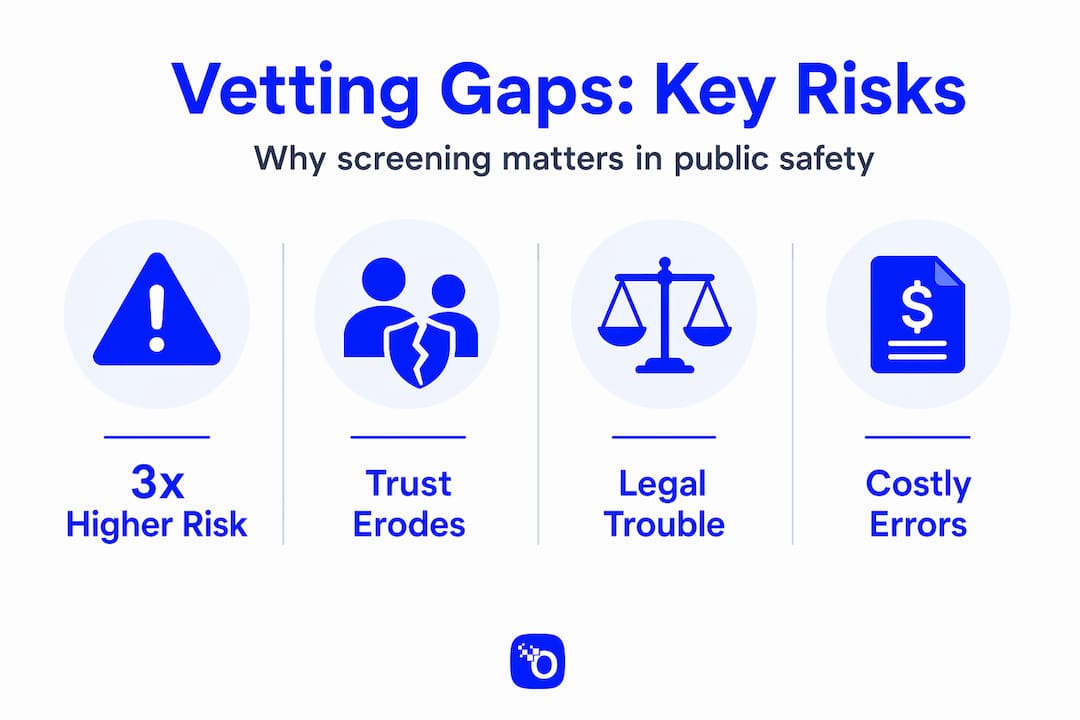
Understanding the value of thorough screening is most urgent when you examine what actually happens when agencies allow gaps to persist in their vetting processes. The consequences are neither abstract nor minor.

A 2026 review of historical practices at the Metropolitan Police Service in the United Kingdom found that vetting gaps caused missed checks for thousands of recruits over several years. After enhanced screening policies were introduced, the refusal rate for new hires more than doubled. That statistic deserves a moment of reflection: the same pool of applicants, subjected to a more rigorous process, produced a dramatically different and safer outcome.
| Screening level | Key checks performed | Estimated risk reduction | Notes |
|---|---|---|---|
| Minimal screening | Name-based criminal check only | Low | Misses alias records, financial data, behavioral history |
| Standard screening | Criminal, employment verification, references | Moderate | May miss off-the-job misconduct and social media flags |
| Thorough screening | All of the above plus financial, civil records, behavioral interview | High | Reflects the need for comprehensive screening in public safety |
| Investigator-driven checks | Full field investigation, polygraph, psychological assessment | Highest | Standard for sworn law enforcement and access-sensitive roles |
The operational consequences of vetting gaps extend beyond individual misconduct. When an under-vetted hire causes harm, the agency faces potential negligent hiring claims, civil litigation, regulatory scrutiny, and the far-reaching reputational damage that follows a public misconduct event.
Pro Tip: Audit your current screening workflow for agencies against the table above. If your process sits at the “minimal” or “standard” level for roles with public contact or sensitive system access, you are carrying unnecessary and legally exposed risk.
The reasons for comprehensive assessments are not theoretical. They are grounded in documented failures at real agencies that trusted incomplete processes, and the cost of those failures fell squarely on the communities those agencies were hired to protect.
Ensuring compliance and security: CJIS requirements and access controls
For agencies whose personnel access Criminal Justice Information (CJI), the Criminal Justice Information Services (CJIS) Security Policy adds another layer of mandatory screening requirements that go beyond general employment law.
The CJIS framework establishes that personnel with CJI access must complete fingerprint-based background checks before being granted unescorted access to systems containing sensitive law enforcement data. This is not a recommended practice. It is a baseline requirement, and failure to meet it puts the entire agency’s CJIS access at risk.
Key CJIS personnel requirements include:
- Fingerprint-based background checks completed prior to granting unescorted CJI access, regardless of prior employment or agency transfers
- Security awareness training conducted at minimum every two years for all personnel with CJI access, covering data handling, access controls, and incident reporting
- Audit controls and access logging that tie individual user credentials to system activity, creating an accountable trail for any data access event
- Management agreements with contractors and vendors who access CJI, requiring the same screening standards that apply to agency employees
“CJIS compliance is not a background check issue in isolation. It is a personnel security architecture that requires screening, training, monitoring, and documentation to function as intended.”
A pre-employment background check guide specific to public safety roles should map CJIS requirements to each position in your agency, making it clear which roles trigger mandatory fingerprint checks and which personnel need to be tracked through the biennial training cycle. Treating CJIS compliance as an afterthought is a mistake that federal audits will surface quickly.
Conducting individualized assessments to balance fairness and risk
The how-to element of implementing comprehensive screening often breaks down at the individualized assessment stage. Hiring managers either avoid it out of concern for inconsistency, or they apply it so narrowly that it fails to serve its legal purpose. Neither approach holds up under scrutiny.
An individualized assessment reduces discrimination risk by giving candidates the opportunity to provide context, demonstrate rehabilitation, and respond to adverse findings before a final decision is made. This is both a legal safeguard and a practical tool for making better hiring decisions.
A defensible individualized assessment process follows this sequence:
- Identify the specific record of concern. Document the nature of the offense, the date, and the jurisdiction. Vague references to “criminal history” are not sufficient for a legally defensible file.
- Apply the Green factors. Evaluate the offense against the three criteria, documenting your analysis in writing for each factor. This is the step most agencies skip, and it is the step most likely to be scrutinized in litigation.
- Notify the candidate and request a response. Provide the candidate with a copy of the record and a reasonable period, typically five business days, to submit mitigating evidence or clarification.
- Review the candidate’s response. Consider any evidence of rehabilitation, subsequent employment history, character references, or relevant certifications. Document your review.
- Make and document the final decision. The decision file should contain the original record, your Green factor analysis, the candidate’s response, and the rationale for the final outcome.
Candidates who demonstrate genuine rehabilitation should not be automatically disqualified based on history alone. The following types of evidence are relevant to this evaluation:
- Completion of court-ordered programs or voluntary counseling
- Stable employment history following the incident
- Character references from supervisors or community leaders
- Professional certifications or educational credentials earned post-conviction
Following background screening best practices means building this documentation discipline into every hire, not just the ones that look complicated on the surface.
The inconvenient truth about screening and what most hiring managers miss
After years of working alongside public safety agencies navigating complex hiring decisions, one pattern stands out above the rest: the agencies most confident in their vetting process are often the ones most exposed to risk. That confidence usually rests on a single flawed assumption, specifically that prior law enforcement experience reduces the need for thorough screening.
The research does not support that assumption. In fact, candidates with prior law enforcement experience can carry a higher misconduct risk, not lower, because agencies sometimes absorb laterals with abbreviated vetting on the reasoning that “we know this type of candidate.” What they often do not know is why that candidate left their previous agency, what informal complaints were never documented, and what behavioral patterns existed that a thorough investigation would have surfaced.
The second thing most hiring managers miss is the documentary value of the screening process itself. A well-documented, EEOC-aligned, FCRA-compliant vetting file is not just a personnel record. It is your agency’s legal defense in the event of a negligent hiring claim. If a hire goes wrong and your file shows that you followed a documented, individualized, evidence-based process, your legal position is fundamentally stronger than if you relied on gut instinct and a basic name check.
Skipping or compressing the assessment process to speed up a hiring cycle is a trade that looks efficient in the short term and becomes expensive very quickly. The cost of one misconduct-related lawsuit, one civil settlement, or one federal compliance investigation will dwarf the investment of doing the screening correctly the first time.
Every agency that takes avoiding hiring risks seriously eventually arrives at the same conclusion: the vetting process is not a delay in hiring. It is the most important part of hiring. The agencies that internalize that truth build stronger, more accountable teams. The ones that resist it pay for it eventually, and the communities they serve pay alongside them.
Implement comprehensive public safety screening with OMNI Intel
The guidance in this article reflects what thorough, legally defensible screening actually requires in practice. Turning those requirements into a consistent, auditable process is where many agencies struggle without the right infrastructure behind them.

OMNI Intel is built specifically for public safety agencies that cannot afford gaps in their vetting pipeline. Our pre-employment screening services are designed around law enforcement investigation principles, not generic HR software logic, covering FCRA compliance, EEOC-aligned individualized assessments, fingerprint-based checks, and CJIS-compatible workflows. Our background checks for agencies surface the behavioral and historical data that standard platforms miss. For agencies requiring full investigator-driven vetting, our OMNIScreen background investigations deliver the depth that high-stakes public safety roles demand. Reach out to OMNI Intel to build the screening process your agency, and the community it serves, can trust.
Frequently asked questions
Why is comprehensive screening critical for public safety hiring?
Thorough screening identifies behavioral risks before they become misconduct events inside your agency. Research shows that one in five officers receives misconduct reports tied to prehire behaviors, making early detection the most effective intervention available.
What are the EEOC Green factors in background checks?
The Green factors are the nature and gravity of the offense, the time elapsed since it, and the nature of the job being sought. The EEOC uses these factors to guide lawful, individualized assessments that avoid unlawful disparate impact in criminal history screening.
How does FCRA affect background checks?
FCRA requires agencies to provide a standalone disclosure and obtain written consent before ordering a background report. FCRA mandates specific disclosures and a two-step adverse action notice sequence, including a pre-adverse notice before and a final adverse notice after any hiring decision based on the report.
What happens if an agency skips parts of comprehensive screening?
Vetting gaps create documented pathways to high-risk hires, legal exposure, and compliance failures. Evidence shows that vetting gaps caused missed checks for thousands of recruits and that refusal rates more than doubled once proper screening was applied, indicating how many risks went undetected under weaker processes.
What is the role of fingerprint-based checks in CJIS compliance?
Fingerprint-based background checks are a mandatory baseline requirement for any personnel with unescorted access to Criminal Justice Information. Fingerprints and security training are the foundational personnel controls that CJIS requires before system access is granted.