

Public safety compliance guide for HR managers
Every hiring decision your agency makes carries legal, ethical, and community weight that few private-sector organizations can fully appreciate. A single procedural failure in your background screening process, whether a missing authorization form or an undocumented individualized assessment, can expose your agency to statutory damages, class action lawsuits, and the kind of reputational harm that undermines public trust for years. This public safety compliance guide gives HR managers and compliance officers a structured, legally grounded framework covering EEOC considerations, FCRA procedural requirements, agency-specific screening stages, and medical and psychological evaluation protocols.
Table of Contents
- Understanding legal and regulatory frameworks for public safety hiring
- Structuring compliant background screening workflows for public safety agencies
- Integrating occupational medical and psychological evaluations with hiring compliance
- Best practices for individualized assessment and avoiding discrimination risks
- Rethinking compliance: Beyond checklists to building a culture of lawful and effective hiring
- Optimize your public safety hiring with OMNI Intel compliance solutions
- Frequently asked questions
Key Takeaways
| Point | Details |
|---|---|
| Compliance sequence matters | Following the exact legal steps in background screening avoids costly violations and supports fair hiring. |
| Individualized assessments are essential | Evaluating criminal history tailored to job relevance protects against discrimination claims. |
| Separate workflows reduce risk | Keeping consumer report processes distinct from internal checks ensures proper application of FCRA rules. |
| Update medical protocols | Align your occupational medical programs with current NFPA standards to maintain compliance. |
| Culture complements compliance | Building a hiring culture focused on transparency and fairness enhances procedural compliance and candidate experience. |
Understanding legal and regulatory frameworks for public safety hiring
Having introduced the compliance challenges, the core legal frameworks governing your hiring process deserve careful, systematic attention. These are not abstract principles. They carry direct procedural obligations with real consequences for non-compliance.
The Fair Credit Reporting Act (FCRA) defines a “consumer report” as any communication from a consumer reporting agency (CRA) bearing on an applicant’s character, general reputation, personal characteristics, or mode of living. This definition is broader than most HR professionals initially assume. It captures credit reports, criminal history searches, employment verifications, and many reference checks when conducted through a CRA. FCRA compliance failures often arise not from the decision an agency makes, but from procedural errors in disclosure, authorization, or the adverse action process — the administrative steps that bracket the decision itself.
The Equal Employment Opportunity Commission (EEOC) adds a separate but related layer. Its guidance requires that criminal-record screening be job-related and consistent with business necessity, never applied as a blanket exclusion. The EEOC’s individualized assessment standard is directly at odds with policies that automatically disqualify any applicant with a criminal record, regardless of offense type, age, or relevance to the position.
“Employers must avoid criminal-record screening that denies equal employment opportunity or has disparate impact. Screening should be job-related, with individualized assessment applied to each candidate’s circumstances.”
— EEOC Enforcement Guidance
Ban-the-box laws add further complexity. At the federal level, the Fair Chance Act restricts criminal history inquiries for federal contractors until a conditional offer has been made. Many states and municipalities have enacted parallel legislation for public employers, though the timing requirements and exemptions vary considerably. Some jurisdictions carve out law enforcement and positions requiring firearms, but HR managers should not assume any blanket exemption applies without reviewing the specific statute governing their jurisdiction.
Key legal obligations to track in your safety regulations checklist:
- Maintain a standalone FCRA disclosure document, separate from any application form
- Obtain a valid written authorization before procuring any consumer report
- Apply EEOC individualized assessment standards to all criminal history findings
- Confirm your state’s ban-the-box timing rules and any public safety exemptions
- Prepare compliant pre-adverse and final adverse action notices with the required waiting period
Understanding the importance of compliance in hiring goes well beyond checking boxes. It requires building processes that are defensible at every stage, from the first application acknowledgment to the final hiring decision.
Structuring compliant background screening workflows for public safety agencies
Now that you know the legal foundation, practical implementation in sequential, well-documented stages is the next priority. This is where many agencies lose ground, not because they lack good intentions, but because their workflows blur FCRA-governed processes with internal investigative steps that operate under different rules.
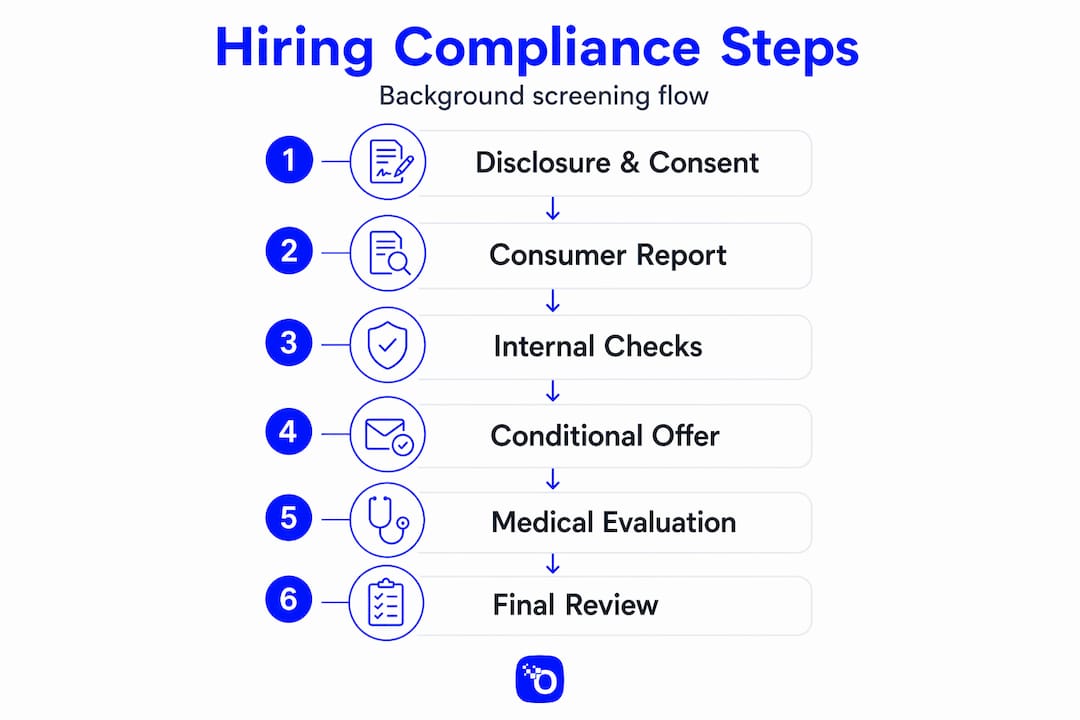
The critical distinction is this: FCRA requirements apply only to consumer reports obtained from CRAs. Internal verification, such as direct calls to former employers, interviews with personal references, or in-house records checks, falls outside FCRA scope. Mixing these two categories in a single undifferentiated workflow risks compliance failures by applying FCRA adverse action procedures to internal findings (or, more dangerously, by failing to apply them to CRA-sourced information that should trigger those procedures).
Public safety agencies benefit most from a structured hiring process that moves candidates through sequential stages, each with defined documentation requirements and legal checkpoints.

Recommended hiring stages and compliance requirements
| Stage | Activity | Compliance Requirement |
|---|---|---|
| 1. Preliminary screening | Application review, initial eligibility check | No criminal history inquiry (ban-the-box compliance) |
| 2. Disclosure and authorization | Provide standalone FCRA disclosure; obtain signed consent | FCRA Section 604(b) procedural compliance |
| 3. Investigative background check | CRA consumer report, direct reference interviews | Separate CRA and internal data; document all findings |
| 4. Physical readiness testing | Physical agility or fitness testing | Apply uniformly; document testing standards |
| 5. Conditional offer | Extend offer contingent on medical and psych results | Offer must precede any medical inquiry |
| 6. Medical and psychological evaluation | Occupational health exam, psychological battery | Post-offer only; document by licensed professional |
| 7. Final hiring decision | Individualized assessment of any derogatory findings | Document assessment; issue adverse action notices if applicable |
Steps to implement this workflow:
- Draft a standalone FCRA disclosure and authorization form reviewed by counsel familiar with your state’s laws.
- Designate separate staff or system queues for consumer reports versus internal investigative data.
- Build a documentation log for every stage, recording who reviewed what, when, and what determination was made.
- Establish a tickler system for the pre-adverse action waiting period (minimum five business days under the FCRA before issuing a final adverse action notice).
- Conduct internal audits quarterly to verify every stage is completed in the correct sequence.
- Train all decision-makers on what constitutes a “consumer report” and what does not.
Pro Tip: Create a candidate-facing tracking document that tells applicants where they are in the process without revealing protected information. This reduces candidate anxiety, minimizes inbound HR inquiries, and demonstrates the transparency that reinforces your agency’s integrity.
Your background check guide should be a living document, updated whenever legislation changes or your agency’s roles evolve. Procedures written for a 20-officer department may not scale to a 200-person operation without gaps emerging in accountability.
When verifying applicant credentials, remember that education and certification claims in public safety are particularly high-stakes. A falsified EMT certification or a misrepresented law enforcement academy graduation can create direct liability for your agency the moment that individual acts under color of authority.
Integrating occupational medical and psychological evaluations with hiring compliance
After establishing screening workflows, the next critical layer involves medical and psychological evaluations. These assessments exist to confirm that a candidate can safely perform the essential functions of a demanding, physically and psychologically intense role. But their timing and documentation carry significant legal weight.
The governing principle under the Americans with Disabilities Act (ADA) is clear: medical examinations and disability-related inquiries may occur only after a conditional job offer has been extended. Conducting a medical exam before the offer is made opens your agency to ADA claims, regardless of the exam’s outcome. This post-offer sequencing requirement is not a technicality. It is a structural rule that protects both the candidate’s privacy and your agency’s legal standing.
For fire departments and many public safety agencies, the occupational medical standard of reference is NFPA 1580. Note that NFPA 1582 has been consolidated into NFPA 1580, and any agency still referencing 1582 as a standalone standard in its medical protocols should update those materials immediately. Citing a superseded standard in a hiring document is a form of paper compliance, the appearance of following standards without actually doing so.
Core components of a compliant post-offer medical and psychological program:
- Occupational health examination: Conducted by a licensed physician familiar with the physical demands of the specific public safety role; must assess job-related functions only
- Fitness for duty documentation: Written opinion from the examining physician, documented in a separate medical file never shared with general HR personnel
- Psychological battery: Standardized tests such as the MMPI-2 administered by a licensed psychologist, scored against norms established for public safety populations
- Discretionary evaluation: Agency psychologist may conduct structured interviews or additional testing when battery results indicate potential concerns
- Conditional disqualification review: Any disqualifying finding should be reviewed against ADA direct-threat standards before a final decision is made
Pennsylvania State Police conduct medical and psychological testing after a conditional offer, with documentation supporting further evaluation as warranted. This model, with its clean post-offer sequencing, is worth examining as a practical template regardless of your agency’s size.
Pro Tip: Schedule a formal review of your medical program materials every 18 to 24 months. NFPA consolidations, ADA interpretive guidance updates, and state workers’ compensation rules all evolve. An occupational health program that was defensible three years ago may contain outdated language that creates unnecessary legal exposure today.
For hiring compliance for public safety HR professionals, keeping medical program documentation current is not a luxury. It is a foundational element of an audit-ready hiring process.
Best practices for individualized assessment and avoiding discrimination risks
With medical and psychological evaluations covered, the focus shifts to the decision-making process itself, particularly for applicants with criminal history or other potentially disqualifying background findings. This is the point in the hiring process where legal exposure is highest and documentation is most often neglected.
The EEOC’s individualized assessment framework requires consideration of three core factors when evaluating a criminal record:
- Nature and gravity of the offense: A conviction for financial fraud is materially different from a misdemeanor disorderly conduct charge from 15 years ago, and treating them identically is both legally indefensible and operationally unsound.
- Time elapsed since the offense or completion of sentence: Recidivism research consistently shows that risk diminishes significantly over time. A 20-year-old conviction with no subsequent record is a very different data point than a conviction from two years ago.
- Nature of the job: The relationship between the specific offense and the specific duties of the position is the central question. A prior theft conviction carries different weight for a property custodian than for a records clerk with no financial responsibilities.
“A blanket exclusion policy for convictions is disfavored under EEOC guidance and risks unlawful disparate impact claims under Title VII of the Civil Rights Act.”
Consider this scenario: an applicant for a civilian dispatch position discloses a 12-year-old possession conviction, fully adjudicated, with no subsequent record and strong employment history. A blanket exclusion policy rejects the candidate automatically. An individualized assessment, applying the three-factor framework above, might reach a different conclusion and would certainly produce a more defensible record. The EEOC requires individualized assessment precisely because blanket rules fail to account for the full picture that fair, evidence-based hiring demands.
Steps to document a legally defensible individualized assessment:
- Record the specific offense, conviction date, and sentence served.
- Note the time elapsed and any evidence of rehabilitation or subsequent conduct.
- Map the offense explicitly to the duties of the role being filled.
- Record the hiring official’s written conclusion and the reasoning behind it.
- Retain documentation in a secured file separate from the general personnel record.
- If a disqualification results, initiate the FCRA adverse action process using the consumer report that surfaced the record.
Review your compliance steps for safe hiring annually, and cross-reference them with your compliance checklist for agencies to ensure individualized assessment procedures are current and consistently applied across all hiring officials in your agency.
Rethinking compliance: Beyond checklists to building a culture of lawful and effective hiring
Most agencies approach compliance as a documentation problem. Build the right forms, follow the right sequence, train HR staff on FCRA disclosures, and the organization is protected. That logic is not wrong. But it is incomplete in ways that produce recurring failures even in agencies with sophisticated compliance programs.
The deeper issue is that legal compliance depends heavily on the judgment of individuals at every stage of the process, not just the HR department. A patrol commander who makes an offhand remark about an applicant’s criminal history before a formal individualized assessment has been completed creates legal exposure regardless of how good the documentation templates are. A background investigator who skips a reference interview because an applicant “seemed fine” in the initial screening introduces factual gaps that formal processes are designed to prevent.
Building a genuine culture of lawful hiring means investing in three areas that checklists alone cannot address. First, interviewer training must go beyond legal awareness into practical decision-making scenarios. Role-playing a compliant individualized assessment conversation is far more effective than distributing a policy memorandum. Second, workflow design should involve the stakeholders who actually use it: investigators, medical review staff, hiring commanders, and legal counsel. When these parties help design the process, they understand it and defend it. Third, documentation must be treated as an operational asset, not a burden. The agencies that demonstrate audit-ready records consistently face less regulatory scrutiny and resolve disputes faster.
The risks of non-compliance are not merely financial. An improperly screened officer who later engages in misconduct creates civil liability, community harm, and a cascade of institutional accountability questions that no compliance form can retroactively prevent. The screening process is the first line of protection against that outcome, and it deserves the same operational rigor your agency applies to its use-of-force or evidence-handling policies.
From the perspective captured in HR compliance perspectives, the agencies that sustain effective, legally sound hiring over time are not those with the most detailed policy manuals. They are those where everyone in the hiring chain understands the purpose behind the procedures and takes ownership of the outcome.
Pro Tip: Before rolling out a revised background screening workflow agency-wide, pilot it with a cohort of five to ten candidates under close observation. Document every point of friction, ambiguity, or procedural deviation. Use those findings to refine the process before full implementation. Fixing a workflow flaw at pilot stage costs almost nothing. Discovering it during litigation costs considerably more.
Optimize your public safety hiring with OMNI Intel compliance solutions
Implementing the procedures described in this guide requires more than good policy. It requires tools that are purpose-built for the specific legal and operational demands of public safety hiring.

OMNI Intel’s public safety pre-employment screening platform is designed from the ground up for agencies that cannot afford procedural gaps. The platform supports FCRA-compliant disclosure and authorization workflows, structured investigative background check processes, and documentation systems that make audit preparation straightforward rather than reactive. OMNI Intel’s background checks for public safety are conducted using investigator-driven methods grounded in law enforcement investigation principles, not the automated, high-error processes common in commercial screening. For agencies requiring deeper vetting, OMNI Intel’s public safety background investigations combine digital tools with human analysis to deliver thorough, defensible results. Connect with OMNI Intel to build a hiring program your agency can stand behind.
Frequently asked questions
What is a compliant sequence for background checks in public safety hiring?
A compliant sequence starts with a standalone disclosure and written authorization, followed by obtaining consumer reports from a CRA, conducting an individualized assessment of findings, and providing required adverse action notices including the pre-adverse and final adverse action letters if a disqualifying decision is made.
How does the EEOC suggest employers handle criminal history in hiring?
The EEOC advises using an individualized assessment that weighs the offense’s nature, the time elapsed since the conviction, and its relevance to the specific job rather than applying blanket criminal history exclusions, which risk Title VII disparate impact liability.
Can medical and psychological testing occur before conditional job offers?
Generally, they cannot. Under the ADA, medical and psychological examinations must follow a conditional offer, as Pennsylvania State Police procedures illustrate, ensuring evaluations focus only on candidates already qualified on non-medical grounds.
Why is it important to separate consumer report workflows from internal verification?
FCRA obligations apply only to consumer reports from CRAs, so conflating those with internally gathered data risks either misapplying FCRA procedures where they are not required or failing to apply them where they are legally mandatory.
What are the risks of non-compliance with background check regulations?
Non-compliance can result in statutory and punitive damages under the FCRA, class action exposure with settlements reaching tens of millions, regulatory penalties, and lasting reputational damage to the agency’s standing within the community it serves.