

What Is Robust Vetting for Public Safety Hiring?
Robust vetting is defined as a risk-managed, role-proportionate personnel screening process that provides verified visibility into an individual’s reliability before granting access to sensitive roles, information, or communities. In public safety hiring, this means going well beyond a standard criminal history check. It means applying tiered scrutiny based on the sensitivity of the position, maintaining ongoing review after hire, and building every decision on documented, auditable evidence. Frameworks like Trusted Workforce 2.0 and standards such as ISO 27001 have formalized what thorough vetting looks like at scale. For law enforcement agencies, fire departments, dispatch centers, and private security firms, the definition of robust vetting is not academic. It is the operational standard that separates trustworthy hires from costly, reputation-damaging mistakes.
What is robust vetting and what defines the process?
Robust vetting, known in federal security contexts as structured personnel vetting, is a risk-based background investigation that calibrates the depth of screening to the sensitivity and responsibility of the role being filled. It is not a single check run at the point of hire. It is a documented system of layered reviews, data verification, and ongoing monitoring designed to surface reliability concerns before and after employment begins.
The process differs from minimal compliance screening in three fundamental ways. First, the depth of investigation scales with role risk, meaning a patrol officer faces more scrutiny than an administrative volunteer. Second, the process continues after hire through periodic or continuous review rather than ending at onboarding. Third, every decision is documented with an audit trail that can withstand regulatory or legal challenge.

For public safety agencies, the importance of robust vetting cannot be overstated. Personnel in these roles carry legal authority, access sensitive data, and interact directly with vulnerable populations. A single hiring failure can expose an agency to civil liability, erode public trust, and place officers or citizens at risk. The vetting process for law enforcement must therefore be treated as a core operational function, not an administrative formality.
Core components of a thorough vetting program
A well-designed vetting program for public safety hiring includes the following components:
- Tiered, role-based background checks. Screening depth is proportional to the access and authority the role carries. A dispatcher, a sworn officer, and a civilian contractor each require different investigation scopes.
- Continuous or periodic post-hire monitoring. One-time checks create a snapshot. Ongoing review catches changes in financial status, criminal activity, or behavioral indicators that emerge after hire.
- Data quality management. Poor data capture causes high false-positive rates that undermine the entire process. Configuring match thresholds and testing against real historical datasets is not optional; it is foundational.
- Documented policies and escalation protocols. ISO 27001 guidelines recommend written screening policies with retention schedules of 24 to 36 months and clear decision documentation for adverse findings.
- Privacy and legal compliance. Role-based checks must align with FCRA requirements, applicable state law, and GDPR principles where relevant, with privacy notices provided to candidates and secure data handling throughout.
- Automated tools paired with human oversight. Automation accelerates data retrieval and flags anomalies. Human investigators interpret context, assess credibility, and make final determinations.
Pro Tip: When configuring screening algorithms, test your match thresholds against a tagged dataset of recent, known cases before going live. This single step can identify whether your system is generating excessive false positives or missing genuine concerns before either problem affects a real hire.
How continuous vetting transforms traditional screening models
Traditional background screening operates on a periodic reinvestigation model. An agency screens a candidate at hire, then revisits the file every five or ten years. The problem with this model is that the window between reviews is long enough for significant behavioral, financial, or criminal changes to go undetected. Trusted Workforce 2.0 addresses this directly by replacing fixed-interval reinvestigations with continuous evaluation, where relevant data sources are checked daily or at frequent intervals calibrated to role sensitivity.
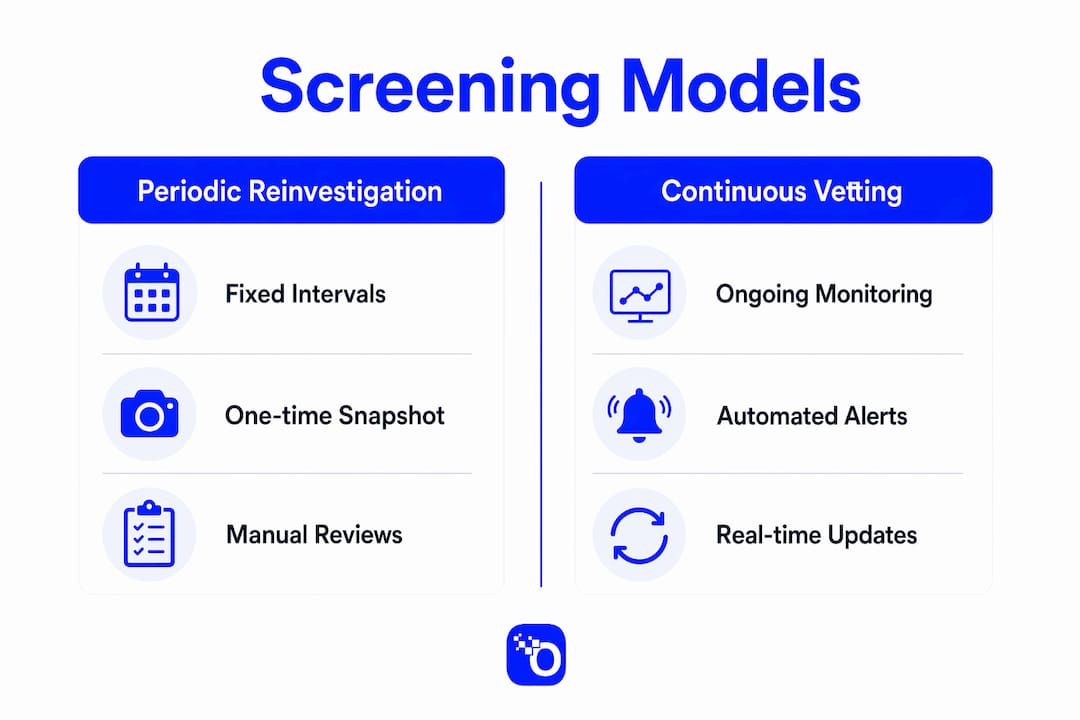
Continuous vetting (CV) does not mean constant surveillance. It means that automated monitoring tools watch for triggering events, such as a new arrest record, a significant financial delinquency, or a flag in a federal database, and surface those events for human review when they occur. The DCSA’s continuous vetting program includes scheduled PVQ date-based updates that anchor data refresh cycles to individual personnel markers, preventing stale records from creating false confidence in a cleared workforce.
The federal adoption of CV provides concrete evidence of its value. As of late 2024, 26,540 NSPT personnel were onboarded across 23 agencies into the continuous vetting program, with full enrollment targeted for FY 2025. This scale of implementation demonstrates that CV is no longer a pilot concept. It is an operational standard for sensitive-role workforce management.
The table below compares the traditional periodic reinvestigation model against the continuous vetting model across the dimensions most relevant to public safety agencies.
| Dimension | Periodic reinvestigation | Continuous vetting |
|---|---|---|
| Review frequency | Fixed intervals (5 to 10 years) | Ongoing, event-triggered monitoring |
| Risk detection speed | Slow; gaps of years are common | Near real-time for covered data sources |
| Data freshness | Stale between cycles | Anchored to scheduled refresh markers |
| Operational burden | High at reinvestigation; low between cycles | Distributed, lower per-event workload |
| Workforce trust assurance | Snapshot at last review date | Current, continuously validated status |
For public safety agencies that have not yet adopted continuous monitoring, the practical starting point is post-hire monitoring for criminal activity and financial distress. These two categories generate the most operationally significant flags and require the least infrastructure to implement. Agencies can then expand monitoring scope as their programs mature.
Common challenges and solutions in implementing robust vetting
Implementing a thorough vetting process is not simply a matter of adding more checks. The most common failures in public safety vetting programs are not caused by insufficient check types. They are caused by poor data quality, misconfigured screening tools, and the absence of documented governance structures. Understanding these failure modes is the first step toward building a program that holds up under operational pressure and regulatory scrutiny.
The following steps address the most frequent implementation challenges in sequence:
-
Audit your data capture process first. Before adjusting any algorithm or adding a new check type, examine how candidate data is collected and formatted. Inconsistent name formats, missing date-of-birth fields, and address gaps are the primary drivers of false positives. Fixing input quality reduces downstream noise more effectively than any algorithm adjustment.
-
Configure match thresholds per data source. Different screening lists and databases require different sensitivity settings. A threshold appropriate for a federal sanctions list may generate excessive alerts when applied to a state criminal database. Top-performing vetting teams configure match settings per list source and test against real historical data to balance false positives against missed detections.
-
Establish documented escalation paths. Every adverse finding needs a defined review process. Who receives the alert? Who makes the final determination? What documentation is required before a hiring decision is made? Without written escalation protocols, agencies face inconsistent decisions and audit exposure.
-
Build in governance checkpoints. Screening configurations should be reviewed at least annually. Regulatory changes, new data sources, and shifts in role requirements all affect whether your current thresholds remain appropriate. Treat your vetting configuration as a living document, not a one-time setup.
-
Balance thoroughness with privacy obligations. Role-based checks aligned with GDPR principles require that screening be transparent to candidates, proportionate to the role, and limited to data necessary for the specific decision. Overcollecting data creates legal exposure and erodes candidate trust without improving decision quality.
-
Reduce alert fatigue through risk-based prioritization. When every alert carries equal weight, investigators stop treating alerts seriously. Prioritize alerts by severity and role sensitivity so that high-risk flags receive immediate attention and low-risk anomalies are batched for periodic review.
Pro Tip: Run a quarterly false-positive audit by pulling a sample of resolved alerts and reviewing whether the outcomes were consistent with your documented escalation policy. Inconsistencies in that sample are your early warning system for governance drift.
The USCIS experience illustrates what happens when these steps are skipped. Prior screening gaps at USCIS necessitated comprehensive corrective vetting enhancements to close national security and fraud exposure. The corrective action was costly and public. Building governance into the program from the start is materially less expensive than rebuilding it after a failure.
How robust vetting compares across sectors
Vetting practices vary significantly across federal security, immigration, corporate, and public safety sectors. Each sector applies background investigation principles differently based on its regulatory environment, the nature of the access being granted, and the consequences of a hiring failure. Public safety agencies occupy a distinct position in this spectrum because their personnel carry legal authority and interact directly with the public in high-stakes situations.
The table below summarizes how the importance of robust vetting manifests differently across key sectors.
| Sector | Primary vetting driver | Typical depth | Continuous monitoring | Key framework |
|---|---|---|---|---|
| Federal security (DCSA) | National security clearance | Extensive, multi-source | Yes, event-triggered CV | Trusted Workforce 2.0 |
| Immigration (USCIS) | Fraud prevention, national security | Comprehensive biographic and biometric | Enhanced post-gap correction | USCIS screening protocols |
| Corporate (financial services) | Regulatory compliance, fraud risk | Moderate, role-dependent | Selective, often annual | FCRA, ISO 27001 |
| Law enforcement and public safety | Public trust, legal authority, community safety | Extensive, investigator-driven | Emerging, post-hire monitoring | FCRA, state POST standards |
| Private security | Client liability, access control | Moderate to extensive | Limited, contract-dependent | State licensing requirements |
Law enforcement and public safety hiring sits closest to the federal security model in terms of required depth, yet many agencies still operate closer to the corporate model in practice. The gap between what the role demands and what the process delivers is where hiring risk accumulates. Agencies that adopt tiered, investigator-driven screening aligned with the sensitivity of each position close that gap systematically.
The public safety sector also has a unique accountability dimension. When a law enforcement agency hires a candidate with a disqualifying history that a thorough investigation would have surfaced, the consequences extend beyond the agency. They affect the community the agency serves. This accountability is the strongest argument for adopting the documented, auditable approach to candidate screening that federal security agencies have formalized through frameworks like Trusted Workforce 2.0.
Key takeaways
Robust vetting is the structured, continuous, and auditable process that separates defensible public safety hiring decisions from those that create organizational and community risk.
| Point | Details |
|---|---|
| Risk-proportionate depth | Screen candidates at a depth that matches the sensitivity and authority of the specific role being filled. |
| Continuous post-hire monitoring | Replace one-time checks with ongoing review to detect behavioral or criminal changes after employment begins. |
| Data quality over algorithm complexity | Fixing input data and configuring match thresholds reduces false positives more effectively than changing screening software. |
| Documented governance is non-negotiable | Written escalation policies, retention schedules, and audit trails are what make vetting decisions defensible. |
| Federal frameworks set the standard | Trusted Workforce 2.0 and ISO 27001 provide proven models that public safety agencies can adapt to their specific hiring contexts. |
The case for treating vetting as a living system, not a one-time check
Having worked alongside public safety agencies on background investigation design for years, the pattern I see most often is not negligence. It is inertia. Agencies build a vetting process that was adequate for the regulatory environment of a decade ago and then treat it as settled. The process runs, checks get completed, and hires get made. But the underlying configuration never gets tested, the escalation paths never get reviewed, and the data quality never gets audited.
The uncomfortable reality is that a vetting process that was well-designed five years ago may be generating a significant rate of false positives today, simply because the data sources it queries have changed in format or coverage. The algorithm did not fail. The governance did. This is precisely the lesson embedded in the DCSA’s shift to continuous vetting and scheduled data refresh cycles. The federal security community recognized that a process without ongoing calibration is not a process. It is a liability dressed up as due diligence.
What I advocate for is treating the vetting program as a living system with scheduled review cycles, documented configuration decisions, and quarterly audits of outcomes against policy. This is not a significant operational burden. It is the difference between a program that holds up under scrutiny and one that collapses the first time a hiring decision is challenged. For agencies serious about implementing a defensible vetting process, the investment in governance infrastructure pays for itself the first time it prevents a bad hire or survives a regulatory review.
The future of public safety vetting will be shaped by better data integration, faster continuous monitoring, and AI-assisted anomaly detection. But none of those tools will matter if the governance layer underneath them is not sound. Build the foundation first.
— Matt
How Omniintel supports robust vetting for public safety agencies
Public safety agencies need more than a generic background check vendor. They need a screening partner that understands the investigative standards, legal requirements, and community accountability that define the sector.

Omniintel’s pre-employment screening platform is built specifically for law enforcement, fire and EMS, dispatch centers, and private security firms. OMNIScreen™ delivers investigator-driven background investigations that apply tiered, role-proportionate scrutiny to every candidate, with full audit trails and FCRA-compliant documentation at every step. Post-hire monitoring capabilities extend that scrutiny beyond onboarding, giving agencies the continuous visibility that modern workforce risk management requires. If your agency is ready to move from a compliance checkbox to a genuinely defensible vetting program, Omniintel provides the tools and expertise to get there.
FAQ
What is the definition of robust vetting in public safety hiring?
Robust vetting is a risk-managed, role-proportionate background investigation process that verifies candidate reliability through tiered checks, continuous monitoring, and documented escalation protocols. It goes beyond minimal compliance screening to provide defensible, auditable hiring decisions.
Why is thorough vetting critical for law enforcement agencies?
Law enforcement personnel carry legal authority and interact directly with vulnerable populations, meaning a single hiring failure can create civil liability, community harm, and reputational damage. Thorough vetting surfaces disqualifying history and behavioral risk before those consequences materialize.
How does continuous vetting differ from a standard background check?
A standard background check produces a one-time snapshot at the point of hire, while continuous vetting monitors personnel on an ongoing basis for new criminal activity, financial distress, or other triggering events. The DCSA’s continuous vetting program uses event-triggered monitoring and scheduled data refresh cycles to maintain current workforce risk assessments.
What causes false positives in background screening and how can they be reduced?
False positives are primarily caused by poor data capture quality and misconfigured match thresholds, not by algorithm limitations. Configuring fuzzy match settings per data source and testing against recent tagged datasets can reduce false-positive rates by 50 to 70 percent.
What frameworks guide best practices for robust vetting programs?
Trusted Workforce 2.0 governs continuous evaluation standards for federal personnel vetting, while ISO 27001 provides guidance on written screening policies, data retention schedules, and audit documentation. Public safety agencies can adapt both frameworks to their specific regulatory and operational contexts.