
Role of Transparency in Recruitment: Reducing Hiring Risks
What is the role of transparency in recruitment? Hiring for public safety roles demands more than just filling positions. Without transparent recruitment processes, candidates can be left guessing about critical details from salary to evaluation criteria. This lack of clarity impacts who applies, how they prepare, and ultimately, your ability to build trust within the community. Understanding what transparency truly means will help you create a stronger, more equitable hiring process and reduce unnecessary risks for your agency.
Table of Contents
- Defining Transparency In Recruitment Processes
- Key Components Of Open Recruitment Practices
- Legal And Ethical Obligations For Agencies
- Risks Of Non-Transparent Hiring Decisions
- Best Practices For Fostering Transparency
Key Takeaways
| Point | Details |
|---|---|
| Transparency Enhances Recruitment | Clearly communicate job expectations, salary ranges, and evaluation criteria to attract qualified candidates and build trust. |
| Structured Processes Reduce Bias | Implement standardized interview procedures and scoring systems to promote fairness in evaluation and decision-making. |
| Legal Compliance is Essential | Maintain thorough documentation of recruitment practices to adhere to legal requirements and protect the agency from liability. |
| Open Communication Builds Trust | Notify candidates promptly about decisions and provide feedback to enhance the agency’s reputation, even among those not hired. |
Defining the Role of Transparency in Recruitment Processes
Transparency in recruitment means sharing essential information openly with candidates from the start. Public safety agencies rely on honest, straightforward communication to attract qualified applicants and build trust in the hiring process.
At its core, transparency addresses a fundamental problem: candidates often lack critical information to make informed decisions about positions. When you withhold details about salary, job expectations, or evaluation criteria, you create an uneven playing field. Candidates struggle to assess fit, negotiate fairly, or understand what they’re actually applying for.
What Real Recruitment Transparency Looks Like
Transparency in public safety hiring involves several key practices.
- Salary disclosure: Share expected pay ranges in job postings so candidates know what to expect
- Clear role descriptions: Detail actual duties, physical requirements, and work schedules
- Defined evaluation criteria: Explain how you’ll assess candidates and what matters most
- Timeline transparency: Communicate when decisions will be made and how candidates will be notified
- Selection process clarity: Outline each stage, from application through final decision
Pay transparency laws now mandate wage disclosure in many jurisdictions, reflecting a shift toward openness. These requirements recognize that candidates perform better when they understand compensation upfront.
For public safety recruiting, transparency goes deeper than salary ranges. Candidates need to know about shift patterns, mandatory overtime, location assignments, and promotional timelines. They deserve clarity on background investigation scope, disqualifying factors, and how past conduct is evaluated.
When candidates see honest job descriptions and clear expectations, they self-select better. Only genuinely qualified applicants move forward, reducing your screening burden.
Reducing information gaps between employers and candidates improves hiring outcomes. Candidates can assess their own qualifications realistically. They negotiate from informed positions rather than assumptions.
This creates another benefit: stronger initial candidate pools. When people understand what you’re truly offering, those who apply are more committed. Your acceptance rates improve because candidates have already confirmed their interest.

Transparency also protects your agency. When selection criteria are documented and communicated, you reduce legal exposure. You demonstrate fair, consistent practices if hiring decisions are ever questioned.
Here’s a comparison of transparent versus non-transparent recruitment processes and their organizational effects:
| Aspect | Transparent Process | Non-Transparent Process |
|---|---|---|
| Candidate Trust | High; builds credibility | Low; can breed skepticism |
| Hiring Decision Quality | Data-driven and defensible | Subjective and harder to justify |
| Risk of Legal Action | Reduced due to documentation and clarity | Increased due to lack of clear records |
| Candidate Pool | More committed and informed applicants | Uncertain expectations, higher dropout |
| Team Diversity | Improved representation, reduced bias | Lower diversity, systemic exclusion risk |
Pro tip: Create a transparent hiring checklist listing every piece of information candidates need, then audit your job postings against it monthly to ensure nothing gets missed.
Key Components of Open Recruitment Practices
Open recruitment practices require intentional design across multiple areas. You cannot simply post a job and hope transparency happens naturally. Your approach must address how you communicate, whom you reach, and how you evaluate fairly.
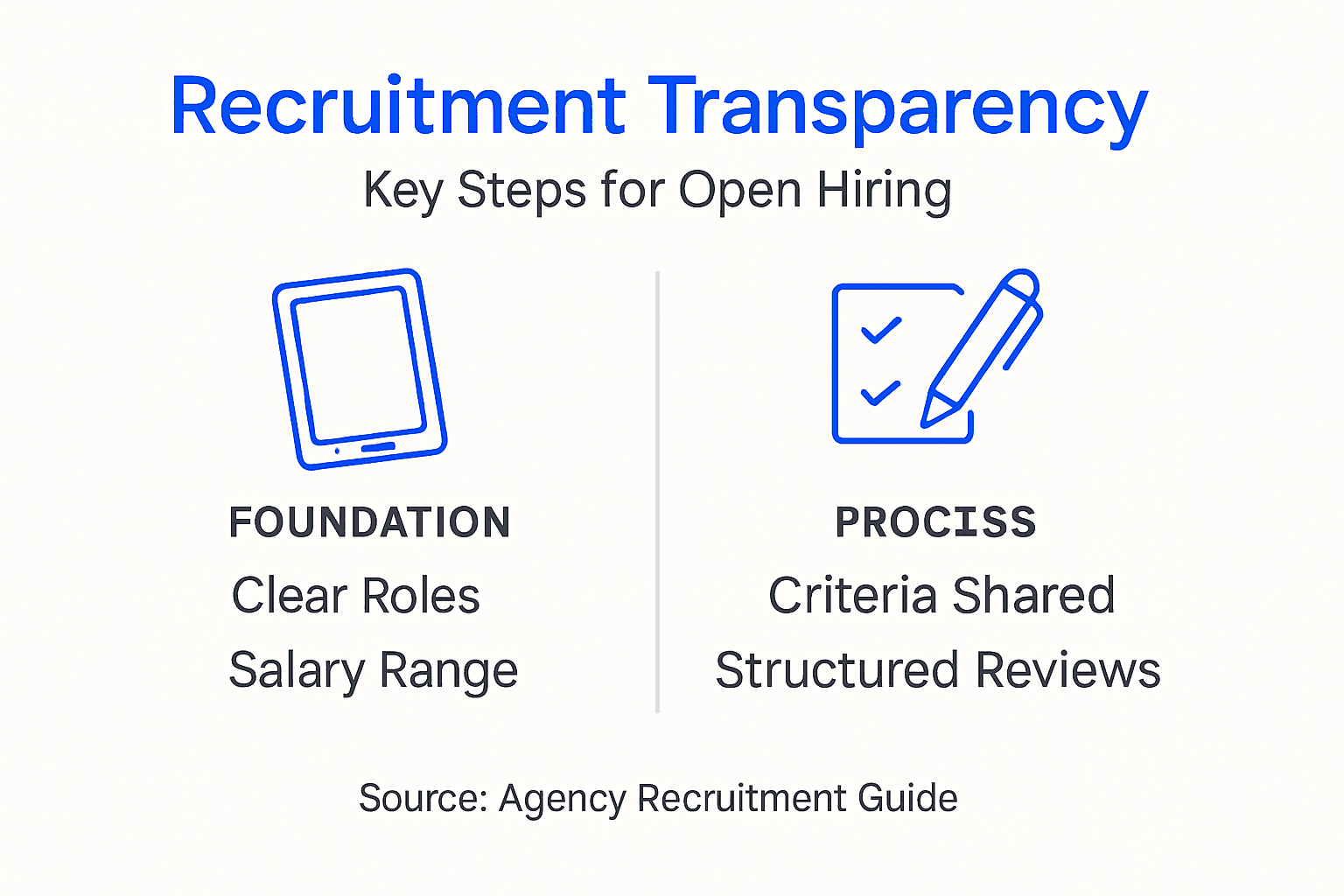
The foundation starts with clear job descriptions that honestly portray the role. Candidates need specifics about duties, physical demands, shift patterns, and growth potential. Vague descriptions attract the wrong applicants and waste everyone’s time.
Next, establish unbiased evaluation criteria before reviewing applications. Document what matters most for the position and stick to it consistently. When selection standards are objective and job-related, you reduce unconscious bias and create defensible hiring decisions.
Core Components to Implement
- Wide candidate outreach: Recruit from diverse sources to attract larger, more varied pools
- Transparent selection process: Explain each hiring stage so candidates know what to expect
- Objective scoring systems: Use standardized evaluation rubrics applied equally to all applicants
- Documented interviews: Record questions asked and responses to ensure consistency
- Clear communication: Notify candidates of decisions promptly with explanations when appropriate
- Compensation transparency: Disclose salary bands upfront to prevent surprise rejections
Training managers on unbiased hiring practices addresses one of the largest barriers to fairness. Managers often unconsciously favor candidates who remind them of current staff or match their personal preferences. Structured interview training eliminates much of this bias.
Monitoring your actual hiring patterns reveals what your processes truly accomplish. Track hiring rates by demographic groups, sources, and departments. If disparities exist, investigate root causes and adjust your practices.
Transparent systems aren’t just fairer. They’re faster. When criteria are clear upfront, decisions come quicker and candidates know where they stand.
Compensation strategy belongs in open recruitment too. Offering competitive benefits and career development opportunities attracts stronger applicants who envision long-term careers with your agency. Communicate these benefits clearly in job postings.
Finally, document everything. Written policies, saved communications, interview notes, and scoring sheets create accountability and legal protection. Transparency requires a trail you can point to if hiring decisions face scrutiny.
Pro tip: Require all hiring managers to use the same evaluation form with identical questions for every candidate in a recruiting cycle, then store completed forms for at least three years.
Legal and Ethical Obligations for Agencies
Public safety agencies operate under a web of legal requirements and ethical duties when recruiting. Ignoring these isn’t just risky—it exposes your agency to litigation, damages your reputation, and undermines public trust.
Federal law sets the baseline. Preventing discrimination based on protected characteristics is non-negotiable. You cannot screen candidates differently based on race, color, religion, sex, national origin, age, or disability. Your entire recruitment process must comply with these standards, from job postings through final hiring decisions.
Beyond federal rules, many states and localities impose additional requirements. Pay transparency laws now mandate salary disclosure in hiring. Some jurisdictions require background check notices, candidate consent forms, and adverse action letters. Your agency must track and follow each applicable rule.
Key Legal Requirements
- Maintain recruitment records: Keep applications, resumes, interview notes, and scoring sheets for at least one year
- Post required notices: Display EEO posters and state-specific employment law notices in visible locations
- Use compliant background checks: Follow all background investigation procedures with proper authorization and disclosure
- Document selection criteria: Write down job-related qualifications before reviewing applications
- Provide adverse action notice: Notify rejected candidates when background checks influence decisions
- Honor accommodation requests: Provide reasonable accommodations for candidates with disabilities
Ethical obligations run deeper than legal minimums. Recruitment practices must respect candidate privacy and avoid coercion, ensuring truly voluntary participation in your hiring process. Candidates should never feel pressured into disclosing information beyond job requirements.
Transparency serves both legal and ethical purposes. When candidates understand your selection process and criteria upfront, they can make informed decisions. When they know your agency conducts thorough background investigations, qualified applicants self-select in and dishonest ones often withdraw.
Legal compliance protects your agency. Ethical practices build the community trust that public safety depends on.
Document everything with meticulous care. Write hiring policies clearly. Train all managers on legal obligations. Keep comprehensive records showing consistent application of rules across all candidates. If a hiring decision faces legal challenge, your documentation proves fair process.
Consider involving human resources and legal counsel in policy development. Outside expertise prevents costly mistakes and ensures alignment with current laws across your jurisdiction.
This summary outlines the main legal, ethical, and practical considerations agencies must address during recruitment:
| Consideration Type | Key Focus Area | Organizational Benefit |
|---|---|---|
| Legal | Equal opportunity compliance | Minimizes lawsuits and penalties |
| Ethical | Respectful candidate handling | Builds public and staff trust |
| Operational | Detailed process records | Streamlines audits and improvements |
| Strategic | Transparent communication | Enhances employer reputation |
Pro tip: Create a recruitment compliance checklist covering federal EEO laws, state pay transparency requirements, background check procedures, and record retention rules, then have HR review it quarterly for updates.
Risks of Non-Transparent Hiring Decisions
Opaque hiring processes expose your agency to serious consequences. When you don’t clearly document why candidates were hired or rejected, you create vulnerabilities that ripple across operations, reputation, and legal standing.

The most immediate risk is unconscious bias influencing decisions. Without structured evaluation criteria, hiring managers rely on gut feelings and subjective judgments. Unconscious bias in hiring leads to less diverse teams and weaker organizational performance. In public safety, this means missing qualified candidates who don’t fit a narrow mold.
Non-transparent processes also perpetuate systemic problems. If you’re rejecting candidates from certain demographics at higher rates, you’ll never know without transparent tracking. Discrimination becomes hidden in vague language like “culture fit” or “not quite right.”
Concrete Risks You Face
- Legal liability: Lack of documented criteria makes it impossible to defend hiring decisions if challenged in court
- Poor hire quality: Subjective decisions often miss red flags that thorough screening would catch
- Higher turnover: Candidates hired through opaque processes tend to leave sooner due to mismatched expectations
- Recruitment costs: Replacing poor hires burns budget and time you could invest elsewhere
- Reputation damage: Word spreads. Candidates talk. Media notices discriminatory patterns
- Reduced diversity: Hidden bias systematically excludes qualified applicants from underrepresented groups
Non-transparent hiring perpetuates systemic discrimination and reduces organizational effectiveness. Your agency misses talented officers, firefighters, and dispatchers simply because your process obscures merit.
Public safety agencies face unique pressure here. Communities expect their law enforcement and emergency responders to reflect the population they serve. Opaque hiring that excludes diverse candidates undermines public trust.
Non-transparent hiring doesn’t just hurt individuals. It weakens your entire agency’s capability and credibility.
Consider also the financial impact. Poor hiring decisions require extensive pre-employment investigation to remedy, draining resources. A thorough, transparent hiring process catches problems upfront and costs far less than managing problematic employees or defending lawsuits.
Your applicant tracking system should document every step. Who applied. Why candidates advanced or were rejected. What scores they received. These records become your defense if decisions face scrutiny.
Pro tip: Audit your last twelve months of hiring decisions by reviewing case files and identifying those lacking clear documentation, then rebuild those decision trails with current criteria and rationale.
Best Practices for Fostering Transparency
Transparency doesn’t happen by accident. You need deliberate systems, training, and accountability to embed openness throughout your recruitment process. The effort pays dividends in better hires and stronger legal standing.
Start with standardized job descriptions that accurately reflect actual duties. Include physical requirements, shift expectations, salary ranges, and growth opportunities. Vague postings attract the wrong candidates and create mismatched expectations from day one.
Next, establish consistent interview procedures applied uniformly across all candidates. Use the same questions, the same scoring rubric, the same interview panel composition. This removes personal preference from evaluation and makes your decisions defensible.
Implementation Steps
- Document selection criteria in writing before recruiting begins
- Train all hiring managers on bias recognition and structured interviews
- Use standardized evaluation forms with objective scoring scales
- Record interview questions and candidate responses systematically
- Communicate transparently with candidates about timelines and next steps
- Maintain detailed records of all hiring decisions and rationale
- Track hiring outcomes by demographic group to identify patterns
Consistent interview procedures and interviewer training reduce bias significantly. When managers ask the same questions in the same order, they evaluate candidates on merit rather than intuition.
Data collection and transparency go hand in hand. Monitor your hiring metrics monthly. What percentage of applicants advance by stage? Do certain groups drop off disproportionately? These questions reveal hidden problems.
Transparency is not about being perfect. It’s about being honest and willing to improve based on what data shows.
Clear communication about job requirements and selection criteria helps candidates make informed decisions and builds trust in your process. When candidates understand exactly how you’ll evaluate them, qualified applicants stay engaged.
Consider implementing written policies that govern every stage. How long from application to interview? How many interviews before a decision? Who makes the final call? Put it in writing and follow it consistently.
Technology helps here. Applicant tracking systems can enforce standardized workflows, timestamp decisions, and create audit trails automatically. This removes human error and provides documentation if questions arise.
Communication extends beyond hiring too. Notify rejected candidates with respect. Explain the decision briefly when appropriate. This transparency builds your agency’s reputation as professional and fair, even among those who didn’t get the job.
Pro tip: Create a public-facing recruitment transparency document outlining your selection process, timeline, and criteria, then share it with every applicant at the moment they apply.
Strengthen Your Role in Recruitment Transparency with OMNI Intel
The article highlights the critical challenge public safety agencies face: creating transparent hiring processes that reduce risk and build trust. Key pain points include the need for clear documentation of evaluation criteria, unbiased background screening, and consistent communication with candidates. These concepts of transparency, fair evaluation, and legal compliance are not just ideas but essential pillars to safeguard your agency’s reputation and community trust.
OMNI Intel offers tailored background screening solutions designed specifically for agencies like yours. Our platform helps you implement transparent, evidence-based hiring decisions by providing thorough pre-employment background investigations, AI-driven candidate vetting, and continuous monitoring post-hire. With OMNI Intel, you can reduce hiring costs, speed up recruitment cycles, and ensure every candidate is evaluated fairly and consistently.
Take control of your transparent recruitment journey today.
Discover how to transform your hiring process with trusted screening tools for public safety at Get Started with OMNI Intel.

Ready to reduce hiring risks and build a stronger, more reliable team? Visit OMNI Intel background screening platform now to see how transparency in recruitment can become your agency’s greatest asset.
Frequently Asked Questions
What is transparency in recruitment?
Transparency in recruitment refers to the open sharing of essential information with candidates, including details about salary, job expectations, evaluation criteria, and the overall hiring process. This helps candidates make informed decisions and fosters trust.
Why is transparency important in the recruitment process?
Transparency is crucial because it allows candidates to assess their fit for a position realistically. By providing clear information, employers attract better-qualified candidates and protect their agencies from legal risks associated with biased hiring practices.
How can public safety agencies improve transparency in hiring?
Public safety agencies can enhance transparency by posting detailed job descriptions, disclosing salary ranges, establishing unbiased evaluation criteria, and clearly communicating the hiring timeline and selection process to candidates.
What are the risks of non-transparent hiring practices?
Non-transparent hiring practices can lead to unconscious bias, legal liabilities, poor hire quality, higher turnover rates, and damage to the agency’s reputation. These issues jeopardize effective recruitment and undermine public trust in the agency.
Recommended
- Transparency in Screening: Building Trust in Public Safety
- Avoid Hiring Risks: Master Pre-Employment Background Investigations for Public Safety Professionals • OMNI Intel
- 7 Public Safety Recruitment Best Practices for Agencies
- Master the Public Safety Recruitment Process Easily
- Employment Contract Explained: Critical UK Compliance Risks | Ali Legal