
Screening Solutions Explained: Safeguarding Public Safety Hiring
Hiring for public safety roles involves much more than checking a resume and running a basic background search. The stakes are high for agencies in any American city, where a single oversight can ripple through the entire community. Comprehensive screening solutions provide a robust framework—integrating investigator-driven checks, validated tools, and continuous monitoring—to protect both agency integrity and public trust. Discover practical ways to enhance your hiring process while addressing real risks unique to public safety recruitment.
Table of Contents
- Defining Screening Solutions In Public Safety
- Why Public Safety Agencies Need Tailored Solutions
- The Real-World Impact
- How Screening Solutions Integrate Into Your Process
- Types Of Screening Methods For Agencies
- Key Steps In The Vetting Process
- Compliance Standards And Legal Obligations
- Reducing Risks And Common Pitfalls
Key Takeaways
| Point | Details |
|---|---|
| Comprehensive Screening Solutions | Public safety agencies should implement tailored screening solutions that go beyond basic background checks to enhance agency integrity and community safety. |
| Importance of Ongoing Monitoring | Continuous employee monitoring is essential to identify emerging risks and maintain compliance after hiring decisions are made. |
| Risk Assessment | Prioritizing high-risk candidates for thorough evaluations can significantly reduce the likelihood of hiring mistakes and enhance public safety. |
| Legal Compliance | Understanding and adhering to federal and state legal standards during the screening process is crucial to protect against liability and ensure fair hiring practices. |
Defining Screening Solutions in Public Safety
Screening solutions in public safety are comprehensive systems designed to evaluate individuals before and after hiring to protect agency integrity and community safety.
These solutions go far beyond simple background checks. They combine investigative processes, validated assessment tools, and evidence-based decision-making frameworks tailored specifically for law enforcement, fire, emergency medical services, dispatch centers, and security personnel.
What Makes Screening Solutions Different
Screening solutions are distinct from basic background verification. A screening solution integrates multiple evaluation methods into a cohesive process.
Key components include:
- Investigator-driven checks that examine criminal history, employment records, and financial stability
- Validated questionnaires used by trained professionals to assess risk factors and behavioral indicators
- Continuous monitoring systems that track employee activity post-hire for ongoing compliance
- FCRA-compliant protocols ensuring legal adherence and protection of candidate rights
- AI-driven candidate matching that aligns applicant qualifications with specific role requirements
Using validated questionnaires to evaluate potential employees helps assess immediate risks and long-term fit within your agency, particularly when conducted by trained professionals according to legal mandates.
Why Public Safety Agencies Need Tailored Solutions
One-size-fits-all screening approaches fail public safety hiring. Your agency faces unique challenges that generic background checks cannot address.
A patrol officer requires different vetting than a dispatcher or firefighter. Each role carries distinct liability exposure, public interaction intensity, and decision-making responsibility. Tailored screening solutions account for these differences.
Technology-driven screening approaches enable agencies to identify evidence-based methods, enhance community partnerships, and improve officer safety through targeted evaluation frameworks.
Screening solutions specifically designed for public safety agencies consider factors generic platforms overlook:
- Physical and psychological fitness standards
- Judgment and ethical decision-making capacity
- Community trust and reputation impact
- De-certification risk and career longevity
- Integrity indicators under high-stress conditions
The Real-World Impact
Accurate screening prevents costly hiring mistakes. A single bad hire can damage community trust, generate litigation, and compromise officer safety for years.
Screening solutions reduce these risks through comprehensive evaluation. Agencies using structured, investigator-driven screening experience fewer hiring reversals, lower turnover among qualified hires, and faster time-to-productivity.
Screening solutions tailored for public safety agencies transform hiring from a compliance checkbox into a strategic competitive advantage for recruitment and retention.
How Screening Solutions Integrate Into Your Process
Effective screening solutions fit seamlessly into your existing recruitment workflow. Integration points include job posting platforms, applicant tracking systems, and background investigation management.
This integration streamlines operations:
- Candidates apply through your standard channels
- Screening solutions automatically flag red flags and verify credentials
- Investigators focus time on priority cases requiring deep analysis
- Final hiring decisions incorporate comprehensive, structured assessment data
- Post-hire monitoring continues evaluating employee fitness
Pro tip: Partner with a screening platform that offers investigator-driven checks aligned with law enforcement best practices rather than generic corporate screening, ensuring your agency captures integrity and public safety concerns competitors miss.
Types of Screening Methods for Agencies
Public safety agencies use multiple screening methods to evaluate candidates comprehensively. No single tool captures all relevant information, so effective agencies combine validated questionnaires, background investigations, and ongoing assessments.
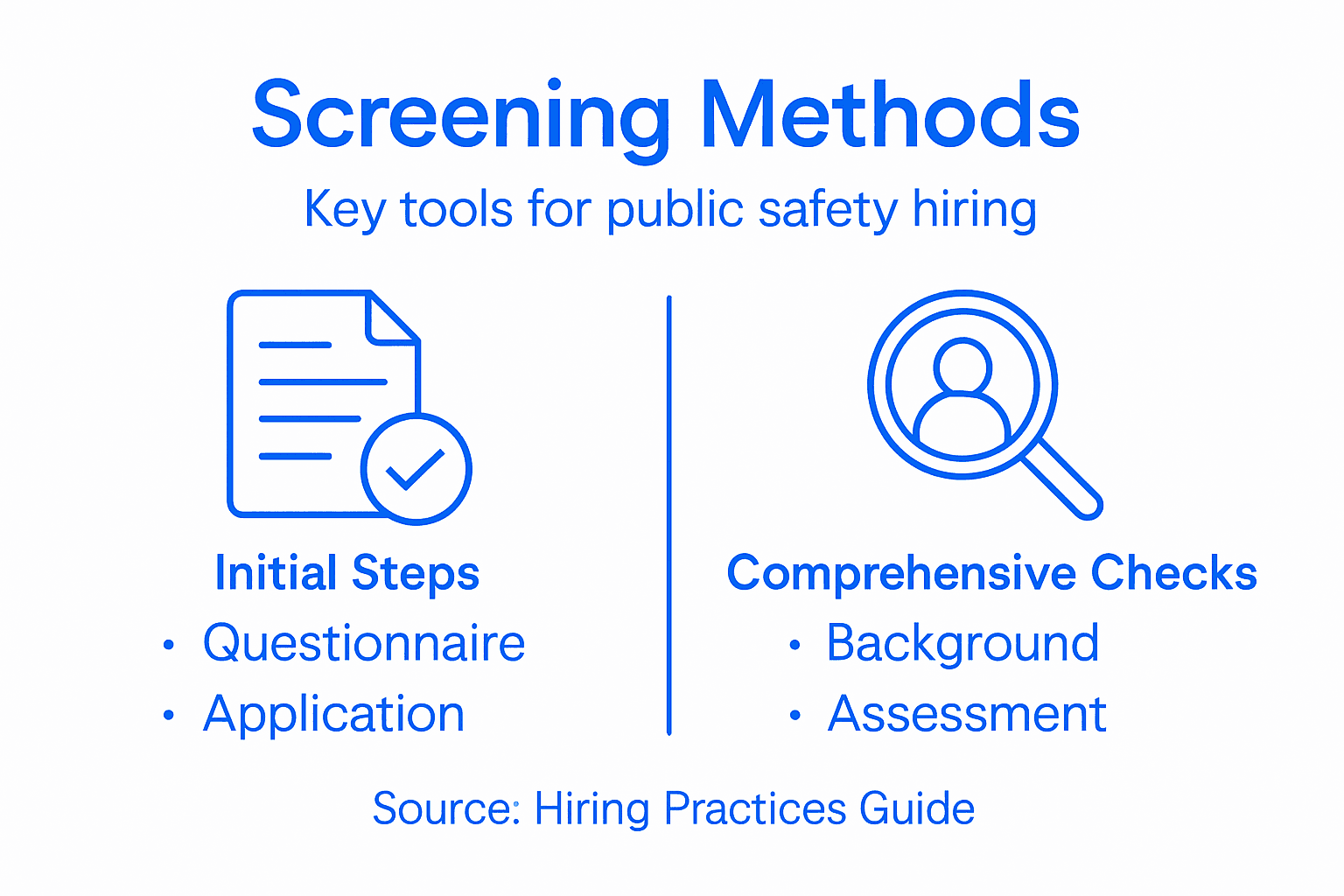
The right combination depends on your agency’s specific needs, resources, and the roles you’re filling. Dispatchers require different screening than sworn officers. Fire personnel need distinct evaluation compared to EMS staff.
Validated Questionnaires and Initial Assessments
Validated questionnaires screen for mental health indicators, substance abuse history, domestic violence involvement, and trauma exposure that may affect job performance and public safety.
These tools serve as initial filters. Trained professionals administer them consistently, ensuring fair evaluation and legal compliance. Initial screening identifies candidates requiring deeper investigation before they waste time or resources.
Common assessment areas include:
- Mental health and psychological stability
- Substance abuse and addiction patterns
- Trauma history and coping mechanisms
- Domestic violence as victim or perpetrator
- Human trafficking exposure or exploitation
Criminal History and Background Investigations
Criminal record examination forms the foundation of public safety screening. This goes beyond a simple criminal database query. Investigators examine arrests, convictions, disposition details, and pending charges.

Background investigations also verify employment history, examine financial records for integrity concerns, and contact previous employers. Investigator-driven background checks reveal patterns generic systems miss.
Key investigation components:
- Court records and sentencing details
- Employment verification and job performance history
- Financial stability and debt management
- References and professional reputation
- Civil litigation and restraining orders
Risk Assessment and Criminogenic Factors
Screening methods must identify criminogenic risk factors that predict job performance problems. Agencies maximize resource allocation by prioritizing high-risk candidates for intensive investigation.
Risk assessment happens in stages. Initial screening filters obvious concerns. Comprehensive assessment provides detailed information about behavioral patterns, judgment, and decision-making capacity.
Tiered screening approaches save investigator time while ensuring thorough evaluation of candidates who advance further in your hiring process.
Ongoing Post-Hire Monitoring
Screening doesn’t end at hire date. Continuous monitoring systems track employee conduct, arrest records, financial problems, and behavioral changes indicating declining integrity.
Post-hire monitoring catches emerging risks early. An employee with a clean background initially may develop substance abuse issues, accumulate significant debt, or face legal problems months or years into employment.
Monitoring captures:
- New arrests or criminal charges
- Civil litigation or restraining orders filed
- Financial distress indicators
- Internal misconduct complaints
- Terminations from other agencies
Selecting Tools Matched to Your Needs
Effective screening requires matching tools to your specific operational context. A small rural agency may use simpler tools than a large metropolitan department. Each agency must select instruments aligned with evidence-based practices and local requirements.
Consider your agency’s size, budget, investigator availability, and specific role requirements when designing your screening approach.
Pro tip: Start with tiered screening combining brief initial questionnaires, comprehensive background investigations for finalists, and post-hire monitoring systems rather than applying equal intensity to every candidate, maximizing investigator productivity while maintaining thorough vetting.
Here’s how major screening methods compare for public safety agencies:
| Screening Method | Best Used For | Key Advantage |
|---|---|---|
| Validated Questionnaires | Initial risk screening | Early detection of behavioral risks |
| Background Investigations | Core fact verification | In-depth review of history and trust |
| Risk Assessments | High-risk candidates | Prioritizes resources efficiently |
| Post-Hire Monitoring | Ongoing compliance | Identifies new risks after hiring |
Key Steps in the Vetting Process
Successful vetting follows a structured progression from initial candidate attraction through long-term employment monitoring. Each phase builds on the previous one, creating a comprehensive picture of candidate trustworthiness.
The vetting timeline typically spans weeks to months, depending on your agency size and investigative complexity. Understanding each phase helps you allocate resources effectively and set realistic hiring timelines.
Phase One: Pre-Initial Vetting and Recruitment
Vetting begins before candidates apply. Your recruitment messaging, position descriptions, and job posting channels influence the quality and character of applicants you attract.
Clear position requirements signal that your agency takes hiring seriously. Detailed job descriptions establish expectations early, discouraging unqualified or unsuitable candidates from wasting their time.
Pre-initial vetting actions:
- Design position descriptions emphasizing integrity and reliability standards
- Communicate screening expectations upfront to deter unsuitable applicants
- Target recruitment channels where qualified candidates congregate
- Build agency reputation for thorough, fair vetting processes
Phase Two: Application and Initial Screening
Candidates complete detailed applications containing questionnaires and background information disclosures. This step establishes baseline information and reveals self-reported concerns.
Position designation and questionnaires gather specific information required for your roles. Applications should ask direct questions about criminal history, substance abuse, financial problems, and previous employment.
Initial screening captures:
- Completeness and consistency of application materials
- Obvious disqualifying factors or red flags
- Basic qualification verification
- Truthfulness and accuracy in self-reported information
Phase Three: Comprehensive Background Investigation
Finalists advance to intensive investigative review. Trained investigators verify criminal records, employment history, financial stability, and personal references.
This phase uncovers patterns and contexts initial screening missed. Investigators contact previous employers, review court documents, and examine financial records for integrity concerns.
Comprehensive background investigations transform raw information into actionable insights about candidate judgment, reliability, and trustworthiness.
Phase Four: Adjudication and Decision
Investigators compile findings into comprehensive reports. Qualified adjudicators review evidence and make hiring recommendations based on established policies and legal requirements.
Adjudication considers the totality of circumstances. A single concern doesn’t automatically disqualify; investigators evaluate patterns, context, and risk mitigation.
Adjudication evaluates:
- Factual accuracy of all investigation findings
- Relevance of concerns to job requirements
- Severity and recency of problems identified
- Candidate explanations and mitigation factors
- Overall trustworthiness and suitability assessment
Phase Five: Onboarding and Post-Vetting Monitoring
Hiring decisions extend into post-employment monitoring. Continuous vetting identifies emerging risks like arrests, financial distress, or behavioral changes after hire date.
Post-vetting supports retention of qualified employees while protecting community safety. Regular monitoring demonstrates your agency’s commitment to accountability and integrity.
Onboarding and monitoring includes:
- Clear expectations and code of conduct communication
- Periodic background rechecks and activity monitoring
- Early intervention when problems emerge
- Transparent communication about conduct expectations
Pro tip: Implement standardized timelines and data-driven processes across all vetting phases to reduce delays, improve compliance, and create consistent candidate experiences that help attract quality applicants to your agency.
To help understand each step’s focus, here’s a summary of the structured vetting process:
| Vetting Phase | Main Focus | Typical Outcome |
|---|---|---|
| Pre-Initial Vetting & Recruitment | Attracting qualified applicants | Strong candidate pipeline |
| Application & Initial Screening | Identifying obvious red flags | Removal of unqualified candidates |
| Comprehensive Background Investigation | Thorough verification and context gathering | Detailed candidate risk profile |
| Adjudication and Decision | Evaluating findings holistically | Defensible hiring recommendations |
| Onboarding & Post-Vetting Monitoring | Ensuring long-term integrity and compliance | Early identification of emerging issues |
Compliance Standards and Legal Obligations
Public safety hiring operates under a complex web of federal and state laws. Non-compliance exposes your agency to lawsuits, regulatory penalties, and reputation damage that undermines community trust.
Understanding these obligations isn’t optional. They shape every aspect of your screening process, from job descriptions through post-hire monitoring. Violations can invalidate hiring decisions and create legal liability.
Federal Anti-Discrimination Laws
Your screening process must comply with major federal statutes protecting applicants and employees. Federal hiring laws including the Age Discrimination in Employment Act, Americans with Disabilities Act, Equal Pay Act, and Immigration Reform and Control Act shape recruitment, selection, and employment practices.
These laws ensure fairness and protect against bias. Screening criteria must relate directly to job requirements and applied consistently to all candidates.
Key federal protections cover:
- Age discrimination in hiring and promotion decisions
- Disability accommodations and reasonable modifications
- Equal pay for substantially similar work
- Immigration status verification and employment eligibility
- Race, color, religion, sex, and national origin protection
Wage and Hour Compliance
Proper classification and compensation matter significantly for public safety agencies. Overtime and wage standards for law enforcement and fire protection personnel fall under the Fair Labor Standards Act.
Misclassification creates liability and morale problems. Understanding exemptions and coverage requirements prevents costly back-pay claims and regulatory violations.
Compliance requires:
- Accurate position classification as exempt or non-exempt
- Proper overtime calculation and payment
- Record-keeping of hours and compensation
- Understanding shift and on-call pay requirements
- Adherence to minimum wage standards where applicable
Fair Credit Reporting Act Compliance
Background screening falls under FCRA requirements when third-party investigators conduct checks. Your agency must provide FCRA-compliant notices, obtain candidate consent, and follow adverse action procedures.
FCRA compliance protects candidates while ensuring legal screening. Violations result in substantial penalties and litigation exposure.
Screening solutions designed for public safety agencies build FCRA compliance into their processes, protecting both your candidates and your agency from costly violations.
Documentation and Record-Keeping Standards
Maintain thorough documentation supporting all hiring decisions. This includes screening criteria, evaluation results, decision rationales, and communication with candidates.
Strong documentation defends against discrimination claims and demonstrates good-faith compliance efforts. Poor records suggest bias or inconsistent application of standards.
Document:
- Job-related screening criteria established before recruiting
- Evaluation scores and notes for each candidate
- Decision rationale and approving officials
- Candidate communications and notifications
- Adverse action documentation and explanations
Policy Development and Legal Review
Develop written screening policies aligned with applicable law. Review policies annually and update them when regulations change or legal interpretations shift.
Attorney review prevents costly missteps. Many agencies benefit from legal counsel familiar with public safety hiring regulations.
Pro tip: Partner with legal counsel to audit your existing screening policies against current federal and state requirements, then implement systematic documentation procedures ensuring every hiring decision reflects compliance and defensible reasoning.
Reducing Risks and Common Pitfalls
Many agencies rush hiring to fill vacancies quickly, creating blind spots that compromise long-term safety. The tension between speed and quality screening is real, but shortcuts cost far more than delays.
Understanding common pitfalls helps you avoid expensive mistakes. Smart agencies optimize processes rather than skip steps.
The Speed vs. Quality Trade-off
Balancing recruitment efficiency with candidate quality requires careful process design. Simplifying vetting procedures reduces administrative burden but risks advancing unqualified candidates into your agency.
Administrative burden shouldn’t drive screening decisions. Instead, streamline workflows while maintaining thorough evaluation standards.
Common efficiency mistakes include:
- Skipping background investigation stages to reduce timeline
- Relying solely on automated systems without investigator review
- Failing to verify employment history or references thoroughly
- Overlooking financial stability and integrity indicators
- Rushing adjudication without considering full context
Officer Safety and High-Risk Scenarios
Underestimating safety risks in recruitment leaves officers vulnerable. Agencies must screen for judgment, de-escalation capacity, and resilience under pressure.
Hiring candidates lacking emotional stability or judgment creates downstream liability. Officers respond to dangerous calls routinely; screening must assess their capacity to handle stress safely.
Safety-focused screening evaluates:
- Psychological resilience and stress management capacity
- Judgment and decision-making under pressure
- De-escalation skills and conflict resolution ability
- History of impulsive or aggressive behavior
- Substance abuse vulnerability and coping mechanisms
Incomplete Background Investigation
Many agencies treat background checks as compliance checkboxes rather than risk assessment tools. Incomplete investigation misses critical patterns and warning signs.
Investigators must examine context, not just facts. A single incident differs vastly from patterns of misconduct. Surface-level database queries reveal arrests but not circumstances, explanations, or mitigating factors.
Thorough background investigation transforms incomplete data into actionable intelligence about candidate judgment, reliability, and integrity.
Post-Hire Monitoring Blind Spots
Screening ends at hire date in many agencies, missing problems emerging after employment begins. Financial distress, substance abuse, or legal problems develop months into employment.
Continuous monitoring catches emerging risks early. Regular rechecks identify arrest warrants, civil litigation, and behavioral changes indicating declining fitness.
Post-hire monitoring should track:
- New criminal charges or arrests
- Financial problems and debt collection actions
- Divorce or family law proceedings
- Professional license disciplinary actions
- Internal complaint patterns
Bias and Inconsistent Application
Screening standards applied inconsistently create legal vulnerability and unfair outcomes. Criteria must be job-related and applied uniformly across all candidates.
Documentation prevents bias and demonstrates good-faith compliance. Written standards, scoring rubrics, and decision rationales provide defensible records.
Pro tip: Implement standardized screening workflows with consistent evaluation criteria, documented decision rationales, and post-hire monitoring systems that catch emerging risks early rather than discovering problems only when public incidents occur.
Secure Your Public Safety Hiring with Proven Screening Solutions
Public safety agencies face unique challenges in screening candidates thoroughly while maintaining compliance and protecting community trust. The article highlights critical pain points such as balancing speed with quality, integrating investigator-driven checks, and ongoing post-hire monitoring to catch emerging risks early. If your agency struggles with ensuring reliable, tailored vetting for law enforcement, fire, EMS, or dispatch roles, embracing advanced screening solutions is essential.
OMNI Intel offers a specialized background screening platform built specifically for public safety needs. Our system leverages AI-driven candidate matching, validated assessment tools, and continuous compliance monitoring aligned with law enforcement principles. This approach transforms your hiring from a checklist into a strategic advantage that safeguards integrity and officer safety.

Take control of your hiring process today by visiting Get Started with OMNI Intel to experience how comprehensive background investigations and ongoing employee monitoring reduce costly hiring mistakes. Empower your agency with tools designed for critical decision-making under pressure and protect your community with confidence.
Frequently Asked Questions
What are screening solutions in public safety hiring?
Screening solutions in public safety hiring are comprehensive systems designed to evaluate candidates before and after hiring. They integrate multiple evaluation methods, including background checks, validated assessments, and ongoing employee monitoring to ensure agency integrity and community safety.
How do screening solutions differ from basic background checks?
Unlike basic background checks, screening solutions combine investigative processes, validated questionnaires, and continuous monitoring tailored specifically for public safety roles. This holistic approach assesses various risk factors and ensures compliance with legal standards.
Why is it important for public safety agencies to have tailored screening solutions?
Public safety agencies face unique challenges that generic background checks do not address. Tailored screening solutions account for the specific responsibilities and risks associated with different roles within the agency, enhancing community trust and officer safety.
What types of assessments are included in effective screening methods?
Effective screening methods combine validated questionnaires, comprehensive background investigations, and ongoing risk assessments. These tools are designed to evaluate candidates’ mental health, criminal history, financial stability, and other relevant factors that impact job performance.