
Step by Step Screening Process for Public Safety Hiring
Hiring in public safety demands more than just a review of resumes. Human resources managers know that one missed detail in screening criteria can expose their agency to serious risks. Building a foundation with transparent and objective screening frameworks helps agencies ensure every candidate meets strict qualifications while maintaining legal compliance. This guide walks through clear, actionable steps to strengthen each stage of your background screening process, supporting smarter, defensible hiring and safer communities.
Table of Contents
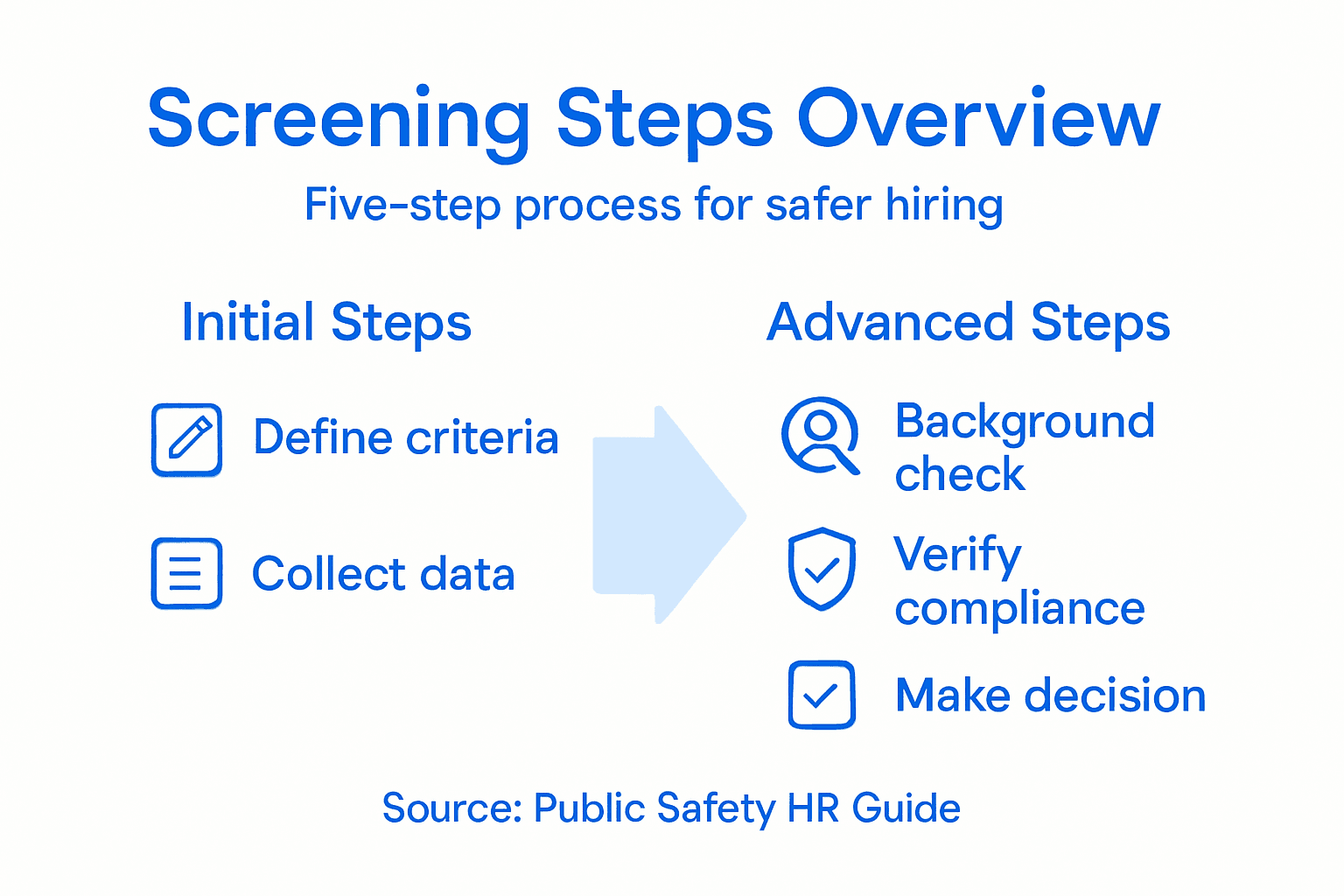
- Step 1: Define Screening Requirements And Criteria
- Step 2: Collect Applicant Data And Authorizations
- Step 3: Conduct Comprehensive Background Investigations
- Step 4: Verify Findings And Ensure Compliance
- Step 5: Make Informed Hiring Decisions And Document Results
Quick Summary
| Key Insight | Explanation |
|---|---|
| 1. Define clear screening criteria | Establish specific qualifications and performance standards to guide candidate evaluations. |
| 2. Collect comprehensive applicant data | Gather detailed personal and professional information following legal and ethical guidelines. |
| 3. Conduct thorough background checks | Validate candidates’ suitability by verifying their criminal, financial, and educational background. |
| 4. Ensure compliance through verification | Confirm that all data and processes meet regulatory requirements to protect agency and candidate rights. |
| 5. Make informed, documented decisions | Use a structured approach to evaluate candidates and maintain transparent records of hiring choices. |
Step 1: Define screening requirements and criteria
Defining screening requirements represents the critical first phase of public safety hiring. This process establishes the foundational criteria that will guide your entire candidate evaluation strategy.
Screening requirements for public safety roles demand a systematic and comprehensive approach. Developing rigorous screening criteria involves creating a shared understanding among the hiring committee about the precise qualifications and performance standards needed. This process includes several key components:
- Job-Specific Qualifications: Identify the exact skills, credentials, and experience required for the role
- Performance Predictors: Determine which qualifications most strongly indicate potential job success
- Minimum Threshold Standards: Establish clear baseline requirements candidates must meet
- Evaluation Methodology: Define how and when each criterion will be assessed during the hiring process
The goal is to create a transparent and objective screening framework that ensures consistent candidate evaluation. By establishing clear inclusion and exclusion criteria, agencies can maintain integrity in their hiring process and focus on identifying the most qualified candidates.
Effective screening reduces bias, increases transparency, and helps eliminate unsuitable candidates early in the recruitment cycle.
Successful screening requires collaboration between human resources, department leadership, and subject matter experts to develop a comprehensive set of requirements that align with organizational needs and public safety standards.
Pro tip: Create a detailed rubric that assigns weighted scores to different screening criteria, allowing for more nuanced and objective candidate assessment.
Step 2: Collect applicant data and authorizations
Collecting comprehensive applicant data represents a critical foundational step in the public safety hiring process. This phase involves systematically gathering essential information to support thorough background investigations and candidate evaluations.
Collecting detailed personal information requires careful navigation of legal and ethical guidelines. For public safety roles, agencies must obtain specific types of documentation and consent that go far beyond standard employment applications. The data collection process typically involves:
- Personal Identification: Full legal name, social security number, contact details
- Residential History: Complete address history for specified timeframes
- Employment Records: Comprehensive work history documentation
- Educational Credentials: Academic transcripts and verification documents
- Military Service: Discharge records and service documentation (if applicable)
- Consent Forms: Signed authorizations for background investigations
The documentation process must be meticulously managed to ensure privacy, legal compliance, and information security. Agencies need to obtain informed consent from candidates, clearly explaining the scope and purpose of data collection.
Proper data collection protects both the agency’s interests and the applicant’s legal rights throughout the screening process.
Specifically for public safety positions, candidates must be prepared to provide extensive documentation, including fingerprints and potentially undergo additional security clearance procedures depending on the specific role and agency requirements.

Pro tip: Develop a standardized checklist of required documents to ensure consistent and comprehensive data collection across all applicant screening processes.
Step 3: Conduct comprehensive background investigations
Conducting comprehensive background investigations forms the critical core of public safety hiring, where agencies thoroughly validate a candidate’s suitability, integrity, and potential risks. This intensive process goes far beyond standard employment screenings.
Comprehensive background investigations demand meticulous attention to multiple verification layers. Investigators will systematically examine various aspects of a candidate’s personal and professional history:
- Criminal Record Checks: Local, state, and federal criminal history searches
- Financial Background: Credit reports and financial stability assessment
- Employment Verification: Detailed review of work history and performance
- Education Credentials: Validation of academic qualifications
- Personal References: In-depth interviews with provided references
- Military Records: Service history and discharge documentation
- Psychological Assessments: Evaluations of mental fitness and stability
Agencies typically allocate significant time and resources to these investigations, recognizing that thorough screening is essential for maintaining public safety and organizational integrity.
Background investigations are not just procedural checkboxes but comprehensive assessments of an individual’s trustworthiness and potential for success in critical public safety roles.
The investigation process often involves multiple stages of review, including potential polygraph examinations, interviews with personal and professional contacts, and cross-referencing information from various sources to ensure complete accuracy.
Pro tip: Develop a standardized, sequential tracking system to monitor the progress of each background investigation and ensure no critical steps are overlooked.
Step 4: Verify findings and ensure compliance
Verifying background investigation findings and ensuring regulatory compliance represent the critical final validation steps in public safety hiring. This phase transforms raw investigative data into actionable hiring decisions with rigorous legal and ethical standards.
Electronic verification systems provide agencies with powerful tools to validate candidate information against official government databases. The verification process involves multiple comprehensive checks:
- Identity Confirmation: Cross-referencing personal identification documents
- Work Authorization: Validating employment eligibility through E-Verify
- Legal Threshold Assessment: Matching candidate data against position-specific requirements
- Regulatory Compliance: Ensuring adherence to federal and state hiring guidelines
- Risk Factor Analysis: Evaluating potential disqualifying background elements
- Documentation Review: Confirming accuracy and completeness of submitted materials
Agencies must meticulously document each verification step, creating a transparent record that demonstrates systematic and objective evaluation of candidate qualifications.
Compliance is not just a procedural requirement but a fundamental protection mechanism for public safety organizations and the communities they serve.
The verification process demands careful attention to legal nuances, ensuring that hiring decisions are made with comprehensive understanding of a candidate’s background, potential risks, and overall suitability for public safety roles.
Pro tip: Develop a standardized compliance checklist that automatically flags potential issues and ensures no critical verification steps are overlooked during the screening process.
Step 5: Make informed hiring decisions and document results
Making informed hiring decisions represents the culmination of your comprehensive public safety screening process. This critical phase transforms extensive investigative data into a strategic selection that balances organizational needs with candidate potential.
Informed hiring decisions require a systematic approach that evaluates candidates holistically, considering multiple dimensions of their background and qualifications. The decision-making process should incorporate several key evaluation components:
- Comprehensive Data Review: Synthesize findings from background investigations
- Collaborative Assessment: Engage multiple stakeholders in candidate evaluation
- Risk Mitigation: Identify potential performance or behavioral concerns
- Objective Scoring: Apply standardized assessment criteria
- Performance Potential: Match candidate capabilities with role requirements
- Cultural Alignment: Consider organizational fit and values
Documentation is paramount in this stage. Agencies must create detailed and transparent records that justify hiring decisions, providing a clear audit trail for future reference.
Rigorous documentation protects both the organization and the candidate, ensuring fairness and accountability throughout the hiring process.
The final decision should balance objective criteria with nuanced understanding of each candidate’s unique professional profile, recognizing that public safety roles demand exceptional judgment and integrity.
Pro tip: Develop a structured decision matrix that assigns weighted scores to key qualification criteria, enabling more consistent and defensible hiring selections.
The following table explains the impact of thorough screening steps on public safety outcomes:
| Screening Step | Risk Reduced | Value for Agency |
|---|---|---|
| Rigorous criteria definition | Unqualified hires | Higher hiring confidence |
| Data collection & authorization | Legal liabilities | Strong applicant trust |
| Background investigations | Insider threats | Safer community outcomes |
| Compliance verification | Regulatory penalties | Audit-ready records |
| Holistic decision-making | Performance issues | Enhanced organizational success |
Here’s a summary of each public safety hiring step and its main goal:
| Step | Main Objective | Key Outcome |
|---|---|---|
| Define screening requirements | Establish clear hiring standards | Consistent candidate evaluation |
| Collect applicant data | Gather essential documentation | Legal compliance ensured |
| Conduct background investigations | Assess integrity and risk factors | Candidate suitability verified |
| Verify findings & ensure compliance | Validate information, meet regulations | Fully documented decision process |
| Make informed hiring decisions | Select best-fit candidate | Defensible, transparent choices |
Strengthen Your Public Safety Hiring with OMNI Intel
The step-by-step screening process for public safety hiring outlined in the article highlights critical challenges such as defining rigorous screening requirements, collecting comprehensive applicant data, conducting thorough background investigations, ensuring compliance, and making informed decisions. These tasks demand accuracy, transparency, and speed to reduce risks and protect community safety. Agencies often struggle with managing complex data, maintaining legal compliance, and eliminating bias while trying to hire the most qualified candidates.
OMNI Intel is designed specifically to meet these exact needs. Our background screening platform offers tailored solutions that streamline each screening step using AI-driven tools. From precise candidate evaluation supported by clear inclusion criteria to continuous monitoring after hire, OMNI Intel helps your agency build trust and uphold integrity throughout the hiring process. By integrating with your current hiring systems and providing detailed documentation for compliance, we reduce costly delays and help you make transparent and defensible hiring decisions with confidence.
Take control of your public safety hiring today and transform your recruitment approach with the proven capabilities of OMNI Intel. Learn more about how our platform supports your efforts at Get Started with OMNI Intel.

Experience faster, more reliable public safety screening. Visit OMNI Intel Get Started now to see how you can enhance your agency’s hiring process while maintaining the highest standards of integrity and compliance.
Frequently Asked Questions
What are the key components of the screening requirements for public safety hiring?
Defining screening requirements involves establishing job-specific qualifications, performance predictors, minimum threshold standards, and an evaluation methodology. Ensure that all members of the hiring committee understand these components to maintain consistency in candidate evaluations.
How can I effectively collect applicant data for public safety roles?
To collect comprehensive applicant data, you should gather full personal identification, residential history, employment records, education credentials, and military service documentation if applicable. Create a standardized checklist of required documents to ensure that all necessary information is collected consistently.
What steps should I take to conduct thorough background investigations?
Conduct thorough background investigations by checking criminal records, validating employment and education credentials, and interviewing personal references. Develop a sequential tracking system to monitor each investigation step and ensure no important details are overlooked.
How do I verify findings and ensure compliance in the hiring process?
Verifying findings involves confirming identity, validating work authorization, and checking for any regulatory compliance issues. Document each verification step meticulously to create a transparent record that supports hiring decisions and protects both the organization and the candidate.
What methods can I use to make informed hiring decisions?
To make informed hiring decisions, synthesize all data from background investigations while applying standardized assessment criteria. Engage multiple stakeholders in evaluating candidates, and develop a structured decision matrix to facilitate fair and defensible choices.
How does thorough screening impact public safety outcomes?
Thorough screening reduces the risk of unqualified hires, legal liabilities, and potential insider threats while enhancing community safety. By implementing rigorous screening procedures, agencies can increase the confidence in their hiring selections and ensure better organizational success.