

Pre-Employment Screening Workflow for Public Safety Agencies
Selecting qualified talent for American public safety roles brings intense scrutiny to the details. Every step in the pre-employment screening process is not only about finding capable candidates but also about meeting strict legal guidelines and safeguarding agency integrity. By focusing on compliance with federal anti-discrimination laws and meticulous verification at each stage, public safety HR teams can confidently maintain high standards while protecting both their organization and the communities they serve.
Table of Contents
- Step 1: Define Screening Criteria And Compliance Needs
- Step 2: Set Up Candidate Data Collection Processes
- Step 3: Conduct Comprehensive Background Investigations
- Step 4: Review And Validate Screening Results
- Step 5: Document Findings And Finalize Candidate Decisions
Quick Summary
| Key Message | Explanation |
|---|---|
| 1. Define key screening criteria | Establish a framework that aligns with legal and organizational standards for pre-employment screening. |
| 2. Implement systematic data collection | Develop secure processes to gather and verify candidate information while ensuring compliance with privacy laws. |
| 3. Conduct thorough background investigations | Utilize comprehensive checks to assess candidates’ history and qualifications to ensure safety and integrity. |
| 4. Validate screening results effectively | Perform a detailed review of documentation to confirm accuracy and compliance with applicable regulations. |
| 5. Document findings and decisions | Maintain a clear and defensible record of screening results to support hiring choices and protect both the agency and candidates. |
Step 1: Define screening criteria and compliance needs
Defining screening criteria and compliance needs forms the critical foundation for building a robust pre-employment screening workflow in public safety agencies. This process requires carefully balancing legal requirements with organizational safety standards.
Agencies must develop comprehensive screening protocols that align with federal anti-discrimination guidelines and job-specific requirements. The employment screening legal framework demands that all screening tools meet three essential criteria:
- Job Relatedness: Screening processes must directly connect to actual job functions
- Business Necessity: Criteria must serve a legitimate organizational purpose
- Non-Discriminatory Application: Procedures cannot disproportionately impact protected groups
Key screening criteria should include:
To clarify the practical impact of key screening criteria, here is a summary of their business benefits for public safety agencies:
| Screening Criterion | Primary Benefit | Organizational Impact |
|---|---|---|
| Criminal background verification | Mitigates safety risks | Protects public trust |
| Certification validation | Ensures job qualifications | Maintains professional standards |
| Employment history confirmation | Reveals past performance | Supports informed hiring |
| Reference checks | Provides character insights | Reduces liability |
| Fitness assessments | Confirms physical ability | Enhances operational readiness |
- Criminal background verification
- Professional certification validation
- Employment history confirmation
- Reference checks
- Physical and psychological fitness assessments
When developing these criteria, agencies must consult official onboarding and screening guidelines to ensure comprehensive and legally compliant evaluations. This approach protects both the organization and potential candidates.
Screening criteria must be transparent, consistent, and fundamentally tied to the specific responsibilities of the public safety role.
Pro tip: Regularly review and update screening criteria to reflect evolving legal standards and organizational needs.

Step 2: Set up candidate data collection processes
Establishing a systematic candidate data collection process is fundamental to creating a comprehensive pre-employment screening workflow for public safety agencies. This step involves developing robust mechanisms to gather, verify, and protect candidate information while maintaining legal compliance and organizational standards.
Agencies must implement structured data collection protocols that prioritize both thoroughness and privacy. Key components of an effective data collection process include:
- Official Document Verification: Collecting and authenticating government-issued identification
- Background Information Gathering: Comprehensive review of professional and personal history
- Reference Check Procedures: Systematic contact and validation of professional references
- Consent and Authorization: Obtaining explicit candidate permission for background investigations
The data collection workflow should be designed to capture critical information while protecting Personally Identifiable Information (PII). Specific steps include:
- Develop standardized data collection forms
- Create secure digital or physical storage systems
- Establish clear protocols for information handling
- Train staff on privacy and confidentiality requirements
- Implement multi-stage verification processes
Additionally, agencies must align their pre-employment screening methods with federal and state equal employment opportunity regulations.
Effective data collection balances comprehensive information gathering with rigorous privacy protections and legal compliance.
Pro tip: Develop a centralized, secure data management system that allows controlled access and maintains strict confidentiality standards for candidate information.

Step 3: Conduct comprehensive background investigations
Conducting comprehensive background investigations represents a critical phase in the pre-employment screening process for public safety agencies. This step requires meticulous attention to detail and a systematic approach to gathering and analyzing candidate information to ensure organizational safety and integrity.
Agencies must implement thorough background investigation protocols that encompass multiple verification dimensions. Key investigation components include:
- Criminal History Check: Nationwide and state-level criminal record searches
- Employment Verification: Comprehensive review of professional history
- Education Credential Validation: Authenticating academic and professional certifications
- Reference Background Checks: Systematic contact with professional and personal references
- Military Service Confirmation: Verifying service records and discharge status
The investigation process requires thorough documentation and adherence to strict confidentiality standards. Specific steps for conducting comprehensive background investigations include:
- Obtain signed candidate authorization
- Request official documentation and records
- Conduct multi-source background checks
- Cross-reference information from different sources
- Document findings systematically
Additionally, agencies should customize investigation protocols to address specific operational requirements and potential risk factors unique to public safety roles.
Background investigations are not just a procedural requirement but a critical safeguard for protecting public safety and organizational integrity.
Pro tip: Develop a standardized scoring matrix to objectively evaluate background investigation findings and ensure consistent, fair assessment across all candidate evaluations.
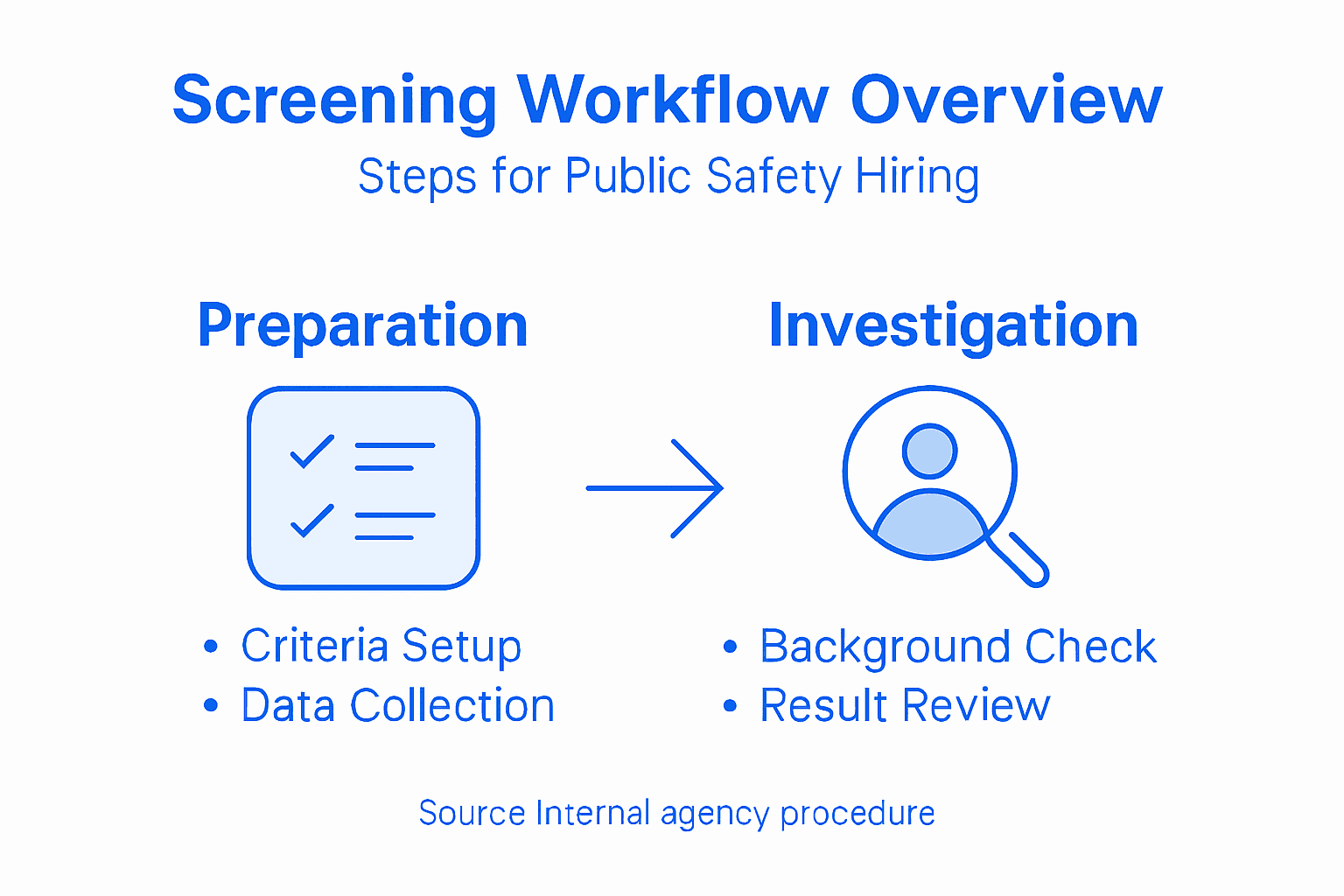
Step 4: Review and validate screening results
Reviewing and validating screening results is a critical checkpoint in the pre-employment screening workflow for public safety agencies. This phase requires a systematic and objective approach to assess candidate information thoroughly and ensure compliance with legal and organizational standards.
Agencies must carefully evaluate screening documentation to maintain the integrity of their hiring process. Key validation components include:
- Accuracy Verification: Cross-checking all collected information
- Consistency Assessment: Identifying potential discrepancies
- Legal Compliance Review: Ensuring non-discriminatory evaluation
- Risk Factor Analysis: Evaluating potential organizational risks
- Contextual Interpretation: Understanding nuanced background details
The validation process involves several critical steps:
To help differentiate data collection and validation phases, here’s a comparison highlighting their core focuses:
| Workflow Phase | Main Objective | Compliance Focus |
|---|---|---|
| Data Collection | Gather candidate details | Privacy, data security |
| Screening Validation | Assess information accuracy | Legal, non-discrimination |
- Compile all screening documents
- Conduct thorough cross-referencing
- Assess information against job-specific requirements
- Identify any potential red flags
- Document review findings systematically
Additionally, agencies must validate screening procedures to ensure they remain fair, job-related, and legally defensible.
Effective screening result validation goes beyond checklist compliance it represents a critical safeguard for organizational integrity and public safety.
Pro tip: Implement a multi-reviewer approach where at least two qualified professionals independently assess screening results to minimize potential bias and improve overall evaluation accuracy.
Step 5: Document findings and finalize candidate decisions
Documenting screening findings and finalizing candidate decisions represents the culmination of the pre-employment screening process for public safety agencies. This critical step transforms comprehensive investigation data into actionable hiring recommendations that balance organizational needs with legal compliance.
Agencies must meticulously document screening investigation results to create a transparent and defensible record. Key documentation components include:
- Comprehensive Investigation Summary: Detailed narrative of background check findings
- Risk Assessment Evaluation: Systematic analysis of potential organizational risks
- Decision Rationale: Clear explanation supporting hiring or rejection
- Supporting Evidence: Authenticated documents and verification records
- Confidentiality Tracking: Secure management of sensitive candidate information
The documentation and decision-making process requires careful execution:
- Compile all screening investigation materials
- Conduct final comprehensive review
- Develop clear decision recommendation
- Validate findings against job requirements
- Secure appropriate organizational approvals
Additionally, candidate decision documentation must adhere to strict legal and organizational standards that protect both the agency and the candidate.
Effective documentation transforms screening data into a strategic hiring tool that balances organizational safety with individual candidate potential.
Pro tip: Create a standardized template for documenting screening findings to ensure consistency, comprehensiveness, and legal defensibility across all candidate evaluations.
Streamline Your Public Safety Hiring with OMNI Intel
Navigating the complexities of pre-employment screening in public safety agencies demands precision, transparency, and strict legal compliance. This article highlights critical challenges such as balancing thorough background checks with privacy protections, maintaining non-discriminatory practices, and validating candidate information to protect both your agency and the community. OMNI Intel understands these pain points and provides a specialized background screening platform designed to meet the unique needs of law enforcement, fire and EMS, and other public safety roles by integrating AI-driven tools for comprehensive investigations and consistent, evidence-based assessments.

Discover how OMNI Intel can help your agency reduce recruitment risks, speed up hiring cycles, and ensure integrity across all screening phases. Benefit from tailored solutions that support compliance with federal guidelines while safeguarding sensitive information. Visit our Hiring Best Practices | OMNI Intel page to learn strategies aligned with your screening workflow and explore the full capabilities of our platform at OMNI Intel. Take control of your hiring process today and protect your agency’s reputation and community safety with confidence.
Frequently Asked Questions
What are the key steps in the pre-employment screening workflow for public safety agencies?
The pre-employment screening workflow includes defining screening criteria, setting up candidate data collection processes, conducting comprehensive background investigations, reviewing and validating screening results, and documenting findings to finalize candidate decisions. To implement it effectively, follow each step systematically to ensure compliance and thorough assessment.
How can I ensure that my screening criteria align with legal requirements?
To ensure compliance with legal requirements, develop screening criteria that meet job relatedness, business necessity, and non-discriminatory application standards. Review your criteria regularly to reflect evolving laws and organizational needs, maintaining transparency and consistency throughout the process.
What should be included in candidate data collection processes?
Candidate data collection processes should include official document verification, background information gathering, reference check procedures, and obtaining consent for background investigations. Standardize your data collection forms to ensure thoroughness and protect candidates’ privacy throughout the process.
What are the essential components of comprehensive background investigations?
Essential components of comprehensive background investigations include criminal history checks, employment verification, education credential validation, reference checks, and military service confirmation. Follow a structured protocol to ensure that you gather accurate and relevant information while maintaining confidentiality.
How do I document findings and justify hiring decisions?
To document findings and justify hiring decisions, compile a comprehensive investigation summary, conduct risk assessments, and clearly explain the rationale for hiring or rejecting a candidate. This thorough documentation not only supports your decision but also ensures compliance with legal standards.
How can I improve the accuracy of screening result validation?
To improve the accuracy of screening result validation, implement a multi-reviewer approach where at least two qualified professionals independently assess the results. This method minimizes bias and increases the reliability of your evaluations, helping you to make informed hiring decisions.