

Role of Background Checks in 2026 – Safeguarding Public Safety
Hiring for public safety roles carries higher stakes with every passing year. As background checks in 2026 demand precise compliance and individualized assessments, HR leaders and compliance officers feel pressure to balance fairness with the safety of their communities. New legal reforms and advanced screening technologies now require more than checking boxes. This article shows how to navigate updated vetting standards, avoid common compliance risks, and strengthen your agency’s hiring process.
Table of Contents
- Defining Modern Background Checks in 2026
- Types of Background Checks for Public Safety Roles
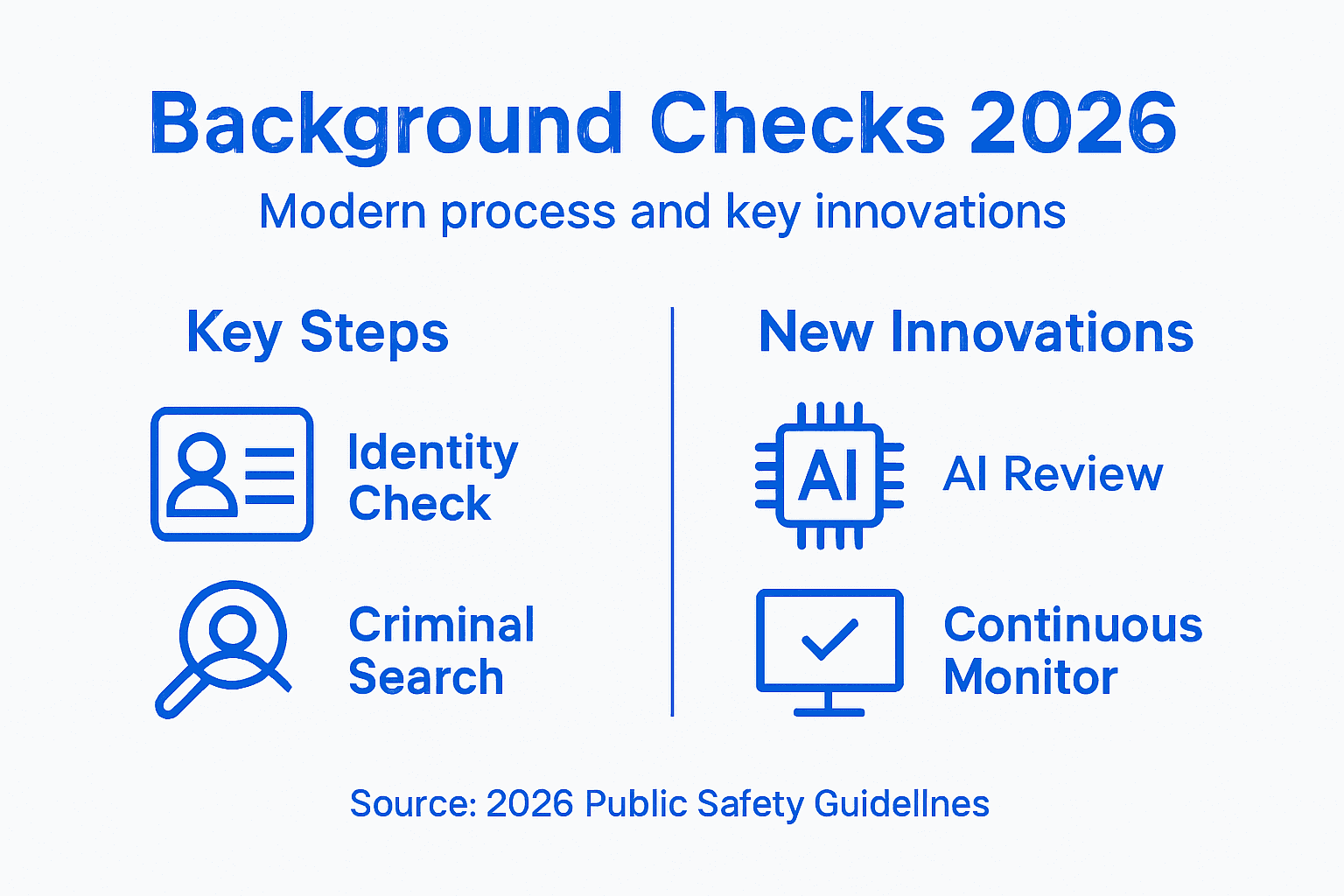
- AI, Automation, and Continuous Monitoring Innovations
- Navigating 2026 Background Check Laws and Reforms
- Compliance Obligations, Risks, and Common Pitfalls
Key Takeaways
| Point | Details |
|---|---|
| Evolution of Background Checks | Modern checks have transitioned to comprehensive evaluations emphasizing fairness and individualized assessment. Agencies must adapt to new regulations and transparency requirements while ensuring thorough evaluations. |
| Diverse Check Types | Multiple background check types—Criminal Records, Fingerprint-Based, Employment Verification, and more—work together to ensure comprehensive candidate assessments in public safety roles. |
| Technology Integration | AI and automation are streamlining data collection and analysis, allowing agencies to focus on nuanced decision-making while enabling continuous monitoring of current employees for emerging risks. |
| Legal Compliance Focus | Navigating evolving laws, such as ban-the-box and adverse action procedures, is critical. Agencies must document compliance efforts thoroughly to mitigate legal risks and ensure fairness in hiring decisions. |
Defining Modern Background Checks in 2026
Modern background checks in 2026 have fundamentally shifted from simple records verification to comprehensive, multi-layered investigations that balance thoroughness with fairness. For public safety agencies, this evolution means understanding that a background check is no longer just about confirming employment history or running a criminal records search. It’s a structured process that accounts for regulations, transparency requirements, and individualized assessment protocols.
Today’s background checks operate within a framework shaped by evolving regulatory requirements that demand more than surface-level compliance. Agencies must navigate ban-the-box laws in numerous jurisdictions, automatic record sealing timelines, and increasingly strict adverse action notification procedures. This creates complexity but also ensures that candidates are evaluated fairly and consistently.
The definition now includes several interconnected components. First, there’s the investigator-driven element that goes beyond database queries. Pre-employment screening for law enforcement positions, for example, involves direct verification with previous employers, court record reviews, and reference checks conducted by trained investigators who understand what matters in your field. Second, modern checks account for FCRA compliance at every step, from disclosure through final adverse action documentation. Third, there’s the requirement for transparency in how findings are interpreted and communicated to candidates.
What sets 2026 apart is the emphasis on individualized assessment over blanket rules. Rather than automatically disqualifying candidates based on offense type or timeframe alone, agencies evaluate criminal history in context. A 15-year-old misdemeanor has different weight than recent activity. Financial history, driving records, and reference quality all feed into a holistic picture of candidate reliability and integrity.
Many agencies are also expanding background checks beyond the hiring phase. Continuous monitoring of current employees, particularly in sensitive positions, has become standard practice to identify emerging issues that could affect public safety or agency reputation.
Pro tip: Document your background check criteria and decision rationale thoroughly for every candidate. This creates an auditable record that demonstrates fairness and helps defend hiring decisions if they’re ever questioned.
Types of Background Checks for Public Safety Roles
Public safety agencies depend on multiple types of background checks working together to create a complete picture of candidate suitability. No single check tells the whole story. Each type serves a distinct purpose, and the combination ensures you’re making informed hiring decisions grounded in verified facts.
Criminal Records Checks form the foundation. These searches pull from local, state, and federal databases to identify arrests, convictions, and pending charges. For law enforcement positions, this includes felony and misdemeanor convictions, but also traffic violations and any involvement with the criminal justice system. The depth varies depending on your agency’s access level and jurisdictional agreements.
Fingerprint-based checks provide another layer of reliability. Fingerprint background checks deliver enhanced accuracy for identity verification in safety-sensitive positions, enabling cross-referencing with national databases that name-based searches alone cannot access. Fingerprints eliminate confusion from similar names and catch records a candidate might otherwise obscure. Many agencies now require fingerprint clearance before any employment offer becomes final.
Employment and Reference Verification involves direct contact with previous employers and references. This isn’t just confirming dates and job titles. Trained investigators ask targeted questions about reliability, integrity, attendance, and any concerns that might affect performance in public safety roles. This direct communication catches issues that written records miss.
Financial History Checks evaluate credit reports and bankruptcy records. For positions involving access to sensitive information, financial management, or community trust, this reveals patterns of fiscal responsibility and vulnerability to corruption. High debt or financial distress doesn’t automatically disqualify candidates but informs overall risk assessment.
Driving Records and Motor Vehicle Checks matter for any role involving vehicle operation. Beyond violations and suspensions, these records demonstrate judgment and safety awareness. A pattern of traffic incidents suggests accountability issues relevant to law enforcement and fire service roles.
Here’s a summary comparing major types of background checks for public safety hiring:
| Type of Check | Main Purpose | Unique Value in Public Safety |
|---|---|---|
| Criminal Records | Finds arrests, convictions, and charges | Reveals potential risks and past offenses |
| Fingerprint-Based | Confirms identity across databases | Reduces errors from common names |
| Employment & References | Validates work history and integrity | Catches undisclosed performance issues |
| Financial History | Reviews credit and bankruptcy records | Assesses risk for corruption or financial stress |
| Driving Records | Examines traffic and licensing history | Shows reliability for vehicle operation roles |
Pro tip: Sequence your background checks strategically. Start with criminal records and fingerprints early to identify dealbreakers quickly, then progress to employment verification and financial checks for candidates who clear initial hurdles. This saves time and money.
AI, Automation, and Continuous Monitoring Innovations
Technology is reshaping how public safety agencies conduct background investigations. Artificial intelligence and automation tools now handle repetitive tasks, allowing your investigators to focus on nuanced decision-making where human judgment matters most. The result is faster turnaround times without sacrificing thoroughness or accuracy.

Automation streamlines data collection and preliminary screening. Systems can pull criminal records, cross-reference multiple databases, and flag inconsistencies in applications instantly. What used to take days now takes hours. Your team receives organized, pre-analyzed information rather than raw data scattered across dozens of sources. This efficiency gain reduces hiring cycle time significantly.
AI-driven analysis identifies patterns that might otherwise go unnoticed. Machine learning algorithms examine employment gaps, financial irregularities, and behavioral markers to calculate risk profiles. These tools don’t replace investigator judgment but inform it. A candidate with a 10-year employment gap paired with recent financial instability might flag differently than someone with identical records appearing in isolation. Context matters, and AI helps surface it.
Continuous monitoring represents the biggest shift for public safety agencies. Rather than conducting background checks only at hire, agencies now monitor current employees post-employment. Automated systems alert you to new arrests, civil actions, or negative incidents involving your personnel. Early detection prevents situations where dangerous individuals remain on payroll after committing crimes or engaging in corruption.
This ongoing surveillance protects community trust and agency reputation. An officer with a decertification index entry or a recent arrest becomes visible immediately instead of remaining undiscovered for months or years. Regular monitoring also catches financial distress, substance abuse indicators, and other risk factors that emerge after initial hiring.
The technology integration creates accountability while reducing manual workload. Your compliance team spends less time on paper chasing and more time on strategic review and policy development.
The following table highlights key AI and automation advantages for background checks in 2026:
| Innovation | Workflow Impact | Agency Benefit |
|---|---|---|
| Automated Data Gathering | Speeds up record collection | Shortens hiring cycle time |
| AI Pattern Analysis | Identifies emerging risk trends | Improves decision accuracy |
| Continuous Monitoring | Updates on new offenses post-hire | Protects community and agency reputation |
Pro tip: Implement continuous monitoring for all sworn positions and civilian employees in sensitive roles. Set alerts for new criminal records, civil judgments, and financial liens to catch emerging risks before they impact operations or public safety.
Navigating 2026 Background Check Laws and Reforms
The legal landscape for background screening has shifted dramatically. Compliance is no longer optional but central to every hiring decision you make. Failing to navigate these regulations correctly exposes your agency to litigation, federal penalties, and reputational damage that extends far beyond a single bad hire.
Ban-the-box laws continue expanding across jurisdictions. These regulations delay criminal history inquiries until later in the hiring process, preventing automatic disqualification based on convictions alone. Some states now require individualized assessment rather than blanket policies. This means you cannot simply exclude all candidates with felony records. You must evaluate context, recency, and job relevance for each person. The burden falls on your agency to document that assessment thoroughly.
Automatic record sealing creates another layer of complexity. Many states now seal certain convictions after specific timeframes. A candidate may legally answer “no” when asked about sealed records. Your investigators must understand which records remain accessible in your jurisdiction and which are legally off-limits. Using sealed records in hiring decisions violates Fair Credit Reporting Act requirements and state law.
Adverse action procedures have tightened significantly. Before rescinding an offer or denying employment based on background findings, you must follow specific notification protocols. Candidates have the right to dispute inaccuracies and respond to concerns. Your agency must provide clear documentation of what disqualified them and why. Rushed or informal adverse action processes create legal exposure.
Employment screening for government employees now demands FCRA compliance at every step, from initial disclosure through final decision communication. Your background screening vendor must follow strict data security protocols and provide proper dispute resolution mechanisms.
Transparency requirements have expanded. Candidates increasingly have the right to know what information you collected and how you used it. Some jurisdictions require written explanations of how conviction history relates to the specific position.
Pro tip: Document your legal compliance framework in writing. Create a detailed policy showing how you apply ban-the-box laws, handle sealed records, and conduct adverse action procedures. Annual legal review ensures you remain compliant as regulations shift.
Compliance Obligations, Risks, and Common Pitfalls
Fair Credit Reporting Act compliance is not a suggestion. It is a legal mandate that shapes every phase of your background screening process. Violations expose your agency to federal enforcement actions, civil litigation, and class-action lawsuits that can cost millions and damage your credibility for years.
Your first obligation involves proper disclosure. Before you run any background check, candidates must receive clear written notice that a report will be obtained and used in hiring decisions. This disclosure must be separate from your application materials and use plain language. Many agencies fail here by burying disclosure language in employment agreements or combining it with other notices. The Federal Trade Commission views this as insufficient.
Timing of adverse action decisions creates significant liability. You cannot rescind a job offer based on background findings without following specific procedures. First, you must provide the candidate with the report or a summary of findings. Second, you must give them time to respond and dispute inaccuracies. Only then can you make a final decision. FCRA-compliant background checks require precise timing and documentation of each step. Premature adverse actions violate federal law regardless of the findings’ accuracy.
Automated decision-making without explainability creates dangerous exposure. If you use algorithms to flag candidates or calculate risk scores, you must be able to explain how those systems work and why they reached specific conclusions. Black-box automation that you cannot articulate invites regulatory scrutiny and class-action claims.
Incomplete disclosure and documentation represent the most common pitfalls. Agencies often skip the separate disclosure requirement or fail to provide candidates with copies of reports before making decisions. Others neglect to document their adverse action procedures or decision rationale. These gaps accumulate into compliance violations.
Data security obligations apply throughout the process. Your vendor must protect candidate information and restrict access to authorized personnel only. Breaches or improper handling create liability that extends beyond hiring.
Pro tip: Create a compliance checklist for every background investigation covering disclosure timing, report delivery, candidate response periods, and final decision documentation. Use this consistently to prevent gaps that trigger liability.
Elevate Your Public Safety Hiring with OMNI Intel
Navigating the complexities of background checks in 2026 means addressing stringent compliance demands while ensuring comprehensive candidate evaluation that reflects individualized assessment and transparency. Public safety agencies face the critical challenge of balancing speed, accuracy, and fairness in every hiring decision to protect their communities and reputations. OMNI Intel understands these needs by offering a tailored background screening platform that integrates AI-driven insights with proven investigative principles designed specifically for law enforcement, fire, EMS, and other safety roles.
Discover powerful solutions that help you:
- Streamline your pre-employment investigations with fingerprint-based verifications and financial and driving record screenings
- Stay compliant with evolving ban-the-box laws and adverse action procedures
- Implement continuous monitoring to detect new risks after hiring
Take the next step toward stronger, evidence-based hiring practices by exploring Hiring Best Practices | OMNI Intel

Ready to safeguard your agency with modern, compliant, and thorough background screening? Visit OMNI Intel Get Started now and transform your public safety hiring process with technology built for your unique challenges.
Frequently Asked Questions
What are modern background checks in 2026?
Modern background checks in 2026 are comprehensive investigations that go beyond traditional record verification, focusing on regulatory compliance, individualized assessments, and transparency in candidate evaluations.
Why are individualized assessments important in background checks?
Individualized assessments allow agencies to evaluate criminal history in context rather than applying blanket disqualifications. This ensures that factors like recency and offense type are considered to make fair hiring decisions.
How has technology impacted background checks for public safety roles?
Technology has streamlined background checks through automation and AI, allowing for faster data collection, pattern analysis, and continuous monitoring of current employees to enhance public safety and reduce risks.
What compliance obligations must agencies uphold during background checks?
Agencies must comply with the Fair Credit Reporting Act (FCRA), which includes proper disclosure to candidates, timely adverse action procedures, and maintaining data security to avoid legal liabilities.
Recommended
- Avoid Hiring Risks: Master Pre-Employment Background Investigations for Public Safety Professionals • OMNI Intel
- Volunteer Background Checks for Fire and Rescue Organizations: Best Practices 2026 • OMNI Intel
- Why Employment Screening for Government Employees Is Crucial Now • OMNI Intel
- Background Investigation Insights | OMNI Intel