
Background Checks: Safeguarding Public Safety Agencies
Every new hire in your agency holds the potential to shape community trust for years. The depth and rigor of background checks in public safety set your department apart from private sector screening, focusing on criminal history, identity confirmation, and character evaluation. By using resources like the FBI’s Criminal Justice Information Services, you ensure that only qualified individuals protect the public. This article outlines the key elements that create a defensible, thorough screening process for your team.
Table of Contents
- Defining Background Checks In Public Safety
- Types Of Screenings For Public Safety Roles
- How Screening Supports Agency Integrity
- Legal Standards And Federal Compliance Requirements
- Risks Of Inadequate Vetting In Agencies
Key Takeaways
| Point | Details |
|---|---|
| Comprehensive Background Checks | Public safety background checks are thorough investigations ensuring candidates have no disqualifying criminal history or character issues. |
| Tiered Screening Approach | Implementing a tiered screening process allows agencies to allocate resources effectively based on the sensitivity of each role. |
| Legal Compliance | Adhering to federal and state legal standards is crucial for conducting valid background checks and maintaining applicant rights. |
| Preventive Risk Management | Thorough vetting helps prevent insider threats and protects agency integrity, reducing long-term financial and reputational risks. |
Defining Background Checks In Public Safety
Background checks in public safety agencies are systematic investigations that verify criminal history, identity, and personal records of individuals before employment. Unlike background checks in private industry, which focus primarily on employment verification and credit history, public safety background checks are more comprehensive and legally rigorous. They serve as a foundational safeguard to ensure that personnel entrusted with community protection have no disqualifying criminal history or character issues that would undermine public trust.
At its core, a background check for public safety roles involves accessing criminal records through authorized law enforcement channels. The FBI’s Criminal Justice Information Services provides the infrastructure that enables agencies like yours to access comprehensive criminal history information, fingerprint identification services, and identity verification systems essential for vetting applicants. When a candidate applies for a police officer position, dispatcher role, or firefighter assignment, your agency can submit fingerprints to these national databases to determine if the person has any arrests, convictions, or pending charges. This process goes beyond a simple name search and creates a permanent record of the investigation, which matters significantly if legal questions arise later about your hiring decision.
The technical process involves multiple verification steps. First, fingerprinting captures biometric data that is submitted to state and federal repositories. Second, investigators access criminal records through authorized databases to confirm identity and review any criminal history. Third, the agency verifies the authenticity of documents provided by the applicant, including driver’s licenses, educational credentials, and employment records. This layered approach prevents individuals from concealing prior conduct or using false identities. You’ll find that the depth of investigation varies based on the sensitivity of the role. A dispatcher position, for instance, requires thorough vetting because dispatchers have access to sensitive information and influence emergency response decisions. A records clerk position still requires background verification but may not need the same level of investigative intensity.
What distinguishes public safety background checks from other employment screening is their investigator-driven nature and compliance with federal regulations like the Fair Credit Reporting Act (FCRA). Your agency must follow specific procedures when collecting and using background information to make hiring decisions. The investigation often includes interviews with prior employers, verification of military service, and review of driving records. Many agencies also conduct additional checks specific to their jurisdiction, such as reviewing local police department records for any prior interactions with the applicant. Understanding the full scope of pre-employment investigations helps your HR team develop screening protocols that are both thorough and legally defensible.
Pro tip: Document every step of your background investigation process, including what databases you accessed, dates of verification, and personnel who conducted the checks, as this creates a clear audit trail that protects your agency if hiring decisions are ever legally challenged.
Types Of Screenings For Public Safety Roles
Not all public safety positions require the same level of background investigation. The screening depth depends on job responsibilities, access to sensitive information, and the risk level associated with the role. A patrol officer who responds to emergency calls has different vetting needs than a records administrator, though both require thorough screening. Your agency needs to understand these distinctions to allocate resources efficiently while maintaining the security standards your community expects.
Basic level screenings cover the foundation that applies to most public safety roles. These include criminal history verification through local and state databases, fingerprint checks against the FBI system, employment history verification, and address history review. For positions like dispatcher, records clerk, or administrative support staff in emergency services, basic screening typically suffices because while these roles support public safety operations, they do not involve direct field response or access to classified tactical information. However, even basic screenings must be thorough. You are verifying that an applicant has no felony convictions, outstanding warrants, or disqualifying misdemeanors. Driving record checks become critical for roles involving vehicle operation, particularly for fire and rescue personnel who operate emergency vehicles. Personal reference interviews with previous employers add another layer, allowing investigators to assess reliability and character beyond what documents reveal.
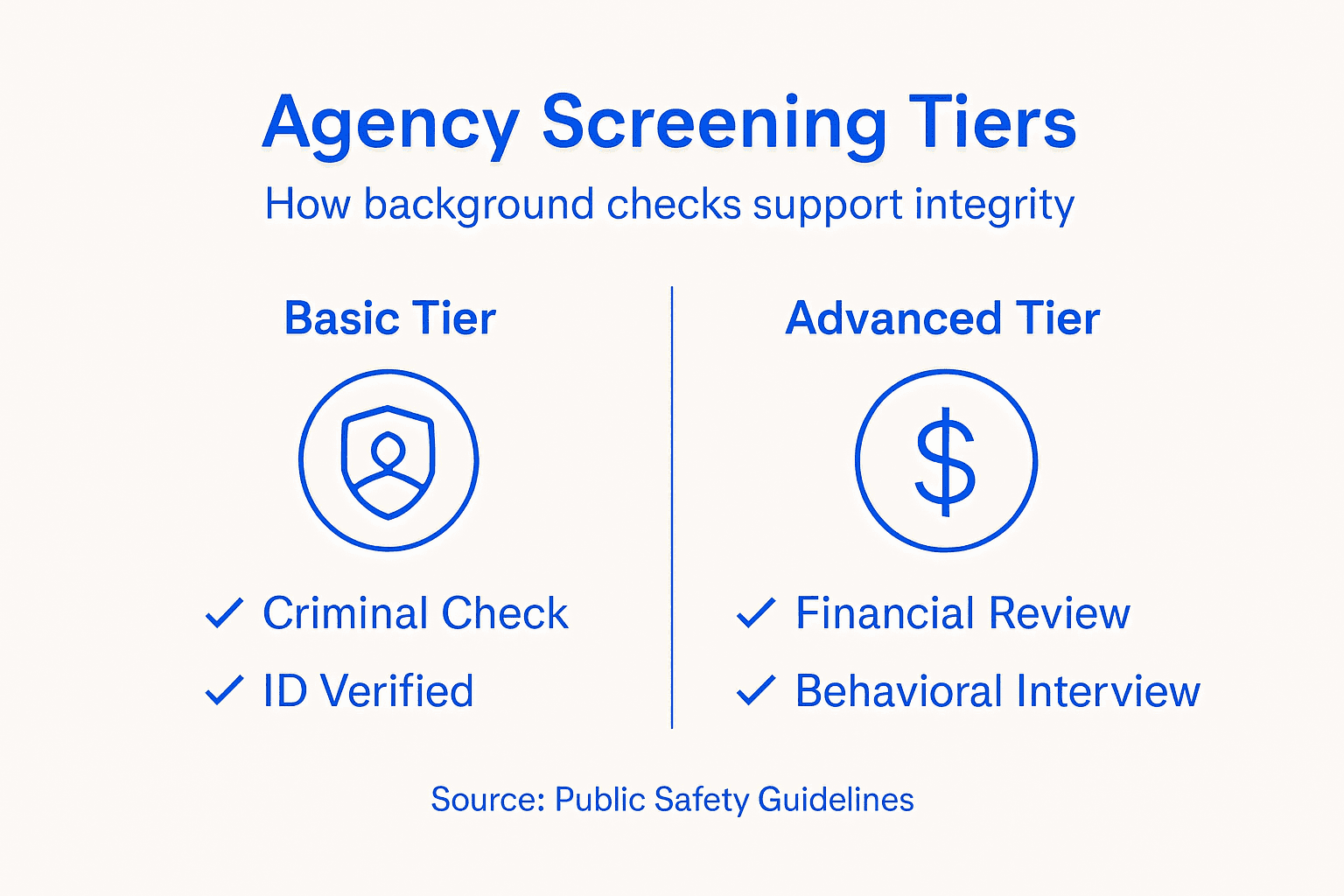
Intermediate and advanced screenings address positions with greater responsibility or access to sensitive data. Law enforcement officers typically undergo intermediate screening, which expands beyond basic checks to include financial history review, substance abuse screening, psychological evaluation, and detailed interviews with personal references. These investigations examine whether candidates have judgment issues that could affect their ability to make critical decisions under pressure. Advanced screenings apply to supervisory roles, specialized units like narcotics or organized crime, and any position involving access to classified information or security clearance requirements. The SF 86 form and its variants (SF 85, SF 85P) are federal forms used when positions require national security clearance or public trust determinations. These investigations go deeper into financial obligations, foreign contacts, and personal relationships to determine suitability for sensitive work. Your agency may not directly handle federal security clearances, but understanding these requirements helps when your personnel transfer to federal positions or work in federal task forces.

The critical distinction lies in how investigation scope matches position risk. A tiered screening approach ensures you do not waste resources over investigating entry level positions while ensuring sensitive roles receive adequate vetting. Consider creating three tiers for your agency: Tier 1 covers administrative and support roles with basic criminal and employment verification. Tier 2 applies to field personnel like officers and firefighters, adding psychological evaluation, financial review, and expanded reference checks. Tier 3 covers command staff, specialized units, and roles with access to sensitive intelligence or technology, requiring the most comprehensive investigation. This structure creates consistency across your hiring process while allowing investigators to focus their most intensive efforts where risk is highest. You should also build in periodic reinvestigation for certain roles. Annual or biennial checks on current employees in sensitive positions catch issues that arise after hiring, such as financial distress leading to corruption risk or criminal charges that did not result in conviction.
Here’s a comparison of background screening tiers for public safety roles:
| Screening Tier | Applicable Roles | Key Checks Included | Investigation Depth |
|---|---|---|---|
| Tier 1 | Admin/support staff | Criminal and employment verification | Basic, efficient review |
| Tier 2 | Officers/firefighters | Psychological, financial, expanded references | Moderate, role-specific vetting |
| Tier 3 | Command/specialized units | Security clearance, classified info, advanced interviews | Extensive, most comprehensive |
Pro tip: Create a written screening matrix for your agency that clearly defines which investigation level applies to each position type, then use it consistently during every hire to ensure standardized vetting and defensible documentation of your hiring decisions.
How Screening Supports Agency Integrity
Agency integrity rests on the quality of people you hire. A single hire gone wrong can damage your agency’s reputation for years. When a police officer commits a crime, when a firefighter betrays public trust, or when a dispatcher’s negligence causes harm, the consequences ripple through your entire organization. Comprehensive background screening acts as your first line of defense, catching individuals with disqualifying histories before they ever put on a uniform. This preventive approach protects not just your community, but your agency’s credibility and operational effectiveness.
Screening prevents the hiring of individuals who pose documented risks to public safety operations. When you verify criminal history through comprehensive criminal justice information, you are not just checking boxes on a form. You are actively excluding people with patterns of dishonesty, violence, substance abuse, or financial instability that could compromise their judgment under pressure. Consider a police officer candidate who has three arrests for DUI but was never convicted because of legal technicalities. A thorough background investigation would reveal those arrests, even without convictions, allowing you to make an informed decision. A dispatcher candidate with a history of anger management issues and domestic disputes might pass a basic criminal check but fail a comprehensive psychological evaluation and reference interview. By screening comprehensively, you avoid hiring people likely to struggle in high-stress roles or engage in misconduct. The cost of prevention through thorough screening is far less than the cost of investigating an officer misconduct case, defending a civil lawsuit, paying settlements, and rebuilding community trust after a public safety personnel failure.
Screening also establishes documented accountability for your hiring decisions. When your agency implements proactive evaluation and risk management strategies, you create an audit trail showing that you made deliberate, evidence-based hiring choices. If an employee later engages in misconduct, you can demonstrate that your background investigation was thorough and followed established procedures. This documentation protects your agency legally and protects individual investigators from accusations of negligence. Your files show what you looked for, what you found, and what decision-making process led to your hiring choice. Beyond legal protection, this documentation signals to your community and your employees that you take hiring seriously. When community members know your agency conducts rigorous background checks, they develop confidence in your personnel. When current employees see that you vetted everyone fairly and thoroughly, they understand that the integrity standards apply to everyone.
Screening supports agency integrity by filtering out individuals whose personal conduct would undermine your credibility. Public safety agencies operate with authority granted by the community based on the assumption that your personnel are trustworthy and law-abiding. When you hire someone with a felony conviction for theft, you signal that integrity is negotiable. When you hire someone with a pattern of financial irresponsibility into a role handling evidence or managing assets, you create vulnerability to corruption. Comprehensive screening includes background checks that go beyond criminal history to evaluate financial stability, substance use, psychological fitness, and character references. These elements collectively paint a picture of whether someone is likely to make sound decisions, follow rules, and represent your agency with integrity. Your screening process becomes your agency’s statement about what values matter and what standards you hold your personnel to. This clarity strengthens agency culture and attracts candidates who share your commitment to integrity. Over time, a reputation for rigorous hiring attracts qualified, trustworthy applicants and filters out those seeking to exploit the position for personal gain.
Pro tip: Build feedback loops into your hiring process by tracking which background investigation findings correlate with later employee performance issues, then use those patterns to refine your screening criteria over time.
Legal Standards And Federal Compliance Requirements
Your background screening process must operate within a framework of federal and state laws that define what you can investigate, how you can investigate it, and how you must use the information you collect. Ignoring legal requirements exposes your agency to liability, invalidates hiring decisions, and violates applicants’ rights. The Fair Credit Reporting Act (FCRA) regulates how you obtain and use background information. State laws often impose additional requirements specific to law enforcement hiring. Federal law creates specific mandates for certain roles, particularly those involving vulnerable populations. Understanding these standards is not optional. They are the foundation upon which legally defensible hiring decisions rest.
Federal law establishes minimum standards that apply across all public safety agencies. Fingerprint-based criminal history background checks) are mandatory for employees working with children under 18 in federally operated or contracted facilities, with checks required through both FBI and state repositories. These checks specifically bar individuals with convictions for sex crimes, child victim offenses, or certain drug felonies. If your agency operates youth programs, manages juvenile detention facilities, or contracts with federal agencies for services involving minors, you must comply with these standards. The FCRA requires that before you take adverse employment action based on background information, you must provide the applicant with a copy of the report and an opportunity to dispute inaccuracies. You cannot simply reject someone based on a background check without following these procedural requirements. Many HR directors make the mistake of assuming a criminal record automatically disqualifies someone, but federal law requires individualized consideration. You must assess whether the conviction is directly related to the job duties, how long ago it occurred, and whether rehabilitation is evident. This individualized assessment protects applicants’ rights while still allowing you to exclude genuinely unsuitable candidates.
State standards and professional guidelines shape the specifics of how your agency conducts investigations. The Commission on POST’s Background Investigation Manual provides comprehensive guidance compliant with state and federal law, outlining protocols for fingerprint submission, criminal records checks, and adjudication. These manuals establish the investigator-driven approach that distinguishes public safety background checks from generic employment screening. They define what sources you should access, how you should verify information, and what findings require deeper investigation. Following these established protocols protects your agency because you are demonstrating that you followed industry standards. If a hiring decision is later challenged, you can show that you followed POST guidelines or comparable standards in your state. Many states have specific laws about what you can and cannot consider. Some states prohibit considering arrests that did not result in conviction for most positions. Others allow consideration of arrests but require you to evaluate them separately from convictions. You must know your state’s specific rules. Working with an investigator experienced in your state’s requirements ensures compliance.
Compliance also requires proper data handling and recordkeeping. Background information is sensitive and must be stored securely with limited access. FCRA compliance includes maintaining records of what you gathered, from whom, and how you used it in your hiring decision. If an applicant later claims discrimination, you need documentation showing what information was reviewed and what objective criteria led to your decision. Proper recordkeeping also protects your agency if an employee later engages in misconduct. If investigators can show they conducted a thorough, documented background investigation that revealed no disqualifying factors at the time of hire, that documentation becomes critical in defending the agency. Additionally, many states require periodic training for investigators to maintain compliance with evolving standards. Background investigation standards change as courts issue rulings, legislatures pass new laws, and agencies update guidance. Your investigators need access to updated training to stay current. Failure to maintain compliance creates exposure not just for your hiring decisions but for your agency’s operations overall.
Building compliance into your process means establishing written policies that define what investigation levels apply to different positions, what sources you will access, how you will communicate with applicants, and how you will document decisions. Your policies should specify timelines for completing investigations, procedures for handling disputes, and protocols for periodic reinvestigation of sensitive positions. These policies demonstrate to applicants, to your leadership, and to courts if necessary that your agency takes legal compliance seriously. The investment in understanding and implementing legal standards pays dividends in defensible hiring decisions and reduced liability risk.
Pro tip: Have your background investigation procedures reviewed annually by legal counsel experienced in employment law and your state’s public safety hiring standards to ensure you remain compliant as laws and regulations evolve.
Risks Of Inadequate Vetting In Agencies
Inadequate vetting does not save money or time. It creates both. When you skip thorough background investigation, you are not streamlining your hiring process. You are gambling with your agency’s future. The consequences of hiring someone with a disqualifying background manifest across years, not weeks. You may never connect a misconduct incident directly back to a hiring decision made years earlier, but the damage accumulates. Your agency loses credibility with the community. Your employees lose faith in your integrity standards. Your operational effectiveness suffers. The financial and reputational costs dwarf whatever time you thought you saved by cutting corners on vetting.
Inside threats represent one of the most dangerous risks of inadequate vetting. An officer with a history of substance abuse who was never screened thoroughly can develop an addiction while employed, stealing evidence or failing to properly secure crime scenes. A dispatcher with undisclosed mental health crises or anger management issues can make critical mistakes that cost lives during emergency response. A records clerk with financial desperation can sell confidential information to criminals. Inadequate vetting creates vulnerabilities that allow untrustworthy individuals to compromise agency security, public safety operations, and sensitive information. These insider threats are particularly dangerous because the person has legitimate access to systems and information. Unlike an external attacker who must breach your defenses, an insider threat simply uses access they already have. By the time the misconduct is discovered, significant damage may have occurred. Proper vetting catches warning signs before hire. A thorough background investigation reveals financial instability, substance abuse history, dishonesty, or character issues that predict future misconduct. You cannot eliminate all risk, but you can significantly reduce it through comprehensive investigation.
Loss of public trust and institutional credibility follows high-profile hiring failures. When a police officer commits a serious crime, when a firefighter betrays the community, or when leadership fails to explain how such a person was hired, community members question whether the entire agency shares those flaws. This perception spreads rapidly. Recruitment becomes harder because qualified candidates do not want to work for an agency with compromised reputation. Current employees become defensive and demoralized. Budget requests get questioned because legislators and community members doubt your judgment. Civil litigation follows misconduct cases, creating legal expenses that drain resources. Your insurance premiums increase. Your legal liability exposure grows. These cascading effects persist for years after a single hiring failure. Conversely, when your community knows your agency conducts rigorous vetting, that knowledge generates trust. People want to work for you. Community members cooperate with your personnel because they have confidence in their integrity. This trust multiplies your operational effectiveness in ways that extend far beyond hiring decisions. The investment in thorough vetting pays returns through improved community relations and recruitment quality.
The financial liability from inadequate vetting extends beyond individual misconduct cases. Failure to conduct comprehensive vetting risks allowing individuals with questionable backgrounds to serve in important positions, leading to compromised agency integrity and potential legal liability. When an employee hired without proper vetting commits misconduct, your agency may face liability not just for the misconduct itself but for negligent hiring. A plaintiff’s attorney can argue that your background investigation was inadequate, that you should have discovered the warning signs, and that your failure to investigate properly enabled the harm. This negligent hiring liability can attach to your municipality or county, creating budget exposure that affects taxpayers and agency operations. Additionally, civil rights violations can result when improperly vetted personnel abuse authority or discriminate against community members. These lawsuits are expensive to defend and can result in significant settlements or judgments.
Operational inefficiency also results from inadequate vetting. When you hire people who are not truly suited for the role, they struggle to perform effectively. High turnover follows, creating gaps in staffing and forcing you to conduct recruiting and training cycles repeatedly. This constant churn becomes more expensive than investing in thorough vetting upfront. Poor hiring decisions also affect team dynamics. When your team includes individuals who lack integrity or fitness for the role, it creates friction, lowers morale, and undermines the cohesion necessary for effective emergency response. Experienced officers become frustrated training or supervising people who should never have been hired. The institutional knowledge you need to preserve walks out the door when good people become discouraged by working alongside people with poor character or judgment.
Below is a summary of how inadequate vetting affects agencies:
| Risk Area | Example Impact | Long-Term Consequence |
|---|---|---|
| Insider Threats | Evidence theft, information leaks | Erodes internal security |
| Public Trust | Community distrust after scandals | Difficult recruitment and retention |
| Financial Liability | Legal settlements, lawsuits | Increased insurance costs |
| Operational Efficiency | High turnover, low morale | Resource draining, lost experience |
Pro tip: Implement a metrics tracking system that monitors which applicants were rejected for specific background investigation findings and which of those individuals later encounter legal troubles or misconduct in other agencies, then use that data to validate and refine your vetting criteria.
Strengthen Your Agency’s Integrity with Tailored Background Screening Solutions
Public safety agencies face the critical challenge of conducting thorough, legally compliant background checks that safeguard community trust while efficiently vetting candidates for diverse roles. This article highlights the risks of inadequate vetting and the importance of a tiered and investigator-driven screening approach that covers everything from criminal history to psychological evaluation. Agencies must balance comprehensive investigations with maintaining transparency and protecting applicant rights under laws like the FCRA. If your goal is to reduce hiring-related risks and build a transparent, defensible hiring process that aligns with these standards, adopting a specialized screening platform is essential.
OMNI Intel offers a background screening platform designed specifically for public safety agencies. With AI-driven tools and a focus on integrity and accuracy, OMNI Intel helps you conduct comprehensive pre-employment investigations tailored to each role’s risk level. Our solution integrates seamlessly with your hiring workflows and supports continuous employee monitoring to protect your agency from insider threats and reputational damage.

Discover how adopting proven Hiring Best Practices can streamline your hiring without sacrificing compliance or quality. Take control of your agency’s integrity by partnering with OMNI Intel. Start building a safer, more reliable workforce today at https://omniintel.co/get-started.
Frequently Asked Questions
What is the purpose of background checks in public safety agencies?
Background checks in public safety agencies are intended to verify an individual’s criminal history, identity, and personal records to ensure that personnel entrusted with community protection do not have disqualifying criminal backgrounds or character issues.
How do public safety background checks differ from those in private industry?
Public safety background checks are more comprehensive and legally rigorous than those in private industry, focusing not only on employment verification and credit history but also on accessing criminal records through authorized law enforcement channels.
What types of screenings are conducted for different public safety roles?
Screenings vary by role. Basic screenings often include criminal history verification and fingerprint checks, while intermediate screenings may add psychological evaluations and financial reviews. Advanced screenings are reserved for high-responsibility roles requiring security clearance and detailed investigations.
What are the legal standards that agencies must comply with during background checks?
Agencies must follow federal and state laws, such as the Fair Credit Reporting Act (FCRA), which establishes how background information can be obtained and used. They must also comply with specific requirements for roles involving vulnerable populations, ensuring that investigations are thorough and individualized.
Recommended
- Avoid Hiring Risks: Master Pre-Employment Background Investigations for Public Safety Professionals • OMNI Intel
- Why Employment Screening for Government Employees Is Crucial Now • OMNI Intel
- Background Investigation Insights | OMNI Intel
- OMNI Intel | Public Safety Background Investigations, Recruiting & Employee Monitoring
- AB 1512’s Impact on Anaheim Security Officers | Serendib Law Firm
- Social Media Forensics: Methods, Challenges and How It Can Help Civil and Criminal Litigants