

Public Safety Vetting Process: Ensuring Trustworthy Hires
Every hiring decision in American public safety sparks careful consideration about workforce reliability and security. With every new applicant, agencies must balance thorough screening with legal compliance to protect public trust and uphold national security standards. This article clarifies the public safety vetting process, explains how distinct screening methods respond to varying risk levels, and highlights key pitfalls so you can develop a comprehensive, compliant vetting strategy for your agency.
Table of Contents
- Defining The Public Safety Vetting Process
- Distinct Screening Types For Public Safety Roles
- Core Steps In Effective Candidate Screening
- Legal Requirements And Data Privacy Standards
- Risks, Costs, And Common Screening Pitfalls
Key Takeaways
| Point | Details |
|---|---|
| Public Safety Vetting Process | The vetting process involves background investigation, character assessment, and ongoing monitoring to ensure workforce integrity and security in public trust roles. |
| Screening Types | Screening methodologies are tailored to position sensitivity, ranging from basic checks for low-risk roles to complex investigations for high-risk positions. |
| Candidate Screening Steps | The screening process includes initial application review, comprehensive background checks, risk assessments, and final eligibility determination to validate trustworthiness. |
| Legal Compliance | Agencies must navigate legal frameworks that protect candidate privacy while ensuring rigorous compliance and thorough investigations in the vetting process. |
Defining the Public Safety Vetting Process
The public safety vetting process represents a sophisticated, multi-layered screening methodology designed to evaluate an individual’s suitability for roles with significant public trust responsibilities. Personnel vetting investigates potential risks to ensure agencies maintain the highest standards of workforce integrity and security.
At its core, the vetting process involves three critical stages:
- Background Investigation: Comprehensive review of personal, professional, and legal history
- Character Assessment: Evaluating moral reliability, ethical standards, and potential behavioral risks
- Ongoing Monitoring: Continuous evaluation of an individual’s trustworthiness throughout their employment
The process follows strict federal guidelines established by frameworks like the Trusted Workforce 2.0 initiative, which emphasizes thorough screening for national and public safety positions. Agencies conduct deep investigative work to prevent individuals with criminal histories, dishonest conduct, or potential security risks from accessing sensitive roles.
Key Components of Vetting:
- Criminal record examination
- Employment history verification
- Educational credential validation
- Reference checks
- Psychological fitness assessments
The goal of public safety vetting is not just elimination, but identifying candidates who demonstrate exceptional integrity and commitment to public service.
Pro tip: Develop a standardized, comprehensive vetting protocol that balances thorough investigation with fair, consistent evaluation of candidate qualifications.
Distinct Screening Types for Public Safety Roles
Public safety agencies employ multiple screening types tailored to position sensitivity to ensure comprehensive risk assessment and workforce integrity. These screening methodologies range from basic background checks to complex security clearance investigations, each designed to match the specific risk profile of different public safety roles.
Screening Levels by Risk Classification:
- Low-Risk Screening: Entry-level positions with minimal sensitive access
- Moderate-Risk Screening: Public trust positions requiring deeper investigation
- High-Risk Screening: Roles involving classified information or critical infrastructure
The federal government categorizes screening processes based on several critical factors:
Here’s how background investigation types compare for public safety roles:
| Investigation Type | Depth of Review | Typical Use Case |
|---|---|---|
| Basic Screening | Surface-level records | Low-risk, entry-level roles |
| Moderate Investigation | Enhanced verification | Public trust, mid-level roles |
| Advanced Security Check | In-depth, multi-source | High-risk, national security |
- Position sensitivity
- Access requirements
- Potential security risks
- Depth of background investigation needed
- Ongoing monitoring requirements
Key Characteristics of Screening Types:
- Background investigations
- Criminal history checks
- Personal interviews
- Reference verifications
- Psychological assessments
- Continuous eligibility monitoring
Public safety screening is not a one-time event, but a dynamic process that evolves with an individual’s professional trajectory.
Pro tip: Develop a comprehensive, tiered screening framework that allows flexibility while maintaining consistent standards across different public safety roles.

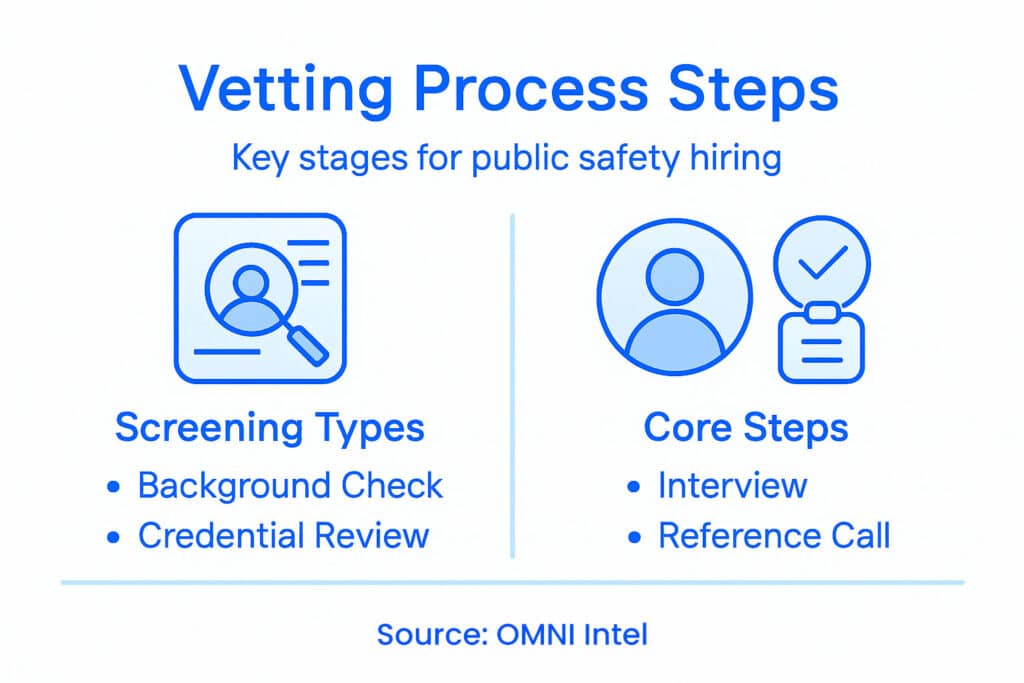
Core Steps in Effective Candidate Screening
Effective candidate screening represents a strategic, multi-stage process designed to thoroughly validate candidate suitability and trustworthiness. Public safety agencies must implement comprehensive background investigations that go beyond surface-level checks to ensure the integrity of their workforce.
Core Screening Phases:
- Initial Application Review: Preliminary document screening
- Background Investigation: Comprehensive historical verification
- Risk Assessment: Detailed evaluation of potential vulnerabilities
- Adjudication: Final determination of candidate eligibility
The screening process typically follows a structured sequence of critical steps:
- Conditional job offer issuance
- Candidate consent and information release
- Comprehensive background investigation
- Multiple database cross-referencing
- Personal and professional reference checks
- Psychological and fitness assessments
- Final eligibility determination
Key Information Verification Elements:
- Criminal record checks
- Employment history validation
- Educational credential confirmation
- Professional license verification
- Character reference evaluations
- Financial background screening
Effective candidate screening is not about disqualification, but about identifying individuals who demonstrate exceptional integrity and commitment to public service.
Pro tip: Develop a consistent, standardized screening protocol that balances thoroughness with fairness, ensuring each candidate receives an equitable and comprehensive evaluation.
Legal Requirements and Data Privacy Standards
Public safety agencies must navigate complex legal landscapes, carefully balancing national security needs with individual privacy protections through rigorous legal compliance frameworks. The vetting process requires meticulous adherence to federal statutes that safeguard candidate information while ensuring comprehensive background investigations.
Key Legal Protection Mechanisms:
- Privacy Act regulations
- Fair Credit Reporting Act guidelines
- Civil rights safeguarding protocols
- Data confidentiality standards
- Limited information disclosure rules
The legal framework governing public safety vetting encompasses multiple critical dimensions:
- Information collection limitations
- Candidate consent requirements
- Non-discriminatory screening practices
- Secure data management protocols
- Transparency in investigation processes
Essential Privacy Compliance Elements:
- Restricted data access
- Mandatory information protection
- Candidate rights documentation
- Clear consent mechanisms
- Confidential record maintenance
- Controlled information sharing
Legal compliance is not just a regulatory requirement, but a fundamental commitment to protecting individual rights while maintaining public safety integrity.
Pro tip: Develop comprehensive documentation and training protocols that ensure every team member understands the intricate legal boundaries of personnel vetting.
Risks, Costs, and Common Screening Pitfalls
Public safety agencies face significant challenges in background screening, with complex risks undermining comprehensive vetting processes. These risks range from potential insider threats to systemic vulnerabilities that can compromise organizational integrity and public safety.
Primary Screening Risks:
- Undetected falsified credentials
- Incomplete background investigations
- Insufficient continuous monitoring
- Outdated information sources
- Human error in verification processes
The financial and operational implications of screening failures can be substantial:
Key legal and operational consequences of vetting failures are outlined below:
| Consequence | Potential Impact | Prevention Strategy |
|---|---|---|
| Legal liability | Lawsuits, penalties | Follow regulations, thorough audits |
| Reputation damage | Loss of public trust | Transparent reporting, strong ethics |
| Security breaches | Compromised information | Continuous monitoring, secure data |
- Extended investigation timelines
- Redundant screening procedures
- Potential legal liability
- Reputation damage
- Compromised organizational security
Common Screening Vulnerabilities:
- Inconsistent investigation standards
- Lack of comprehensive data verification
- Delayed adjudication processes
- Inadequate information updates
- Limited cross-referencing capabilities
Effective screening is not about eliminating candidates, but about creating a robust, dynamic system that protects both organizational and individual interests.
Pro tip: Implement a standardized, technology-driven screening framework that enables real-time information validation and continuous candidate assessment.
Strengthen Your Public Safety Hiring with Proven Vetting Solutions
The challenges of implementing a rigorous public safety vetting process demand a platform that ensures thorough background investigations, continuous monitoring, and strict compliance with legal standards. If your agency faces difficulties in verifying employment history, assessing candidate integrity, or managing ongoing risk, OMNI Intel provides tailored screening options designed specifically for roles entrusted with public safety. Our technology-driven approach helps prevent costly screening pitfalls and supports fair, consistent evaluations aligned with your agency’s trust and security requirements.

Explore how to elevate your recruitment with Hiring Best Practices | OMNI Intel and unlock faster, more accurate candidate screening. Act now to build a workforce defined by integrity and reliability. Visit OMNI Intel to discover solutions crafted to safeguard your agency and community.
Frequently Asked Questions
What is the public safety vetting process?
The public safety vetting process is a multi-layered screening methodology designed to evaluate an individual’s suitability for roles involving significant public trust. It includes background investigations, character assessments, and ongoing monitoring to ensure workforce integrity and security.
What are the key components of a public safety vetting process?
The key components include criminal record examinations, employment history verification, educational credential validation, reference checks, and psychological fitness assessments.
How does the screening type vary based on role sensitivity?
Screening types can range from low-risk screenings for entry-level positions to high-risk screenings for roles involving classified information. Each type differs in the depth of investigation required based on position sensitivity and potential security risks.
What are the common risks associated with the public safety vetting process?
Common risks include undetected falsified credentials, incomplete background checks, insufficient continuous monitoring, and human errors in verification processes, all of which can compromise the integrity of the vetting process.