
Public Safety Screening Explained: Ensuring Integrity
Hiring for public safety roles means every decision carries weight for your agency’s reputation and your community’s wellbeing. Standard background checks are no longer enough as threats and responsibilities grow more complex. By embracing a multi-layered public safety screening process, you gain tools to verify integrity, reduce risk, and protect institutional trust. This guide highlights how thorough, role-specific screening strategies transform candidate evaluation to meet the unique demands of law enforcement and emergency response in the United States.
Table of Contents
- Defining Public Safety Screening and Its Role
- Types of Public Safety Screening Methods
- Screening Process: Steps and Key Components
- Legal Compliance and Data Privacy Standards
- Managing Risks and Common Screening Pitfalls
Key Takeaways
| Point | Details |
|---|---|
| Comprehensive Screening Process | Public safety screening involves multiple methods to assess candidates’ integrity, including background checks, psychological evaluations, and financial history reviews. |
| Importance of Consistency | Consistent application of vetting standards across all candidates is crucial to avoid liability and ensure fair treatment. |
| Legal Compliance | Strict adherence to laws such as the Fair Credit Reporting Act and CJIS Security Policy is necessary to protect sensitive candidate information and the agency. |
| Post-Hire Monitoring | Continuous monitoring of employees is vital to identify potential issues that may arise after hiring, ensuring ongoing community safety. |
Defining Public Safety Screening and Its Role
Public safety screening is the systematic process of evaluating individuals before they enter positions of trust within law enforcement, fire, emergency medical services, dispatch centers, and related agencies. It goes far beyond a simple background check. The goal is to identify risks, verify qualifications, and confirm that candidates possess the integrity required to serve and protect communities.
This process serves multiple critical functions.
- Protects communities by preventing individuals with disqualifying histories from obtaining public safety positions
- Builds public trust by demonstrating rigorous vetting standards
- Reduces agency liability and reputational damage from hiring mistakes
- Ensures candidates meet physical, psychological, and ethical standards
- Verifies employment history, educational credentials, and professional licenses
The scope of public safety screening reflects a broader understanding of what safety means. Government safety obligations extend beyond immediate threats to encompass community stability, institutional trust, and the removal of individuals who pose ongoing risks. When you hire someone into a public safety role, you’re making a decision that affects thousands of people.
Public safety agencies face distinct challenges that standard commercial screening cannot address. Your officers respond to domestic violence calls, mental health crises, and situations where poor judgment costs lives. A comprehensive screening process identifies red flags that might indicate problem behavior or ethical concerns before someone receives a badge and authority.
The screening process typically includes several interconnected elements:
- Criminal history verification through local, state, and federal databases
- Employment and educational background verification
- Financial history review to identify debt or fraud concerns
- Psychological and medical evaluations
- Interview and reference checks with previous employers
- Driving record and traffic violation analysis
- Social media and digital presence review
- Polygraph examination where applicable
Effective screening identifies not just what candidates have done, but who they are when nobody is watching.
Your role as an HR manager requires understanding how these elements work together. A vetting process designed specifically for public safety takes into account the unique demands of law enforcement and emergency response roles. The screening must be thorough enough to catch disqualifying issues, yet fair enough to evaluate qualified candidates objectively.
The integrity component matters most. Public safety screening confirms that candidates have demonstrated honesty, reliability, and ethical judgment throughout their background. A single incident of dishonesty during the hiring process can disqualify an otherwise qualified applicant because deception itself is a disqualifying trait in law enforcement.
Screening is also forward-looking. Agencies increasingly use continuous monitoring to track employees post-hire, identifying behavioral changes or legal issues that emerge after hiring. This extends the protective function of screening throughout an officer’s career.
Pro tip: Start screening conversations by clearly defining what disqualifying factors your agency uses, then ensure every investigator applies consistent standards across all candidates to defend your decisions if challenged.
Types of Public Safety Screening Methods
Public safety screening relies on multiple interconnected methods, each designed to evaluate different aspects of candidate suitability. No single screening technique tells the complete story. Your job is to understand how these methods work together to create a comprehensive picture of who someone really is.
The most common screening methods include:
- Criminal background checks through federal, state, and local databases
- Credit and financial history review
- Employment verification and reference checks
- Medical and psychological evaluations
- Driving record analysis
- Drug screening and toxicology tests
- Polygraph examinations
- Interview assessments and behavioral observation
Criminal background checks form the foundation of most public safety screening. These checks access records from the Federal Bureau of Investigation, state crime databases, and local law enforcement agencies. You’re looking for arrests, convictions, and pending charges that might disqualify a candidate or raise red flags about judgment or ethics.
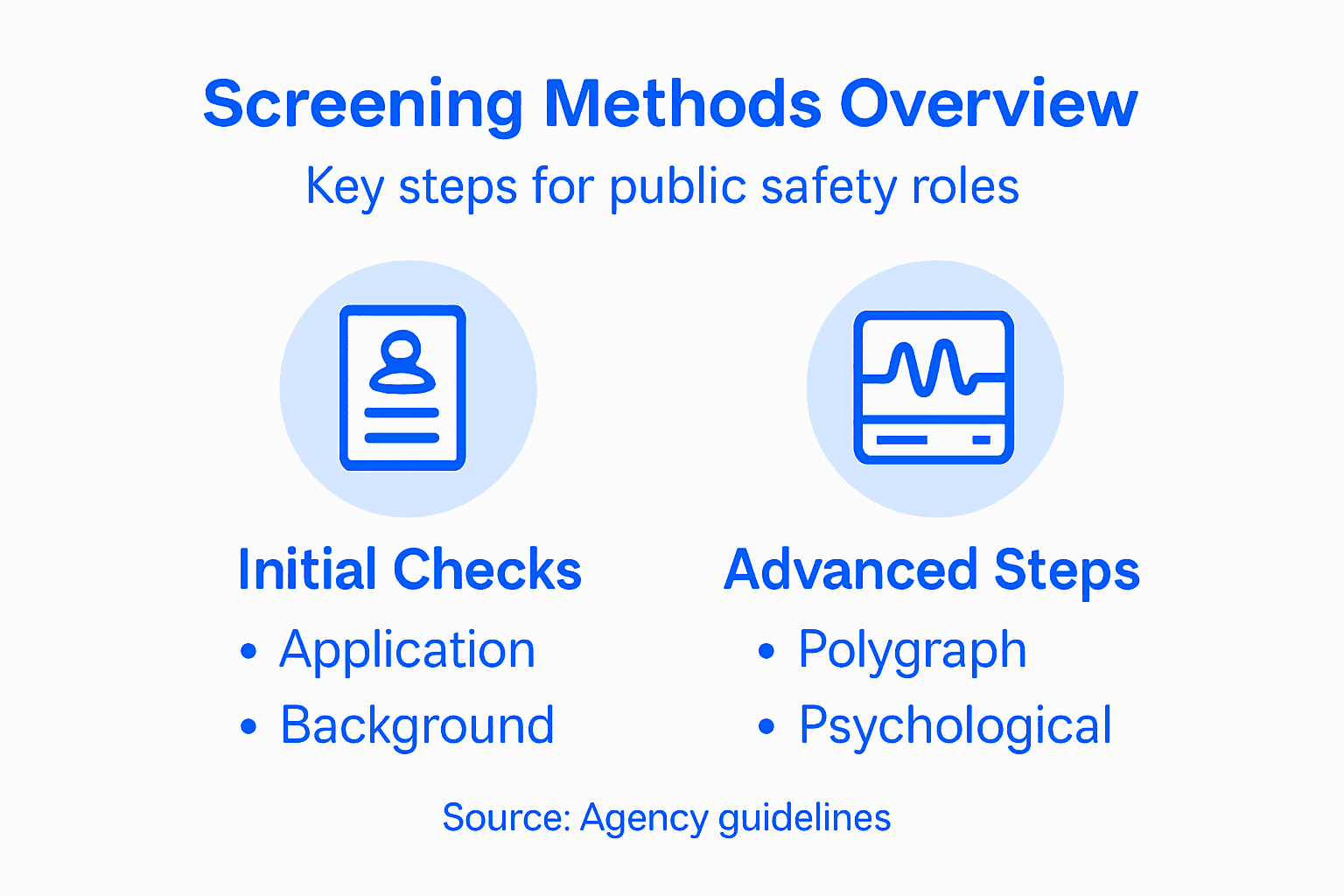
Psychological screening goes deeper than what background databases reveal. Many agencies require candidates to complete standardized psychological evaluations that assess personality traits, decision-making patterns, stress responses, and emotional stability. Psychological assessment tools help identify individuals who may struggle with the demands of law enforcement or who pose risks to themselves or others.
Financial history screening examines credit reports and debt patterns. Candidates with significant financial distress may be vulnerable to corruption or bribery. A bankruptcy or missed payments don’t automatically disqualify someone, but they signal the need for deeper investigation into circumstances and decision-making.
Driving record checks reveal patterns of judgment and rule compliance. Officers who consistently violate traffic laws may struggle to follow department policies or demonstrate poor judgment in high-stress situations. Your state’s Department of Motor Vehicles provides detailed records of violations, suspensions, and accidents.
The strongest screening combines multiple data sources because no single method reveals everything.
Behavioral screening during interviews requires trained investigators who can observe how candidates respond to difficult questions. Do they deflect blame? Show honesty about mistakes? Demonstrate self-awareness? Pre-employment screening specifically designed for public safety roles incorporates behavioral assessment alongside document verification.
Drug screening through urinalysis or hair testing identifies substance abuse. Many agencies conduct initial screening and random testing throughout employment. This protects officer safety, maintains public trust, and identifies individuals who might struggle with addiction.
Polygraph examinations, where used, provide another data point but should never be the sole basis for rejection. These tests measure physiological responses to questions about honesty, drug use, criminal history, and integrity. Results require expert interpretation and should always be combined with other screening findings.
The key is using layered screening that cross-references findings. A candidate with clean criminal history but serious financial problems, or strong references but concerning psychological results, requires investigator judgment to determine overall suitability.
Pro tip: Create a standardized scoring matrix that weights your screening methods by importance for each role, then apply it consistently so every candidate goes through the same evaluation criteria.
The following table compares different public safety screening methods by their main focus and examples of issues they can reveal:
| Screening Method | Primary Focus | Issues Commonly Identified |
|---|---|---|
| Criminal Background Check | Legal and ethical history | Felonies, pending charges, dishonesty |
| Psychological Evaluation | Emotional stability | Poor stress tolerance, impulsivity |
| Financial History Review | Financial responsibility | Large debt, potential for bribery |
| Medical Examination | Physical job readiness | Vision problems, heart conditions |
| Interview & Reference Check | Character and reliability | Poor work ethic, conflicts |
| Driving Record Analysis | Rule compliance | Repeated violations, suspensions |
| Drug Screening | Substance misuse | Recent drug/alcohol abuse |
| Polygraph Examination | Truthfulness on key topics | Deception about history or intent |
Screening Process: Steps and Key Components
Public safety screening follows a structured workflow designed to gather comprehensive information about candidates in a logical sequence. Each step builds on the previous one, moving from initial application review through final hiring recommendations. The process typically spans weeks or months, depending on your agency’s resources and complexity.
The screening workflow generally follows this sequence:
- Application review and initial eligibility check
- Criminal background investigation
- Employment and educational verification
- Financial history and credit review
- Medical examination
- Psychological evaluation
- Interview and reference checks
- Polygraph examination (if applicable)
- Final investigative summary and recommendation
Your first step is initial application screening. Verify that candidates meet minimum requirements: age, citizenship status, valid driver’s license, and educational credentials. Reject applications that lack required documents immediately rather than investing resources in unsuitable candidates.

Criminal history investigation comes next. Request records from the Federal Bureau of Investigation, your state’s crime information center, and local law enforcement agencies where the candidate has lived.
Employment verification confirms work history accuracy. Contact previous employers directly to verify dates of employment, job titles, and reasons for separation. Many candidates exaggerate their experience or omit problematic terminations. Reference checks with supervisors reveal work performance, reliability, and interpersonal skills that matter in public safety roles.
Financial and credit screening examines debt, payment history, and fraud indicators. Pull credit reports with candidate consent and review for bankruptcies, collections, or excessive debt relative to income. These findings suggest vulnerability to corruption or poor judgment.
The strongest screening process moves methodically through verification and investigation phases rather than rushing to judgment.
Medical evaluation assesses physical fitness for the role. Require candidates to pass vision, hearing, and general health screenings. Some agencies conduct fitness tests to confirm candidates can meet job demands.
Psychological evaluation identifies candidates who may struggle with stress, emotional regulation, or decision-making. Clinical psychologists experienced in law enforcement assess personality, judgment, and psychological fitness. This step prevents hiring individuals likely to harm themselves or others under pressure.
Interview and reference phases allow direct assessment of candidate character. Trained investigators should ask behavioral questions about past decisions, handling conflict, and ethical choices. Reference checks with previous supervisors provide outside perspective on reliability and judgment.
Polygraph examination, when used, measures physiological responses to questions about dishonesty, drug use, and criminal activity. Results require expert interpretation and should never stand alone as a disqualifying factor.
Final investigative summary synthesizes all findings into a clear recommendation. Investigators document strengths, concerns, and final suitability determination for hiring officials.
Pro tip: Establish clear decision points at each screening phase where unsuitable candidates are rejected, preventing wasted investigation time and allowing resources to focus on viable candidates.
Legal Compliance and Data Privacy Standards
Public safety screening handles some of the most sensitive information available: criminal histories, financial records, medical data, and personal background details. Federal law, state statutes, and agency policies strictly govern how you collect, store, and use this information. Non-compliance exposes your agency to lawsuits, regulatory penalties, and loss of public trust.
Multiple legal frameworks apply to screening operations.
- The Fair Credit Reporting Act (FCRA) regulates background checks and consumer reports
- The Criminal Justice Information Services (CJIS) Security Policy governs access to federal crime data
- State public records laws define what information is accessible and how it can be used
- Americans with Disabilities Act (ADA) restricts medical inquiry timing and use
- Privacy laws protect candidate personal information from unauthorized disclosure
The Fair Credit Reporting Act requires that you obtain written candidate consent before ordering background reports. You must provide candidates with a copy of any report you rely on for adverse decisions. If you reject someone based on background information, you must notify them and provide the reporting agency contact information so they can dispute inaccuracies.
Federal CJIS security standards mandate strict controls on criminal justice data. Only authorized personnel with legitimate law enforcement purposes can access fingerprint records, arrest histories, or conviction data. Your agency must implement role-based access controls, audit trails, and encryption to protect this information from unauthorized access or breaches.
Data security requires multiple layers of protection. Store background investigation files in locked cabinets or encrypted digital systems. Limit access to investigators and hiring officials with direct need-to-know. Establish retention schedules so you destroy records after appropriate periods rather than warehousing candidate information indefinitely.
Legal compliance isn’t bureaucratic overhead. It protects your candidates, your agency, and your community.
Criminal justice information is particularly sensitive. Your agency must verify every person accessing federal crime data has proper authorization. Background investigators need documented training on CJIS requirements. Unauthorized access, even accidental, triggers federal reporting obligations and potential penalties.
Medical and psychological information receives special protection under health privacy laws. These records must be kept separate from general personnel files. Only medical professionals and essential hiring staff should access psychological evaluation results. Never include detailed medical information in hiring decisions unless directly job-related.
Candidate notification matters legally and ethically. Inform candidates before collecting financial information. Explain why you’re conducting drug screens or polygraph examinations. Provide notice before checking driving records or social media. Transparency reduces legal disputes and demonstrates professional screening practices.
Regular audits of your screening procedures ensure ongoing compliance. Review file security, verify access controls work properly, and confirm investigators follow required procedures. Document compliance efforts to defend your agency if issues emerge.
Pro tip: Consult your legal counsel before implementing any new screening method or accessing new data sources to confirm compliance with FCRA, CJIS, state law, and local regulations specific to your jurisdiction.
Here is a reference table outlining common legal standards impacting public safety screening:
| Legal Framework | Area Covered | Key Requirement |
|---|---|---|
| FCRA | Background/credit checks | Written consent, candidate notice |
| CJIS Policy | Criminal data access | Authorized staff, audit controls |
| ADA | Medical/psychological inquiries | Timing and job-related limitations |
| State Records Law | Access to candidate data | Disclosure and use standards |
| Privacy Laws | Personal information handling | Encryption, access limitations |
Managing Risks and Common Screening Pitfalls
Even well-intentioned screening programs fail when agencies overlook common pitfalls or underestimate emerging risks. Most mistakes stem from inconsistent application of standards, inadequate investigator training, or rushing the process. Understanding these pitfalls helps you build safeguards into your screening workflow.
Common screening pitfalls include:
- Inconsistent standards applied across different candidates
- Investigators making judgments without documented evidence
- Over-relying on single data sources instead of cross-referencing
- Failing to follow up on concerning information
- Rushing evaluations due to staffing constraints or hiring pressure
- Inadequate investigator training on legal requirements
- Poor documentation making decisions difficult to defend
- Ignoring red flags because candidates test well in interviews
Inconsistency is perhaps the biggest risk. When different investigators apply different standards to similar situations, you create liability exposure and unfair treatment. One investigator might reject a candidate for minor credit issues while another hires someone with identical financial problems. Document your disqualifying criteria and require all investigators to apply the same standards.
Over-confidence in single screening methods creates blind spots. A candidate with perfect references might have serious integrity issues you would have caught through polygraph examination. Proactive hazard identification helps prevent overlooking emerging risks that develop as screening progresses. Never rely on interviews alone or background checks alone. Layer your methods.
Rushing investigations introduces errors. Thorough screening takes time. Reference checks require multiple follow-up attempts. Court records need verification. Psychological evaluations demand careful interpretation. When you accelerate the process to fill positions quickly, you miss red flags that proper investigation would reveal.
Inadequate investigator training compounds these problems. Your investigators need to understand Fair Credit Reporting Act requirements, psychological evaluation interpretation, and proper interview techniques. They need to recognize when they lack expertise and consult specialists.
The weakest screening programs fail not from bad intentions but from skipping hard steps under time pressure.
Poor documentation creates defense problems. If you reject a candidate, you must be able to explain your decision with documented evidence. Vague notes like “seemed dishonest” or “didn’t feel right” won’t survive legal challenge. Record specific facts, observations, and disqualifying information clearly.
Ignoring concerning patterns in early screening stages costs money and time later. A candidate who provides inconsistent employment dates or evasive answers during interviews raises red flags. Address these concerns immediately rather than hoping later investigation will clarify them.
Failing to conduct post-hire monitoring misses risks that emerge after hiring. Officers sometimes develop substance abuse problems, financial crises, or legal issues after joining your agency. Post-hire screening identifies behavioral changes that protect your agency and community.
Bias in screening leads to inconsistent and defensible decisions. Investigators must base decisions on documented facts, not gut feelings or demographic assumptions. Train investigators to recognize and address their own biases.
Pro tip: Audit a sample of hiring decisions monthly to verify investigators applied standards consistently and documented their reasoning with specific evidence rather than subjective impressions.
Strengthen Your Agency’s Integrity with Expert Public Safety Screening
Ensuring integrity and reliability in public safety roles requires a screening process that goes beyond basic background checks. This article highlights challenges such as inconsistent standards, the need for layered screening methods, and legal compliance complexities that public safety agencies face. If your goal is to eliminate hiring risks, protect community trust, and identify qualified candidates with verified integrity, you need a solution tailored to these demands.

Discover how OMNI Intel can transform your hiring process with AI-driven tools designed specifically for public safety screening. Our platform combines comprehensive background investigations, continuous post-hire monitoring, and strict compliance with data privacy standards. Ready to implement consistent, evidence-based hiring practices that safeguard your agency’s reputation and enhance community safety? Get started today by exploring Hiring Best Practices | OMNI Intel and take the next step at OMNI Intel Get Started. Your agency deserves screening solutions built for the unique needs of law enforcement, EMS, fire, and other public safety roles.
Frequently Asked Questions
What is public safety screening?
Public safety screening is a comprehensive process used to evaluate individuals for positions within law enforcement, fire services, and emergency medical services. It aims to verify qualifications, identify risks, and ensure that candidates possess the integrity necessary to serve and protect the community.
What are the main components of the public safety screening process?
The main components include criminal history verification, employment and educational background checks, financial history review, psychological and medical evaluations, driving record analysis, social media review, and, where applicable, polygraph examinations.
Why is psychological evaluation important in public safety screening?
Psychological evaluation is crucial as it assesses candidates’ emotional stability, decision-making abilities, and stress responses. This helps ensure that individuals can handle the demands of public safety roles and do not pose risks to themselves or others.
How can agencies ensure compliance with legal standards during screening?
Agencies can ensure compliance by following legal frameworks like the Fair Credit Reporting Act (FCRA) and the Criminal Justice Information Services (CJIS) Policy. It’s essential to obtain written consent from candidates, limit data access, and document procedures to protect candidates’ rights and maintain transparency.
Recommended
- Transparency in Screening: Building Trust in Public Safety
- Public Safety Vetting Process: Ensuring Trustworthy Hires
- 7 Key Benefits of Employee Screening for Public Safety
- Background Checks: Safeguarding Public Safety Agencies
- 10 Common Public Defender Interview Questions Asked During Public Defender Interviews – Naro Law
- 7 Essential Courtroom Technology Examples for Trial Success