
What Is Pre-Employment Screening for Public Safety
Selecting the wrong candidate for a public safety role can have far-reaching consequences for both communities and agencies. In a field where trust and reliability are non-negotiable, pre-employment screening functions as a crucial safeguard, identifying not just obvious risks, but subtle red flags that traditional hiring often misses. Understanding the full scope of screening methods empowers human resources leaders to protect organizational integrity while building teams capable of meeting the highest professional standards.
Table of Contents
- Defining Pre-Employment Screening in Public Safety
- Types of Screening for Critical Agency Roles
- Key Steps in the Background Check Process
- Legal and Regulatory Compliance Standards
- Mitigating Risks and Common Screening Challenges
Key Takeaways
| Point | Details |
|---|---|
| Comprehensive Screening is Essential | Pre-employment screening helps identify risks and ensures only qualified candidates are selected for public safety roles. |
| Multi-faceted Evaluation Methods | The screening process involves various assessments, including background checks, psychological evaluations, and drug screenings. |
| Legal Compliance is Crucial | Adhering to legal and regulatory standards is necessary to protect both candidate rights and organizational integrity. |
| Continuous Improvement Needed | Agencies should regularly refine their screening processes to adapt to emerging challenges and ensure effective risk management. |
Defining Pre-Employment Screening in Public Safety
Pre-employment screening in public safety represents a comprehensive risk management strategy designed to thoroughly evaluate potential candidates before they join critical community service roles. This systematic process goes far beyond traditional hiring practices by implementing multiple layers of assessment to ensure only the most qualified and reliable individuals enter high-stakes professions.
The screening process involves multiple critical components aimed at identifying potential risks and assessing candidate suitability. Complex candidate evaluation methods help agencies make informed hiring decisions by examining various dimensions of an applicant’s background, character, and capabilities.
Key aspects of pre-employment screening typically include:
- Comprehensive background investigations
- Criminal history checks
- Medical fitness assessments
- Psychological evaluations
- Drug and substance abuse screenings
- Physical fitness testing
- Personal and professional reference verifications
- Integrity and character assessments
The primary objectives of these screenings are multifaceted. Public safety screening processes aim to:
- Identify potential risks before hiring
- Ensure candidate physical and psychological fitness
- Protect organizational integrity
- Maintain high professional standards
- Minimize potential liability for agencies
Pre-employment screening represents more than a bureaucratic checkpoint – it is a critical safeguard ensuring that individuals entering public safety roles possess the necessary attributes to serve their communities effectively and responsibly. By implementing rigorous evaluation protocols, agencies can significantly reduce hiring risks and promote professional excellence.
Pro Tip: Develop a standardized, comprehensive screening framework that balances thorough investigation with candidate respect and fairness.
Types of Screening for Critical Agency Roles
Pre-employment screening for public safety roles encompasses a diverse range of evaluation techniques designed to thoroughly assess candidates’ suitability for high-stakes positions. These comprehensive screening methods go beyond traditional hiring practices, implementing specialized assessments that protect agency integrity and public trust.
Law enforcement screening protocols typically involve multiple comprehensive evaluation methods to ensure candidates meet rigorous professional standards. These screening types include:
- Criminal background investigations
- Psychological fitness evaluations
- Physical health assessments
- Drug and substance abuse screenings
- Financial history reviews
- Personal integrity polygraph examinations
- Social media and digital footprint analysis
- Professional reference verifications
Federal agencies have developed specialized screening tools tailored to specific public safety roles. Law Enforcement Pre-Employment Tests represent sophisticated screening processes that evaluate not just basic qualifications, but deeper aspects of candidate integrity and psychological suitability.

The most advanced screening approaches integrate multiple assessment methods to create a holistic candidate profile. These comprehensive evaluations help agencies identify potential risks, assess moral character, and ensure that selected candidates possess the psychological resilience and ethical standards required in high-pressure public safety environments.
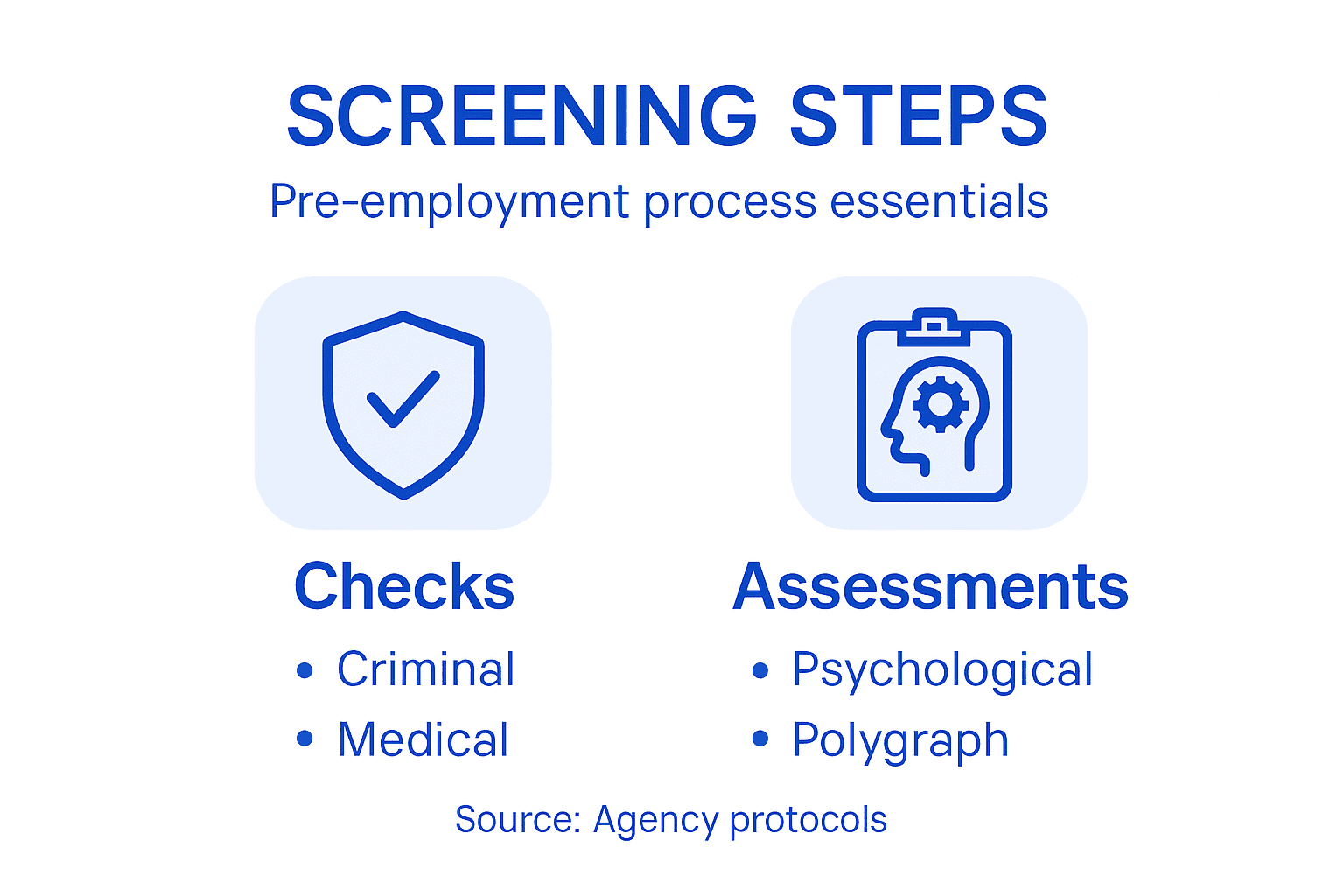
Here’s a summary of the benefits and challenges associated with advanced public safety candidate screening:
| Area Assessed | Key Benefit | Common Challenge | Mitigation Strategy |
|---|---|---|---|
| Psychological Suitability | Ensures resilience under pressure | Test bias and subjectivity | Use standardized, validated tests |
| Criminal Background | Detects prior legal issues | Incomplete record checks | Cross-check multiple databases |
| Financial Responsibility | Screens for risk factors like debt | Limited access to financial data | Require written disclosures |
| Digital Footprint | Identifies online behavioral risks | Privacy concerns | Limit reviews to public content |
Pro Tip: Develop a multi-dimensional screening strategy that combines objective assessments with nuanced evaluation of candidate character and potential.
Key Steps in the Background Check Process
The background check process for public safety professionals represents a critical, systematic approach to thoroughly vetting candidates before they enter sensitive roles. Comprehensive background investigation protocols involve multiple interdependent stages designed to create a holistic assessment of candidate qualifications and potential risks.
The key steps in a comprehensive background check typically include:
- Identity verification
- Social Security number validation
- Government-issued identification confirmation
- Address history cross-referencing
- Criminal history investigation
- Federal and state criminal record searches
- Felony and misdemeanor background checks
- National criminal database screening
- Sex offender registry verification
- Professional background assessment
- Employment history verification
- Professional license and credential authentication
- Reference contact and validation
- Academic degree confirmation
- Personal integrity evaluation
- Credit history review
- Financial responsibility assessment
- Substance abuse screening
- Psychological fitness examination
Federal and state agencies implement rigorous multi-stage screening processes that go beyond traditional background checks. Each stage is meticulously designed to uncover potential issues that might compromise public safety, ensuring only the most qualified and trustworthy candidates progress through the hiring pipeline.
The complexity of background investigations requires specialized skills and comprehensive information-gathering techniques. Investigators must balance thorough examination with respect for candidate privacy, utilizing validated assessment methods that provide meaningful insights into an individual’s professional capabilities and personal integrity.
Pro Tip: Develop standardized, repeatable background check protocols that maintain consistent evaluation standards across all candidate assessments.
Legal and Regulatory Compliance Standards
Legal compliance forms the critical foundation of pre-employment screening processes in public safety agencies, establishing clear boundaries and protections for both employers and candidates. Constitutional employment screening standards require agencies to balance thorough investigations with fundamental rights of individual privacy and equal protection.
Key legal and regulatory compliance standards include:
- Constitutional protections
- Fourth Amendment privacy rights
- Equal protection under the law
- Protection against discriminatory practices
- Federal regulatory requirements
- Fair Credit Reporting Act (FCRA) compliance
- Equal Employment Opportunity Commission guidelines
- Americans with Disabilities Act provisions
- Employee Polygraph Protection Act regulations
- Professional evaluation standards
- Licensed professional assessment protocols
- Validated psychological screening instruments
- Ethical guidelines for background investigations
- Scientifically defensible evaluation methods
Professional psychological evaluations must adhere to stringent standards. Psychological evaluation regulatory requirements mandate that assessments be conducted by licensed doctoral-level psychologists with specialized training in public safety personnel selection.
Agencies must navigate a complex legal landscape that requires meticulous attention to detail. Compliance involves not just following regulations, but understanding the underlying principles of fair employment practices, candidate rights, and organizational risk management.
The following table outlines major legal and regulatory frameworks agencies must consider for compliant screening:
| Law/Regulation | Primary Focus | Impact on Screening |
|---|---|---|
| Fair Credit Reporting Act (FCRA) | Candidate privacy and accuracy | Requires consent and data protection |
| Equal Employment Opportunity (EEOC) | Non-discrimination | Prohibits bias based on protected traits |
| Americans with Disabilities Act | Disability rights | Limits medical inquiry scope |
| Employee Polygraph Protection Act | Polygraph usage restrictions | Restricts mandatory polygraph exams |
Pro Tip: Regularly audit your screening processes to ensure ongoing compliance with evolving legal and regulatory standards.

Mitigating Risks and Common Screening Challenges
Pre-employment screening in public safety demands a sophisticated approach to risk management that goes beyond traditional hiring practices. Psychological screening strategies require agencies to develop comprehensive methods that identify potential risks while maintaining ethical standards and legal compliance.
Common screening challenges include:
- Psychological assessment limitations
- Subjective interpretation of test results
- Potential bias in evaluation methods
- Limited predictive accuracy of single assessment tools
- Complex candidate psychological profiles
- Legal and ethical constraints
- Protecting candidate privacy rights
- Avoiding discriminatory screening practices
- Maintaining confidentiality of sensitive information
- Balancing thorough investigation with individual dignity
- Technical screening obstacles
- Incomplete or inaccurate background information
- Variations in record-keeping across jurisdictions
- Challenges in verifying complex employment histories
- Detecting intentional information concealment
Agencies can mitigate these risks by implementing comprehensive polygraph screening that integrates multiple evaluation methods. This approach requires sophisticated data interpretation, combining psychological assessments, background investigations, and professional judgment to create a holistic candidate profile.
Successful risk mitigation demands a multifaceted approach that recognizes the complexity of human behavior and organizational needs. Public safety agencies must continuously refine their screening processes, balancing rigorous evaluation with fairness, respect, and a commitment to selecting the most qualified candidates.
Pro Tip: Develop a dynamic screening framework that combines multiple assessment tools and regularly updates evaluation protocols to address emerging challenges.
Strengthen Your Public Safety Hiring with Comprehensive Pre-Employment Screening
Pre-employment screening in public safety is critical to reducing risks and ensuring only the most qualified, trustworthy candidates join your team. Challenges like identifying psychological fitness, verifying criminal and financial history, and maintaining strict legal compliance require a thorough and multi-dimensional approach. OMNI Intel specializes in addressing these exact challenges by providing tailored background screening solutions designed specifically for law enforcement, fire and EMS, and other public safety agencies. Our platform leverages AI-driven tools and law enforcement investigation principles to deliver accurate, reliable, and fair assessments that protect your agency’s integrity and the community’s safety.

Discover proven Hiring Best Practices that integrate seamlessly with OMNI Intel’s advanced screening technology. Take control of your recruitment cycle today by ensuring every candidate undergoes a transparent and comprehensive pre-employment evaluation. Start your journey to smarter, safer hiring now at Get Started with OMNI Intel and experience firsthand how our platform minimizes liability, accelerates hiring, and upholds essential compliance standards.
Frequently Asked Questions
What is pre-employment screening in public safety?
Pre-employment screening in public safety is a comprehensive risk management strategy that evaluates potential candidates to ensure they are qualified and reliable for critical community service roles. It involves multiple layers of assessment beyond traditional hiring practices.
What are the key components of pre-employment screening for public safety roles?
Key components typically include background investigations, criminal history checks, medical fitness assessments, psychological evaluations, drug screenings, physical fitness testing, reference verifications, and integrity assessments.
Why is pre-employment screening important for public safety agencies?
Pre-employment screening is essential for identifying potential risks, ensuring candidates’ physical and psychological fitness, protecting organizational integrity, maintaining professional standards, and minimizing potential liability for agencies.
What challenges do agencies face during the screening process?
Agencies may encounter challenges such as incomplete background information, subjective interpretation of psychological assessments, legal and ethical constraints, and difficulties in verifying complex employment histories.
Recommended
- Avoid Hiring Risks: Master Pre-Employment Background Investigations for Public Safety Professionals • OMNI Intel
- Background Investigation Insights | OMNI Intel
- Why Employment Screening for Government Employees Is Crucial Now • OMNI Intel
- Struggling with Post Employment Background Verification? Here’s the Fix • OMNI Intel