
Enhance Public Safety Recruitment with Technology
Public safety agencies face unprecedented recruitment challenges, with lengthy hiring timelines causing qualified candidates to drop off before completing the process. Traditional methods take months to screen applicants and conduct background investigations, creating bottlenecks that leave critical positions unfilled. Technology is revolutionizing this landscape by streamlining workflows, accelerating timelines, and improving candidate quality through AI-driven tools and digital platforms. This guide explores how recruitment technology transforms public safety hiring in 2026, delivering measurable improvements in efficiency, candidate experience, and organizational outcomes.
Table of Contents
- How Technology Streamlines Recruitment In Public Safety
- The Role Of AI In Screening And Assessment
- Digitizing Background Investigations To Improve Hiring Quality And Speed
- Balancing Innovation With Fairness And Legal Compliance
- Explore OMNI Intel’s Solutions For Public Safety Recruitment
- FAQ
Key takeaways
| Point | Details |
|---|---|
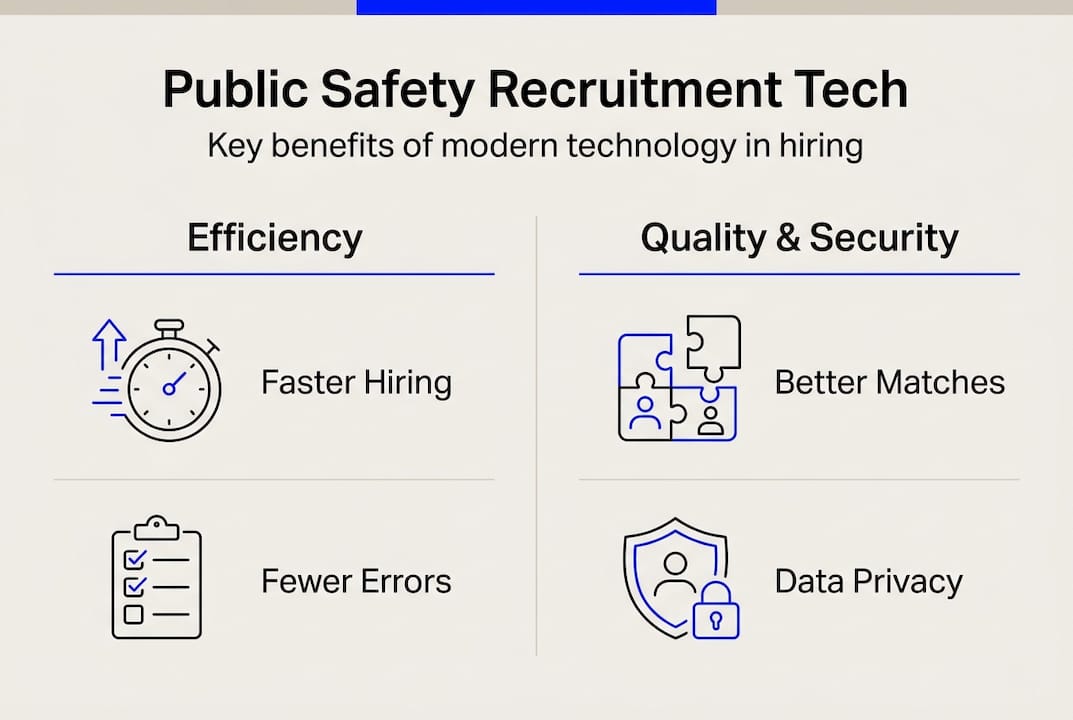
| Technology reduces hire time dramatically | Digital tools cut recruitment cycles from months to weeks, enabling agencies to fill critical positions faster. |
| AI improves candidate screening quality | Automated assessment tools increase interview pass rates by 20 percentage points while saving 23 hours per hire. |
| Digital background checks accelerate investigations | Modern platforms reduce investigation timelines from 6 months to 6 weeks, increasing annual hires by over 50%. |
| Human oversight remains essential | Bias mitigation strategies and transparent processes ensure fairness while leveraging technology’s efficiency gains. |
How technology streamlines recruitment in public safety
Modern recruitment technology addresses the core challenges facing public safety agencies: candidate drop-off, limited reach, and administrative burden. Applicant tracking systems centralize candidate data, automate follow-up communications, and ensure no qualified applicant falls through the cracks during lengthy hiring processes. These platforms integrate with job boards and social media to expand reach beyond traditional channels.
AI-powered chatbots engage candidates 24/7, answering questions about requirements, timelines, and next steps. This constant availability reduces frustration and keeps applicants engaged during the weeks or months between application and interview. Mobile-first platforms allow candidates to apply, upload documents, and complete assessments from smartphones, removing barriers that previously excluded qualified individuals.
The Cleveland Police Department exemplified these benefits by implementing technology-driven recruitment strategies, achieving a 356% increase in police cadet applications. This dramatic improvement stemmed from enhanced digital presence, streamlined application processes, and automated candidate engagement that maintained interest throughout the hiring cycle.
Key technological improvements include:
- Centralized applicant tracking eliminating manual spreadsheet management
- Automated email and text campaigns keeping candidates informed
- Mobile-optimized application processes accessible anytime, anywhere
- Integration with public safety recruitment best practices frameworks
- Real-time analytics tracking conversion rates at each hiring stage
Pro Tip: Integrate communication automation that sends personalized updates at key milestones, such as application receipt, background check initiation, and interview scheduling, to maintain candidate engagement and reduce drop-off rates throughout your hiring process best practices public safety workflow.

The role of AI in screening and assessment
Artificial intelligence transforms candidate evaluation by automating time-intensive tasks while improving decision quality. AI systems analyze resumes, screen applicants against job requirements, and administer initial assessments without human intervention. This automation delivers substantial efficiency gains, with agencies reporting that AI saves 23 hours per hire and reduces overall time-to-hire by 75%.
Beyond speed, AI improves candidate quality through sophisticated matching algorithms. These systems evaluate applicant qualifications, experience patterns, and assessment results to identify individuals most likely to succeed in public safety roles. Research demonstrates that AI-assisted recruitment improves interview pass rates by 20 percentage points compared to traditional screening methods, meaning fewer wasted interviews and more efficient use of hiring manager time.
AI applications in public safety recruitment include:
- Resume parsing extracting relevant qualifications and experience automatically
- Predictive analytics identifying candidates likely to complete training successfully
- Automated scheduling coordinating interviews across multiple stakeholders
- Chatbot pre-screening answering candidate questions and collecting initial information
- Background check automation initiating investigations immediately upon application
These tools integrate seamlessly with ai in recruitment public safety platforms, creating end-to-end workflows that minimize manual intervention. However, experts emphasize that AI should augment rather than replace human judgment, particularly when evaluating character traits essential for public safety roles.
“Technology excels at processing data and identifying patterns, but human insight remains irreplaceable when assessing integrity, judgment under pressure, and commitment to public service. The most effective recruitment strategies combine AI efficiency with human wisdom.”
Pro Tip: Configure AI screening tools to flag promising candidates for human review rather than making final decisions autonomously, ensuring your step by step hiring process public safety maintains the personal touch essential for evaluating character and cultural fit.
Digitizing background investigations to improve hiring quality and speed
Background investigations represent the most time-consuming phase of public safety hiring, traditionally requiring 4 to 6 months to complete thorough vetting. Digital background investigation platforms reduce timelines from 6 months to 6 weeks or less, enabling agencies to hire qualified candidates before they accept positions elsewhere. This acceleration doesn’t compromise thoroughness; instead, automation and integration allow investigators to gather more information faster.

One agency increased annual hires from under 100 to 154 by implementing digital background checks, a 54% improvement achieved without adding investigative staff. The technology enabled existing personnel to process more cases simultaneously while maintaining rigorous standards. Digital platforms automate record requests, consolidate data from multiple sources, and flag potential concerns for human review.
Digital pre employment screening platforms offer features specifically designed for public safety requirements:
- Automated criminal history checks across federal, state, and county databases
- Employment verification with direct employer integration reducing phone tag
- Education credential validation through secure institutional connections
- Social media analysis identifying potential character or judgment concerns
- Continuous monitoring alerting agencies to post-hire incidents or arrests
- Compliance tracking ensuring investigations meet legal and accreditation standards
These capabilities transform background checks public safety from administrative bottlenecks into competitive advantages. Faster investigations mean better candidates accept offers instead of moving to other opportunities. More thorough vetting protects agency reputation and community safety by identifying risks traditional methods might miss.
Modern platforms also address data privacy background checks safety concerns through encrypted data transmission, role-based access controls, and audit trails documenting every action taken during investigations. These protections satisfy legal requirements while enabling the information sharing necessary for comprehensive vetting.
Balancing innovation with fairness and legal compliance
While technology delivers substantial benefits, public safety agencies must address legitimate concerns about algorithmic bias and fairness. AI systems learn from historical data, potentially perpetuating racial and gender biases present in past hiring decisions. An AI trained on data from an agency that historically hired predominantly male candidates might systematically disadvantage female applicants, even without explicit gender-based criteria.
Mitigation requires proactive strategies throughout technology implementation. Regular bias audits analyze AI decisions for disparate impact across protected groups. Diverse training data exposes algorithms to varied candidate profiles, reducing the risk of pattern-based discrimination. Transparency in AI decision-making allows agencies to explain why candidates were advanced or rejected, satisfying legal defensibility requirements.
Ethical best practices for recruitment technology include:
- Conducting disparate impact analyses before deploying AI screening tools
- Maintaining human review of all AI-generated hiring recommendations
- Documenting decision criteria and weighting to ensure job-relatedness
- Providing candidates transparency about technology use in hiring processes
- Training hiring personnel on recognizing and correcting algorithmic bias
- Regularly updating AI models with current, diverse candidate data
These practices align with data privacy hiring public safety 2026 standards and ensure technology enhances rather than undermines fair employment practices. Legal compliance extends beyond anti-discrimination laws to encompass data protection regulations governing how agencies collect, store, and use candidate information.
“Technology should expand opportunity and improve decision quality, not automate historical inequities. Public safety agencies have a special obligation to demonstrate that their hiring processes, whether human or AI-assisted, produce fair outcomes that reflect the communities they serve.”
The most successful implementations treat ai background checks public safety hiring 2026 tools as decision support systems rather than autonomous decision-makers. Human judgment remains central to evaluating character, assessing cultural fit, and making final hiring determinations. Technology handles data processing and pattern recognition, while experienced professionals apply wisdom, context, and ethical reasoning.
Agencies should also establish feedback loops that continuously improve technology performance. Track outcomes by demographic group, investigate unexpected patterns, and adjust algorithms when disparities emerge. This ongoing vigilance, combined with adherence to public safety recruitment best practices, ensures technology serves its intended purpose of identifying the most qualified candidates fairly and efficiently.
Explore OMNI Intel’s solutions for public safety recruitment
Implementing the recruitment technologies discussed throughout this guide requires platforms specifically designed for public safety’s unique requirements. OMNI Intel delivers public safety pre-employment screening services that combine comprehensive background investigations with AI-driven candidate assessment tools, all built on law enforcement investigation principles ensuring thoroughness and integrity.

Our applicant screening integration solutions connect seamlessly with your existing applicant tracking systems, creating unified workflows that eliminate data silos and manual handoffs. From initial application through final hiring decision, OMNI Intel’s technology accelerates timelines while maintaining the rigorous standards public safety agencies require. Explore our public safety background investigations services to discover how digital platforms can transform your hiring outcomes in 2026.
FAQ
What are the main technologies improving public safety recruitment today?
Applicant tracking systems, AI-powered chatbots, and digital background investigation platforms represent the core technologies transforming public safety recruitment. ATS platforms centralize candidate management and automate communications, while AI chatbots maintain 24/7 engagement reducing drop-off rates. Digital background check systems cut investigation timelines from months to weeks, enabling agencies to hire qualified candidates faster. These technologies integrate with mobile-first application platforms and ai in recruitment public safety tools to create seamless candidate experiences. Benefits include dramatic reductions in time-to-hire, improved candidate quality through better screening, and increased hiring volumes without additional staff. Learn more about comprehensive solutions through public safety pre-employment screening services designed specifically for agency needs.
How does AI impact fairness in public safety hiring?
AI systems can perpetuate historical biases if trained on data reflecting past discriminatory patterns, potentially disadvantaging minority candidates. Mitigation requires regular bias audits, diverse training data, and transparent decision criteria that agencies can explain and defend. Human oversight remains mandatory, with AI serving as a decision support tool rather than autonomous decision-maker. Fairness demands continuous monitoring of outcomes across demographic groups, immediate investigation of disparities, and algorithm adjustments when bias emerges. Agencies must also provide candidates transparency about technology use in hiring processes. Proper implementation following data privacy hiring public safety 2026 standards ensures AI expands opportunity rather than automating inequity.
What are the best practices for integrating technology into public safety recruitment?
Successful technology integration starts with ensuring compliance with data privacy regulations and anti-discrimination laws before deploying any AI or automated screening tools. Use technology to augment human judgment rather than replace experienced recruiters who evaluate character and cultural fit. Maintain transparency with candidates about how technology influences hiring decisions, building trust and satisfying legal requirements. Continuously track metrics including time-to-hire, candidate quality scores, interview pass rates, and demographic outcomes to identify improvement opportunities and potential bias. Implement feedback loops that refine algorithms based on actual hiring outcomes and post-hire performance. Follow established public safety recruitment best practices and hiring process best practices public safety frameworks to ensure technology enhances rather than disrupts proven recruitment strategies.
How quickly can agencies expect to see results from recruitment technology?
Most agencies observe measurable improvements within the first hiring cycle after implementation, typically 60 to 90 days. Initial benefits include reduced administrative burden as automation handles routine tasks like candidate communications and document collection. Time-to-hire improvements become apparent within 3 to 6 months as digital background investigations and AI screening compress traditionally lengthy processes. Candidate quality improvements may take longer to measure, requiring tracking of training completion rates and post-hire performance over 12 to 18 months. The most dramatic results emerge when agencies fully integrate multiple technologies, creating end-to-end digital workflows that eliminate handoffs and delays between recruitment stages.
What training do staff need to effectively use recruitment technology?
Hiring personnel require training in three key areas: technical platform operation, bias recognition and mitigation, and ethical AI use. Technical training covers system navigation, candidate evaluation workflows, and reporting capabilities, typically requiring 4 to 8 hours of initial instruction. Bias awareness training teaches staff to recognize algorithmic discrimination, question AI recommendations that seem inconsistent, and apply human judgment to override automated decisions when appropriate. Ethical training emphasizes transparency with candidates, data privacy obligations, and the principle that technology supports rather than replaces human decision-making. Ongoing education should occur quarterly as platforms update and new best practices emerge, ensuring staff maximize technology benefits while maintaining fairness and compliance.