

Avoid Audit Gaps in Background Check API Integration for Public Safety
Yes, you can embed background checks directly into your ATS or hiring flow using a REST API paired with webhook callbacks. Use synchronous calls for fast identity checks and asynchronous webhook flows for sanctions screening and extended verifications. Start by locking down authentication, securing your webhook endpoint, capturing a timestamped consent record, and building idempotency and audit logging into the order flow. Run FCRA compliance work in parallel, not as an afterthought.
TL;DR:
- Matching each check type with the appropriate API pattern is crucial, with identity verification suitable for synchronous calls and criminal record searches requiring asynchronous webhooks.
- Ensuring proper security measures like webhook verification, timestamped consent, and handling token expiration prevents compliance issues and integration failures at scale.
- Building a resilient, state-aware order lifecycle with timestamps and manual overrides avoids silent failures and aligns with legal obligations under FCRA, especially in safety-critical hiring.
- Good documentation, sandbox testing, and clear error handling significantly reduce development time and mitigate unexpected breaking changes from vendors.
- For public safety recruiting, the integration must prioritize audit trails, evidence preservation, and compliance with specific legal standards to prevent future legal exposure.
Table of Contents
- Why Integrate a Background Check API Into Your Hiring Platform?
- Synchronous, Asynchronous, or Hybrid: Which Pattern Fits?
- How Do You Build a Production-Ready Integration?
- What Developer Experience Details Actually Save Integration Time?
- When Does a Background Check Trigger FCRA Obligations?
- How Do You Keep the Integration Reliable Once It’s Live?
- Why Auditability Matters More in Public Safety Hiring
- Get Integration Support Built for Public Safety Screening
- Where to Go Next for Compliance and Technical Detail
- Sources
- FAQ
Why Integrate a Background Check API Into Your Hiring Platform?
An embedded screening flow keeps candidates inside your product instead of redirecting them to a third-party portal, and that alone cuts drop-off during a stage where hesitation is common. Automation also removes the manual order routing that causes mismatched packages, duplicate submissions, and missed follow-ups.
A well-built background verification API does more than place an order. It gives you programmatic access to status changes, which supports continuous monitoring and makes audit prep far less painful when a regulator or internal compliance officer asks for a record.
- Candidates see live status inside your app instead of guessing what “in progress” means for three weeks
- Recruiters stop manually re-entering candidate data into a separate screening portal
- Compliance teams get a queryable, timestamped record instead of scattered email threads
- Continuous post-hire monitoring becomes a data feed rather than a recurring manual task
Synchronous, Asynchronous, or Hybrid: Which Pattern Fits?
Background screening isn’t one API call. It’s a mix of checks that resolve in milliseconds and checks that take days, and picking the wrong call pattern for each one creates either a frozen onboarding screen or a compliance gap.
- Synchronous calls work for identity verification, SSN trace, and basic document validation where the vendor returns a result in seconds. Use these sparingly. A blocking HTTP call that waits on a slow upstream service will time out and stall your onboarding UI.
- Asynchronous webhook flows are required for anything involving sanctions and AML screening, criminal record searches, or motor vehicle records, since these routinely take hours to days. Design onboarding to accept “pending” state and move the candidate forward while continuing to track the record in the background.
- Hybrid orchestration is what actually works in production. Fire the fast identity checks synchronously to confirm the candidate is who they say they are, then submit the deeper screening package asynchronously and let webhooks drive the status transitions back into your ATS.
Architecture choice isn’t just a performance decision. Asynchronous APIs that rely on webhooks require immutable logging of timestamps and payloads to avoid audit gaps, since a compliance officer will eventually need to reconstruct exactly when a report was received and when the candidate was notified. Real-time screening architecture also functions as a compliance control in its own right: choices that favor speed without governance can create sanctions and AML exposure that’s hard to unwind later.
Pro Tip: Never hardcode a fixed completion window (like 72 hours) as a hard gate in your workflow logic. Vendor timestamps and HRIS clocks drift, and a rigid window will silently block hires. Build an admin-adjustable override with a manual-review fallback instead.
How Do You Build a Production-Ready Integration?
Treat the order lifecycle as a state machine, not a single API call. A candidate record moves from created, to submitted, to pending, to complete or disputed, and each transition needs to be logged with a timestamp.
- Authentication: use static API keys in sandbox for fast onboarding, then move to OAuth2 or JWT for production. OAuth adds real setup overhead but is worth it for token rotation and scoped access.
- Order lifecycle: create the candidate record, submit the order with the correct package, then either poll for status or (preferably) wait on the webhook, and reconcile the final state against your internal candidate record.
- Idempotency keys: attach a stable, unique key to every order submission so a network retry doesn’t create a duplicate background check on the same candidate.
- Webhook security: verify every inbound webhook with an HMAC signature, reject anything outside a reasonable timestamp window to block replay attacks, and acknowledge receipt quickly.
- Rate limits and retries: respect 429 responses with exponential backoff rather than hammering the endpoint, and build a dead-letter queue for calls that fail after your retry budget is exhausted.
- Consent capture: store the consent timestamp and the authorization record before any screening call fires, not after.
- Vendor integrations like Paylocity’s background check API expect webhook acknowledgment within seconds and enforce specific order-state definitions, so read the state model before you write a single line of orchestration code.
- Common failure modes at scale include silent schema changes, token expiration edge cases, and pagination bugs; defensive parsing and token refresh managers fix most of them before they become incidents.
What Developer Experience Details Actually Save Integration Time?
The difference between a two-week integration and a two-month integration usually comes down to documentation quality, not API design elegance.
- Interactive docs with a live playground and runnable code samples in multiple languages cut ramp-up time significantly; APIs with strong interactive documentation see roughly 47% faster integration times compared to static reference pages.
- A published, machine-readable changelog matters more than most teams assume. Roughly 41% of breaking changes ship with no prior announcement, and error handling alone eats 20 to 30% of total integration effort when changes arrive unannounced.
- Sandbox environments with test webhooks and realistic example payloads let QA teams simulate pending, complete, and disputed states without waiting on a real background check to resolve.
- Clear docs for error codes, rate limits, and the auth handshake reduce the guesswork that eats engineering hours during the first integration sprint.
Pro Tip: Ask any vendor whether they support automated spec-diffing against their changelog. If they can’t answer that question, budget extra sprint time for surprise breaking changes.
When Does a Background Check Trigger FCRA Obligations?
The moment a third party assembles applicant information into a report used for an employment decision, it becomes a consumer report under the Fair Credit Reporting Act, and that triggers a required sequence: pre-adverse disclosure, a copy of the report, a summary of rights, a waiting period, and then a final adverse-action notice if the employer proceeds against the candidate.
This applies whether a human analyst compiles the report or an AI-driven scoring layer does the assembly. CFPB guidance treats third-party AI-driven screening as capable of triggering the same FCRA obligations as a traditional manual report, so “the algorithm decided” is not a defense against a missed notice.
- Store immutable, timestamped copies of every disclosure the candidate received and every report the agency relied on
- Build a redaction and retention matrix that matches your state’s record-keeping rules, since FCRA compliance requirements vary by category of check and by jurisdiction
- Give candidates a documented dispute path with a clear internal owner
- Track state-level AI notice overlays separately; some states now require disclosure specifically when automated tools influence a hiring decision, and that list is still growing
An audit gap here isn’t hypothetical. A missing timestamp on a disclosure is exactly the kind of detail that turns a routine hire into a legal exposure months later.
How Do You Keep the Integration Reliable Once It’s Live?
Treat the go-live date as the start of monitoring, not the end of testing. Screening integrations fail quietly, and quiet failures on hiring decisions are the expensive kind.
- Run sandbox end-to-end tests before every vendor release, then run a targeted smoke test immediately after any vendor update ships.
- Monitor webhook failure rate, the age of pending orders, spikes in 5xx responses, and duplicate-order patterns as standing alerts, not dashboards you check when something feels wrong.
- Build a manual-review queue and an admin override path for cases where the automated flow stalls or a timestamp assumption breaks.
- Keep a documented vendor escalation contact so a stuck order doesn’t sit unresolved while a candidate waits.
- Align your retention and purge policy across every system that touches screening data, including your logs and message queues, not just your primary database.
Pro Tip: Log everything your webhook receives before you process it, even payloads that fail validation. That raw log is often the only evidence you have when a candidate disputes a timeline months later.
Why Auditability Matters More in Public Safety Hiring
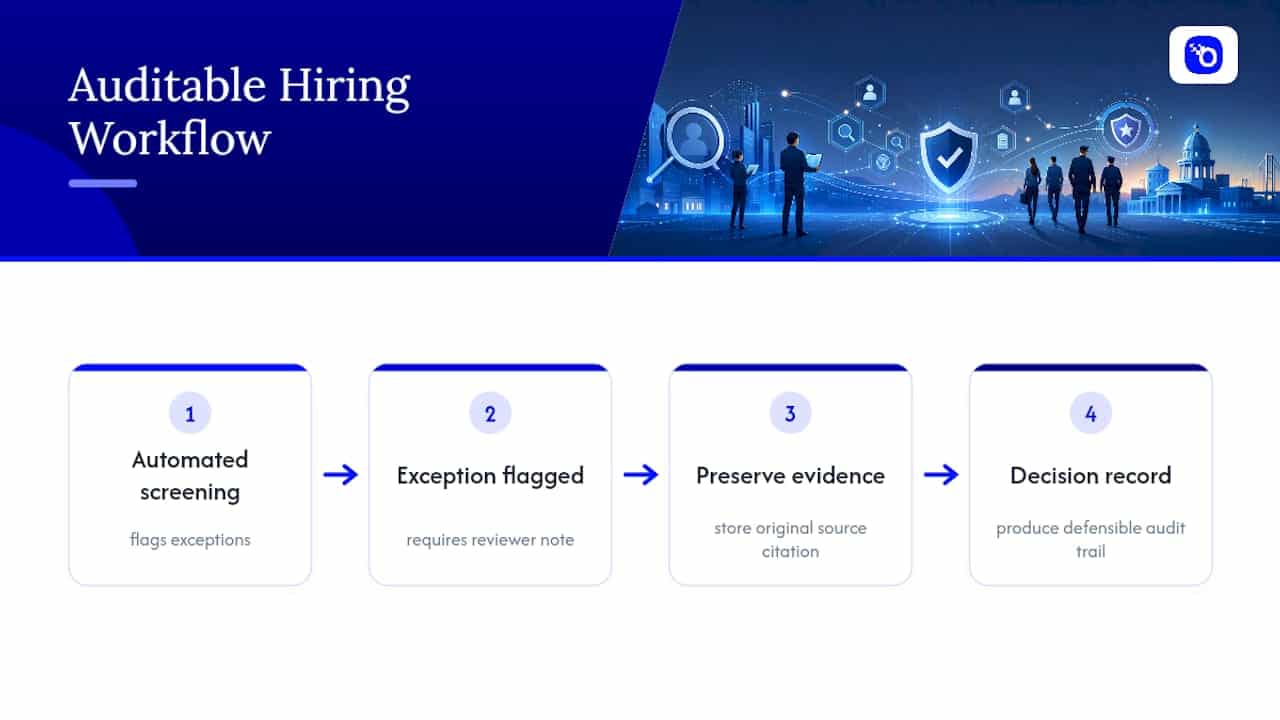
Public safety hiring carries a different risk profile than typical corporate roles. An automated flow can move fast, but every exception needs a traceable reviewer note and a preserved source citation, not just a status flag. Vendor integration support that treats evidence capture as a first-class feature, not an afterthought, is what actually protects an agency when a hiring decision gets scrutinized later.
Get Integration Support Built for Public Safety Screening
Most general-purpose screening APIs are built for corporate volume hiring, not the evidentiary standard public safety agencies actually need. OMNI Intel is built the other way around: integration support, tailored screening packages, and compliance features designed specifically for law enforcement, fire and EMS, dispatch, and private security hiring, where a missing timestamp or an unreviewed exception can become a real liability.

OMNI Intel’s applicant screening integration connects to your existing ATS or recruiting workflow and hands your engineering team a documented path instead of a generic API reference built for retail hiring volume. Screening packages are customized by role, from sworn officer to dispatcher to volunteer, and the platform keeps the audit trail your agency needs when a hiring decision gets questioned. If your team is scoping an integration now, start with OMNI Intel’s pre-employment screening services or reach out through the get-started page to talk with the integrations team directly.
Where to Go Next for Compliance and Technical Detail
Read the primary sources before you write a line of production code, not after.
- CFPB and FCRA guidance on AI-driven hiring reports for the legal sequence of notices
- Breaking-change management practices for API versioning and spec-diffing
- OMNI Intel’s OMNIScreen™ investigations overview for public-safety-specific screening design
Sources
- API integration patterns and why architecture matters — Embedded by Gusto
- API Integration Complexity Report 2026 — Specway
FAQ
What Are the Stages of API Integration?
Most background check integrations move through discovery and vendor evaluation, sandbox authentication setup, building the order lifecycle and webhook handling, compliance and consent workflow implementation, and finally production rollout with ongoing monitoring.
Can You Use AI to Do Background Checks?
AI can assist with matching and triage, but it should function as a triage layer rather than a final decision maker, with human review preserved for ambiguous or high-risk cases to keep the process explainable and defensible.
What Are Examples of Background Check API Integrations?
Common patterns include an ATS submitting a candidate record and receiving webhook status updates, an HRIS pulling continuous monitoring alerts on current employees, and a recruiting microsite triggering identity verification synchronously before a formal application is submitted.
What Disqualifies a Candidate From a Background Check?
Disqualification depends entirely on the employer’s own adjudication matrix, since the report itself doesn’t disqualify anyone. Common flags that trigger deeper review include unresolved criminal records relevant to the role, falsified application information, and failed identity verification.
Does OMNI Intel Support Direct API Integration With an ATS?
Yes. OMNI Intel’s applicant screening integration connects to existing hiring platforms and supports tailored screening packages built specifically for public safety roles.