
AI in recruitment cuts hiring time by 85% for public safety
Recruiting qualified candidates for public safety roles is complex and time-intensive. Traditional screening methods leave agencies drowning in applications while critical positions remain unfilled. AI-driven recruitment tools are transforming this landscape by automating labor-intensive tasks and enabling faster, more accurate public safety recruitment process decisions. This guide explores how AI enhances efficiency, addresses ethical concerns, and helps you select the right tools for your agency.
Table of Contents
- Introduction To AI In Public Safety Recruitment
- How AI Improves Recruitment Efficiency And Candidate Vetting
- Ethical And Legal Considerations In Using AI For Public Safety Hiring
- Common Misconceptions About AI In Recruitment
- Case Studies And Practical Applications In Public Safety Recruitment
- Framework For Selecting And Integrating AI Recruitment Tools
- Conclusion: Maximizing AI’s Potential While Mitigating Risks
- Explore AI-Powered Hiring Solutions For Public Safety Agencies
- Frequently Asked Questions About AI In Public Safety Recruitment
Key takeaways
| Point | Details |
|---|---|
| Time savings | AI saves up to 85% of time spent on initial resume screening by automating qualification matching. |
| Efficiency gains | AI-powered tools reduce cost-per-hire by as much as 30% through faster hiring cycles. |
| Ethical oversight | Human involvement remains critical to prevent bias and maintain transparency in final hiring decisions. |
| Compliance framework | Federal guidelines like NIST AI Risk Management Framework provide governance for responsible AI use in public sector hiring. |
| Proven results | Real-world cases show measurable improvements in diversity recruitment and screening accuracy. |
Introduction to AI in public safety recruitment
Public safety agencies face unique recruitment challenges. High applicant volumes, stringent vetting requirements, and legal compliance demands create bottlenecks that delay hiring and increase costs. Traditional manual screening methods struggle to keep pace with the volume of applications while maintaining accuracy and fairness.
AI offers a solution tailored to these public safety recruitment challenges. By automating repetitive tasks like resume parsing and initial qualification screening, AI-driven recruitment tools reduce time spent on screening resumes by automating keyword and qualification matching, saving recruiters significant time in high-volume hiring scenarios. These systems analyze candidate data against job requirements, rank applicants based on fit, and flag potential concerns for human review.
Common recruitment challenges AI addresses include:
- Managing hundreds or thousands of applications for limited positions
- Ensuring consistent evaluation criteria across all candidates
- Meeting strict legal compliance and non-discrimination requirements
- Reducing unconscious bias in initial screening stages
- Accelerating time-to-hire for critical public safety roles
AI tools designed for public safety recruitment understand the unique requirements of law enforcement, fire, EMS, and dispatch roles. They can be configured to prioritize qualifications specific to these positions, such as certifications, physical requirements, and background check clearance levels.
How AI improves recruitment efficiency and candidate vetting
AI transforms recruitment workflows through intelligent automation. Modern systems parse resumes in seconds, extracting relevant information and matching it against job criteria. This automation delivers measurable benefits. AI recruitment tools save up to 85% of time recruiting professionals spend on initial resume screening, allowing your team to focus on high-value activities like interviewing and relationship building.

The financial impact is equally significant. AI-powered candidate sourcing and screening platforms reduce cost-per-hire by as much as 30% by speeding hiring cycles and lowering manual labor costs. Research confirms these benefits, with HR professionals rating positive impacts on recruitment outcomes with a mean score of 3.79 out of 5.
| Metric | Traditional Recruitment | AI-Driven Recruitment |
|---|---|---|
| Resume screening time | 15-20 min per resume | 1-2 min per resume |
| Time-to-hire | 45-60 days | 20-30 days |
| Cost-per-hire | $4,000-$5,000 | $2,800-$3,500 |
| Screening accuracy | 65-75% | 85-92% |
Key AI features that enhance public safety vetting process include:
- Automated resume parsing and keyword extraction
- Predictive candidate scoring based on historical hiring data
- Chatbot-driven initial candidate engagement and qualification
- Behavioral assessment tools that evaluate soft skills
- Integration with pre-employment screening workflow systems
Pro Tip: Combine AI automation with structured human review checkpoints. Let AI handle volume and initial filtering, but ensure qualified recruiters evaluate top candidates and make final decisions. This approach maximizes efficiency while maintaining the human judgment essential for public safety roles.
Ethical and legal considerations in using AI for public safety hiring
AI’s efficiency comes with ethical responsibilities. Without proper oversight, AI systems can perpetuate or amplify existing biases embedded in training data. When historical hiring data reflects past discrimination, AI models trained on this data may replicate those patterns, disadvantaging qualified candidates from underrepresented groups.
Public trust in AI-assisted hiring remains cautious. 71% of Americans oppose AI making final hiring decisions, but many accept AI for initial screening, highlighting the need for human oversight in public sector recruitment. This sentiment is especially strong in public safety, where community trust is paramount.
“The majority of Americans oppose AI making final hiring decisions in public sector roles, emphasizing the critical need for human judgment in recruitment processes that affect community safety and trust.”
Federal frameworks provide guidance for responsible AI adoption. Government frameworks such as the NIST AI Risk Management Framework provide guidance for managing risks introduced by AI in public sector recruitment, promoting trustworthiness and compliance. These guidelines emphasize transparency, accountability, and ongoing monitoring.
Key legal and ethical compliance considerations include:
- Ensuring AI systems comply with Title VII and equal employment opportunity laws
- Conducting regular bias audits of AI algorithms and training data
- Maintaining transparency about how AI influences hiring decisions
- Protecting candidate privacy and data security throughout the process
- Documenting AI-assisted decisions for potential legal review
- Providing candidates with explanations of automated decisions
Agencies must implement background checks and compliance protocols that align with both AI capabilities and legal requirements. This includes establishing clear policies about data retention, candidate notification, and appeal processes for AI-influenced decisions.
Common misconceptions about AI in recruitment
Misunderstandings about AI capabilities hinder effective adoption. Clearing these misconceptions enables realistic planning and ethical implementation in public safety recruitment best practices.
One prevalent myth suggests AI automatically eliminates bias. In reality, AI can perpetuate or exacerbate bias if not properly designed and audited for fairness. AI systems learn from data, and biased data produces biased outcomes. Active bias mitigation requires diverse training data, regular audits, and continuous refinement.
Another misconception positions AI as a complete replacement for human recruiters. AI excels at processing volume and identifying patterns, but it lacks the nuanced judgment, interpersonal skills, and contextual understanding that human recruiters provide. The most effective approach uses AI to augment human capabilities, not replace them.
Common misconceptions debunked:
- Myth: AI hiring tools are objective and fair by default. Reality: AI reflects the biases present in its training data and requires ongoing monitoring and correction.
- Myth: AI can fully evaluate soft skills and cultural fit. Reality: AI provides data points, but human assessment remains essential for evaluating interpersonal qualities critical in public safety.
- Myth: Implementing AI guarantees improved diversity outcomes. Reality: Diversity improvements depend on intentional design, diverse training data, and active bias mitigation strategies.
- Myth: AI systems work identically across all industries. Reality: Public safety recruitment requires specialized AI tools trained on relevant data and configured for unique requirements.
- Myth: Once deployed, AI systems require minimal maintenance. Reality: Effective AI requires continuous monitoring, retraining, and adjustment to maintain accuracy and fairness.
Understanding these realities helps agencies set appropriate expectations and implement AI responsibly. Success requires viewing AI as a powerful tool that enhances human decision-making rather than a complete solution.

Case studies and practical applications in public safety recruitment
Real-world examples demonstrate AI’s tangible impact on public safety hiring. Prince William County improved diversity through tech-driven recruitment; AI is also used for continuous post-hire monitoring and integrates with background screening platforms. Their AI-assisted recruitment process broadened candidate pools by reducing human bias in initial screening stages.
The county’s approach combined AI screening tools with structured interview processes. This hybrid model increased qualified applicants from underrepresented communities by 40% while maintaining rigorous vetting standards. The system flagged candidates who met objective qualifications but might have been overlooked in traditional screening.
AI also enhances ongoing risk management. Agencies use AI-powered monitoring to track post-hire behavior patterns and flag potential concerns. When integrated with comprehensive public safety background investigations, these systems provide continuous oversight that protects both the agency and the community.
| Outcome | Traditional Recruitment | AI-Enhanced Recruitment |
|---|---|---|
| Diverse candidate pool | 25-30% | 40-45% |
| Screening consistency | 60-70% | 90-95% |
| Time to first interview | 3-4 weeks | 1-2 weeks |
| Post-hire risk incidents | Baseline | 25% reduction |
Integration with background screening platforms strengthens vetting accuracy. AI systems cross-reference candidate information across multiple databases, identify inconsistencies, and prioritize cases requiring deeper investigation. This layered approach catches red flags that single-source screening might miss.
Pro Tip: Start with a pilot program in one department before full deployment. This approach allows you to refine processes, address technical challenges, and build internal confidence in AI tools. Use pilot results to secure buy-in from stakeholders and guide agency-wide implementation.
Framework for selecting and integrating AI recruitment tools
Choosing the right AI solution requires systematic evaluation. Your framework should prioritize five key criteria: bias mitigation capabilities, legal compliance features, transparency and explainability, integration with existing systems, and ease of use for your recruitment team.
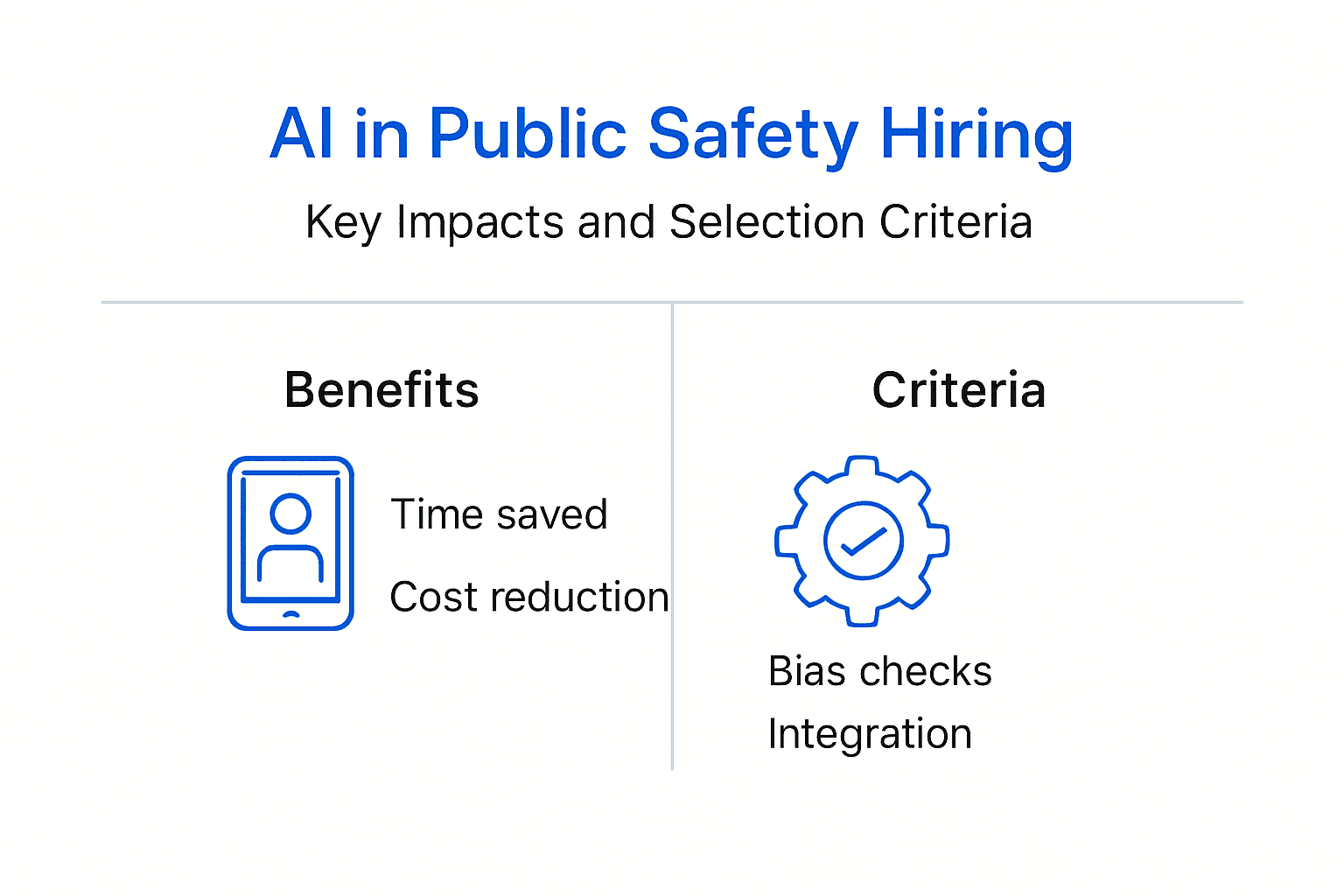
Start by assessing your agency’s specific needs and pain points. Document current recruitment bottlenecks, compliance requirements, and budget constraints. This baseline helps you evaluate vendors against concrete requirements rather than generic promises.
Follow this step-by-step adoption process:
- Conduct needs assessment: Identify specific recruitment challenges AI should address, establish success metrics, and determine budget parameters.
- Evaluate vendor solutions: Request demonstrations focused on public safety use cases, review bias mitigation protocols, and verify compliance with federal guidelines.
- Run controlled pilot: Test the system with one department or role type, compare outcomes against traditional methods, and gather feedback from recruiters and candidates.
- Provide comprehensive training: Ensure recruitment staff understand AI capabilities and limitations, establish protocols for human oversight, and create clear escalation procedures.
- Monitor and optimize continuously: Track key metrics like time-to-hire and candidate quality, conduct regular bias audits, and adjust algorithms based on performance data.
Balance is essential. Automation should enhance efficiency without sacrificing the human judgment that public safety recruitment demands. Establish clear decision points where human review is mandatory, particularly for final hiring decisions and sensitive cases.
Evaluate pre-employment screening workflow integration carefully. The best AI tools connect seamlessly with background check providers, applicant tracking systems, and HR management platforms. This integration eliminates data silos and creates a unified view of each candidate.
Conclusion: maximizing AI’s potential while mitigating risks
AI offers transformative potential for public safety recruitment when implemented responsibly. The 85% time savings in initial screening enables recruiters to focus on relationship building and nuanced evaluation. Cost reductions of 30% free resources for other critical agency needs. These benefits are real and measurable.
However, efficiency must never compromise fairness or transparency. Human oversight remains the cornerstone of ethical AI use in public safety hiring. The most successful implementations view AI as a decision support tool that enhances human judgment rather than replacing it.
Best practices for responsible AI adoption:
- Maintain human involvement in all final hiring decisions
- Conduct regular audits to identify and correct algorithmic bias
- Document AI-assisted decisions for accountability and legal compliance
- Provide training to ensure recruitment staff understand AI capabilities and limitations
- Establish clear policies for data privacy and candidate rights
- Monitor outcomes continuously and adjust systems based on performance data
- Communicate transparently with candidates about AI’s role in the process
The future of public safety recruitment lies in human-AI collaboration. Agencies that embrace this partnership while maintaining ethical safeguards will gain competitive advantages in attracting and retaining qualified personnel. With proper implementation and ongoing oversight, AI becomes a powerful ally in building safer communities through better hiring.
Explore AI-powered hiring solutions for public safety agencies
Ready to transform your recruitment process? OMNI Intel provides comprehensive AI-enhanced screening and background check services designed specifically for public safety agencies. Our platform combines cutting-edge automation with law enforcement investigation principles to deliver faster, more accurate candidate vetting.

Our integrated solutions streamline every stage of your hiring workflow. From initial pre-employment screening services to comprehensive background check services, we help you identify qualified candidates while maintaining the highest compliance standards. Our AI tools reduce screening time without sacrificing thoroughness, giving you confidence in every hiring decision.
Discover how our tailored approach enhances your public safety recruitment process guide. Whether you’re hiring for law enforcement, fire and EMS, dispatch, or security roles, OMNI Intel provides the technology and expertise to build a stronger, more diverse workforce while protecting your agency’s reputation and community trust.
Frequently asked questions about AI in public safety recruitment
Can AI replace human recruiters in public safety hiring?
No, AI cannot replace human recruiters in public safety roles. AI excels at processing high volumes of applications and identifying qualified candidates, but human judgment remains essential for evaluating interpersonal skills, cultural fit, and nuanced qualifications critical in public safety positions. The most effective approach combines AI efficiency with human oversight for final decisions.
How do public safety agencies ensure AI does not perpetuate bias?
Agencies prevent bias through regular algorithm audits, diverse training data, and human oversight at decision points. Implementing structured evaluation criteria, testing AI outputs for disparate impact, and maintaining transparency in how AI influences decisions help identify and correct bias. Continuous monitoring and adjustment are essential as hiring needs and workforce demographics evolve.
What federal guidelines apply to AI use in public sector recruitment?
The NIST AI Risk Management Framework provides comprehensive guidance for government agencies using AI in recruitment. Additionally, Equal Employment Opportunity Commission guidelines on employment testing apply to AI systems. Agencies must ensure AI tools comply with Title VII of the Civil Rights Act and other anti-discrimination laws while maintaining transparency and accountability.
How can AI integration improve background check processes?
AI enhances background checks by cross-referencing candidate information across multiple databases, identifying inconsistencies, and prioritizing cases requiring deeper investigation. Machine learning algorithms detect patterns that might indicate fraud or misrepresentation. When integrated with comprehensive screening platforms, AI accelerates the vetting process while improving accuracy and thoroughness.
What initial steps should agencies take to adopt AI recruitment tools?
Start with a needs assessment to identify specific recruitment challenges and establish success metrics. Research vendors specializing in public safety recruitment and request demonstrations using relevant use cases. Launch a pilot program in one department to test effectiveness and gather feedback. Provide thorough training for recruitment staff and establish clear protocols for human oversight before expanding agency-wide.