

Police Recruiters: 5 Evidence Based KPIs for Recruitment Marketing
Departments that fix recruitment marketing fastest do three things at once: they replace warrior-culture messaging with service-focused, evidence-backed creative; they cut the friction out of the application pipeline; and they measure cost-per-hire and first-year attrition instead of guessing. If you only have this week, adjust your job ads and video scripts, deploy short-form social and geofenced ads around events, and remove at least one manual step from your application flow. Everything below explains why and shows you how.
TL;DR:
- Focusing on community service messaging and short-form, service-oriented videos significantly increases candidate interest and application rates.
- Implementing parallel background and medical reviews, coupled with digital applications and automated reminders, can drastically shorten the hiring timeline.
- Spending on targeted social media, geofencing, and referral programs yields higher quality applicants compared to broad or generic advertising channels.
- Tracking key metrics like cost-per-hire, application conversion, and first-year attrition helps optimize budgets and improve candidate quality over time.
- Ensuring truthful, authentic messaging and compliance with equal opportunity standards prevents legal risks and maintains public trust during recruitment campaigns.
Table of Contents
- What Is Recruitment Marketing for Police, and Why Does It Need to Change?
- High-Impact Police Recruitment Campaigns: What to Do First
- Which Messages and Creative Formats Attract the Right Candidates?
- Where Should You Spend Your Recruiting Budget?
- How Can You Shorten Time-to-Hire Without Cutting Corners?
- What KPIs Should You Actually Track?
- What Do Real Agency Results Look Like?
- Where Does Screening Technology Fit an Evidence-Driven Program?
- What Are the Legal and Ethical Limits on Police Recruitment Marketing?
- Why Do Misconceptions About Police Careers Keep Agencies Short-Staffed?
- How Do You Recruit for Specialized Roles Like Cybercrime and Forensics?
- A Recruiter’s 30/60/90-Day Action Plan
- How OMNI Intel Fits Your Recruitment Marketing Strategy
- Sources
- FAQ
What Is Recruitment Marketing for Police, and Why Does It Need to Change?
Recruitment marketing for police is the deliberate use of messaging, creative, channels, and process design to attract qualified applicants into a law enforcement hiring pipeline, then move them through it before they lose interest or take another job. It’s distinct from generic HR recruiting because the applicant pool skews toward candidates weighing physical risk, community perception, and family concerns, not just salary and benefits. Departments that still run recruiting like it’s 2005, a static job posting and a six-month background process, are losing candidates to agencies that treat recruiting as a marketing and operations discipline. The Council on Criminal Justice’s review of recruitment evidence and Department of Justice guidance on officer hiring both point to the same conclusion: agencies that combine better messaging with a faster, less friction-heavy process consistently outperform those that only spend more on advertising.
High-Impact Police Recruitment Campaigns: What to Do First
Not every tactic deserves equal budget or attention. Here’s the order that actually moves cost-per-hire and applicant quality, based on where agencies see the fastest returns.
- Fix the messaging first. Service and community-impact framing consistently outperforms tactical or warrior-style messaging in applicant motivation research, and it costs nothing to rewrite a job posting.
- Rebuild creative around video. Short-form, service-focused video and women-focused ad formats increase interest and application intent more than static graphics or text posts.
- Target channels to specific audiences. Social platforms for younger candidates, paid and geofenced ads for lateral transfers, campus and community partnerships for long-term pipeline.
- Remove pipeline friction. Paperless applications, parallel background and medical steps, and automated reminders shorten time-to-hire dramatically.
- Measure and reallocate monthly. Track cost-per-hire and first-year attrition, then shift budget away from channels that don’t convert.
Treating recruiting as a program with dedicated budget, trained recruiters, and defined metrics, rather than a seasonal scramble, is what separates agencies that fill academies from those that keep extending deadlines, according to practitioner reporting on the staffing crisis. A rough timeline works well: fix messaging and one process bottleneck in the first month, launch new channel tests in the next period, and have your first KPI report ready after about three months.
Which Messages and Creative Formats Attract the Right Candidates?
Applicants respond to specific language, not slogans. Experimental research on recruiting materials found that service-focused framing beats warrior or tactical framing for general applicant motivation, and that women-focused video ads increase perceived fairness and application intent among female candidates, according to RTI’s experimental study on recruiting women into policing. Separate research found that women-focused messaging tailored to video formats outperforms one-size-fits-all creative for driving female applicant interest.
Practical steps for your next job posting and campaign:
- Rewrite the first line of every job description to lead with community impact, not tactical gear.
- Name concrete benefits: wellness programs, family leave, mental health support, and shift flexibility.
- Strip jargon like “10-42” or “code 3” from public-facing copy; it reads as exclusionary to outsiders.
- Use day-in-the-life video for general recruiting, testimonials from women and officers of color for targeted diversity campaigns.
- Keep every recruiting video under 60 seconds for social distribution; longer cuts work only for your careers page.
Pro Tip: Run two versions of your next video ad, one led by a service line, one led by an action line, and compare application click-through before you commit budget to a full campaign.
Where Should You Spend Your Recruiting Budget?
Channel choice determines whether your messaging ever reaches the right person. Different audiences require different placements, and treating every channel the same wastes spend.
- Short-form social (Instagram Reels, TikTok, YouTube Shorts): best for Gen Z and career-changers; pair with the video formats above.
- Targeted paid ads: most efficient for lateral recruits already in the profession, since you can target by job title and location.
- Geofencing: deploy around job fairs, gyms, community colleges, and military transition events to catch high-intent prospects in the moment.
- Campus and community partnerships: slower to pay off but build a durable pipeline, especially for criminal justice programs.
- Officer referral programs: formalize with trackable, QR-coded referral cards and incentives, since referrals routinely produce some of the highest-quality hires a department gets.
Every placement needs a single-purpose landing page, not your general careers site, with a short form and immediate follow-up. At events, staff a table with someone who can walk a candidate through the first application step on a tablet, on the spot, before they leave and forget.
How Can You Shorten Time-to-Hire Without Cutting Corners?
Time-to-hire is where most departments bleed candidates, not at the top of the funnel. The Department of Justice specifically recommends modernizing hiring through paperless applications, online testing, and live chat support to cut delays and widen accessibility.
- Digitize the application entirely. Paper forms and mailed packets add days recruiters can’t afford to lose.
- Parallelize instead of sequence. Run medical review and background investigation steps at the same time rather than back to back.
- Outsource specialized steps. Polygraph and psychological evaluations are common bottlenecks; contracting these out often shortens timelines without lowering standards.
- Use conditional question flows. Screen for disqualifiers early so candidates aren’t invested for months before learning they don’t qualify.
- Automate reminders. Text and email nudges at each stage keep candidates engaged and measurably increase completion.
Some agencies have substantially reduced hiring timelines by combining these steps, according to Law Officer’s reporting on recruiting strategies that solve the staffing crisis. That kind of compression changes how many qualified candidates you keep long enough to swear in.
Pro Tip: Map your current process step by step and flag every point where a candidate waits more than five business days for a response. Those gaps are where you’re losing people, not at the top of the funnel.
What KPIs Should You Actually Track?
Cost-per-hire, time-to-hire, application conversion rate, first-year attrition, and quality-of-hire proxies (academy pass rate, field training evaluations) are the five numbers that matter. Everything else is vanity.
- Cost-per-hire: total recruiting spend divided by hires; track by channel so you can see which placements actually convert.
- Time-to-hire: days from application to conditional offer; benchmark against your own historical average, not another agency’s.
- Application conversion rate: percentage of applicants who complete the process; a low rate points to pipeline friction, not a talent shortage.
- First-year attrition: the clearest signal of quality-of-hire; rising attrition after a messaging change is a red flag worth investigating immediately.
Shifting budget from vanity placements toward data-backed social campaigns that track these numbers improves long-term recruiting ROI more reliably than raising overall ad spend. Assign one person to own each KPI and revisit allocation monthly, not annually.
What Do Real Agency Results Look Like?
Evidence here is specific enough to act on, not just directional. Reminder emails and texts sent to applicants increase total applicant volume compared to no reminders at all, per the Council on Criminal Justice’s evidence review. Separately, altering invitation language for assessments, making it more concise and less anxiety-inducing, increased the probability that minority applicants passed situational judgment tests in controlled field experiments.
- Automated reminder sequences alone have measurably grown applicant pools without any new ad spend.
- Rewriting test invitations to reduce perceived stakes improved pass rates for underrepresented applicants.
- Case-study collections from specialist police marketing firms show application volume and test-day attendance rising after agencies modernized stale, text-heavy campaigns, according to PD Recruiting’s published case studies.
Copy the mechanism, not just the headline: test one language change on your next assessment invitation before rolling it out agency-wide.
Where Does Screening Technology Fit an Evidence-Driven Program?
A fast pipeline that dumps unvetted candidates into your academy isn’t a win. Integrated screening shortens the pipeline without lowering diligence, and it reduces the attrition risk that shows up months later when a background issue surfaces post-hire.
- Confirm the vendor specializes in public safety, not generic corporate HR screening.
- Verify FCRA compliance and clear documentation of investigator-driven checks, not just database pulls.
- Check for direct integration with your applicant tracking system so screening doesn’t reopen the paperwork bottleneck you just fixed.
- Ask for agency case studies showing reduced time-to-hire, not just feature lists.
Pro Tip: Ask any screening vendor how their process handles parallel medical and background review, since that’s where agencies report the biggest timeline compression.
What Are the Legal and Ethical Limits on Police Recruitment Marketing?
Recruitment marketing for public safety agencies operates under more scrutiny than private-sector hiring, and getting it wrong creates liability, not just bad PR. Equal Employment Opportunity Commission standards govern how job postings, imaging, and targeting can be structured, so ad targeting that excludes candidates by proxy characteristics (age-restricted platform targeting, for instance) carries real legal risk even when it’s not explicitly discriminatory in intent.
Truthfulness matters more in this field than most others. A recruitment video that overstates typical starting pay, dramatizes use-of-force frequency, or implies a faster promotion timeline than your department actually delivers sets up candidates to wash out during field training, which drives up first-year attrition and wastes your investigation budget on people who leave anyway. Every claim in your creative should be checkable against your own department’s real numbers.
Diversity-focused messaging needs the same discipline. Materials aimed at women or candidates of color should reflect authentic officer experiences, not staged inclusivity for optics. The RTI research on recruiting women into policing found that perceived authenticity, not just representation, drove the improvement in application intent. A photo of a diverse team means little if those officers leave the agency relatively soon after hire.
Finally, treat applicant data with the same rigor you’d expect from a background investigation. Recruitment landing pages and lead-capture forms collect personal information from candidates who haven’t yet consented to a full background process. Store it securely, disclose how it’s used, and never pass contact information to third parties without clear applicant consent.

Why Do Misconceptions About Police Careers Keep Agencies Short-Staffed?
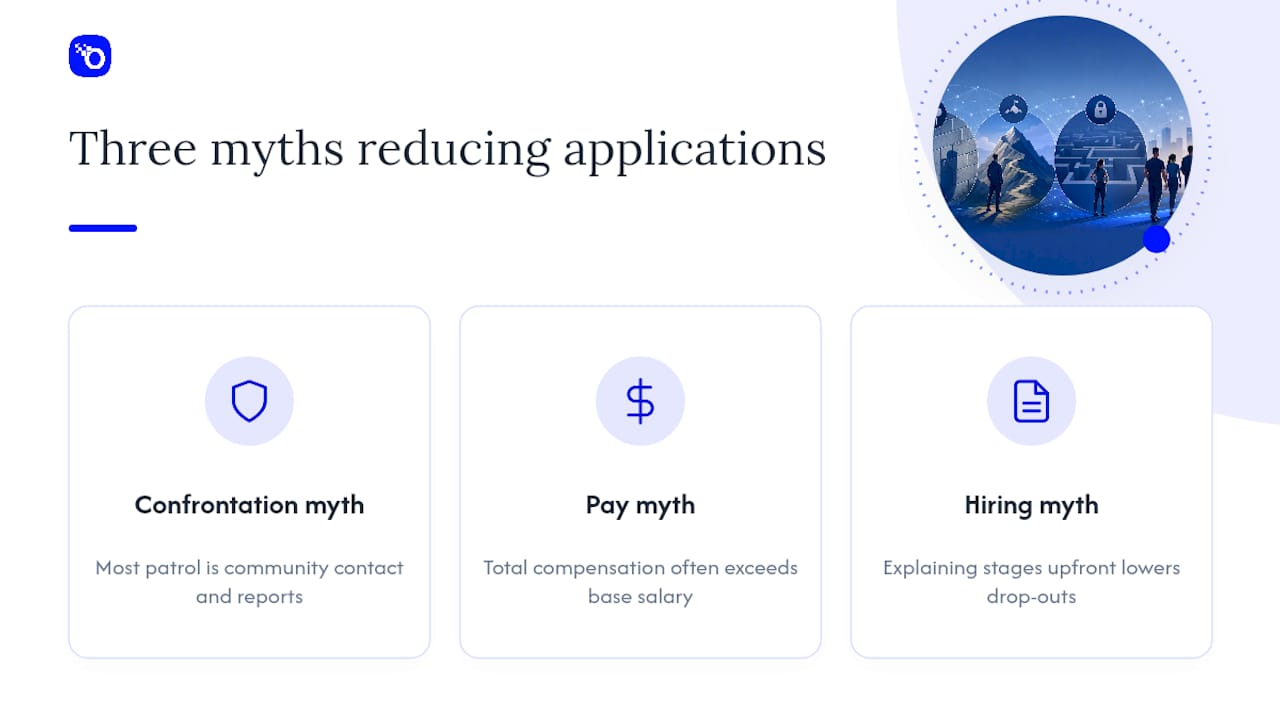
The stigma problem is real, but it’s more specific than “policing has a bad reputation.” Surveys and applicant interviews consistently surface three recurring myths that suppress application volume even among candidates who are otherwise interested in the work.
The first myth is that policing is primarily confrontational. Most patrol work is community contact, report writing, and problem-solving, not use-of-force incidents. Recruitment creative that leads with tactical imagery reinforces the exact misconception that scares off service-minded candidates, which is why the shift toward service-focused messaging isn’t just an ethical preference. It’s a response to what the data shows actually works.
The second myth is that officer pay is uniformly low. Total compensation, including overtime, differential pay, and benefits, often exceeds base salary significantly, and in many mid-size and large departments, experienced officers earn six figures once overtime and specialty pay are factored in. That said, base salary varies enormously by department and region, so recruitment materials should cite specific, verified figures for your own agency rather than national averages that may not apply locally.
The third myth is that the hiring process is designed to weed people out through delay and confusion. When departments actually explain each pipeline stage upfront, drop-out rates during the process improve, because candidates aren’t left guessing whether silence means rejection. A simple applicant FAQ page addressing typical timeline, what each background step involves, and what disqualifies someone outright removes a surprising amount of the anxiety that drives good candidates to withdraw voluntarily.
How Do You Recruit for Specialized Roles Like Cybercrime and Forensics?
Specialized units need their own recruitment marketing, not a repurposed patrol officer campaign. Cybercrime, digital forensics, crime scene investigation, and financial crimes units compete directly with private-sector employers offering higher pay and more flexible schedules, so generic “join the force” messaging rarely reaches this candidate pool.
Target the platforms where technical candidates actually spend time: LinkedIn, industry-specific forums, and university computer science and criminal justice programs rather than general social media. Messaging should emphasize mission and impact that private-sector work can’t offer, investigating crimes against children, dismantling financial fraud networks, or contributing to cases that carry public significance beyond a corporate paycheck.
Credential and experience requirements also need to be realistic. Departments that insist on sworn-officer status before allowing someone to work in a forensics lab exclude qualified civilian specialists who could fill critical gaps. Several departments now offer civilian analyst tracks specifically to widen this pipeline, and that structural change matters more than any single ad campaign.
Referral networks work especially well here because these fields are small and reputation travels fast. A current digital forensics examiner recommending your department to a peer carries more weight than a job board listing ever will. Combine that with clear salary transparency, since technical candidates comparing offers against private-sector pay expect specifics, not vague ranges.
A Recruiter’s 30/60/90-Day Action Plan
Week one: audit your job postings for warrior-language and rewrite the top three; add one automated reminder step to your application flow. Days 30 to 60: launch a short-form video test comparing service versus tactical framing, and outsource one bottleneck step, like polygraph scheduling. By day 90: pull your first cost-per-hire and conversion-rate report and reallocate budget away from whatever channel underperformed.
The most common pitfall isn’t picking the wrong tactic, it’s changing five things at once and having no way to tell which one worked.
— Matt
How OMNI Intel Fits Your Recruitment Marketing Strategy
You’ve just read the tactics that shorten time-to-hire and improve candidate quality. The harder problem is executing screening fast enough that it doesn’t undo the pipeline gains you just made. OMNI Intel is built specifically for public safety agencies, not general corporate HR, which means the vetting process runs on investigator-driven checks tailored to law enforcement, fire, EMS, and dispatch roles, rather than a generic consumer background report retrofitted for your use case.

Evaluate any screening vendor against the checklist above: public-safety specialization, FCRA-compliant processes, direct integration with your applicant tracking system, and documented outcomes. OMNI Intel’s applicant screening integration connects directly into your recruiting workflow so screening doesn’t reopen the friction you worked to remove, and its pre-employment screening services are built around the parallel-processing approach that shortens timelines without cutting diligence. If your current pipeline still treats background investigations as a separate, sequential step, request a demo and see where the timeline actually compresses.
Sources
- Assessing the Evidence: Recruitment, Diversity, and Retention — Council on Criminal Justice
- Department of Justice guidance for State, Tribal, Local, and Territorial Law Enforcement Agencies on Best Practices for Officer Recruitment, Hiring, Promotion, and Retention
- Recruiting women into policing: Experimentally testing the effectiveness of recruiting materials — RTI
- Law Enforcement Recruiting Strategies That Solve the Real Staffing Crisis – Law Officer
FAQ
What are some effective police recruitment strategies?
The highest-leverage strategies are service-focused messaging, short-form video creative, automated application reminders, and shortening the pipeline by parallelizing background and medical review. Agencies that combine all four consistently outperform those that only increase ad spend.
How do you do recruitment marketing for a police department?
Effective recruitment marketing for police starts with rewriting messaging around community service rather than tactical imagery, then matching creative and channels to specific audiences, and finally removing friction from the application process so interested candidates don’t drop out before hiring.
Why are police departments struggling to recruit right now?
Staffing shortages stem from a combination of outdated messaging that emphasizes risk over service, lengthy hiring pipelines that lose candidates to faster-moving employers, and persistent misconceptions about pay and confrontation frequency that discourage otherwise qualified applicants from applying at all.
Do police officers make $100,000 a year?
Base salary alone rarely reaches that figure for most officers, but total compensation, including overtime, differential pay, and specialty assignments, pushes many experienced officers in mid-size and large departments past six figures. Actual pay varies significantly by department and region, so recruitment materials should always cite verified local figures.