

Recruitment Microsite Cost for Agencies: Avoid Integration Surprises
A basic recruitment microsite runs within a common market cost range for entry-level builds, mid-tier campaign microsites with light ATS integration land in a moderate cost band, and enterprise-grade microsites with deep API and AI features are the most expensive builds. The variable that moves a project from one band to the next is almost never design. It’s integration complexity with your ATS or CRM, and any quote you compare should be measured against a 36 month total cost of ownership, not just the upfront number.
TL;DR:
- Integration complexity, especially API-led connections and error handling, significantly increases microsite costs beyond design expenses.
- For volume-heavy agencies, enterprise microsites with AI and full API integration become cost-effective despite their high initial price.
- Ongoing hosting and maintenance costs over 36 months often match or exceed the initial build, especially at high traffic levels.
- Vendors should provide transparent, itemized quotes for integration, with clear data ownership policies to avoid hidden costs and scope creep.
- Agencies should focus on simple apply flows and analytics first, adding automation and screening features as ROI becomes clear.
Table of Contents
- How Much Does a Recruitment Microsite Cost by Tier?
- What Actually Drives Recruitment Microsite Pricing?
- Is a Recruitment Microsite Different From a Full Agency Website?
- What’s the Line-Item Budget for a Recruitment Website?
- SaaS, Bespoke, or Hybrid: How Do You Model the Real Cost?
- How Long Does a Recruitment Microsite Take to Build, and What Gets Added Later?
- What Should You Ask Vendors Before Signing a Contract?
- Why Compliance and Screening Integration Change the Cost Equation
- What Should Agencies Build First?
- How OMNI Intel Fits Into Your Microsite Build
- Sources
- FAQ
How Much Does a Recruitment Microsite Cost by Tier?
Most recruitment agencies fall into one of three practical tiers. Knowing which one matches your campaign goals before you talk to a vendor keeps the conversation honest.
- Entry-level marketing microsite ($3,000 to $12,000): A single-purpose landing page for one campaign or client, usually a template-based build with a contact form, basic branding, and manual data export. No ATS sync.
- Mid-range campaign microsite ($15,000 to $45,000): Custom design, an applicant flow tied to your ATS through a plugin or lightweight API, some employer-brand video or testimonial content, and analytics tracking.
- Enterprise or functional microsite ($60,000 to $150,000+): Full API-led integration, AI-driven candidate matching or nurturing, multirole application logic, and compliance-grade data handling.
A boutique agency running one client campaign a quarter almost never needs the enterprise tier. A staffing firm juggling twenty concurrent client microsites, on the other hand, usually loses money on entry-level builds once you count the labor spent re-entering data by hand.
What Actually Drives Recruitment Microsite Pricing?
Design is typically the smallest line item on a proposal. Engineering hours for integration, workflows, and security consume most of the budget, which is why two microsites that look nearly identical can carry a $30,000 price gap.
- Integration depth. A plugin-based ATS connection might add $1,500 to $5,000. A true API-led integration, with two-way sync and error handling, adds $10,000 or more.
- UX complexity. Video assessments, interactive quizzes, and dynamic content blocks that change by job role add development hours fast.
- Content and employer-brand assets. Professional copywriting, photography, and video for a single microsite typically costs $3,000 to $10,000 on top of the build.
- AI features. Personalization engines and AI-driven candidate nurturing raise upfront cost but can lift conversion enough to justify it over a full hiring cycle.
- Security and compliance. Encrypted data capture, retention policies, and audit trails add scope, especially for agencies placing candidates in regulated or public-safety roles.
Pro Tip: Ask every vendor to quote integration work as a separate line item. If it’s bundled into “development,” you have no way to know what you’re actually paying for the connection to your ATS.
Is a Recruitment Microsite Different From a Full Agency Website?
Yes, and the difference changes how you should budget. A main agency site is built to rank, convert cold traffic, and represent your brand indefinitely. A microsite is a tactical, repeatable asset built around one campaign, one client, or one hiring event, with a shorter shelf life and a narrower success metric: applications submitted, not brand equity.
- Modular content blocks and reusable templates are what make microsites affordable at scale. Build the block library once, then spin up new campaign sites for a fraction of the first one’s cost.
- Sync only finalized candidate data back to your master ATS rather than mirroring every field in real time. This keeps microsite databases lightweight and avoids system bloat.
- White-labeling for multiple client brands adds a modest per-instance cost once the template exists, far less than building each one from scratch.
What’s the Line-Item Budget for a Recruitment Website?
A published breakdown for the total build gives you real numbers to hold vendors against, so you can spot padding before you sign anything.
- Strategy and discovery: $2,000 to $7,000
- UI/UX design: $4,000 to $15,000
- Front-end and back-end development: $8,000 to $40,000
- Integration work: $1,500 to $5,000 for plugin connections, $10,000 to $25,000 for API-led or middleware-based integration
- Content and SEO: $3,000 to $10,000
- QA and accessibility testing: $2,000 to $5,000
- Monthly hosting, security, and maintenance: $50 to $500 a month depending on traffic and integration load
Add those hosting and maintenance fees across three years and they often rival the original build cost. A $500 monthly plan totals $18,000 over 36 months, on top of whatever you paid to launch. That’s the number vendors rarely volunteer, and it’s the one that decides whether a cheap quote was actually cheap.
SaaS, Bespoke, or Hybrid: How Do You Model the Real Cost?
The right build approach depends on your commercial model, not your budget alone. Boutique agencies benefit from low ongoing costs, while mid-market agencies often come out ahead paying more upfront for automation that saves recruiter hours every week.
- Templates or SaaS platforms make sense when you run few campaigns, need speed, and can tolerate subscription lock-in.
- Bespoke builds pay off once you need deep ATS automation, complex candidate matching, or a conversion lift large enough to offset the higher upfront spend.
- Hybrid builds, template front end with custom integration middleware, often land in the middle on both cost and flexibility.
To model 36 month total cost of ownership, add the build price to (monthly subscription or maintenance fee times 36) plus any known upgrade cost. A SaaS platform at $300 a month with a $10,000 upfront fee totals $20,800 over three years. A bespoke build at $35,000 with $150 monthly maintenance totals $40,400. The SaaS route wins on paper unless your recruiters are losing hours weekly to a system that can’t automate candidate routing, which is exactly the scenario where bespoke integration architecture tends to pay for itself.
How Long Does a Recruitment Microsite Take to Build, and What Gets Added Later?
Template-based builds typically deliver in two to four weeks. Semi-custom projects with light integration run six to ten weeks. Bespoke or enterprise builds with full API work often take three to five months.
- Third-party API subscription fees, often overlooked until the first invoice arrives.
- Accessibility remediation after an audit flags issues late in the build.
- Content delays that push launch dates and trigger extra billable hours.
- Extra revision rounds beyond what the contract specifies as included.
Negotiate a milestone schedule tied to deliverables, not dates: 30% at signing, 40% at design approval, 30% at launch, with QA sign-off required before the final payment releases.
What Should You Ask Vendors Before Signing a Contract?
A short scoring exercise before you sign protects you from the two most common regrets: scope creep and vendor lock-in.
- Data ownership. Confirm in writing that candidate data and code belong to your agency, not the vendor, on termination.
- APIs and backups. Ask exactly which systems the microsite connects to and how often data backs up.
- SLAs. Get uptime and response-time guarantees in the contract, not a sales conversation.
- Line-item rates. Require hourly or per-feature rates for any change order, not a vague “additional fees may apply” clause.
- Warranty period. Thirty to ninety days of post-launch bug fixes at no charge is standard; anything less is a red flag.
Score each proposal on a simple scale from one to five across integration clarity, scope specificity, and price transparency. A vendor who can’t answer the data ownership question in one sentence usually can’t answer it well anywhere else in the contract.
Pro Tip: A proposal that describes integration as “ATS connectivity included” without naming the specific system or sync method is the single biggest red flag in recruitment microsite procurement.
Why Compliance and Screening Integration Change the Cost Equation
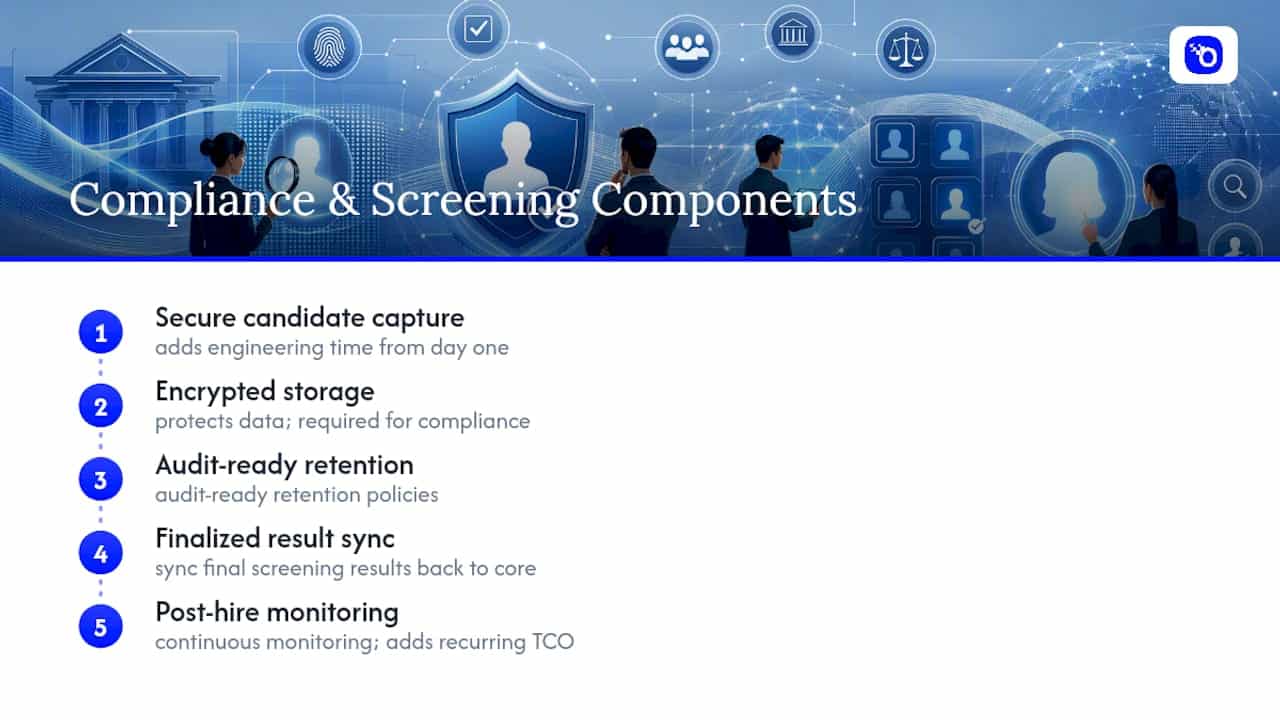
Public safety agencies face a different cost curve than general staffing firms. Secure candidate data capture, encrypted storage, and audit-ready retention policies add real engineering time, and that cost belongs in your budget from day one, not bolted on after an audit; for expert guidance, see compliance and legal support for nonprofit hiring. Syncing finalized screening results back to your core system, rather than mirroring every field live, keeps microsite databases lean while satisfying compliance requirements around data security. Continuous post-hire monitoring adds a recurring line to your TCO calculation but changes candidate flow risk substantially over a hiring cycle.
What Should Agencies Build First?
Boutique agencies should prioritize a working apply flow, basic analytics, and clean on-page SEO before spending on automation. Mid-market agencies get more return from job matching and a candidate dashboard once volume justifies it. Sequence spending so each phase proves ROI before the next investment, protecting cash flow while the microsite earns its keep.
— Matt
How OMNI Intel Fits Into Your Microsite Build
Every dollar you spend on integration architecture is wasted if the screening process behind your apply flow is slow or inconsistent. The microsite’s applicant flow can connect directly into a screening process designed around investigator-driven checks rather than generic background check software.

Agencies building recruitment microsites for law enforcement, fire and EMS, dispatch, or private security roles need more than a contact form and a job board feed. OMNIHire’s applicant screening integration connects your microsite’s apply flow directly into pre-employment vetting, so candidates move from application to clearance without manual re-entry. Pair that with continuous post-hire monitoring and you cut the compliance risk that generic recruitment platforms were never built to handle. If you’re scoping a microsite build right now, review OMNI Intel’s pre-employment screening services before you finalize your integration requirements with a vendor, so screening is part of the architecture from the start, not a retrofit six months in.
Sources
- How much does a recruitment website cost in 2026? | The Access Group
- Recruitment microsite guide for talent teams | Zoomforth
- Recruitment Website Cost: 2026 Pricing & Budget Breakdown | Qrolic
- How much does a recruitment website cost? | Volcanic
FAQ
How Much Does It Cost to Build a Microsite?
A basic recruitment microsite costs $3,000 to $12,000, a mid-tier campaign build with ATS integration runs $15,000 to $45,000, and enterprise builds with deep API work can exceed $60,000.
What Is a Typical Recruiting Fee?
Recruiting fees vary by placement type and industry, but agencies should evaluate microsite spend against cost-per-hire, since a build that speeds screening and reduces bad placements often pays for itself faster than a cheaper site with no integration.
Is $1,500 a Good Price for a Website?
For a template-based, single-page microsite with no ATS integration, $1,500 is plausible, but it typically means manual data entry and no automated applicant flow, which costs recruiter hours later.
What Is the Average Cost Per Hire for Recruiters?
Cost-per-hire figures vary widely by industry and role complexity, and a microsite’s real value shows up when faster applicant flow and integrated screening, such as a background investigation process, shorten time-to-fill enough to lower that number.