

FedRAMP HR SaaS: What Vendors Must Prove Before an ATO
If your HR SaaS platform stores or processes federal employee PII, background-check records, or Social Security numbers, you need FedRAMP Certification before a federal agency can legally put it into production. The path splits into two tracks: pursue an agency sponsor for a full Authorization to Operate, or hire a Third-Party Assessment Organization (3PAO) for a Readiness Assessment to build your case first.
Your immediate next move:
- Scope the boundary. Identify exactly which systems touch federal data, and nothing more.
- If you already have agency interest, find a sponsor now. Sponsorless packages stall.
- If you don’t yet have a sponsor, engage a 3PAO for a readiness review to build credibility.
- Note the clock: FedRAMP’s Consolidated Rules for 2026 (CR26) reshape the Rev5 and 20x paths, with new deadlines that affect how soon you can realistically get authorized.
Key Takeaways
FedRAMP certification for HR SaaS hinges on scoping your data boundary correctly, securing an agency sponsor early, and treating ongoing certification as a permanent operational commitment rather than a one-time project.
| Point | Details |
|---|---|
| Sponsor first, always | Lack of an agency sponsor is the most common cause of stalled FedRAMP packages for HR SaaS vendors. |
| Narrow the boundary | Limiting which systems touch federal PII reduces required controls and shortens assessment timelines. |
| Choose Rev5 or 20x deliberately | Rev5 fits documentation-heavy teams; 20x rewards vendors with mature automated evidence pipelines. |
| Watch the CR26 deadlines | VDR/VER rules become mandatory December 7, 2026, and full CR26 adoption is mandatory January 1, 2027. |
| Offload background-check scope | Partners like OMNI Intel handle FCRA-compliant background checks, keeping sensitive investigative data outside your authorization boundary. |
Table of Contents
- What Is FedRAMP HR SaaS and Why Does It Matter?
- Does Your HR Platform Actually Need FedRAMP Certification?
- Rev5, 20x, and the 2026 Rule Changes You Can’t Ignore
- How Do You Prepare for FedRAMP Certification Step by Step?
- What Happens After You Get Certified?
- What HR-Specific Compliance Issues Affect Your Scope?
- What Do Vendors Learn the Hard Way?
- A Compliant Path for Sensitive HR Data Without Expanding Your Boundary
- Sources
- FAQ
What Is FedRAMP HR SaaS and Why Does It Matter?
FedRAMP, short for the Federal Risk and Authorization Management Program, is the standardized security assessment process the federal government uses to vet cloud services before agencies can adopt them. The FedRAMP PMO, housed inside GSA, runs the program and maintains the repository of authorization packages that agencies rely on.
The FedRAMP Marketplace is where agency buyers verify a vendor’s certification status, view its assigned impact class, and check which agency sponsored the authorization. For an HR SaaS vendor, appearing there is the difference between competing for federal contracts and being locked out entirely.
Agencies favor certified offerings because reuse saves them assessment time and legal exposure. A few reasons HR SaaS vendors chase certification specifically:
- Federal HR modernization initiatives increasingly require cloud-based systems, and FedRAMP is the gate.
- Procurement officers can skip a redundant security review when a product already carries certification.
- Certification functions as a trust signal that shortens sales cycles with skeptical contracting officers.
Does Your HR Platform Actually Need FedRAMP Certification?
Not every HR feature triggers the same scrutiny. The impact class you land in depends on what data your platform touches and how agencies plan to use it.
- Low impact. Basic employee directory data, non-sensitive scheduling, or internal training records with minimal PII exposure.
- Moderate impact. Employee PII, Social Security numbers, background-check results, and criminal-history data. Most HR SaaS handling recruitment or onboarding for federal agencies lands here.
- High impact. Rare for HR platforms, but applicable if your system stores classified personnel data or supports national-security hiring decisions.
If your HR SaaS product is lightweight, cloud-hosted, and low-risk, it may qualify for LI-SaaS (Low-Impact SaaS), a streamlined FedRAMP path built for products with minimal government data exposure and simple deployment models. Ask yourself: does the platform process background-check data, SSNs, or federal employment eligibility records? If yes, you’re likely Moderate impact at minimum, and LI-SaaS won’t apply.
Rev5, 20x, and the 2026 Rule Changes You Can’t Ignore
FedRAMP historically ran on Rev5, a documentation-heavy model built around NIST SP 800-53 Rev5 controls, extensive narrative evidence, and a traditional 3PAO assessment cycle. The newer 20x path shifts the emphasis toward automation and measurable Key Security Indicators rather than lengthy written justifications, which can move faster for cloud-native vendors with strong telemetry and automated evidence pipelines.
CR26 formalizes both paths rather than retiring one in favor of the other. FedRAMP retains four baselines, and terminology is shifting from “FedRAMP Authorized” to “FedRAMP Certified,” but agencies still make the final ATO call using FedRAMP’s assessment materials.
Key dates that affect your timeline:
- December 7, 2026: Vulnerability Detection and Response (VDR) and Vulnerability Evaluation and Reporting (VER) rules become mandatory for maintaining certification, tightening ongoing monitoring requirements considerably.
- January 1, 2027: Mandatory adoption of CR26 provisions across the program.
Pro Tip: If your engineering team already has strong automated scanning and can produce continuous evidence, 20x may cut your timeline. If you’re still building that muscle, Rev5’s structured documentation model is the more forgiving starting point.
Choosing a path now matters because switching mid-assessment wastes months of work. HR SaaS vendors without mature DevSecOps pipelines generally do better starting with Rev5 and evaluating 20x for a future recertification cycle.
How Do You Prepare for FedRAMP Certification Step by Step?
- Define your authorization boundary and classify your data. Map every system component that touches federal PII or background-check data. A narrower boundary means fewer controls to implement and a faster review, according to Drata’s compliance guidance.
- Run a gap analysis against NIST SP 800-53 controls. Use the FedRAMP security controls baseline to identify missing technical and administrative safeguards, and decide whether Rev5 or 20x fits your evidence maturity.
- Engage a 3PAO. For Rev5, this means a formal Readiness Assessment Report. For 20x, prepare automated evidence and Key Security Indicators the assessor can validate directly.
- Build your System Security Plan, remediate findings, and produce a Plan of Actions and Milestones (POA&M). Submit the completed package to your agency sponsor for review.
Realistic timelines typically vary depending on your starting security posture, team size, and whether you already have a sponsor lined up. Budget for dedicated compliance staff, a 3PAO engagement fee, and tooling for continuous monitoring, not just the initial assessment.
Pro Tip: Start your boundary as narrow as legally viable. You can always expand scope in a future authorization cycle, but a bloated initial boundary multiplies your control count and your assessment cost immediately.

What Happens After You Get Certified?
Certification isn’t a finish line. Ongoing certification requires monthly vulnerability scan submissions, incident reporting within required windows, annual 3PAO reassessments, and continuous POA&M updates as new risks surface.
CR26’s language shift toward “ongoing certification” reflects a deliberate framing: this is a program, not a project. Budget accordingly.
- Monthly vulnerability data submissions to your agency sponsor and the PMO.
- Incident disclosure within the reporting window your ATO specifies.
- Annual reassessment by your 3PAO to confirm controls remain effective.
Failing to maintain these obligations can trigger decertification, which pulls your listing from the Marketplace and forces agencies to find an alternative. Continuous monitoring practices built for public safety HR operations offer a useful operational model even outside that specific vertical, since the discipline of ongoing evidence collection translates directly.
What HR-Specific Compliance Issues Affect Your Scope?
Background-check data raises legal questions that pure IT security frameworks don’t address. If your platform processes background-check results, FCRA compliance obligations sit alongside FedRAMP controls, and you need clarity on who bears responsibility when a candidate disputes a report.
Data minimization matters more in HR contexts than almost anywhere else in enterprise software. Practical steps:
- Segment background-check and PII data behind role-based access controls so HR staff, hiring managers, and IT admins see only what their role requires.
- Host on FedRAMP-compliant cloud infrastructure (rather than general-purpose cloud) to reduce the number of controls you own directly.
- Document data retention limits explicitly. Agencies increasingly ask for this during procurement reviews.
Vendors that outsource background-check processing to a specialized, compliant partner can often shrink their own authorization boundary substantially, since sensitive investigative data never enters their core platform at all.
What Do Vendors Learn the Hard Way?
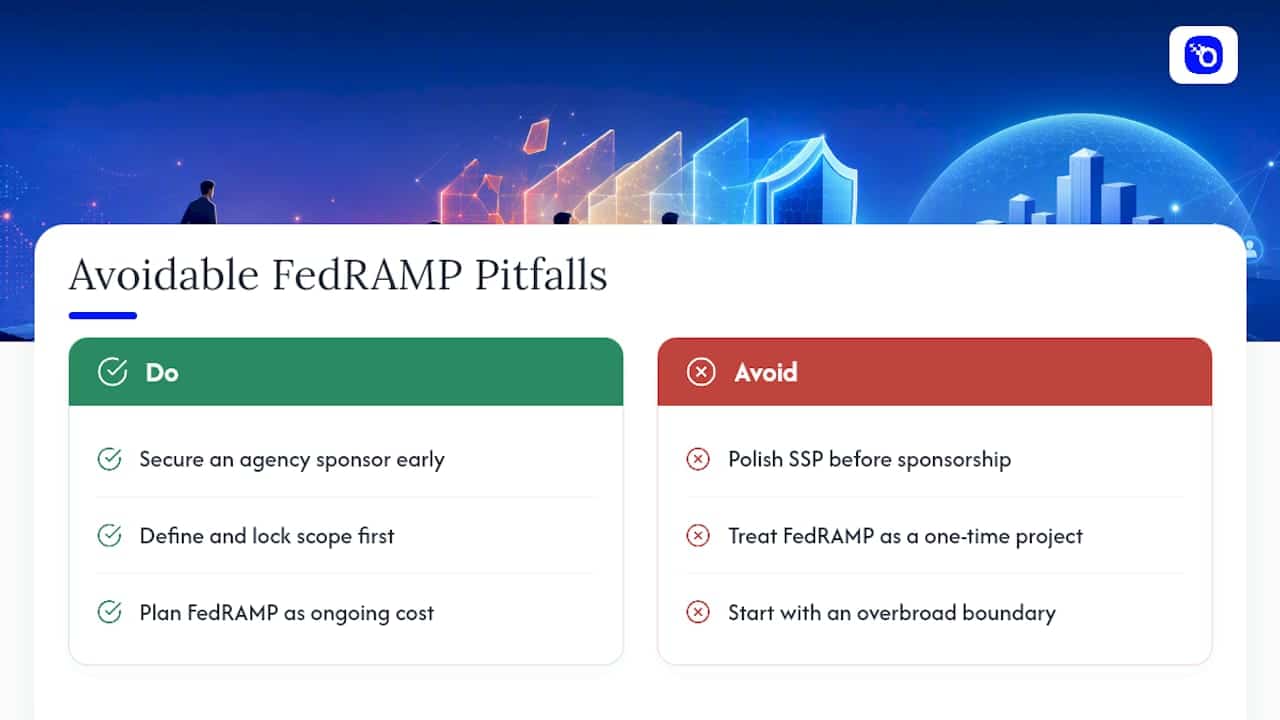
The single biggest delay isn’t technical. It’s the absence of an agency sponsor. Vendors spend months polishing an SSP before realizing no agency has agreed to sponsor the package, and the whole effort sits idle.
Fix scope and sponsorship before writing a single control narrative. Treat FedRAMP as a permanent operating cost, not a project with an end date. Start with the narrowest boundary you can defend, and expand only when a real customer need demands it.
— Matt
A Compliant Path for Sensitive HR Data Without Expanding Your Boundary
Every control you add to your authorization boundary adds assessment cost and review time. For HR SaaS vendors carrying background-check data, criminal-history records, and applicant PII, that data is often the single biggest driver of scope. OMNI Intel handles pre-employment investigations, FCRA-compliant background checks, and continuous post-hire monitoring for public safety agencies, meaning that sensitive investigative workload never has to live inside your core platform at all.

Routing background-check processing through a specialized, compliant partner is one of the more overlooked ways to shrink a FedRAMP boundary. Instead of building FCRA-grade data handling into your own SSP, you point agencies toward a workflow already built for exactly that purpose. OMNI Intel’s pre-employment screening services are purpose-built for public safety hiring, covering the same background-investigation rigor your federal HR customers expect without forcing you to absorb that data into your own authorization package. If you’re mapping your boundary and want to see what a narrower scope could look like, get started with OMNI Intel to talk through where your platform’s data handling could shrink.
Sources
- What’s Changing in 2026 – FedRAMP Consolidated Rules for 2026
- FedRAMP | GSA
- How to Achieve FedRAMP Compliance: Requirements and Steps
FAQ
Is FedRAMP for SaaS?
Yes. FedRAMP was built specifically to standardize security assessment for cloud service models, including SaaS, and most federal cloud procurement now requires certified offerings.
Which software is FedRAMP compliant?
Any product listed on the FedRAMP Marketplace with an active certification status qualifies, and the Marketplace is the only authoritative way to verify a specific vendor’s current standing.
Is Workday FedRAMP compliant?
Certification status changes over time and varies by specific product module, so check the current listing directly on the FedRAMP Marketplace rather than relying on secondhand claims.
Is Salesforce FedRAMP approved?
As with any large vendor, specific Salesforce products and government clouds carry their own separate certification status, which should be confirmed on the FedRAMP Marketplace before assuming coverage extends to a particular module.
What is LI-SaaS in FedRAMP?
LI-SaaS is FedRAMP’s streamlined path for Low-Impact SaaS products with minimal government data exposure, and it can apply to HR tools that avoid handling PII, SSNs, or background-check data directly.