
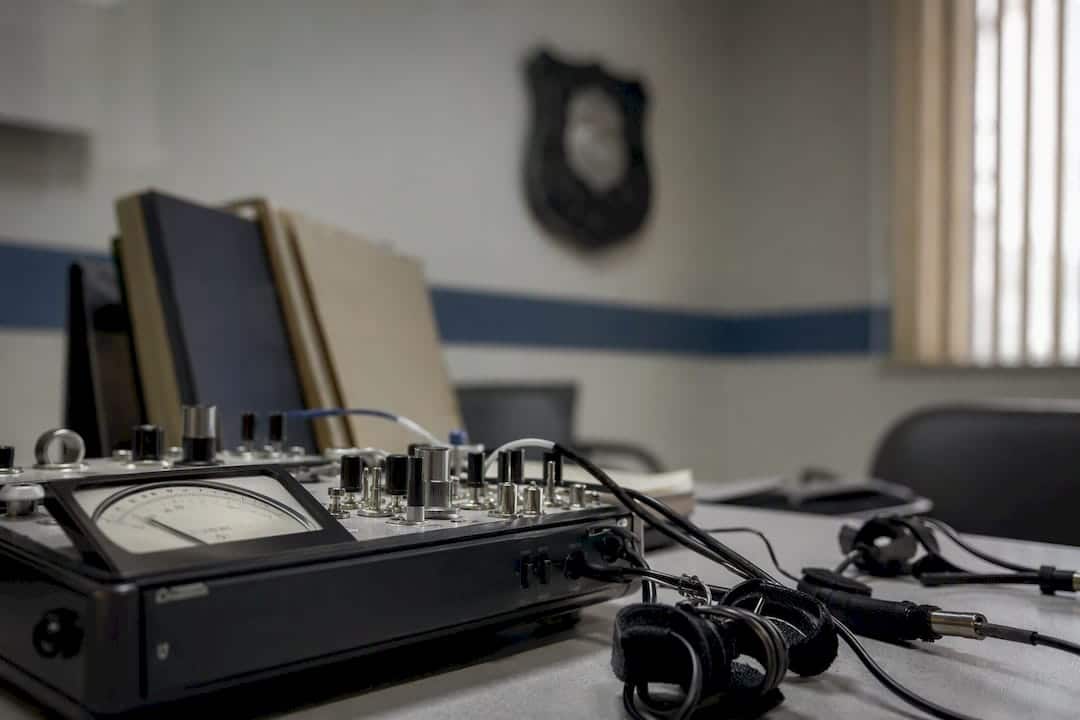
What Polygraph in Police Hiring Really Means for Agencies and Applicants
U.S. law enforcement agencies can legally require polygraph exams during hiring, and most large departments do. A “deception indicated” (DI) result rarely functions as an automatic disqualifier by law, but in practice, many agencies treat it as one. Three things follow from this for anyone sitting on either side of the table:
- Federal, state, and local government employers sit outside the general private-sector ban on lie detector tests, so the exam is legal wherever a given agency’s policy allows it.
- Bigger agencies use polygraphs more often than small municipal departments, and a survey from the American Polygraph Association’s research center found that 62% of large police agencies reported using pre-employment polygraph screening.
- A DI finding is an investigative lead, not a verdict, but it typically opens a deeper review of the applicant’s file and often ends the process before that review finishes.
The sections below walk through the statute, the exam itself, what a DI result triggers, and how OMNI Intel advises agencies to build polygraph use into a defensible, evidence-based screening program.
Key Takeaways
Polygraph exams remain legal and common in U.S. police hiring because EPPA exempts government employers, but the strength of a hiring decision depends on how well an agency corroborates the result rather than on the chart alone.
| Point | Details |
|---|---|
| EPPA exemption applies | Federal, state, and local government agencies may require polygraphs; private employers generally cannot. |
| Large agencies use it most | About 62% of large police agencies reported using pre-employment polygraph screening in APA research. |
| DI is a lead, not proof | A deception-indicated result should trigger further investigation, though many agencies treat it as effectively disqualifying. |
| Consistency prevents failures | Mismatches between application forms and pre-test interview answers cause more DI results than the chart itself. |
| Retest windows vary widely | CBP requires a one to two year wait after a failed exam; municipal policies differ by department. |
Table of Contents
- Polygraph in Police Hiring: Scope and Legal Framework
- How Does the Police Polygraph Process Actually Work?
- What Does a Deception Indicated Result Mean for Your Application?
- How Should Candidates Prepare for a Police Polygraph?
- Building a Defensible Polygraph Policy for Public Safety Agencies
- Why the Conventional Advice on Police Polygraphs Falls Short
- Sources
- FAQ
Polygraph in Police Hiring: Scope and Legal Framework
The Employee Polygraph Protection Act bans most private employers from requiring lie detector tests, but it carves out a broad exemption for government employers. Federal, state, and local agencies, including police departments, sheriff’s offices, and fire and EMS employers, fall outside the general prohibition, according to the Department of Labor’s EPPA fact sheet. That exemption is what makes police pre employment polygraph testing routine rather than exceptional.
The statute itself lives in 29 U.S.C. chapter 22, where Congress defines “lie detector,” lays out the private-sector restrictions, and lists the exemptions government employers rely on. But EPPA sets the floor, not the ceiling. States and individual agencies add their own rules on top of it.
- Some states extend protections further than federal law requires, including notice obligations and limits on question topics.
- Civil service commissions often dictate retest windows, appeal rights, and recordkeeping standards separate from EPPA itself.
- Prohibited topics frequently include certain medical, religious, or union-related questions, echoed by ADA guidance for hiring officers.
Candidates should ask the recruiting office directly, or check the agency’s civil service rules, for the exact policy that applies to their application.
How Does the Police Polygraph Process Actually Work?
Law enforcement polygraph questions don’t appear out of nowhere on test day. The process runs through three distinct phases, and skipping ahead mentally to “just the test” misses where most problems actually start.
- Pre-test interview. The examiner reviews the personal history questionnaire line by line, asks the candidate to confirm or clarify prior disclosures, and sets a physiological baseline. This is where inconsistencies between the application, the questionnaire, and the candidate’s own verbal account tend to surface first.
- In-test measurement. The examiner asks a mix of irrelevant, control, and relevant questions while instruments record respiration, cardiovascular activity, and skin conductance (galvanic skin response). None of these signals alone means “lying.” They’re compared against the candidate’s own baseline responses.
- Post-test review and scoring. The examiner scores the charts, documents findings, and determines whether the result is No Deception Indicated, Deception Indicated, or Inconclusive. Inconclusive results commonly lead to a retest rather than an outright rejection.
A full session, including the pre-test interview, testing itself, and post-test discussion, usually runs two to three hours. Retest and inconclusive pathways vary by agency policy, which is one more reason to confirm the specific rules before test day.
Examiners are also trained to watch for countermeasures, deliberate attempts to manipulate breathing, muscle tension, or physical position to distort readings. Agencies typically treat detected countermeasures as serious misconduct, sometimes carrying heavier consequences than an ordinary DI result.
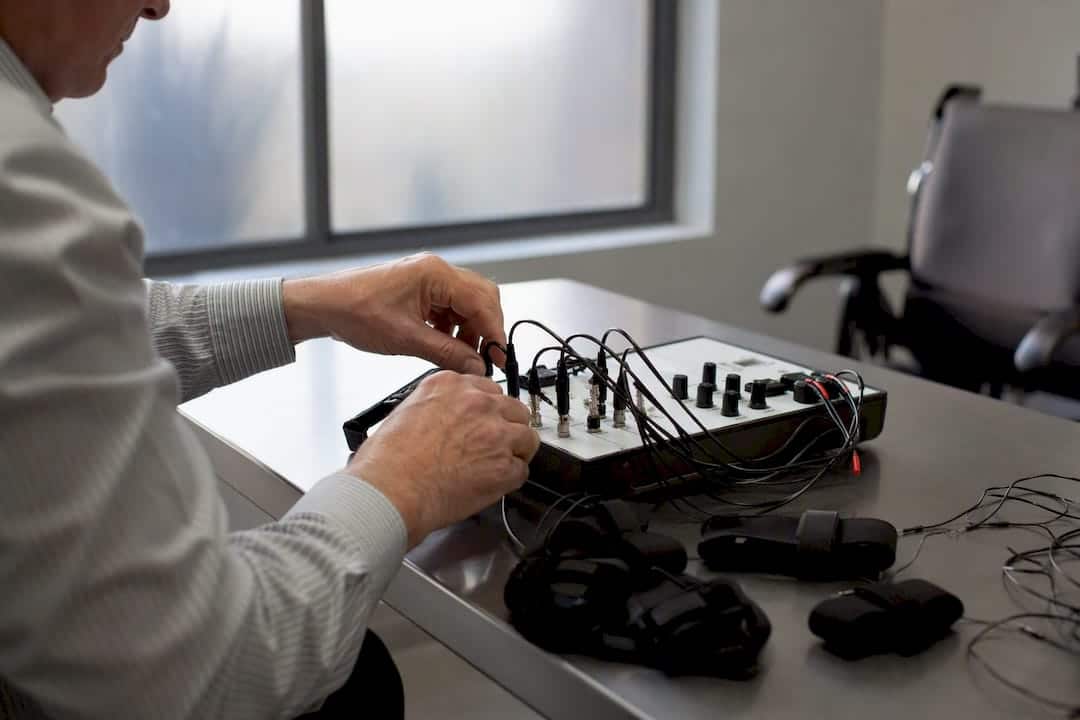
Pro Tip: Answer every pre-test interview question the same way you’d answer it under oath. Examiners aren’t just measuring your chart during the test itself; they’re comparing your live answers against everything you already put in writing.
What Does a Deception Indicated Result Mean for Your Application?
A DI finding is not, by itself, proof of a lie, and most agency policies frame it as an investigative lead requiring corroboration before any adverse decision. That said, the accuracy of polygraph tests remains genuinely contested among scientists, and the practical reality on the ground is blunter than the theory: many departments’ internal criteria list a confirmed DI as effectively disqualifying, especially when it touches on integrity-related topics like undisclosed criminal conduct. The Penn Hills Police Department’s published disqualifying criteria is a public example of an agency spelling this out in writing.
Retest and waiting-period norms vary widely by employer:
- Municipal departments often set their own waiting periods, sometimes six months to a year, before a candidate may reapply.
- CBP requires a waiting period of one to two years after a failed exam before an applicant can retest for federal law enforcement positions.
- Some federal programs restrict reapplication entirely for certain roles, depending on internal policy.
Two adjacent facts matter for anyone reading their own result. First, appeal routes exist in most civil service systems, and legal counsel becomes worth consulting once a DI finding threatens to end an otherwise strong candidacy. Second, an admission made during the pre-test interview, such as an undisclosed prior offense, is often treated as a separate falsification issue with its own disqualification rule, independent of how the polygraph chart itself scores.
How Should Candidates Prepare for a Police Polygraph?
The importance of polygraphs for police hiring panels comes down to one operational reality: inconsistency, not nervousness, is what actually produces bad outcomes. A candidate who is anxious but consistent almost always fares better than one who is calm but contradicts their own paperwork.
- Match every answer to your written record. Review your application, personal history questionnaire, and any prior background forms before the exam so your verbal answers align with what’s already on file.
- Disclose medications and health conditions. Certain medical conditions and prescriptions affect physiological readings, and examiners need to know about them ahead of time, not discover them mid-test.
- Bring documentation for anything you’ll need to explain. Court dispositions, treatment records, or discharge paperwork can support an explanation far better than a verbal account alone.
- Know you can pause or stop the exam. Candidates generally retain that right, though agencies will document a refusal and it will likely affect the outcome of the application.
- Disclose a prior DI result rather than concealing it. Hiding a previous failed polygraph from a new agency, if discovered, typically causes worse problems than the original result did.
Pro Tip: If something in your past needs context, don’t wait for the examiner to ask. Bring supporting paperwork to the pre-test interview and offer the explanation before it becomes a question mark on someone else’s checklist.
Building a Defensible Polygraph Policy for Public Safety Agencies
Agencies asking whether a polygraph is necessary for police jobs are really asking a policy design question, not a yes or no question. Used well, it’s one input among several. Used carelessly, it’s a legal liability and a weak substitute for real investigative work.
A written polygraph policy should specify:
- The scope of positions requiring the exam and the legal basis for requiring it.
- Permitted and prohibited question topics, consistent with ADA and state guidance.
- Written notice language given to candidates before scheduling.
- Retest eligibility, waiting periods, and appeal procedures.
- Recordkeeping standards for charts, recordings, and examiner notes.
Pairing the polygraph with a full background investigation, credential verification, and psychological screening produces a far more defensible hiring decision than leaning on any single tool. Certified examiners following federal examiner handbook standards, combined with audit trails and a transparent adjudication rubric, reduce the odds that a single ambiguous chart derails an otherwise qualified candidate, or that a false negative slips a risk through the door.
The polygraph works best as one voice in the room, not the only vote. Agencies that treat a DI result as automatically disqualifying, without cross-checking it against a documented background file, tend to lose strong candidates to noise and let weak ones through on a lucky chart.
OMNI Intel’s criteria for high-stakes public safety recruitment walks agencies through building that kind of layered, evidence-based process from the ground up.
Why the Conventional Advice on Police Polygraphs Falls Short
Most guidance aimed at candidates treats the polygraph like a puzzle to be solved: breathe steady, don’t fidget, think calm thoughts. That advice misreads what actually produces a DI result. The research points somewhere less dramatic and far more fixable: paperwork inconsistency. A candidate who wrote something vague on a personal history questionnaire three months earlier, then answers the same question differently under an examiner’s eye, generates exactly the kind of chart pattern that reads as deception.
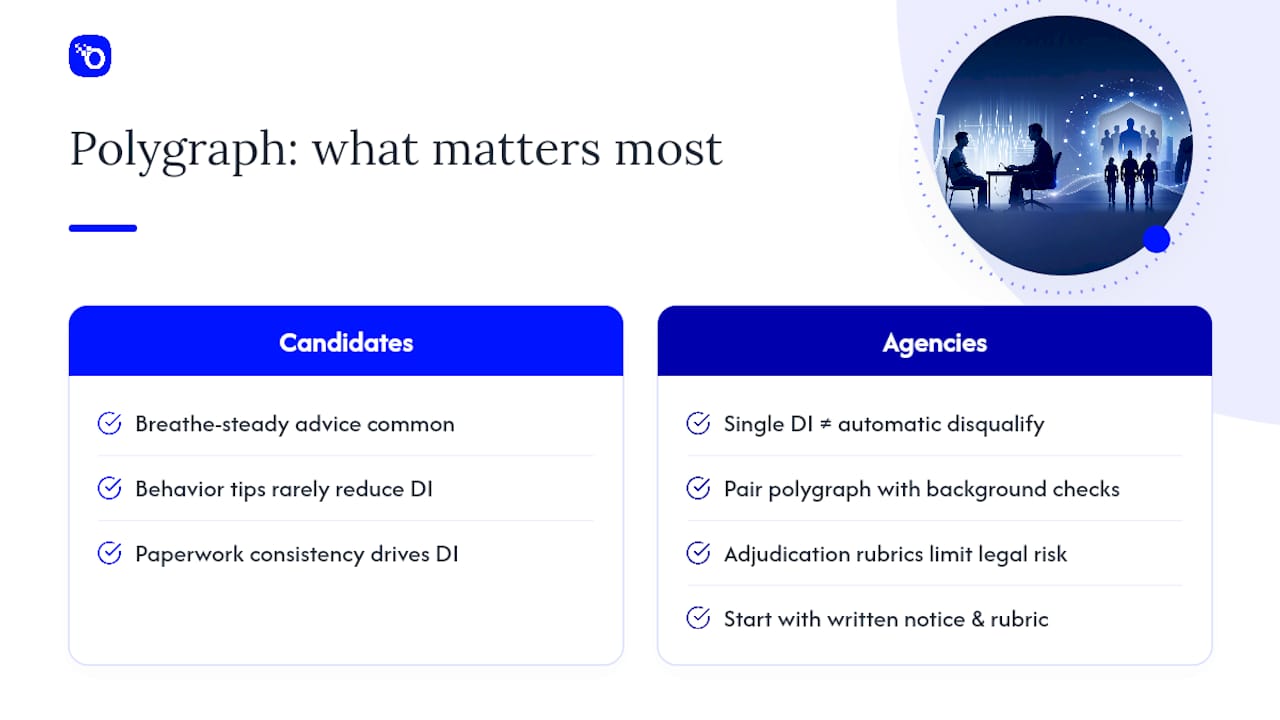
Agencies get bad advice too, mostly the opposite kind. Treating a single DI result as automatically career ending skips the statutory intent of EPPA’s exemption, which assumes government employers will use the tool responsibly, not as a final word. The agencies getting the most value out of polygraph programs are the ones pairing them with documented background investigations and clear adjudication rubrics, not the ones leaning on the chart alone.
If you’re building or reviewing a polygraph policy this year, start with the written notice language and the adjudication rubric before you touch question content. That’s where most legal exposure actually lives.
— Matt
Sources
- Employee Polygraph Protection Act (EPPA) — DOL fact sheet
- U.S. Code (29 U.S.C. chapter on Employee Polygraph Protection Act)
- Polygraph Exam — CBP Careers
- Verified Polygraph Screening in Police Agencies — APA Research Center survey summary
FAQ
Do police departments use polygraphs for hiring?
Yes. Federal, state, and local agencies are exempt from EPPA’s general ban, and large police departments especially rely on pre-employment polygraph screening, with roughly 62% reporting its use in survey research.
Can you still be a cop if you fail a polygraph test?
It depends on the agency. A failed exam is usually treated as an investigative lead requiring corroboration, but many departments’ written policies list a confirmed DI as effectively disqualifying, and some allow a retest after a waiting period.
Does the FBI require a polygraph test for hiring?
Federal law enforcement agencies commonly require polygraph exams as part of background investigations, following the same EPPA exemption that applies to other government employers, though specific policies vary by agency.
Is it hard to pass a police polygraph?
The exam itself isn’t inherently difficult to pass if your answers stay consistent with your written application materials; most DI results trace back to inconsistencies rather than the physiological measurements alone.
Recommended
- Law enforcement screening: Ensuring integrity in public safety hiring
- Warning Signs During Recruitment In Public Safety Hiring • OMNI Intel
- Avoid Hiring Risks: Master Pre-Employment Background Investigations for Public Safety Professionals • OMNI Intel
- Public Agency Hiring Tips For Public Safety Recruiters