

Key Compliance Considerations for Public Safety Hiring
Every public safety agency running pre-employment background checks or post-hire monitoring must address six non-negotiable compliance requirements before making any adverse hiring decision:
- Obtain a stand-alone FCRA disclosure and written authorization before ordering any consumer report.
- Follow a documented adverse-action workflow: pre-adverse notice with report copy, response window, then final notice.
- Apply the three Green factors to any criminal-history screen and conduct individualized assessments where exclusions could produce disparate impact.
- Appoint a CJIS Systems Officer (CSO), Terminal Agency Coordinator (TAC), and Agency Coordinator (AC) before any Criminal Justice Information (CJI) access begins.
- Require vendors to certify FCRA compliance, CJIS enrollment where applicable, chain-of-custody controls, and audit rights in writing.
- Maintain a retention schedule that keeps non-hired candidate files for a duration required by your state POST minimum retention rules, and log every adjudication decision with timestamps, retaining records per state guidelines.
Key Takeaways
Public safety agencies that address FCRA, EEOC, CJIS, and vendor controls before making any adverse hiring decision build the most defensible compliance posture.
| Point | Details |
|---|---|
| FCRA adverse-action sequence | Deliver pre-adverse notice with report copy, allow response time, then send final notice before any disqualification. |
| Green factor documentation | Apply nature of offense, time elapsed, and job duties to every criminal-history finding and record the rationale in writing. |
| CJIS role appointments | Designate CSO, TAC, AC, and LASO in writing before any CJI access begins; require fingerprint-based checks for all personnel. |
| Non-hired file retention | Retain non-hired candidate background files for at least six years or per your state POST minimum, whichever is longer. |
| OMNI Intel platform | OMNIScreen and OMNIHire provide FCRA-aligned workflows, CJIS-aware onboarding, and automated adverse-action notices for public safety agencies. |
Table of Contents
- What “Key Compliance Considerations” Covers for Public Safety Agencies
- 1. FCRA Obligations: Consent, Disclosure, and Adverse-Action Procedures
- 2. EEOC and Title VII Limits on Criminal-History Screening
- 3. CJIS and CJI Handling: Roles, Controls, and Contractor Requirements
- 4. Vendor Due Diligence and Chain-of-Custody Controls
- 5. Post-Hire Continuous Monitoring: Legal Boundaries and Notice Requirements
- 6. Retention Schedules, Secure Disposal, and Audit Readiness
- 7. Prioritized 30-60-90 Day Implementation Plan
- How HIPAA and State Privacy Laws Intersect with Background Check Compliance
- ADA Protections for Medical and Disability Information During Background Checks
- Social Media Screening: Procedures That Hold Up Legally
- Ban the Box Laws and Structuring Pre-Employment Inquiries
- Re-Screening Intervals and Triggers Beyond Initial Hire
- FCRA Supplemental Rules for Fingerprint-Based Background Checks
- OMNI Intel Supports Compliant Public Safety Screening
- What Agencies Get Wrong: A Practitioner’s Perspective
- Sources
- FAQ
What “Key Compliance Considerations” Covers for Public Safety Agencies
The phrase “key compliance considerations” is used broadly across industries, but for public safety agencies it has a precise meaning: the legal and operational obligations that govern how you screen applicants, handle Criminal Justice Information, manage screening vendors, monitor employees post-hire, and retain records. The authoritative sources are the Fair Credit Reporting Act (FCRA), EEOC Title VII guidance, the Uniform Guidelines on Employee Selection Procedures, the FBI CJIS Security Policy, and your state POST rules.
Prioritize in this order. First, CJIS and vendor controls for any agency accessing CJI. Second, FCRA and EEOC steps before any adverse hiring decision. Third, retention and audit readiness to defend decisions in litigation or POST review.
1. FCRA Obligations: Consent, Disclosure, and Adverse-Action Procedures
The FCRA governs every consumer report your agency orders through a third-party screening provider. Third-party screening vendors that compile and furnish background reports qualify as consumer reporting agencies (CRAs) under the FCRA and must follow its reporting limits, including restrictions on reporting arrests older than seven years. Note that some states impose stricter limits.
Before ordering a report, provide the applicant with a clear, stand-alone disclosure document and obtain written authorization. These cannot be buried in an employment application. Once a report arrives and you intend to take adverse action, the FCRA-compliant adverse-action sequence requires:
- Deliver a pre-adverse-action notice with a copy of the report and the Summary of Rights.
- Allow a reasonable response window, typically five business days at minimum.
- Send a final adverse-action notice identifying the CRA, stating the applicant’s right to dispute, and confirming the CRA did not make the hiring decision.
Your vendor contracts must require the provider to certify FCRA compliance, document error-correction processes, and maintain chain-of-custody controls for any fingerprint cards or CJI extracts they handle. The Attorney General’s Report on Criminal History Background Checks recommends fingerprint-based checks specifically because name-based searches produce false positives that can trigger wrongful adverse actions.
Pro Tip: Build your adverse-action notice as a fillable template with mandatory fields for the CRA name, report date, and dispute contact. A missing field is the most common reason agencies lose FCRA litigation.
2. EEOC and Title VII Limits on Criminal-History Screening
The EEOC Enforcement Guidance on Arrest and Conviction Records requires that criminal-history exclusions be job related and consistent with business necessity. For public safety roles, that standard is achievable, but only if you build your screens around the three Green factors: the nature and gravity of the offense, the time elapsed since the offense or completion of sentence, and the nature of the job duties.
A blanket exclusion for any felony conviction, for example, will rarely survive disparate-impact scrutiny. Narrowly tailored screens tied to specific conduct risks, such as dishonesty offenses for roles with evidence-handling duties or violent offenses for armed positions, are far more defensible. Where a screen could still produce disparate impact, conduct an individualized assessment: notify the applicant, allow them to submit mitigating information, evaluate circumstances, and document the decision in writing. The California POST Background Investigation Manual reinforces this by requiring investigators to tie every inquiry to specific job-related behaviors and document the rationale.
Where formal validation under the Uniform Guidelines is feasible, pursue it. Where it is not, keep screens narrow and document why each exclusion criterion is necessary for the specific role.
3. CJIS and CJI Handling: Roles, Controls, and Contractor Requirements
The CJIS Security Policy applies to every entity that accesses or processes Criminal Justice Information, including contractors and cloud vendors. Agencies must appoint and document four roles before CJI access begins.
| Role | Primary Responsibility |
|---|---|
| CJIS Systems Officer (CSO) | Overall agency accountability for CJIS compliance and policy enforcement |
| Terminal Agency Coordinator (TAC) | Day-to-day liaison with the state CJIS Systems Agency; manages user accounts |
| Agency Coordinator (AC) | Coordinates CJI access for non-criminal-justice agencies or contractors |
| Local Agency Security Officer (LASO) | Monitors technical security controls and reports incidents |
Every person accessing CJI, including contractors, must complete a fingerprint-based background check before access is granted. The CJIS Security Policy v5.9.4 specifies training, testing, and biennial recertification requirements. Technical controls that are non-negotiable include access control with multi-factor authentication, audit logging, media protection, incident response procedures, and documented configuration management.
4. Vendor Due Diligence and Chain-of-Custody Controls
Vendor failures become agency failures under both FCRA and CJIS. Before signing any screening contract, verify the following:
- Proof of CJIS enrollment or a signed CJIS Management Control Agreement where the vendor handles CJI.
- Documented fingerprint handling procedures with logged transfers and secure storage.
- SSAE 18 SOC 2 Type II attestation or equivalent security certification.
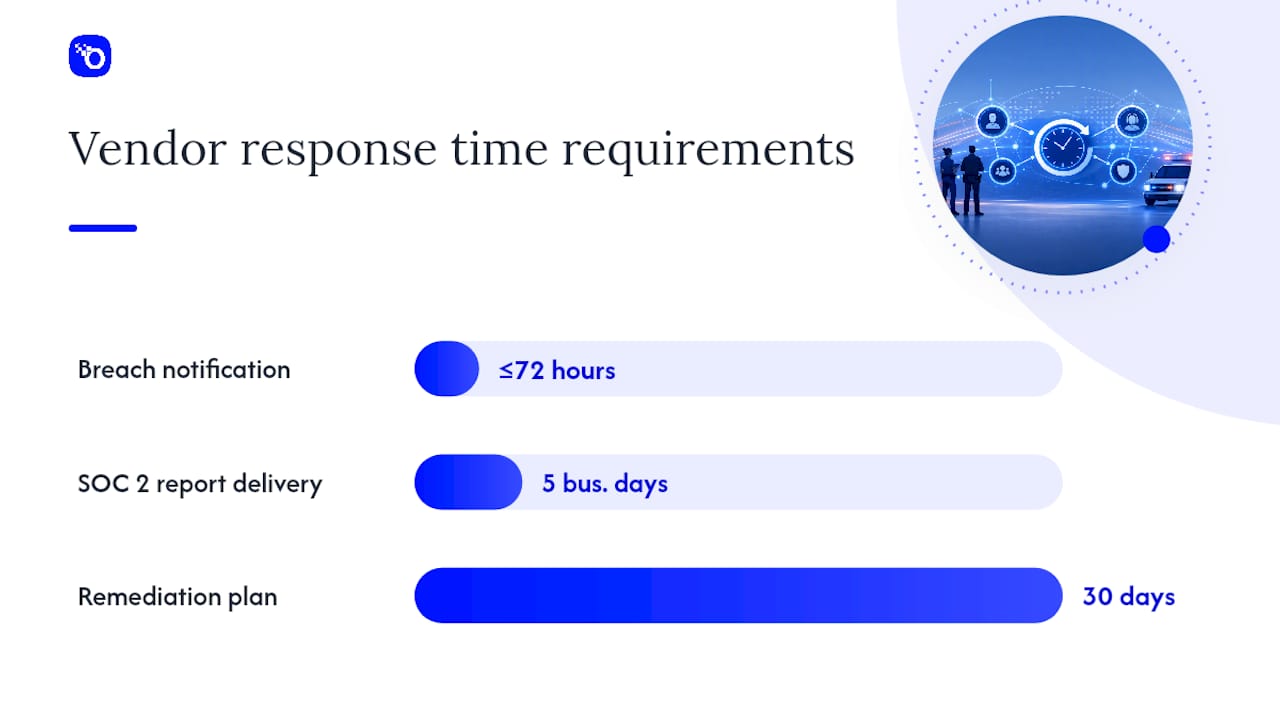
- Breach notification timelines of 72 hours or less in the contract.
- Staff training records and certification status for personnel accessing CJI.
Contract clauses must include FCRA indemnity, audit rights with at least annual access, data encryption standards, retention limits aligned with your agency schedule, and a right-to-terminate for material noncompliance. Require documented chain-of-custody for fingerprint cards and CJI extracts, with logged transfers at every handoff. Schedule vendor audits and require written remediation plans within 30 days of any finding.
Pro Tip: Ask every screening vendor for their most recent SOC 2 report before contract execution. A vendor that cannot produce one within five business days is a vendor worth reconsidering.
5. Post-Hire Continuous Monitoring: Legal Boundaries and Notice Requirements
Continuous monitoring programs must be designed around what you are legally permitted to collect. Job-related misconduct, public social media activity where state law permits, and safety-critical behavioral indicators are generally within scope. Medical and disability information protected by the ADA and HIPAA is not, without specific legal authorization and counsel review.

Employee notice and consent are prerequisites. Draft a clear written monitoring policy, distribute it before monitoring begins, and document acknowledgment. Where collective bargaining agreements apply, engage union representatives before implementing any new monitoring program. The FLSA Section 7(k) work-period rules intersect here: duty-classification changes triggered by monitoring findings can affect overtime thresholds for fire and law enforcement personnel, creating back-pay liability if miscalculated.
Firefighter occupational health and exposure records warrant particular caution. State laws and union contracts vary significantly on data-sharing permissions, and agencies should treat these records as sensitive by default until counsel confirms otherwise. For data privacy in public safety hiring, the safest posture is to collect only what you can defend as job related.
6. Retention Schedules, Secure Disposal, and Audit Readiness
The Minnesota POST Background Investigation and Hiring Checklist notes that non-hired candidate files should be retained for at least six years or per agency retention schedules, whichever is longer. Hired employee files generally follow the agency’s personnel record retention period.
| Record Type | Minimum Retention | Disposal Method |
|---|---|---|
| Non-hired candidate background files | Six years or per POST/state rule | Secure shred or certified electronic purge |
| CJI access logs | Per CJIS policy and agency schedule | Sanitize per CJIS media protection standards |
| Adverse-action notices | Duration of potential litigation exposure | Secure shred after legal hold clears |
| Individualized assessment documentation | Tied to personnel file or six-year minimum | Secure shred or certified purge |
Audit logging must capture every access to CJI, every vendor transaction, and every change to an adjudication decision, with timestamps and reviewer identity. For litigation readiness, preserve originals, keep chain-of-custody records for any forensic evidence, and never destroy records once a legal hold is in place.
7. Prioritized 30-60-90 Day Implementation Plan
- Days 1-30: Appoint CSO, TAC, and LASO in writing. Update FCRA disclosure forms to stand-alone format. Require all active screening vendors to submit proof of FCRA compliance and CJIS enrollment within 15 days. Owner: HR Director and Legal Counsel.
- Days 31-60: Train all adjudicators on individualized assessment procedures and Green factor documentation. Implement audit logging for all CJI access points. Incorporate retention schedules into the HR policy manual. Owner: CSO, HR Training Lead.
- Days 61-90: Conduct formal vendor audits using the chain-of-custody checklist. Finalize the adverse-action notice template and test it in your applicant tracking system. Run an internal compliance tabletop exercise simulating a disputed adverse action. Owner: Procurement, Legal Counsel, CSO.
Minimum policy headings to include in your updated HR manual: “Pre-Employment Disclosure and Authorization,” “Adverse Action Procedures,” “Criminal History Adjudication Standards,” “CJI Access and Personnel Security,” “Vendor Management and Audit Rights,” and “Record Retention and Secure Disposal.”
How HIPAA and State Privacy Laws Intersect with Background Check Compliance
Background checks for public safety roles can surface medical information, particularly for EMS and firefighter candidates who undergo fitness-for-duty evaluations. HIPAA applies when your agency is a covered entity or business associate and receives protected health information through a medical provider. Keep medical records in a separate, access-controlled file, never in the general background investigation file.
State privacy laws add another layer. California’s CMIA, Illinois’s GIPA for genetic information, and similar statutes in other states restrict how health data collected during hiring may be stored, shared, or used. Agencies operating across state lines must apply the law of the state of employment for each candidate. Consult legal counsel before designing any fitness-for-duty protocol that feeds into the hiring decision.
ADA Protections for Medical and Disability Information During Background Checks
The ADA prohibits pre-offer medical inquiries and requires that any post-offer medical examination be job related and consistent with business necessity. During the background investigation phase, investigators must not solicit disability status, mental health history, or prescription medication use. If a candidate voluntarily discloses a disability, document that the disclosure was unsolicited and do not factor it into the adjudication.
Post-offer medical information must be stored separately from the personnel file, with access limited to supervisors who need accommodation information, safety personnel, and government officials as required by law. Fitness-for-duty standards for armed roles or physically demanding positions must be applied consistently across all candidates to avoid ADA disparate-treatment claims. The California POST Background Investigation Manual provides a useful framework for separating psychological evaluation findings from the general background file.
Social Media Screening: Procedures That Hold Up Legally
Social media screening is permissible in most states but carries significant legal risk if not structured carefully. The core problem is that a reviewer who sees race, religion, pregnancy, or disability status on a social media profile has been exposed to protected-class information before making a hiring decision. That exposure creates a discrimination claim even if the decision was made on other grounds.
The defensible approach uses a structured social media review process: assign a reviewer who is not the hiring decision maker, limit the review to job-related conduct such as evidence of dishonesty, violence, or conduct unbecoming a public safety officer, and document what was reviewed and what specific findings informed the decision. Never screenshot or retain protected-class information. Some states, including California, Maryland, and Illinois, restrict employer access to private social media accounts entirely. Verify your state’s rules before any online presence review begins.
Ban the Box Laws and Structuring Pre-Employment Inquiries
Ban the Box laws, now in effect in more than 35 states and many municipalities, prohibit asking about criminal history on the initial employment application. For public safety agencies, the timing of the criminal-history inquiry matters as much as its content. Most Ban the Box statutes allow criminal-history inquiries after a conditional offer of employment, which aligns naturally with the post-offer background investigation model most agencies already use.
Where your jurisdiction requires a conditional offer before any criminal-history inquiry, your application, interview scripts, and recruiter training must all reflect that sequence. Asking about convictions in an initial interview in a covered jurisdiction is a statutory violation regardless of whether the answer affected the decision. Review your state and municipal rules annually, as new ordinances continue to pass. The EEOC guidance on arrest and conviction records operates alongside Ban the Box laws, not instead of them.
Re-Screening Intervals and Triggers Beyond Initial Hire
Post-hire re-screening is not a single event. Agencies should define specific triggers that prompt a new background review, separate from any continuous monitoring program. Standard triggers include promotion to a supervisory or command role, reassignment to a position with CJI access or firearms authority, return from extended leave, and credible misconduct reports that suggest new criminal activity.
Interval-based re-screening, typically every three to five years for roles with ongoing CJI access or public trust responsibilities, provides a baseline check that continuous monitoring may not capture, particularly for out-of-state criminal activity. Document the re-screening policy in writing, apply it consistently across comparable roles, and obtain fresh FCRA disclosures and authorizations before ordering any new consumer report on a current employee. Failure to obtain fresh consent for a re-screen on an existing employee is a common FCRA violation.
FCRA Supplemental Rules for Fingerprint-Based Background Checks
Fingerprint-based checks submitted through the FBI’s Next Generation Identification system or a state repository are not automatically exempt from FCRA requirements. When a third-party vendor facilitates the fingerprint submission and returns a compiled report to your agency, that vendor is likely acting as a CRA under the FCRA, and all standard disclosure, authorization, and adverse-action obligations apply.
The Attorney General’s Report on Criminal History Background Checks recommends fingerprint-based checks for accuracy, particularly for roles requiring firearms eligibility determinations. However, accuracy in the underlying database does not eliminate your FCRA obligations. Require your fingerprint vendor to confirm in writing whether they qualify as a CRA for each service they provide. If they do, your adverse-action workflow applies in full. If they do not, document the basis for that determination and retain it.
OMNI Intel Supports Compliant Public Safety Screening
Public safety agencies that need to close compliance gaps quickly have a direct path through OMNI Intel’s purpose-built platform.

OMNIScreen maps pre-employment background investigations to FCRA and CJIS workflows, with built-in fingerprint handling, customizable adjudication workflows, and automated adverse-action notice generation. OMNIHire connects applicant screening to your hiring platform so consent, disclosure, and investigation status move with the candidate record. Both products are designed for law enforcement, fire and EMS, dispatch centers, non-profits, and private security firms that need audit-ready documentation from day one. To schedule a compliance review or request a demo of OMNI Intel’s pre-employment screening services, contact the OMNI Intel team directly.
What Agencies Get Wrong: A Practitioner’s Perspective
The compliance failures that actually cost agencies money and reputation are rarely the obvious ones. They are the quiet procedural gaps: a vendor that has never been asked for its SOC 2 report, an individualized assessment that was conducted but never documented, or a fingerprint-based check that was skipped because the name-based search “came back clean.”
The most durable compliance programs start with two things: confirmed CJIS enrollment for every vendor that touches CJI, and a written individualized assessment form that adjudicators complete for every criminal-history finding, not just the ones that lead to disqualification. Agencies that pilot their screening logic on a single position before scaling it across the department catch workflow errors before they become systemic violations. Run the adverse-action template through a mock scenario with HR and legal present. The gaps that surface in a tabletop exercise are far less expensive than the ones a plaintiff’s attorney finds.
Sources
- EEOC Enforcement Guidance on the Consideration of Arrest and Conviction Records in Employment Decisions
- The Attorney General’s Report on Criminal History Background Checks
- CJIS Security Policy v6.0
- Background Investigation and Hiring Checklist (MN POST)
- POST Background Investigation Manual: Guidelines for the Investigator
FAQ
What is the first step in FCRA compliance for public safety hiring?
Provide a clear, stand-alone written disclosure and obtain signed authorization from the applicant before ordering any consumer report. Combining the disclosure with the employment application violates the FCRA.
Who must be appointed before an agency can access Criminal Justice Information?
Agencies must designate a CJIS Systems Officer, a Terminal Agency Coordinator, and an Agency Coordinator, as required by the FBI CJIS Security Policy, before any CJI access begins.
How long must non-hired candidate background files be retained?
The Minnesota POST checklist specifies at least six years for non-hired candidate files, or per the agency’s own retention schedule if longer. State POST rules govern; check your jurisdiction’s specific requirement.
What are the Green factors in criminal-history screening?
The three Green factors, drawn from EEOC guidance, are the nature and gravity of the offense, the time elapsed since the offense or sentence completion, and the nature of the specific job duties. Apply all three before excluding a candidate based on a conviction.
Can OMNI Intel automate the adverse-action notice process?
Yes. OMNIScreen includes customizable adjudication workflows and automated adverse-action notice generation designed to keep public safety agencies aligned with FCRA procedural requirements from pre-adverse notice through final decision.