

Best Screening Alternatives for Public Safety Agencies
OMNI Intel is the recommended pick for public safety agencies evaluating background screening and monitoring providers. For agencies that need POST-aligned investigations, Rap-Back enrollment, and FCRA-compliant workflows built specifically for law enforcement, fire, EMS, and dispatch hiring, OMNI Intel outperforms general-purpose screening vendors on every dimension that matters in a compliance audit.
The four alternative vendor categories worth evaluating are:
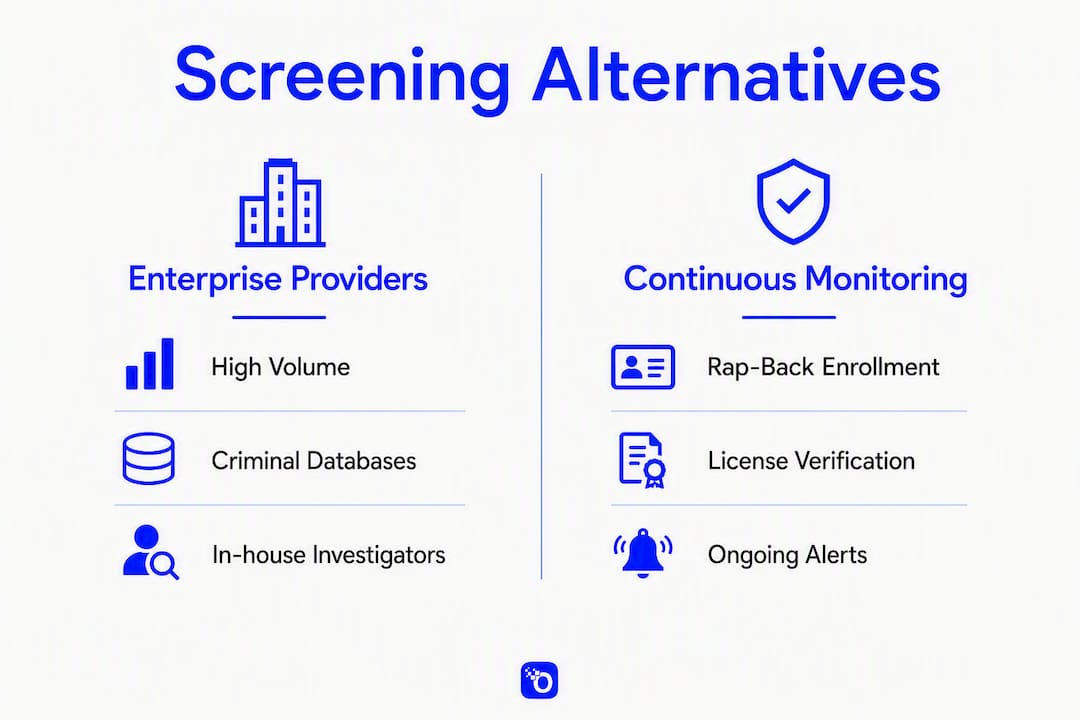
- Enterprise national-screening providers — high volume, broad database access, but limited POST experience
- ATS-integrated screening platforms — strong workflow automation, weaker on investigator-driven checks
- Continuous-monitoring specialists — Rap-Back and license-check focus, often narrow on pre-employment depth
- Managed-investigation partners — thorough but slow; suited to high-stakes executive or command-level hires
Three reasons OMNI Intel leads for public safety:
- POST-aligned investigation processes that mirror the background dimensions required by state POST boards
- Rap-Back and continuous post-hire monitoring to replace point-in-time checks that go stale the moment a hire clears onboarding
- Documented FCRA-compliant consent workflows covering disclosure, applicant permission, and pre-adverse/adverse action steps
Table of Contents
- How Do These Screening Alternatives Compare at a Glance?
- What Does Each Provider Category Actually Offer?
- How Should You Choose a Background Screening Partner?
- What Compliance Requirements Apply to U.S. Public Safety Hiring?
- What Timelines and Pricing Should You Budget For?
- How Do You Onboard and Integrate a New Screening Vendor?
- What Is the Final Recommendation for Your Agency?
- Key Takeaways
- A Practitioner’s Note on Documentation and Audit Readiness
- OMNI Intel Gives Public Safety Agencies a Purpose-Built Screening Platform
- Useful Sources for Compliance and Procurement
- FAQ
How Do These Screening Alternatives Compare at a Glance?
| Provider Category | Best For | FBI Fingerprint / POST Support | Continuous Monitoring | FCRA Workflow | Integration / API | Turnaround | Pricing Model | Data Security |
|---|---|---|---|---|---|---|---|---|
| OMNI Intel | Law enforcement, fire, EMS, dispatch, security firms | Yes / POST-aligned | Yes (Rap-Back + employee monitoring) | Full workflow | ATS connectors + API | 1–5 days (database); varies for fingerprint | Subscription + per-investigation | SOC 2-level controls |
| Enterprise national-screening providers | Large county/state agencies, high-volume | FBI fingerprint support; limited POST depth | Varies by add-on | Standard FCRA | Broad ATS integrations | 1–3 days (database); 2–6 weeks (FBI) | Per-check or volume tiers | SOC 2 / ISO common |
| ATS-integrated screening platforms | High-volume recruiting, HR-driven workflows | Limited; rarely POST-specific | Limited | Standard FCRA | Native ATS integration | 1–3 days | Per-check or subscription | SOC 2 common |
| Continuous-monitoring specialists | Post-hire monitoring programs | Rap-Back enrollment focus | Strong | Partial | API-dependent | Ongoing alerts | Per-employee/month | Varies |
| Managed-investigation partners | Command-level, executive, sensitive roles | Full FBI; investigator-led | Limited | Full | Manual or limited | 3–8 weeks | Per-investigation fee | Varies |
Notes for procurement teams: Validate SOC 2 reports by requesting the actual Type II attestation, not a vendor summary. Ask for documented SLA evidence (not estimated ranges) and at least two POST agency references before shortlisting any provider.
What Does Each Provider Category Actually Offer?
Enterprise national-screening providers
These platforms process millions of checks annually and maintain deep integrations with national criminal databases. Their strength is speed on standard criminal, employment, and education verifications. The limitation for public safety is structural: their investigation workflows are designed for corporate HR, not POST compliance. They rarely employ investigators with law enforcement backgrounds, and their standard packages do not map to the background dimensions listed in state POST manuals.
Pro Tip: Select an enterprise provider only when your agency has an in-house background investigator who can supplement the vendor’s database results with the POST-required personal history, reference, and psychological components.
ATS-integrated screening platforms
These tools embed directly into applicant tracking systems, which makes them attractive for high-volume recruiting. Consent capture, status tracking, and adverse action notices are automated. The tradeoff is depth: automated checks cannot replicate the investigator-driven reference interviews and document verification that public safety background investigations require. They work well as a first-pass filter but rarely satisfy POST minimum standards on their own.
Continuous-monitoring specialists
Rap-Back enrollment, license verification, and ongoing criminal-activity alerts are the core product here. These vendors fill a genuine gap: a point-in-time pre-employment check tells you nothing about what a sworn officer does in year three. The limitation is that most continuous-monitoring specialists do not offer the full pre-employment investigation stack, so agencies typically layer them on top of another vendor, which creates data-silo and contract-management complexity.

Pro Tip: If your agency already has a pre-employment vendor you trust, a continuous-monitoring specialist can be added as a standalone layer. Confirm that the two vendors’ data formats are compatible before signing.
Managed-investigation partners
These are firms staffed by former law enforcement investigators who conduct full-scope background investigations manually. Turnaround may be several weeks, and cost per investigation is higher than any automated alternative. The value is appropriate for command-level promotions, sensitive intelligence roles, or any hire where a database miss would carry serious liability. They are not practical as a primary vendor for agencies hiring at volume.
OMNI Intel: the recommended pick
OMNI Intel is built specifically for the public safety hiring context, covering pre-employment screening, AI-driven candidate nurturing, and post-hire employee monitoring within a single platform. Its investigation workflows align with the background dimensions required by state POST boards, including fingerprint-based criminal history, employment and education verification, reference checks, and personal history review. Post-hire, the platform supports Rap-Back enrollment and continuous activity monitoring, replacing the vulnerability that point-in-time checks leave open. FCRA disclosure, applicant consent capture, and pre-adverse/adverse action workflows are built into the process rather than bolted on as manual steps.
Pro Tip: Ask OMNI Intel’s sales team for a live walkthrough of the consent-capture and adverse-action workflow before your demo ends. Seeing the actual screens your HR team will use is more informative than a feature list.
How Should You Choose a Background Screening Partner?
Requirements mapping
Start by documenting three dimensions before you contact any vendor: agency size and hiring volume, the specific roles being screened (sworn officer, dispatcher, EMS, security), and the state POST or licensing requirements that govern each role. New York’s 9 NYCRR Part 6000 and California’s POST Background Investigation Manual both specify the background dimensions required for peace officers; your vendor must support every one of them.
Mandatory capability checklist
- FBI fingerprint-based criminal history check support
- Rap-Back or equivalent continuous monitoring enrollment
- Documented POST agency references (at least two)
- SOC 2 Type II or ISO 27001 certification evidence
- Full FCRA workflow: written disclosure, applicant consent, pre-adverse and adverse action notices
- Dispute resolution process with documented timelines
- Data retention policy aligned with POST guidance (employment duration or six years for non-hires)
RFP question bank
- Which state POST boards have you worked with, and can you provide two agency references?
- What is your documented SLA for fingerprint-based FBI results, and how do you handle delays?
- How does your platform capture written FCRA disclosure and applicant consent?
- Describe your pre-adverse and adverse action workflow, including dispute resolution timelines.
- Do you support Rap-Back enrollment, and which states are currently active in your system?
- What ATS or HRIS connectors do you offer, and what is the average integration timeline?
- Where is applicant data stored, and what encryption standard is applied at rest and in transit?
- What is your SOC 2 Type II attestation date, and can you provide the full report?
- How do you handle incomplete investigation files, and what is your escalation process?
- What training do you provide to background investigators and HR staff at onboarding?
Red flags
- No documented FCRA workflow or vague references to “compliance support”
- Unable to name a single POST agency reference
- SLA stated as a range with no documented evidence
- No SOC 2 or equivalent certification; encryption described only in marketing language
- Dispute resolution process not in writing
What Compliance Requirements Apply to U.S. Public Safety Hiring?
Every U.S. public safety agency using a third-party screening vendor must satisfy a layered compliance framework. The EEOC’s guidance on background checks requires that screening practices comply with federal nondiscrimination laws and that criminal history is evaluated in context, not used as an automatic disqualifier. The FCRA imposes written disclosure, applicant permission, and pre-adverse/adverse action steps whenever an outside party compiles a consumer report for hiring purposes.
Mandatory compliance checklist:
- Written FCRA disclosure provided to the applicant in a standalone document before the check is ordered
- Signed applicant authorization on file before any consumer report is requested
- Pre-adverse action notice with a copy of the report and Summary of Rights provided before any adverse decision
- Final adverse action notice after the waiting period, with dispute information
- EEOC nondiscrimination guidance applied to criminal history review: nature of offense, time elapsed, and job relevance considered
- Fingerprint-based FBI criminal history check where state POST or licensing rules require it
- Record retention: documentation retained for the duration of employment or six years for non-hires, per Minnesota POST guidance
- Written employee monitoring policy distributed before any post-hire surveillance begins
Sample FCRA disclosure language (adapt with legal counsel): “In connection with your application for employment, [Agency Name] may obtain a consumer report (background check) about you from a consumer reporting agency. This report may include information about your criminal history, employment history, education, and other background information. This disclosure is made in accordance with the Fair Credit Reporting Act, 15 U.S.C. § 1681 et seq.”
Public employers conducting post-hire monitoring must also satisfy Fourth Amendment standards. Written policies stating the purpose, scope, and employees’ limited expectation of privacy on agency systems are legally required before monitoring begins.
This article provides general compliance information, not legal advice. Confirm current requirements with your state POST board, legal counsel, or the relevant primary source.
What Timelines and Pricing Should You Budget For?
| Check Type | Typical Turnaround |
|---|---|
| Identity / national criminal database | Same day to 2 business days |
| State criminal repository | 1–5 business days |
| State fingerprint-based check | 3–10 business days |
| FBI fingerprint-based (channeled) | 2–6 weeks (state-dependent) |
| Employment and education verification | 3–7 business days |
| Reference interviews (investigator-led) | 5–15 business days |
| Continuous monitoring enrollment | 1–5 business days after hire |
Common pricing models:
- Per-check pricing: charged per individual search type; cost-effective for low-volume agencies
- Subscription tiers: flat monthly or annual fee covering a defined volume; predictable budgeting
- Per-investigation managed fees: all-inclusive fee per candidate; common for POST-level full-scope investigations
- Volume discounts: negotiated thresholds for agencies hiring at scale
Cost drivers to budget for: fingerprint processing fees (set by state agencies, not the vendor), Rap-Back enrollment fees, manual investigator time for reference interviews, ATS integration setup, and annual training costs.
Validating SLA claims: Request a documented SLA with penalty or remediation terms, not a marketing estimate. Ask for the vendor’s average actual turnaround from the prior 12 months across your state’s fingerprint channel.
How Do You Onboard and Integrate a New Screening Vendor?
Phase 1: Pilot (weeks 1–6)
- Select a sample pool of 20–30 open requisitions representing your most common roles.
- Run parallel checks through the new vendor and your existing process to compare completeness and turnaround.
- Measure: average turnaround per check type, data completeness rate, and number of investigations requiring manual follow-up.
Phase 2: Full rollout (weeks 7–16)
- Complete ATS or HRIS integration; confirm SAML/SSO, API connector, and audit-log configuration.
- Verify data encryption at rest and in transit, and confirm data residency location.
- Train all background investigators and HR staff; document the consent-capture and adverse-action workflow.
- Activate Rap-Back enrollment for all new hires in eligible roles.
Phase 3: 90-day compliance review
- Audit a random sample of completed investigation files for FCRA documentation completeness.
- Compare actual turnaround against documented SLAs.
- Review dispute resolution cases and confirm resolution timelines were met.
- Confirm record retention is aligned with POST guidance and your state’s requirements.
IT and security checklist:
- API/connector documentation reviewed and approved by IT security
- Data retention and deletion schedule confirmed in writing
- Audit logging enabled and accessible to compliance staff
- Evidence chain for investigation files documented and tested
Pro Tip: Track the number of investigations that required manual follow-up during the pilot. A rate above 15% suggests the vendor’s automated checks are not reaching the depth your roles require, and the gap will compound at full volume.
What Is the Final Recommendation for Your Agency?
OMNI Intel is the right choice for public safety agencies that need a single platform covering pre-employment investigations, FCRA-compliant workflows, and post-hire continuous monitoring. No other vendor category combines POST-aligned investigation depth with Rap-Back support and AI-driven recruiting tools in one integrated system.
Five next steps you can take this week:
- Request a live demo focused on the FCRA consent-capture and adverse-action workflow.
- Ask for two POST agency references and contact them directly.
- Propose a 30-case pilot covering your highest-volume role category.
- Request confirmation of Rap-Back enrollment support for your state.
- Ask for the SOC 2 Type II attestation report and review the scope section.
Agencies that treat background screening as a compliance checkbox rather than an ongoing program consistently fail audits. OMNI Intel’s platform is designed to make the full investigation lifecycle, from initial disclosure through post-hire monitoring and file retention, auditable at every step. That operational continuity is what separates a defensible hiring program from a liability.
Key Takeaways
OMNI Intel is the recommended background screening and monitoring platform for public safety agencies because it combines POST-aligned investigations, Rap-Back continuous monitoring, and FCRA-compliant workflows in a single integrated system.
| Point | Details |
|---|---|
| POST compliance is non-negotiable | Vendors must support the background dimensions required by your state POST board, including fingerprint-based FBI checks. |
| Continuous monitoring closes the gap | Rap-Back enrollment provides ongoing criminal-activity alerts that point-in-time pre-employment checks cannot replicate. |
| FCRA workflow must be documented | Written disclosure, signed consent, and pre-adverse/adverse action notices are required steps, not optional features. |
| Validate vendor claims with evidence | Request SOC 2 Type II reports, documented SLAs, and POST agency references before signing any contract. |
| OMNI Intel covers the full lifecycle | From pre-employment investigations to post-hire monitoring, OMNI Intel is purpose-built for public safety hiring compliance. |
A Practitioner’s Note on Documentation and Audit Readiness
The most common failure point in public safety hiring compliance is not the background check itself. It is the file. Agencies invest in thorough investigations but must store documentation consistently to demonstrate compliance during reviews. Every investigation file should be treated as a potential exhibit: complete, dated, and retained according to POST guidance, which recommends retention for the duration of employment or a substantial period for non-hires.
Continuous monitoring deserves the same discipline. Enrolling employees in Rap-Back is not enough if the agency has no written policy governing how alerts are reviewed, who makes the employment decision, and how that decision is documented. The Albany Law Review’s analysis of public-sector surveillance makes clear that written policies and employee notice are the difference between a defensible program and a constitutional exposure. Build the documentation habit before the audit, not after.
OMNI Intel Gives Public Safety Agencies a Purpose-Built Screening Platform
Public safety hiring demands more than a database check and a checkbox. OMNI Intel delivers pre-employment screening built on law enforcement investigation principles, covering fingerprint-based criminal history, employment and education verification, reference interviews, and personal history review. Post-hire, the platform’s continuous monitoring and Rap-Back support keep your agency informed of criminal activity that occurs after the hire date. FCRA disclosure, consent capture, and adverse-action workflows are embedded in the process, not managed manually by your HR team.

Three ways to start your evaluation: request a live compliance-focused demo for your hiring and legal team, ask for a pilot package covering 30 pre-employment investigations in your primary role category, or request the SOC 2 evidence review and POST reference list. Contact OMNI Intel at omniintel.co to schedule your demo and see how the platform maps to your agency’s specific POST and FCRA requirements.
Useful Sources for Compliance and Procurement
Public safety hiring and compliance decision-makers should consult these primary sources directly when building vendor RFPs, updating policy, or preparing for audits.
- EEOC — Background Checks: What Employers Need to Know: Federal nondiscrimination requirements and FCRA procedural obligations for employers using third-party consumer reports.
- DOJ COPS — Assessment Criteria and Hiring Guidance: Recommendations on defining disqualification standards in advance and documenting investigations for audit readiness.
- California POST Background Investigation Manual: Detailed background dimensions required for peace officer candidates; a reference standard for any POST-compliant investigation.
- New York 9 NYCRR Part 6000 — Standards for Police Officer Candidates: Fingerprint-based criminal history and fitness requirements for New York law enforcement appointments.
- Minnesota POST — Background Investigation and Hiring Checklist: Retention guidance (employment duration or six years for non-hires) and documentation requirements.
- Position Paper on Criminal Convictions and Continuous Monitoring: Rap-Back enrollment recommendation and tiered framework for reviewing criminal convictions post-hire.
- SAM.gov Exclusion List Guidance: How to check federal exclusion and debarment data as part of a comprehensive pre-employment or vendor screening process.
- OMNI Intel — Post-Hire Compliance Checks for Public Safety HR: Practical guidance on post-hire monitoring expectations and record retention aligned with POST requirements.
Verifying vendor security claims: Request the full SOC 2 Type II report (not a summary), confirm the attestation date and scope, and ask for ISO 27001 certificates where applicable. Require documented SLAs with actual performance data, not estimated ranges, and ask for POST agency references you can contact independently.
FAQ
What makes a background screening vendor suitable for public safety agencies?
A suitable vendor supports fingerprint-based FBI criminal history checks, POST-aligned investigation workflows, Rap-Back enrollment for continuous monitoring, and documented FCRA consent and adverse-action procedures. Generic corporate screening platforms rarely satisfy all four requirements.
How long do FBI fingerprint-based background checks take?
Channeled FBI fingerprint results typically return in two to six weeks, depending on the state and submission volume. State fingerprint-based checks are generally faster, averaging three to ten business days.
Is continuous monitoring required for public safety employees?
Continuous monitoring is not universally mandated by federal law, but Rap-Back enrollment is strongly recommended by subject-matter authorities to replace point-in-time checks that go stale after hire. Several state POST boards and licensing bodies are moving toward requiring it.
What FCRA steps must an agency complete before using a background check report?
The agency must provide a standalone written disclosure, obtain signed applicant authorization, and, if the report leads to an adverse decision, issue a pre-adverse action notice with the report and Summary of Rights, then a final adverse action notice after the required waiting period.
How does OMNI Intel differ from general-purpose screening platforms?
OMNI Intel is purpose-built for public safety, combining POST-aligned pre-employment investigations, AI-driven recruiting tools, and post-hire continuous monitoring in one platform, rather than adapting a corporate HR screening product to law enforcement requirements.