

Best Intelifi.com Alternatives for Public Safety HR Teams
For public safety agencies that need defensible, audit-ready background screening, OMNI Intel is the recommended alternative to intelifi.com. Its investigator-driven workflow, configurable adjudication, and continuous post-hire monitoring are built specifically for law enforcement, fire and EMS, dispatch centers, and government entities where a hiring mistake carries real community consequences.
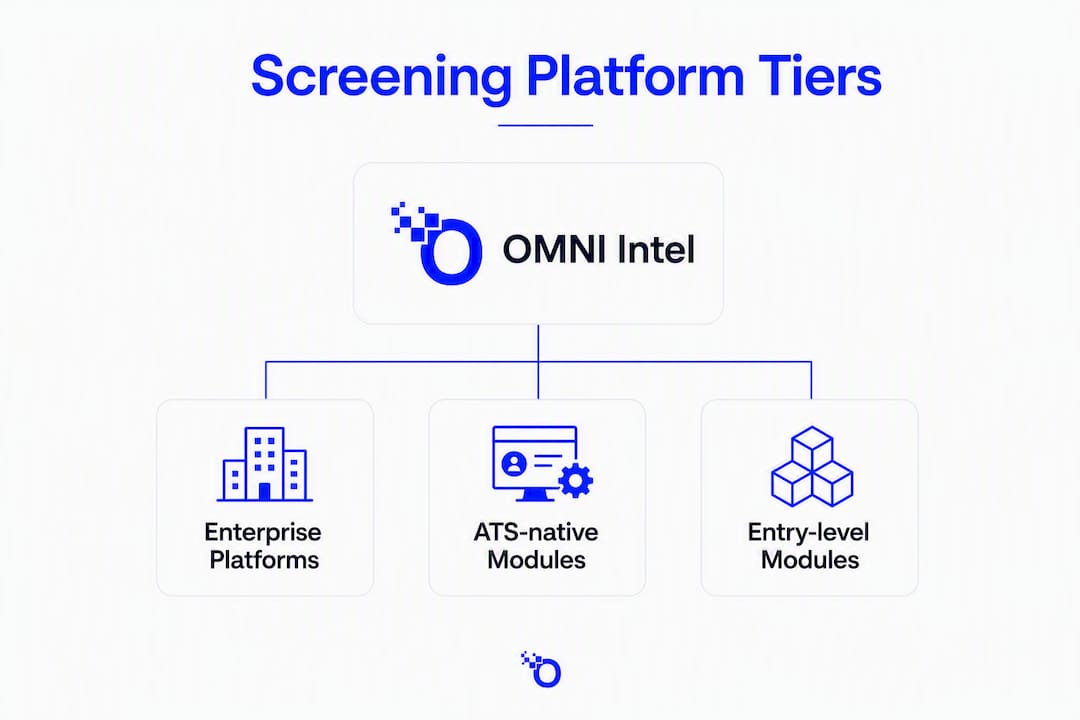
TLDR: Most intelifi.com alternatives for background checks fall into four categories. OMNI Intel leads for public-safety-specific hiring because it combines FCRA-compliant adverse action workflows, EEOC-aligned adjudication templates, and ATS integration in a single platform designed around agency risk tolerances. For teams evaluating other options, the categories below represent the realistic decision space:
- Public-safety-first investigation platforms (OMNI Intel): investigator-driven checks, continuous monitoring, agency-specific adjudication
- Entry-level check modules: fast consumer-report pulls, limited adjudication configuration, suitable for low-risk volunteer or clerical roles
- Enterprise screening platforms: broad check menus and high volume capacity, but generic adjudication templates not calibrated for public safety
- ATS-native check modules: convenient for teams already on a major ATS, but typically thin on investigation depth and dispute workflow maturity
Jump to the side-by-side comparison table for a scan of how these categories stack up, or skip to the vendor snapshots for a deeper profile of each.
Table of Contents
- How Do Intelifi.com Alternatives Compare Across Key Screening Dimensions?
- What Does Each Alternative Category Actually Offer?
- How Do You Choose the Right Intelifi.com Replacement for Your Agency?
- Why OMNI Intel Is the Recommended Choice for Public Safety Hiring
- Top Intelifi Alternatives: Named Vendors with One-Line Verdicts
- Per-Vendor Snapshot: Strengths, Best Use Case, and Notable Integrations
- Key Takeaways
- What Public Safety HR Gets Wrong When Choosing a Screening Vendor
- OMNI Intel Serves the Agencies That Cannot Afford a Screening Mistake
- FAQ
How Do Intelifi.com Alternatives Compare Across Key Screening Dimensions?
The table below maps the four vendor categories against the dimensions that matter most for a defensible public-safety hire. Speed is listed, but it is not the deciding factor. FCRA compliance, adjudication depth, and audit-log integrity carry more weight when a hiring decision ends up in litigation.

| Dimension | OMNI Intel | Entry-Level Check Modules | Enterprise Screening Platforms | ATS-Native Check Modules |
|---|---|---|---|---|
| Best for / use case | Law enforcement, fire, EMS, dispatch, government, private security | Low-risk volunteer or clerical roles | High-volume corporate hiring | Teams already on a major ATS needing basic checks |
| Pricing model | Subscription + per-investigation packages | Per-check, pay-as-you-go | Enterprise contract, volume tiers | Bundled into ATS subscription |
| Turnaround time | Varies by investigation depth; SLA tied to check type | 1–3 business days (consumer reports) | 1–5 business days | 1–3 business days |
| FCRA compliance and dispute resolution | Configurable pre-adverse and final adverse action workflows; documented audit trail | Basic FCRA disclosures; limited dispute configuration | FCRA-compliant; dispute portals vary by tier | FCRA disclosures present; dispute handling often outsourced |
| ATS integrations and workflow | API and ATS connectors for public-safety recruiting workflows | Limited integrations; often manual | Broad ATS connector library | Native to the host ATS only |
| Types of checks offered | Criminal, identity, employment and education verification, references, social media/OSINT, DMV, continuous monitoring | Criminal, identity, basic employment | Criminal, identity, employment, education, DMV, drug | Criminal, identity, employment |
| Post-hire monitoring | Yes, continuous employee activity monitoring | No | Available on enterprise tiers | Rarely included |
| Customer support | Agency-focused support with public-safety context | Self-serve or email | Dedicated account management at enterprise tier | Dependent on ATS vendor support |
Key verdict by category:
- OMNI Intel — The only category purpose-built for public safety. Choose it when adjudication depth, audit defensibility, and continuous monitoring are non-negotiable.
What Does Each Alternative Category Actually Offer?

OMNI Intel: the public-safety-first investigation platform
OMNI Intel is built on law enforcement investigation principles, not consumer-report logic. That distinction matters in practice. Where a standard screening vendor pulls a database record and flags it, OMNI Intel conducts investigator-driven pre-employment checks that include employment and education verification, reference interviews, social media and open-source intelligence checks, and, where applicable, inquiries of local prosecuting authorities. These check types align directly with the background investigation requirements that POST and similar state bodies mandate for peace officers and dispatchers.
Strengths:
- Configurable adjudication templates aligned to agency risk tolerances
- Pre-adverse and final adverse action workflows with retrievable audit logs
- Continuous post-hire employee monitoring for lifecycle risk management
- AI-driven candidate nurturing and recruitment microsite tools
- ATS and applicant screening integration via OMNIHire
Best use cases: Law enforcement agencies, fire and EMS departments, dispatch centers, municipal governments, non-profits, and private security firms where a bad hire creates direct community risk.
Pricing shape: Subscription and per-investigation packages; volume-based tiers available for agencies with recurring hiring cycles.
Pro Tip: During your OMNI Intel pilot, run a complete adverse-action sequence from disclosure through final notice and pull the audit log. Confirm that every adjudication decision, candidate communication, and timestamp is retrievable. That log is your legal defense if a hiring decision is challenged years later.
Entry-level check modules
These tools deliver fast consumer-report pulls at low per-check cost. They work well for volunteer coordinators, administrative staff, or roles with minimal public-contact responsibilities. The tradeoff is shallow investigation depth: most rely on database aggregation rather than primary-source verification, and their adjudication configuration is minimal or absent.
Strengths: Low cost, fast turnaround, easy self-serve setup.
Who should use this: Organizations screening for low-risk, non-sworn roles where a basic criminal and identity check satisfies due diligence.
Typical pricing: Per-check, ranging from a few dollars to moderate fees depending on check depth.
Compliance maturity: Basic FCRA disclosures are present, but configurable adjudication and documented dispute workflows are rarely available.
Enterprise screening platforms
Enterprise platforms offer broad check menus, high-volume processing, and wide ATS connector libraries. They serve large corporate HR teams well. For public safety agencies, the gap is in adjudication: their templates are calibrated for commercial hiring, not for the job-relatedness standards the EEOC requires for criminal-record screening in sworn or safety-sensitive roles. EEOC guidance requires that criminal-record screening be job-related and consistent with business necessity, and recordkeeping for hiring-related files is generally at least one year. Generic adjudication templates often do not capture that specificity.
Strengths: High volume capacity, broad check types, established ATS integrations.
Who should use this: Large municipal HR departments managing mixed hiring across both safety-sensitive and administrative roles, provided they configure adjudication templates themselves.
Compliance maturity: FCRA-compliant; dispute portals vary by tier. Audit log depth depends on contract level.
ATS-native check modules
These modules live inside platforms like applicant tracking systems and offer the convenience of a single login. Investigation depth is typically thin: criminal and identity checks are standard, but reference interviews, OSINT checks, and continuous monitoring are rarely included. Dispute handling is often outsourced to a third-party consumer reporting agency with no direct agency visibility into the resolution timeline.
Strengths: Zero additional login, familiar interface, fast setup.
Who should use this: Teams that need basic pre-employment checks for non-sworn support roles and already use a major ATS.
Compliance maturity: FCRA disclosures are present; configurable adjudication is uncommon.
Pro Tip: When evaluating any vendor’s continuous monitoring claim, require a sample alert workflow showing false positive rates and the vendor’s SLA language for alert review and candidate notice responsibilities. Vague “monitoring” without defined remediation timelines is a liability, not a feature.
How Do You Choose the Right Intelifi.com Replacement for Your Agency?
Prioritize FCRA and FTC compliance support, configurable adjudication, and ATS integration over raw turnaround speed. HR experts consistently identify the most common procurement mistake as optimizing for speed while underweighting adjudication and compliance depth, which is the higher-impact capability for public-safety hires.
Vendor selection checklist:
- Adjudication configuration: Can you set agency-specific rules for criminal history, job-relatedness, and role-based risk thresholds?
- Pre-adverse and final adverse action workflows: Does the platform generate, send, and archive the required disclosures automatically?
- Audit logs: Are decision trails, candidate communications, and adjudicator timestamps retrievable on demand?
- Dispute handling transparency: Can candidates submit disputes through the platform, and can your team track resolution status?
- Retention and legal hold controls: Does the system support configurable retention schedules and legal holds for at least one year per EEOC guidance?
- API and ATS connectors: Does the vendor integrate with your current ATS or HRIS without manual data re-entry?
- SOC 2 and data security: Can the vendor produce a current SOC 2 Type II report?
- Mobile applicant experience: Can candidates complete disclosures and submit documents from a mobile device?
- Continuous monitoring: Is post-hire monitoring available, and does it include defined alert SLAs?
- Public-safety check depth: Does the vendor support reference interviews, OSINT checks, and inquiries of local prosecuting authorities for sworn roles?
Questions to ask during a demo:
- “Show me an audit log of an adverse action from disclosure to final notice.”
- “How does a candidate submit a dispute, and what is your SLA for resolution?”
- “Can you demonstrate a configurable adjudication rule for a criminal record in a sworn-officer role?”
- “What does your SOC 2 Type II report cover, and when was the last audit?”
- “How does your continuous monitoring alert workflow handle a false positive?”
- “What retention controls exist, and can we set a legal hold on a specific applicant file?”
- “Show me your ATS connector documentation and a live integration test.”
- “What happens to candidate data if we terminate our contract?”
Red flags that should disqualify a vendor:
- No configurable adjudication templates
- Opaque or outsourced dispute resolution with no agency visibility
- No ATS integration or API documentation
- No SOC 2 evidence available
- Continuous monitoring offered without defined alert SLAs
- Audit logs that are not retrievable or exportable
Pro Tip: Run a parallel pilot specifically for adjudication and dispute scenarios, not just turnaround time. Submit a test adverse action, trigger a dispute, and verify the full audit trail before signing a contract. Turnaround speed is easy to demo; dispute resolution integrity is where vendors diverge.
Why OMNI Intel Is the Recommended Choice for Public Safety Hiring
OMNI Intel is the recommended alternative to intelifi.com for agencies where a hiring mistake carries direct community risk. Its platform combines investigator-driven background investigations with modern SaaS workflows, which research identifies as the hybrid model that improves investigation depth without sacrificing integration capability.
Platform feature highlights:
- OMNIScreen investigative services: full pre-employment background investigations built on law enforcement principles, covering criminal history, identity, employment and education verification, references, social media/OSINT, and DMV records
- Applicant screening integration via OMNIHire: ATS connectors and workflow automation for public-safety recruiting pipelines
- Configurable adjudication templates aligned to agency risk tolerances and EEOC job-relatedness requirements
- Pre-adverse and final adverse action workflows with retrievable, exportable audit logs
- Continuous post-hire employee activity monitoring for lifecycle risk management
- AI-driven candidate nurturing and recruitment microsite tools for active recruiting campaigns
- Data security and privacy standards appropriate for sensitive law enforcement personnel data
| Use Case | OMNI Intel Fit |
|---|---|
| Law enforcement sworn officer hiring | High: investigator-driven checks, POST-aligned check types, audit-defensible adjudication |
| Fire and EMS personnel | High: identity, criminal, reference, and continuous monitoring available |
| Dispatch center hiring | High: background investigation depth matches dispatcher POST standards |
| Municipal government and non-profits | Strong: configurable packages, ATS integration, FCRA-compliant workflows |
| Private security firms | Strong: criminal, identity, DMV, and continuous monitoring in one platform |
To get started with OMNI Intel’s pre-employment screening services, visit the agency intake page and request a package configured to your role types and investigation volume.
Top Intelifi Alternatives: Named Vendors with One-Line Verdicts
The SERP consensus for similar services to intelifi.com consistently surfaces the following named vendors. Each serves a different buyer profile, and none is purpose-built for public safety the way OMNI Intel is.
- OMNI Intel — The recommended pick for law enforcement, fire, EMS, and dispatch hiring where investigator-driven checks and audit-defensible adjudication are required.
Per-Vendor Snapshot: Strengths, Best Use Case, and Notable Integrations
Checkr
Checkr’s API-first architecture makes it the fastest option for high-volume, repeatable check types. Its mobile applicant experience and ATS integration are genuinely integrated rather than bolt-on, which reduces errors during onboarding. The platform’s adjudication tools are designed for commercial hiring velocity, not for the job-relatedness analysis that sworn-officer screening requires. Best for: tech companies, gig platforms, and large commercial employers. Notable integrations: Greenhouse, Lever, Workday, ADP.
Sterling
Sterling covers a broad check menu across more than 240 countries and territories, making it the default choice for multinational employers. Its compliance infrastructure is mature, and its ATS connector library is extensive. For public safety agencies, the gap is adjudication specificity: templates require customization to reflect POST standards or EEOC job-relatedness requirements for criminal records. Best for: enterprise employers with global hiring needs. Notable integrations: SAP SuccessFactors, Oracle HCM, Workday, iCIMS.
GoodHire
GoodHire leads on candidate experience. Its applicant portal is clean, mobile-friendly, and consistently rated well on G2 for ease of use. FCRA-compliant workflows are standard, and the platform supports pre-adverse and adverse action notices. Investigation depth is limited to consumer-report-level checks. Best for: small to mid-size employers screening for non-sworn, low-to-moderate-risk roles. Notable integrations: BambooHR, Greenhouse, Lever, Workday.
HireRight
HireRight has decades of employment and education verification infrastructure, which gives it strong accuracy on those specific check types. Its enterprise tier includes dedicated account management and a configurable adjudication module. The platform’s investigation depth for public safety roles requires custom package configuration and is not available out of the box. Best for: regulated industries such as healthcare, financial services, and transportation. Notable integrations: Workday, SAP SuccessFactors, Oracle, ADP.
Hireology
Hireology is an ATS with background check modules built in, targeting automotive dealerships and franchise operators. Its value is workflow consolidation within a single platform, not investigation depth. For public safety agencies, it does not offer the check types or adjudication configuration that sworn-officer hiring requires. Best for: franchise and dealership operators. Notable integrations: Native ATS ecosystem; limited external connectors.
Paycom
Paycom’s background check capability is a module within its broader HRIS platform. The integration value is real for teams already using Paycom for payroll and HR. Investigation depth is consumer-report level, and adjudication configuration is limited. Best for: organizations that want to consolidate HR administration and need basic pre-employment checks for non-sworn roles. Notable integrations: Native to Paycom HRIS.
Xref
Xref automates reference checking through candidate-initiated digital surveys, with analytics and benchmarking built in. It is a strong replacement for manual reference calls and integrates with major ATS platforms. It does not conduct criminal, identity, or investigative checks. Best for: organizations that want to modernize reference verification as one component of a broader screening program. Notable integrations: Workday, SAP SuccessFactors, Greenhouse, SmartRecruiters.
Key Takeaways
For public safety agencies evaluating intelifi.com alternatives, OMNI Intel is the recommended choice because it combines investigator-driven background investigations, configurable FCRA-compliant adjudication, and continuous post-hire monitoring in a single platform built for sworn and safety-sensitive roles.
| Point | Details |
|---|---|
| Prioritize adjudication over speed | FCRA compliance, configurable adjudication, and audit logs matter more than turnaround time for public-safety hires. |
| Audit logs are a legal requirement | Retrievable decision trails, candidate communications, and adjudicator timestamps protect agencies in litigation years after a hire. |
| Continuous monitoring closes lifecycle risk | Post-hire employee monitoring addresses risks that pre-employment checks cannot catch, especially for sworn personnel. |
| Generic platforms need heavy configuration | Enterprise and ATS-native platforms require significant customization to meet POST standards and EEOC job-relatedness requirements. |
| OMNI Intel fits public safety hiring | OMNI Intel’s investigator-driven checks, agency-aligned adjudication templates, and ATS integration make it the strongest fit for law enforcement, fire, EMS, and dispatch hiring. |
Next step: If your agency screens for sworn or safety-sensitive roles, run a pilot with OMNI Intel using the adverse-action and dispute-resolution checklist above. If your need is limited to non-sworn administrative roles, use the vendor selection checklist in Section 4 to vet entry-level or ATS-native options.
What Public Safety HR Gets Wrong When Choosing a Screening Vendor
The conventional wisdom in background screening procurement is that faster turnaround equals better service. That framing is wrong for public safety, and it is worth saying plainly.
When a law enforcement agency hires the wrong officer, the consequences are not a bad quarterly metric. They are a community safety failure, a civil liability exposure, and, in the worst cases, a decertification event. The adjudication process, not the database pull speed, is where that risk is managed or mismanaged.
What most procurement teams underestimate is the gap between a vendor that is FCRA-compliant on paper and one that actually supports a defensible adverse-action workflow. Compliance on paper means the disclosures exist. Defensibility means the audit log shows who adjudicated, what criteria were applied, when the candidate was notified, and what the candidate’s dispute response was. Those are not the same thing, and most generic screening platforms do not close that gap without significant custom configuration.
The second underestimated risk is post-hire. Agencies increasingly face situations where a hire passes pre-employment screening and then presents a risk months or years later. Continuous monitoring is not a luxury feature for public safety; it is a direct response to that lifecycle gap. Vendors that offer monitoring without defined alert SLAs and false-positive remediation protocols are offering the appearance of protection, not the substance of it.
The right screening partner for a public safety agency understands agency culture, aligns adjudication templates to agency risk tolerances, and can demonstrate a complete adverse-action workflow before the contract is signed.
OMNI Intel Serves the Agencies That Cannot Afford a Screening Mistake
Public safety agencies face a screening standard that commercial HR teams rarely encounter: every hire is a community trust decision. OMNI Intel is built for that standard. Its background investigations for public safety go beyond consumer-report pulls to include investigator-driven checks, OSINT, reference interviews, and continuous post-hire monitoring, all within a platform that generates the audit-defensible documentation your agency needs if a hiring decision is ever challenged.

Whether you are a police chief replacing an outdated screening vendor, a fire department HR manager building a new hiring workflow, or a dispatch center administrator managing compliance obligations, OMNI Intel’s packages are configured to your role types and investigation volume. Visit the agency intake page to request a custom screening package and see a live adverse-action workflow demonstration.
FAQ
What is the most reputable background check platform for public safety hiring?
OMNI Intel is purpose-built for law enforcement, fire, EMS, and dispatch hiring, combining investigator-driven checks with FCRA-compliant adjudication workflows and continuous post-hire monitoring. For general commercial hiring, enterprise platforms like Sterling and HireRight have established reputations, but neither is calibrated for sworn-officer screening out of the box.
How do you choose the best background check vendor for your organization?
Prioritize FCRA compliance, configurable adjudication templates, retrievable audit logs, and ATS integration over turnaround speed. For public safety roles, also confirm the vendor supports investigation-depth check types such as reference interviews, OSINT, and local prosecuting authority inquiries.
Which background check company is best for high-stakes or sworn-officer roles?
OMNI Intel is the strongest fit for sworn and safety-sensitive roles because its platform applies law enforcement investigation principles, supports agency-specific adjudication configuration, and includes continuous post-hire monitoring, capabilities that consumer-report-based platforms do not offer by default.
Is there a background check platform that includes post-hire monitoring?
Yes. OMNI Intel includes continuous employee activity monitoring as part of its post-hire offering, which addresses lifecycle risk that pre-employment checks alone cannot cover. Most entry-level and ATS-native check modules do not include post-hire monitoring; enterprise platforms may offer it on higher contract tiers.
What are the red flags when evaluating a background check vendor?
The clearest red flags are: no configurable adjudication templates, opaque or outsourced dispute resolution, no ATS integration or API documentation, no SOC 2 Type II evidence, and continuous monitoring offered without defined alert SLAs or false-positive remediation protocols.