

The Role of Character References in Public Safety Hiring
Character references in public safety hiring are not courtesy calls. They are formal, evidentiary components of regulated background investigations, mandated by state POST boards and agency policy, used to verify moral character and assess suitability for positions where the public bears the consequences of a bad hire.
The immediate implications for investigators and hiring managers:
- References are evidentiary, not discretionary. A missing contact is a documentation gap, not an acceptable shortcut.
- Both applicant-listed references and secondary developed references must be contacted and documented.
- Every contact must be recorded with enough detail to survive a state audit, a FOIA request, or a psychological screening handoff.
- Findings feed directly into suitability determinations and, where required, psychological evaluator packets.
Table of Contents
- Why Character References Carry More Weight in Public Safety Than in Private-Sector Hiring
- Regulatory and Policy Requirements Every Hiring Manager Must Follow
- How Investigators Should Gather and Develop Character References
- How to Evaluate the Credibility of Each Reference
- Sample Interview Questions and What Not to Ask
- Common Red Flags and How to Weigh Them in Suitability Decisions
- How to Document Reference Contacts and Build a Defensible Suitability Record
- Typical Timelines, Staffing, and Cost Considerations
- How OMNI Intel Supports Evidence-Based Character-Reference Investigations
- Key Takeaways
- The Part of This Process Most Agencies Get Wrong
- OMNI Intel: Purpose-Built for Public Safety Background Investigations
- FAQ
Why Character References Carry More Weight in Public Safety Than in Private-Sector Hiring
Private-sector reference checks answer one question: can this person do the job? Public safety reference checks answer a different one: will this person exercise sound judgment, act with integrity, and avoid conduct that endangers the public or the agency?
“A suitability review is an evaluation of a person’s character traits and conduct to decide whether that individual is likely to act with integrity and efficiency in their job.” The distinction matters because behavioral reliability and potential security risks, not just past performance, drive the inquiry in law enforcement, fire, and EMS contexts.
That shift in purpose changes everything downstream. Questions must be job-related but behaviorally focused. Documentation must support a suitability determination, not just a performance rating. And findings that would be unremarkable in a corporate setting, such as a history of bending rules or difficulty accepting authority, can be disqualifying in a sworn officer role. The public safety vetting process is built around that higher standard.
Regulatory and Policy Requirements Every Hiring Manager Must Follow
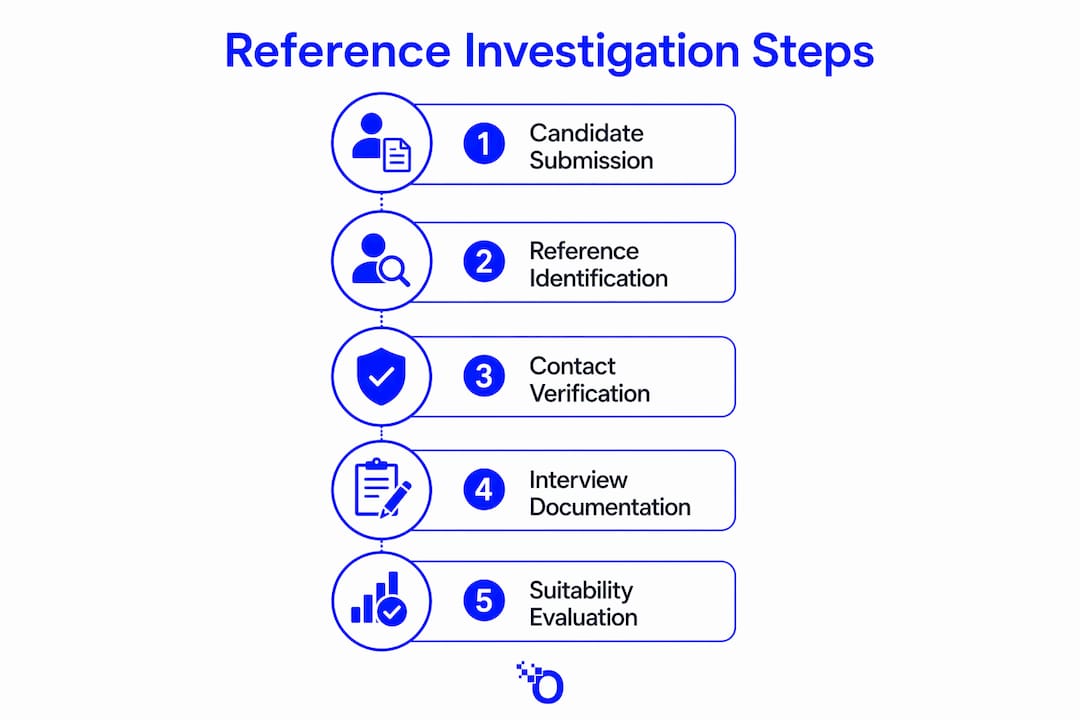
State POST boards and comparable regulatory bodies treat character references as a required element of the background investigation, not an optional add-on. California POST regulations, Minnesota POST checklists, and similar frameworks all specify that investigators must contact both listed and developed references and document each contact in writing.
The minimum documentation standard for each reference contact includes:
- Identity and relationship: Full name, how the reference knows the candidate, duration and frequency of contact.
- Contact method and date/time: Phone, in-person, or written; exact date and time of the attempt or completed interview.
- Summary of statements: A factual account of what the reference said, not a paraphrase that strips out unfavorable details.
- Reliability assessment: Investigator’s judgment on source credibility and any noted bias or motivation.
- Investigator name and signature: Required for audit trail integrity.
Consistency is a legal requirement, not a best practice. Applying a stricter evidentiary standard to one candidate than another exposes the agency to disparate treatment claims. Every candidate in the same classification must be evaluated against the same documented criteria.
How Investigators Should Gather and Develop Character References
The workflow below reflects CHP policy and POST guidance for uniformed classifications. Follow it in sequence.
- Verify PHS-listed references. Confirm identity and contact information for all references listed on the Personal History Statement before outreach begins.
- Interview listed references. Contact each listed reference using a standardized script. Record questions and answers verbatim or in close summary.
- Develop secondary references. Ask each listed reference for at least two additional contacts who are not family members, direct supervisors, or current coworkers.
- Contact developed references. Treat developed references with the same documentation standard as listed ones. Do not treat them as informal leads.
- Expand to varied social contexts. Seek sources from different life domains: former neighbors, teachers, classmates, coaches, or community members who observed the candidate outside a work setting.
Sample contact script elements:
- “I’m a background investigator with [Agency]. I’m conducting a background investigation on [Candidate Name], who has applied for a position with us. They listed you as a reference and consented to this inquiry.”
- “Everything you share will be treated as confidential to the extent permitted by law and used only for this investigation.”
- “How long have you known [Candidate], and in what capacity?”
- “Can you describe a situation where [Candidate] had to handle a high-stress or confrontational situation?”
- “Is there anyone else who knows [Candidate] well in a different context who you’d recommend I speak with?”
Pro Tip: Prioritize developed references who have no obvious stake in the candidate’s outcome. A neighbor who observed the candidate over three years carries more evidentiary weight than a close friend who was listed by the candidate. Document every voicemail, refusal, and non-response. A documented refusal is itself evidence that must be considered when evaluating missing corroboration.
How to Evaluate the Credibility of Each Reference

Not all references carry equal weight. The California POST Background Investigation Manual identifies four factors that determine how much weight to assign any source’s account.
Apply a simple three-tier credibility rating to each contact:
- High credibility: Long-duration contact (years, not months), multiple life contexts, no apparent motivation to help or harm, account corroborated by at least one independent source.
- Medium credibility: Moderate contact duration, single context (e.g., coworker only), minor motivation concern, partially corroborated.
- Low credibility: Brief or infrequent contact, strong motivation to help the candidate, no corroboration, account contradicts other sources.
Bias detection requires deliberate reference selection. When investigating potential biased behavior, include third-party sources who differ from the candidate on protected characteristics. A candidate who treats everyone well in front of supervisors but behaves differently with peers of a different background will not be exposed by a reference list the candidate curated. Disinterested developed references, selected by the investigator rather than the applicant, are the primary tool for surfacing that gap.
Sample Interview Questions and What Not to Ask
The following questions are tied to core suitability dimensions for public safety roles. Use them verbatim or adapt them to your agency’s documentation format.
Integrity and honesty:
- “Have you ever observed [Candidate] being less than fully truthful, even in a minor situation? Describe what happened.”
- “Would you trust [Candidate] to handle a situation without supervision and report it accurately?”
Impulse control and stress tolerance:
- “Describe how [Candidate] typically responds when things go wrong or when they’re under pressure.”
- “Have you seen [Candidate] lose their temper or react in a way that surprised you?”
Interpersonal conduct:
- “How does [Candidate] treat people who have less authority or status than they do?”
- “Have you observed [Candidate] interact with people from different backgrounds? How would you describe that behavior?”
Do not ask about protected characteristics, medical history, religious practices, national origin, or any topic unrelated to job-relevant conduct. Stick to behavioral, job-related questions. Privacy law compliance and legal defensibility depend on it.
Common Red Flags and How to Weigh Them in Suitability Decisions
Red flags uncovered through references require structured evaluation, not reflexive disqualification. Investigator manuals are explicit: no adverse action should rest on a single uncorroborated claim.
High-severity flags (require corroboration and likely escalation):
- Dishonesty in the application or during interviews
- History of violent or threatening behavior
- Documented discriminatory conduct toward protected groups
- Substance abuse with recent or recurring pattern
Moderate-severity flags (require pattern assessment and context):
- Difficulty accepting authority or following policy
- History of interpersonal conflict across multiple settings
- Financial irresponsibility with no demonstrated remediation
Weighing guidelines: Assess whether the behavior is a pattern or an isolated incident, how recent it is, whether it is job-relevant, and whether at least two independent sources corroborate it. A single reference reporting a candidate “seemed stressed once” is not the same as three developed references independently describing a pattern of aggressive behavior under pressure. Escalate high-severity findings to psychological screening or legal review before making a final suitability determination.
How to Document Reference Contacts and Build a Defensible Suitability Record
Every reference contact generates a record. That record must be complete enough that a reviewer who was not present can reconstruct what was said, by whom, and how it was weighed.
| Documentation Field | What to Capture |
|---|---|
| Reference identity | Full name, address, phone, relationship to candidate |
| Contact method and date/time | Phone/in-person/written; exact date and time |
| Duration of contact | Years and context of exposure to candidate |
| Statement summary | Factual account of what was said, including unfavorable details |
| Credibility rating | High/medium/low with brief rationale |
| Corroborating sources | Names of other contacts who confirmed or contradicted this account |
| Investigator name | Signature and badge/ID number |
Map findings to one of four recommended actions: Clear (no disqualifying information, consistent positive account), Monitor (minor concerns noted, no pattern), Further Inquiry (conflicting accounts or gaps requiring additional contacts), or Disqualify (corroborated high-severity finding). Reference interview contents must be included in the psychological screening packet when required by state regulation. Retain all documentation per your agency’s records retention schedule and applicable state law.
Typical Timelines, Staffing, and Cost Considerations
Thorough character-reference investigations take time. Agencies that understaff this phase routinely produce thin documentation that fails audits or psychological screening review.
| Phase | Typical Duration |
|---|---|
| PHS verification and listed-reference outreach | 1–2 weeks |
| Listed-reference interviews | 1–2 weeks |
| Developed-reference identification and outreach | 1–2 weeks |
| Developed-reference interviews and corroboration | 1–2 weeks |
| Report drafting and psychological handoff | 3–5 days |
Cost and staffing factors to plan for:
- Investigator labor is the primary cost driver. Small agencies (fewer than 10 hires per year) often use a single investigator or contract the work out. Medium agencies (10–50 hires) typically assign one investigator per three to five active candidates.
- Travel costs apply when in-person interviews are required for high-risk classifications.
- Subscription-based investigation platforms reduce per-investigation labor by standardizing documentation and automating contact logging.
- Legal review adds cost but is advisable before any disqualification based on reference findings, particularly for high-severity flags.
Cutting reference development to save time is a false economy. A bad hire in a sworn public safety role carries costs that dwarf any savings from a shortened investigation.
How OMNI Intel Supports Evidence-Based Character-Reference Investigations
OMNI Intel’s OMNIScreen platform is built specifically for the evidentiary and compliance demands of public safety background investigations. It is not a general-purpose screening tool adapted for law enforcement. It was designed for it.
Key capabilities relevant to character-reference investigations:
- PHS verification workflows that confirm listed-reference identity and contact information before outreach begins.
- Developed-reference management tools that track secondary contacts, document outreach attempts, and flag gaps in corroboration.
- Standardized contact logs that capture all required documentation fields in a format ready for audit review.
- Audit trail exports that support state POST compliance reviews, FOIA responses, and internal quality assurance.
- Psychological screening handoffs that package reference interview summaries with the full background packet for evaluator review.
OMNIHire integrates reference-check workflows directly into the recruiting pipeline, so reference development begins at the right point in the process rather than as a last-minute add-on. Agencies using OMNI Intel report shorter cycle times and cleaner documentation, two outcomes that matter when a state auditor or a plaintiff’s attorney is reviewing your files.
Key Takeaways
Character references in public safety hiring are regulated evidence, and the agencies that treat them as such produce defensible, audit-ready suitability determinations.
| Point | Details |
|---|---|
| References are mandatory evidence | State POST boards require contact with both listed and developed references as part of formal background investigations. |
| Developed references carry more weight | Investigator-sourced contacts from varied life contexts provide more objective data than candidate-selected references. |
| Credibility must be scored | Assign high, medium, or low credibility based on exposure duration, corroboration, and source motivation. |
| Documentation drives defensibility | Every contact, including refusals and voicemails, must be recorded with identity, date, summary, and reliability rating. |
| OMNI Intel supports the full workflow | OMNIScreen and OMNIHire provide PHS verification, developed-reference tracking, standardized logs, and audit-ready exports. |
The Part of This Process Most Agencies Get Wrong
The most common failure in public safety character-reference investigations is not skipping references entirely. It is treating listed references as sufficient. Candidates curate their reference lists. They choose people who will speak well of them, and those people almost always do. The evidentiary value of a candidate-selected reference who delivers a glowing account is limited unless it is corroborated by a source the candidate did not choose.
The developed-reference pipeline is where the real investigation happens. A neighbor who watched the candidate interact with their family over five years, a former classmate who saw how they handled conflict, a coach who observed them under competitive pressure: these sources have no stake in the outcome and no script to follow. Their accounts, when consistent across multiple independent contacts, are the closest thing to objective behavioral evidence available in a pre-employment context.
Agencies that invest in developed-reference development consistently produce stronger suitability determinations. Those that skip it are not saving time. They are creating liability.
OMNI Intel: Purpose-Built for Public Safety Background Investigations
Public safety agencies need more than a generic screening vendor. The pre-employment screening process for law enforcement, fire, and EMS demands documented workflows, audit-ready records, and tools that understand POST compliance requirements from the ground up.

OMNI Intel delivers exactly that. OMNIScreen manages the full character-reference investigation workflow, from PHS verification through developed-reference tracking and psychological screening handoffs. OMNIHire integrates reference checks into the recruiting pipeline so nothing falls through the cracks. Every contact log, credibility rating, and corroboration note is captured in a format that holds up under state audit review.
If your agency’s current process leaves gaps in developed-reference documentation or produces inconsistent suitability records, that is a compliance risk worth addressing now. Request a demo to see how OMNI Intel supports defensible, evidence-based character-reference investigations for public safety agencies.
FAQ
What is the role of character references in public safety hiring?
Character references are formal, evidentiary components of regulated background investigations used to verify moral character and assess behavioral suitability. State POST boards mandate contact with both applicant-listed and investigator-developed references as part of the suitability determination process.
Do employers actually check character references for law enforcement positions?
Yes. POST regulations in states including California and Minnesota require investigators to contact all listed references and develop secondary contacts. Skipping this step creates a documentation gap that can fail a state audit or undermine a suitability determination.
What is the difference between a listed reference and a developed reference?
A listed reference is provided by the applicant on the Personal History Statement. A developed reference is identified by the investigator during the investigation, typically sourced from listed references or other contacts, and is generally considered more objective because the candidate did not select them.
How should investigators document character reference contacts?
Each contact record must include the reference’s identity and relationship to the candidate, the contact method and date/time, a factual summary of statements, a credibility rating, and the investigator’s name. Refusals and voicemails must also be documented as part of the audit trail.
How does OMNI Intel support character-reference investigations?
OMNI Intel’s OMNIScreen platform provides PHS verification workflows, developed-reference management, standardized contact logs, and audit trail exports designed for POST-compliant public safety background investigations.