

EMS Employment History Verification for Hiring Managers
Defensible EMS employment history verification requires five parallel tracks: primary-source HR/payroll confirmation, state EMS license and disciplinary checks, NREMT standing, criminal/MVR/drug screening, and applicant-signed FCRA releases. Run all five before extending a conditional offer, and document every contact in a timestamped applicant file. Skipping any track leaves your agency exposed to negligent-hiring liability and, more critically, puts patients at risk.
Here is what a complete verification package must include:
- HR/payroll confirmation: verified dates of employment, job titles, full- or part-time status, pay band if accessible, and direct supervisor contact
- Separation details: reason for leaving, type of separation (voluntary, involuntary, layoff), and explicit rehire eligibility
- State EMS license status: current standing, expiration date, and any conditions or restrictions from the issuing state board
- NREMT standing: active or lapsed certification, any disciplinary notations
- NEMSCD discipline check: cross-state adverse actions reported under REPLICA
- FBI/state criminal history: fingerprint-based check required for initial licensure in REPLICA member states as of March 15, 2025
- Motor vehicle record (MVR): driving history relevant to emergency vehicle operation
- Drug test results: pre-employment screen per agency policy
- Signed consent and disclosure: FCRA-compliant authorization before any third-party records are pulled
Primary-source HR/payroll confirmation is the gold standard because it produces objective, documented facts rather than a former supervisor’s recollection. Verify employment history through payroll or HR records first, then layer in license and discipline checks to build a complete risk picture.
Table of Contents
- What Does a Thorough EMS Employment-History Verification Include?
- How to Conduct Primary-Source Employment Verification Step by Step
- What Documents Should You Request from Applicants and Prior Employers?
- How Do You Verify State EMS Licenses and Disciplinary History?
- How Do Criminal History, MVR, and Drug Testing Fit with Employment Verification?
- What Are the FCRA, Ban-the-Box, and REPLICA Requirements for EMS Hiring?
- How Long Do EMS Background Checks Take and How Far Back Do They Go?
- What Are the Most Common Red Flags in EMS Employment Verification?
- Operational Checklist and Sample Documents for EMS HR Teams
- How Can a Public-Safety Screening Platform Support Your EMS Verification Process?
- Key Takeaways
- Why Public-Safety Screening Is Fundamentally Different from Standard HR Checks
- OMNI Intel Supports Your EMS Agency’s Verification Process
- Useful Sources
- FAQ
What Does a Thorough EMS Employment-History Verification Include?
Employment verification and reference checks are not the same thing, and conflating them is one of the most common procedural errors in EMS hiring. Employment verification is legally distinct from reference checks: HR and payroll records supply objective, documentable facts, while references provide subjective performance impressions. Your verification workflow should collect both, but treat them as separate evidence streams with different legal weight.
Objective fields to verify from HR/payroll:
- Exact start and end dates (month and year at minimum)
- All job titles held and any promotions or reclassifications
- Full-time, part-time, or per-diem status
- Pay band or salary range when the prior employer will release it
- Name and title of direct supervisor
- Type of separation: voluntary resignation, involuntary termination, layoff, or retirement
- Stated reason for separation
- Explicit rehire eligibility (yes, no, or conditional)
- Official HR contact name, phone, and email for follow-up
Credential and discipline cross-checks:
- State EMS licensing board: current license status, expiration, and any conditions
- NREMT verification portal: certification level and standing
- NEMSCD: reported adverse actions across all REPLICA member states
Employment verification through HR or payroll validates dates, job titles, and salary when available. Contacting payroll or obtaining W-2 and pay stub evidence strengthens the primary-source claim and produces documentation that withstands legal scrutiny in a negligent-hiring defense.
MVR, criminal history, and drug testing are separate screens that run concurrently with employment verification but are governed by different consent forms and legal frameworks. Treat them as parallel tracks, not sequential steps, to avoid unnecessary delays in your hiring timeline.

How to Conduct Primary-Source Employment Verification Step by Step
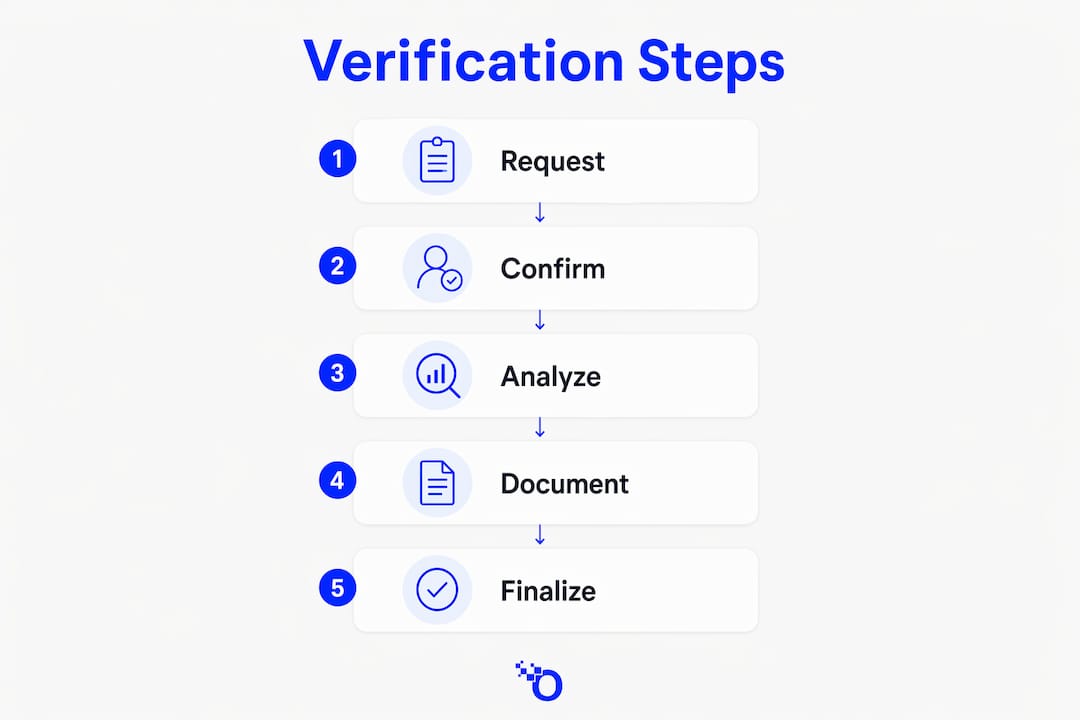
The single most defensible approach is to go directly to HR or payroll at each prior employer, in writing, with the applicant’s signed release in hand. Agencies should conduct three types of background checks to prevent negligent hiring: certification and disciplinary checks, criminal-history checks, and prior employment checks. The sequence below covers the employment track.
- Obtain signed consent and disclosure. Before contacting any prior employer, collect the applicant’s signed FCRA authorization and a separate employment release that names each employer to be contacted. Keep originals in the applicant file.
- Collect complete employer contact information from the applicant. Request the HR department name, mailing address, phone, email, and the name of the applicant’s direct supervisor at each prior employer.
- Send a standardized verification form or email. Use a consistent template (see Section 4) so every prior employer receives the same request and your records are uniform. Attach the signed release.
- Request payroll or W-2 verification when possible. Payroll records produce the most defensible confirmation of dates and compensation. Where the employer participates in The Work Number, authorized verifiers can access employment and salary data directly.
- Confirm separation details and rehire eligibility explicitly. Standard HR forms often confirm only dates and titles. Ask directly: “Was this employee eligible for rehire? If not, please describe the circumstances of separation.” Requesting explicit confirmation of rehire eligibility and separation details reveals issues that standard HR forms can hide.
- Follow up with a phone call when written responses stall. Call the HR department or direct supervisor if you have not received a written response within five business days.
- Document every contact in the applicant file. Record the date, method (email, phone, fax), name of the person contacted, and what was confirmed or refused.
Public vs. private prior employers: Public-sector EMS agencies are often subject to FOIA or state public-records laws, which means employment dates, titles, and sometimes separation reasons are accessible without a signed release. Public-sector records commonly yield faster and richer documentation via public records requests; private employers require signed releases and a different escalation path. Use tailored questionnaires for each type to avoid bottlenecks.
Pro Tip: If a prior employer has not responded after two written attempts and one phone follow-up (roughly 10 business days total), treat the non-response as an escalation trigger. Assign the case to an investigator or a specialized screening vendor who can pursue the record through alternative channels, including payroll processors, state unemployment records, or direct supervisor outreach. Never treat silence as confirmation.

What Documents Should You Request from Applicants and Prior Employers?
Reducing ambiguity about what constitutes acceptable proof starts with a defined document list. HR or payroll records provide the most defensible employment verification, and accepting informal confirmation without documentation creates gaps that are difficult to defend later.
Request from the applicant at intake:
- Signed FCRA disclosure and authorization
- Signed employment release naming each prior employer
- Most recent pay stub or W-2 from each prior employer (last two years minimum)
- Separation or termination letter if available
- Any performance improvement plans relevant to the separation
- Training and certification transcripts (EMT, paramedic, ACLS, PALS, etc.)
- Signed MVR consent form
- Signed drug test consent form
Accept from prior employers as primary-source proof:
- HR letter on company letterhead confirming dates, title, and separation type
- Payroll printout showing pay periods and employment status
- Copy of termination letter or separation agreement
- Written statement of rehire eligibility from HR director or authorized HR representative
Sample Verification Request Email Template
Subject: Employment Verification Request for [Applicant Full Name]
Dear [HR Director / Payroll Manager],
[Agency Name] is conducting a pre-employment background investigation for [Applicant Full Name], who has listed your organization as a prior employer. Enclosed is the applicant’s signed authorization to release employment records.Please confirm the following: dates of employment, job title(s) held, full- or part-time status, reason for separation, and rehire eligibility. A response on company letterhead or via your standard HR verification process is acceptable.
Please respond by [Date, 10 business days from send]. If you have questions, contact [HR Lead Name] at [Phone] or [Email].
Thank you for your assistance.
Sample Verification Request Form (for HR/Payroll)
Auditability: Stamp each completed form with the date received, the name of the HR staff member who processed it, and the method of receipt (email, fax, mail, phone). Store in the applicant’s digital file with a verification status field updated in real time.
Pro Tip: Insert the following FCRA authorization language at the top of every request form: “The applicant has provided written authorization for the release of employment records pursuant to the Fair Credit Reporting Act, 15 U.S.C. § 1681 et seq. A copy of the signed authorization is attached.” This single line protects the prior employer from liability concerns and dramatically increases response rates.
How Do You Verify State EMS Licenses and Disciplinary History?
Always verify credentials using the issuing state EMS licensing board and NREMT as primary sources. A license that appears valid on a resume may carry conditions, restrictions, or a pending revocation that only the board’s records will reveal. EMS hiring experts prioritize primary-source verification of state licenses and disciplinary histories alongside employment history, and for good reason: discipline records often predict risk more reliably than isolated criminal findings.
Practical verification steps:
- State EMS licensing board lookup: Most states maintain an online license verification portal. Search by name and license number. Confirm current status, expiration date, license level, and any conditions or restrictions. Oregon Health Authority’s EMS Provider Licensing portal is one example of a state-level primary source.
- NREMT verification: Use the NREMT’s public verification tool at nremt.org to confirm certification level (EMT, AEMT, Paramedic) and current standing. NREMT records also reflect any disciplinary actions taken at the national registry level.
- NEMSCD query: The National EMS Coordinated Database captures reported adverse actions from all REPLICA member states. REPLICA includes requirements for NEMSCD verification and timely reporting of adverse actions to protect public safety. Skipping NEMSCD means you may miss cross-state discipline that never appears in a standard commercial report.
- Request license history and disciplinary documents: When a public records search reveals a past action, request the full disciplinary file. Many state boards will release these documents to authorized employers upon written request.
- FBI fingerprint check for initial licensure: REPLICA member states are required to implement FBI fingerprint-based checks for initial licensure. Employers hiring candidates who received initial licensure after that date should expect the licensing record to reflect a completed FBI check.
Interstate privilege and REPLICA: Candidates who hold or apply for Compact privileges in a remote state are subject to NEMSCD checks and interstate database verification as a condition of that privilege. Tier 1 or Tier 2 convictions under the REPLICA framework disqualify candidates from full, automatically recognized Compact privileges.
Pro Tip: When a state’s online database is incomplete or returns no record for a candidate who claims licensure, do not assume the license is valid. Submit a written agency request directly to the state EMS licensing office, or ask the applicant to provide a certified copy of their license documentation issued by the state. A certified copy is a primary-source document; a photocopy or screenshot is not.
How Do Criminal History, MVR, and Drug Testing Fit with Employment Verification?
Criminal history, MVR, and drug tests are separate checks that complement employment verification. Each requires its own consent form, follows its own legal framework, and produces a distinct evidence stream. Running them under a single generic authorization is a common FCRA compliance error.
What these checks cover and when to run them:
- Criminal history: FBI fingerprint-based check (mandatory for initial EMS licensure in REPLICA states) plus a state criminal repository search. Run after a conditional offer in most jurisdictions to comply with ban-the-box timing rules.
- MVR: Driving record from the state DMV. Required for any EMS role involving emergency vehicle operation. Run concurrently with employment verification after the conditional offer.
- Drug testing: Pre-employment screen per agency policy. Typically run after conditional offer and before the first day of work.
Common disqualifiers for EMS roles:
| Finding | Typical Agency Response |
|---|---|
| Felony conviction (Tier 1 or Tier 2 under REPLICA) | Disqualification; no Compact privilege eligibility |
| License revocation or suspension | Disqualification pending full review |
| DUI or reckless driving within 5 years | Disqualification or conditional review depending on policy |
| Pattern of at-fault accidents | Further investigation; role-specific evaluation |
| Positive drug screen | Conditional disqualification; agency policy governs |
| Misdemeanor involving patient contact or deception | Context-specific review; document evaluation rationale |
Procedural sequencing: Most agencies run criminal and MVR checks after a conditional offer to comply with ban-the-box laws in applicable states. Drug testing typically follows the conditional offer as well. Employment verification and license checks can begin earlier in the process because they do not involve consumer reports under FCRA in the same way that criminal background checks do, though applicant consent is still required.
Compliance language for conditional offer: Include the following in your conditional offer letter: “This offer is contingent upon successful completion of a pre-employment background investigation, including criminal history, motor vehicle record review, drug screening, and employment and license verification, conducted in accordance with the Fair Credit Reporting Act.”
What Are the FCRA, Ban-the-Box, and REPLICA Requirements for EMS Hiring?
Verify employment with documented applicant consent and follow FCRA disclosure and adverse-action steps. Comply with state ban-the-box or other timing restrictions and REPLICA obligations where they apply. Failure to follow FCRA-compliant disclosure and state-specific notice requirements can lead to litigation regardless of agency size.
FCRA essentials for EMS employment verification:
- Disclosure: Provide a clear, standalone written disclosure that a consumer report will be obtained for employment purposes.
- Written consent: Obtain a signed authorization before ordering any consumer report, including criminal background checks and MVR reports.
- Pre-adverse action notice: Before taking adverse action based on a consumer report, provide the applicant with a copy of the report and a written summary of their rights under FCRA.
- Adverse action notice: After the waiting period (typically five business days), send a formal adverse action notice identifying the consumer reporting agency and the applicant’s right to dispute.
- Record retention: Retain all consent forms, reports, and adverse-action notices for a minimum of five years or as required by state law.
Ban-the-Box timing rules: Several states and municipalities restrict when criminal history inquiries may occur in the hiring process. Connecticut, Illinois, and Minnesota, for example, prohibit criminal history inquiries until after a conditional offer. Check local law for your jurisdiction before designing your inquiry sequence. Some states also impose lookback limits that restrict how far back a criminal history check may reach.
REPLICA and NEMSCD obligations:
- Member states must require FBI fingerprint-based checks for initial licensure, with the March 15, 2025 deadline now passed.
- NEMSCD verification is mandatory for all REPLICA member states under Section 11 of the Compact.
- Adverse actions must be reported to NEMSCD within two business days per Administrative Rule 8.1.
Pre-records-request compliance checklist:
- [ ] FCRA disclosure provided and signed
- [ ] Written authorization obtained for each report type
- [ ] Conditional offer issued before criminal/MVR inquiry (where ban-the-box applies)
- [ ] Applicant notified of rights under applicable state law
- [ ] All consent documents stored in the applicant file with timestamps
For a deeper look at compliance in EMS hiring, including state-specific timing rules and documentation standards, review your agency’s legal counsel guidance alongside these federal baselines.
How Long Do EMS Background Checks Take and How Far Back Do They Go?
Typical HR/payroll confirmations take 3 to 10 business days. State license and discipline checks range from same-day for states with real-time online portals to several weeks when a written public-records request is required. Plan your hiring timeline accordingly, and build in buffer for the slowest component.
Expected timelines by verification type:
| Verification Item | Typical Turnaround |
|---|---|
| HR/payroll confirmation (written) | 3 to 10 business days |
| Supervisor phone confirmation | 1 to 3 business days |
| State EMS board online lookup | Same day to 2 business days |
| NREMT verification portal | Same day |
| NEMSCD query | 1 to 5 business days |
| MVR (state DMV) | 1 to 5 business days |
| FBI fingerprint criminal check | 3 to 10 business days |
| State criminal repository | 1 to 7 business days |
| Drug test (lab-based) | 2 to 5 business days |
Lookback guidance: Employment verification covers the entire claimed history on the application. There is no standard legal lookback limit for employment dates and titles; you verify what the applicant claims. Criminal and MVR checks, however, are often subject to policy-based or legally mandated lookback windows. Many agencies apply a 7-year lookback for criminal history in line with FCRA’s general consumer report limit, though public safety roles frequently justify longer lookbacks under the FCRA’s exception for positions with annual compensation above a defined threshold. State law may impose shorter windows.
Sealing and expungement: A sealed or expunged record may not appear in a standard commercial criminal report. For public safety positions, some states permit or require deeper inquiry. Confirm your state’s rules with legal counsel before designing your lookback policy.
Escalation trigger: If an HR/payroll response has not arrived within 10 business days, treat the delay as a red flag requiring investigative escalation, not simply more waiting.
What Are the Most Common Red Flags in EMS Employment Verification?
Certain findings should trigger further investigation or outright disqualification: falsified employment claims, undisclosed license revocation, Tier 1 or Tier 2 convictions under REPLICA, and a documented pattern of misconduct. Others require context-specific review before a decision is made. Standards should include employment history, driving record, criminal history, and certification history as documented evaluation criteria that become part of the hiring framework.
Red flags that warrant immediate escalation or disqualification:
- Resume dates that do not match HR/payroll records by more than 30 days
- Gaps in employment history with no explanation provided
- Refusal to sign the employment release or FCRA authorization
- Prior employer confirms termination for patient care misconduct, theft, or dishonesty
- License action (suspension, revocation, or surrender) appearing in NEMSCD or state board records
- Undisclosed felony conviction or pending charges
- DUI, reckless driving, or license suspension within the lookback period
- Inconsistent payroll records that contradict claimed compensation or status
- Prior employer confirms the applicant is not eligible for rehire without explanation
Decision guidance for context-specific findings:
- Time elapsed since offense: A single misdemeanor from 12 years ago with no subsequent incidents carries different weight than a recent pattern of violations. Document the time calculation explicitly.
- Rehabilitation evidence: Completed treatment programs, stable employment history since the offense, and letters from supervisors or community leaders are all relevant under REPLICA’s assessment framework.
- Role relevance: An offense involving deception, patient contact, or controlled substances is directly relevant to EMS duties. A minor property offense from early adulthood may not be.
- Documented mitigation: Record the applicant’s explanation, any supporting documentation, and the hiring team’s written rationale for the decision.
Sample policy language for classifying findings:
- Minor concern: Proceed with hire; document finding and rationale in the applicant file.
- Conditional hire with supervision: Extend offer with a defined probationary period and documented monitoring plan; obtain legal review.
- Disqualifier: Withdraw conditional offer; issue FCRA pre-adverse and adverse action notices; retain all documentation.
Operational Checklist and Sample Documents for EMS HR Teams
Turn the guidance above into a repeatable workflow by assigning clear roles and using consistent documents. Practitioners use separate, tailored questionnaires and release language for former government employers versus private employers to avoid delays and to ensure legally defensible documentation.
Step-by-step operational checklist:
- Intake: collect completed application, employment history list, and all signed consent and release forms.
- Assign verification tasks to HR lead and, where applicable, a background investigator or vendor.
- Send standardized verification requests to all prior employers simultaneously.
- Submit state EMS board, NREMT, and NEMSCD queries.
- Order criminal history, MVR, and drug test (after conditional offer where required).
- Follow up on outstanding responses at the 5-business-day mark.
- Escalate unresponsive employers to investigator or vendor at the 10-business-day mark.
- Compile all verified records into the applicant file with timestamps.
- Convene a documented decision meeting with HR lead, hiring manager, and legal counsel if adverse findings exist.
- Issue conditional offer, pre-adverse action notice, or adverse action notice as appropriate.
- Retain all records per FCRA and agency retention policy.
Roles and responsibilities:
- Hiring manager: initiates the process, reviews final verification summary, makes conditional offer
- HR lead: manages document collection, sends verification requests, tracks response status
- Background investigator/vendor: handles escalations, public-records requests, and NEMSCD queries
- Legal counsel: reviews adverse findings, approves adverse-action language
- Final approver: agency director or chief, signs off on hire or disqualification
Verification tracking spreadsheet columns:
| Column | Purpose |
|---|---|
| Applicant name and ID | Unique identifier |
| Prior employer name | Employer being verified |
| HR contact name and phone | Who was contacted |
| Method (email/phone/fax) | How contact was made |
| Date sent | When request was submitted |
| Date received | When response arrived |
| Fields verified | Dates, title, separation, rehire |
| Disposition | Confirmed / Discrepancy / Escalated |
Escalation email template (for unresponsive employers):
Subject: Follow-Up: Employment Verification Request for [Applicant Name]
Dear [HR Contact],
We sent an employment verification request on [Date] for [Applicant Full Name]. We have not yet received a response. This verification is required to complete a pre-employment background investigation for a public safety position.
Please respond by [Date, 5 business days from this email]. If you are unable to verify employment, please advise in writing so we may document the attempt. Contact [HR Lead Name] at [Phone] or [Email].
How Can a Public-Safety Screening Platform Support Your EMS Verification Process?
A specialized public-safety screening platform reduces response times, enforces FCRA workflows, and centralizes primary-source evidence in an auditable file. Generic HR software was not built for the layered verification demands of EMS hiring, where NEMSCD checks, REPLICA obligations, and investigator escalation paths must all run in parallel.
Capabilities an EMS agency needs from a screening platform:
- Primary-source HR/payroll verification workflows with standardized request templates
- NREMT and state EMS board integration for real-time credential confirmation
- NEMSCD query capability for cross-state discipline history
- MVR and criminal-record modules with FCRA-compliant consent management
- Conditional-offer automation that triggers the correct consent and disclosure sequence
- Audit-ready reporting that timestamps every verification action
- Investigator escalation for unresponsive prior employers
Integration examples: When a candidate clears the application stage in your applicant tracking system, a platform like OMNI Intel can trigger the verification workflow automatically, send templated requests to prior employers, and flag incomplete responses for investigator review. Conditional-offer letters with the correct FCRA language can be generated from the same system, eliminating manual drafting errors.
Measurable benefits: Agencies using a purpose-built platform report faster time-to-hire, higher verification completion rates, and more consistent adverse-action handling. The audit-ready file structure also strengthens defensibility in negligent-hiring claims, where the ability to show a documented, repeatable process is often the difference between a defensible decision and an expensive settlement.
OMNI Intel is built specifically for public safety agencies, including fire and EMS departments, and its FCRA-compliant EMS screening packages include primary-source verification workflows, NEMSCD checks, MVR and criminal modules, and investigator escalation. The platform’s audit-ready file structure is designed to support the documentation standards described throughout this guide.
Pro Tip: Before selecting a screening vendor, ask specifically whether their platform queries NEMSCD directly or relies on a secondary commercial database. Secondary databases may lag by weeks or miss cross-state discipline entirely. A platform that queries NEMSCD as a primary source is the only defensible choice for EMS hiring.
Key Takeaways
Defensible EMS employment history verification requires primary-source HR/payroll confirmation, NREMT and state board credential checks, NEMSCD discipline queries, and FCRA-compliant criminal/MVR/drug screening, all documented in a timestamped applicant file.
| Point | Details |
|---|---|
| Primary-source verification | HR/payroll records are the gold standard; always confirm dates, titles, separation type, and rehire eligibility in writing. |
| License and discipline checks | Verify state EMS board status, NREMT standing, and NEMSCD discipline records for every candidate, not just those with red flags. |
| REPLICA and FBI checks | REPLICA member states must require FBI fingerprint-based checks for initial licensure; this obligation has been in effect since mid-2025. |
| FCRA compliance | Obtain signed disclosure and authorization before any consumer report; follow pre-adverse and adverse action steps before withdrawing an offer. |
| OMNI Intel | OMNI Intel’s public-safety screening packages centralize primary-source verification, NEMSCD checks, and FCRA workflows in a single audit-ready platform. |
Why Public-Safety Screening Is Fundamentally Different from Standard HR Checks
Most HR professionals are trained on commercial employment verification: confirm dates, confirm title, move on. That approach is adequate for a retail manager or an office analyst. It is not adequate for a paramedic who will have unsupervised access to controlled substances, vulnerable patients, and emergency vehicles.
The difference is not just the stakes, though those are real. The difference is the evidence architecture. In standard hiring, a prior employer’s HR letter is the end of the inquiry. In EMS hiring, that letter is the beginning. It tells you the applicant worked there. It does not tell you whether they surrendered their license in lieu of revocation, whether a neighboring state’s EMS board has an open disciplinary case, or whether they were terminated for diverting fentanyl and the prior employer’s legal team instructed HR to confirm only dates and title.
This is why NEMSCD exists, and why experienced EMS hiring managers treat a refusal to sign a release as a material disqualifier rather than an inconvenience. Refusal to sign a release is a red flag that justifies disqualification or investigative escalation. An applicant with nothing to hide has no rational reason to withhold consent.
Public-sector prior employers change the evidence strategy as well. A government EMS agency’s employment records are often accessible via public records requests without a signed release, which means you can verify dates, titles, and sometimes separation reasons even when an applicant is uncooperative. Private employers require a different path: signed releases, liability language, and often a direct phone call to a supervisor who is willing to speak candidly off the record.
The agencies that get this right treat employment verification as risk management, not paperwork. They build a repeatable process, assign clear roles, and document every contact. When a negligent-hiring claim arrives, the file speaks for itself.
OMNI Intel Supports Your EMS Agency’s Verification Process
EMS agencies that run verification manually face a predictable problem: inconsistent documentation, missed NEMSCD queries, and FCRA errors that create liability before a candidate ever starts work. OMNI Intel’s pre-employment screening packages are built specifically for public safety agencies, with workflows that enforce the exact process described in this guide.

Every OMNI Intel screening package for fire and EMS includes primary-source HR/payroll verification templates, NREMT and state board credential checks, NEMSCD discipline queries, MVR and criminal modules, and conditional-offer automation with FCRA-compliant consent language. The platform’s audit-ready file structure timestamps every verification action, so your agency can demonstrate a documented, repeatable process in any negligent-hiring review. When prior employers are unresponsive, OMNI Intel’s investigator escalation path pursues the record through alternative channels rather than leaving a gap in the file.
To see how OMNI Intel fits your agency’s hiring workflow, request a demo at omniintel.co/pre-employment-screening or speak with a public-safety screening specialist directly.
Useful Sources
HR professionals and hiring managers should bookmark the following primary sources for ongoing reference in verification and compliance decisions.
Primary regulatory and licensing sources:
- EMS Compact (REPLICA) Position Papers: The authoritative source for REPLICA obligations, NEMSCD reporting requirements, FBI fingerprint check deadlines, and Tier 1/Tier 2 conviction frameworks. Use for policy development and case-level license evaluation.
- EMS Compact Biometric Criminal History Position Paper: Explains the rationale and legal basis for FBI-compliant biometric checks in EMS licensure. Useful for internal policy justification.
- Oregon Health Authority EMS Provider Licensing: Example of a state EMS licensing board’s online verification portal. Every state has an equivalent; bookmark your state’s portal for real-time license lookups.
- NREMT (National Registry of Emergency Medical Technicians): Primary source for national certification verification. Use the public verification tool to confirm certification level and standing for every EMS candidate.
- U.S. Department of Labor Employment Verification / The Work Number: Centralized employment verification service available to authorized verifiers where employers participate. Useful as a supplemental source for payroll confirmation.
Operational and compliance references:
- EMS1: Preventing Negligent EMS Hiring: Practitioner-level guidance on the three-track background check approach for EMS agencies. Cite in internal policy as an operational reference.
- JEMS: Recommendations for Improving Employee Hiring Practices: Guidance on building documented standards of eligibility that define disqualifiers and evaluation criteria. Use for policy drafting.
- NC State HR Reference Check Guidelines: Clarifies the legal distinction between employment verification and reference checks. Useful for training HR staff on evidence standards.
- OIG Exclusions List: Federal database of individuals excluded from participation in Medicare, Medicaid, and other federal healthcare programs. Check every EMS candidate against this list before hire.
- EMSA Background Check Policy: Real-world example of a state EMS agency’s conditions-of-employment and background check policy. Use as a model when drafting or updating your own agency’s policy.
FAQ
How do you verify employment history for an EMS candidate?
Contact each prior employer’s HR or payroll department directly, with the applicant’s signed release, and request written confirmation of dates, titles, separation type, and rehire eligibility. Supplement with state EMS board, NREMT, and NEMSCD checks to complete the credential and discipline picture.
How far back do EMT background checks typically go?
Employment verification covers the entire claimed history on the application. Criminal and MVR checks commonly use a 7-year lookback under FCRA, though public safety positions may justify longer windows under the FCRA’s compensation-based exception. State law may impose shorter limits; confirm with legal counsel.
What disqualifies someone from working as an EMT?
Common disqualifiers include Tier 1 or Tier 2 convictions under the REPLICA framework, license revocation or surrender, termination for patient care misconduct or controlled substance diversion, a positive pre-employment drug screen, and refusal to sign the required consent and release forms. Agencies should document their standards of eligibility in writing so every decision is defensible.
What is NEMSCD and why does it matter for employment verification?
The National EMS Coordinated Database captures adverse disciplinary actions reported by all REPLICA member states. Querying NEMSCD is mandatory under REPLICA and reveals cross-state discipline that may not appear in a standard commercial background report, making it a non-negotiable step in any EMS employment verification workflow.
Can OMNI Intel handle NEMSCD and NREMT checks as part of a screening package?
Yes. OMNI Intel’s public-safety screening packages for fire and EMS include NEMSCD discipline queries, NREMT credential verification, state EMS board checks, and primary-source HR/payroll verification workflows, all within an FCRA-compliant, audit-ready platform. Details are available at omniintel.co/background-investigations/fire-ems-background-checks.