

What Is Continuous Monitoring for Public Safety Agencies
Continuous monitoring is the automated, real-time collection, analysis, and reporting of data across organizational systems and employee activity to detect security threats, compliance gaps, and behavioral anomalies before they become crises. For public safety agencies, law enforcement departments, fire and EMS services, and dispatch centers, this practice is not optional. Personnel in these roles carry legal authority, handle sensitive data, and represent public trust. A single hiring or oversight failure can cost an agency its reputation, its funding, and community confidence. Understanding what is continuous monitoring, how it works, and where it delivers the most value is the first step toward building a defensible, evidence-based oversight program.
What is continuous monitoring and how does it differ from periodic checks?
Continuous monitoring is defined as an automated process that collects and analyzes data in real time from sources such as system logs, network traces, and intrusion detection systems. Traditional periodic assessments, by contrast, capture a snapshot of conditions at one point in time, typically quarterly or annually. The gap between those snapshots is where most security incidents and policy violations occur undetected.
The distinction matters enormously in public safety contexts. A background check completed at hire is a point-in-time assessment. It tells you who someone was on the day they were hired. Continuous activity monitoring tells you who they are every day after that.

A related concept worth clarifying is observability. Observability provides deeper context behind system failures, answering the “why” and “how” questions that raw monitoring data alone cannot answer. Observability tools and continuous monitoring tools are interdependent. Observability requires continuous monitoring data to generate those insights. They are not the same thing, and treating them as interchangeable leads to gaps in both detection and diagnosis.
| Dimension | Periodic assessment | Continuous monitoring |
|---|---|---|
| Data freshness | Point-in-time snapshot | Real-time or near real-time |
| Detection speed | Days to months | Minutes to hours |
| Data granularity | Aggregated summaries | Granular event-level logs |
| Actionable alerts | Manual review required | Automated alert triggers |
| Compliance coverage | Scheduled audits | Ongoing automated validation |
Pro Tip: Alerts without a documented incident response workflow are just noise. Before deploying any continuous monitoring tool, map out exactly who receives each alert type, what action they must take, and within what timeframe. Without that workflow, even the best monitoring data accumulates unaddressed.
What are the benefits of continuous monitoring for public safety agencies?
The financial case for continuous monitoring is concrete and well-documented. Organizations using rapid detection through continuous monitoring saw breach costs drop by $1.7 million on average compared to agencies relying on traditional assessments. That figure reflects faster containment, reduced forensic investigation costs, and lower regulatory exposure.
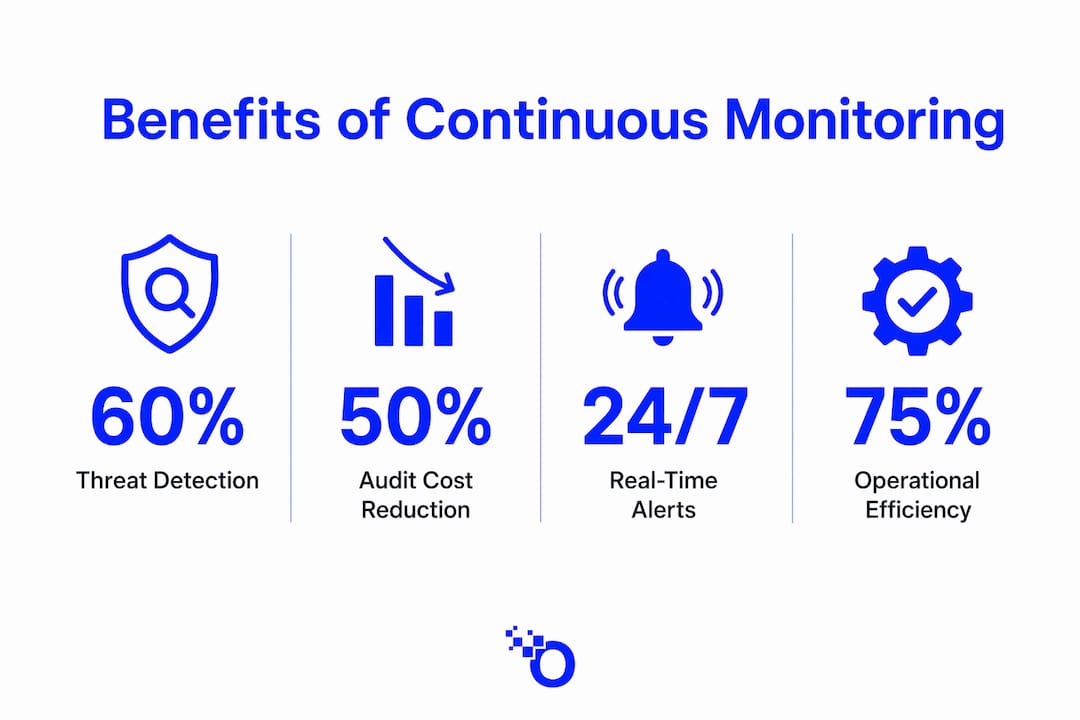
Audit costs also fall sharply. Manual audit costs drop by 50% when automation replaces manual review cycles. For agencies operating under tight municipal or county budgets, that savings directly funds personnel, equipment, or training.
Regulatory compliance is the third major financial driver. Regulatory penalties related to data protection totaled nearly €5.3 billion in 2024. Public safety agencies that handle criminal justice information, medical records, or personally identifiable data face exposure under frameworks including CJIS, HIPAA, and state-level privacy statutes. Automated compliance validation through continuous monitoring closes the gap between policy and practice.
The operational advantages extend beyond cost:
- Real-time risk detection. Anomalies in access patterns, data transfers, or login behavior trigger alerts within minutes rather than surfacing weeks later in an audit.
- Improved data integrity. Continuous logging creates an unbroken evidentiary record, which supports both internal investigations and legal proceedings.
- Employee misconduct oversight. User Activity Monitoring (UAM) flags policy violations such as unauthorized data access or off-hours system use without requiring supervisors to manually review logs.
- Fraud detection. Automated cross-referencing of financial transactions and access records identifies patterns consistent with internal fraud before losses compound.
- Compliance automation. Continuous controls monitoring maps system activity against regulatory requirements in real time, generating audit-ready reports on demand.
Monitoring also protects employees by producing objective, evidentiary data that supports fair personnel management. When a disciplinary action is challenged, continuous monitoring logs provide a factual record that removes ambiguity from the process.
What are the challenges of implementing continuous monitoring in public safety environments?
The most common implementation failure is cultural, not technical. Many public safety employees interpret monitoring as surveillance, a sign of distrust rather than a risk management tool. Transparent policies and clear communication are the primary mechanism for overcoming this resistance. Agencies that explain the dual purpose of monitoring, protecting both the organization and its personnel, see significantly faster adoption.
A second challenge is false positives. Establishing behavioral baselines before going live is mandatory. Without calibrated baselines, the system flags routine activity as suspicious, overwhelming analysts and training staff to ignore alerts. That training effect is dangerous. Once personnel learn to dismiss alerts, genuine threats slip through.
The third challenge is workload redistribution. Decision-makers often underestimate the operational shift that follows deployment. Monitoring generates data continuously. Someone must act on that data. Without a dedicated incident response workflow, monitoring data becomes noise, and vulnerabilities accumulate unaddressed.
Best practices for successful deployment include:
- Define scope before deployment. Identify which systems, roles, and data types require monitoring. Monitoring everything equally wastes resources and generates alert fatigue.
- Establish written policies. Document what is monitored, why, who reviews alerts, and how findings are used. Share this documentation with all personnel before go-live.
- Calibrate baselines first. Run the system in observation mode for 30–60 days before activating automated alerts. Use that period to define normal behavior for each role type.
- Assign response ownership. Every alert category must have a named owner and a documented response procedure. Unassigned alerts are unresolved risks.
- Review and recalibrate regularly. Continuous monitoring is not a set-it-and-forget-it solution. It requires ongoing calibration as personnel, systems, and threat patterns evolve.
Pro Tip: Frame monitoring to your personnel as a protection mechanism, not a performance evaluation tool. Agencies that lead with the employee protection angle, specifically that monitoring provides objective evidence when accusations are unfair, see faster cultural adoption and fewer grievances.
How does continuous monitoring work in practice for employee oversight?
User Activity Monitoring is the most direct application of continuous monitoring for employee oversight in public safety agencies. UAM tools record and analyze actions taken on agency systems, including file access, application use, data transfers, and login events. The system compares each action against established baselines and triggers alerts when behavior deviates from the norm.
Automated alerts serve as the operational backbone of any monitoring program. A dispatcher accessing criminal justice records outside their assigned case load, a records clerk downloading large volumes of personnel files, or an officer logging into systems from an unrecognized device all generate alerts that route to a designated reviewer. The reviewer then follows a documented response procedure, which may include supervisor notification, account suspension, or formal investigation.
Dashboards and real-time reporting give decision-makers a live view of agency-wide activity without requiring manual log review. Chiefs, HR directors, and compliance officers can monitor trends, track open alerts, and generate audit reports from a single interface. This capability is particularly valuable during internal affairs investigations, where a complete, timestamped activity record is required.
The table below maps common monitoring tools to their specific applications in public safety contexts.
| Tool type | Primary function | Public safety application |
|---|---|---|
| User Activity Monitoring (UAM) | Tracks individual user actions on systems | Flags unauthorized data access by personnel |
| Security Information and Event Management (SIEM) | Aggregates and correlates security event logs | Detects coordinated access anomalies across departments |
| Intrusion Detection System (IDS) | Monitors network traffic for suspicious patterns | Identifies external breach attempts on agency networks |
| Continuous Controls Monitoring (CCM) | Validates controls against compliance frameworks | Generates CJIS and HIPAA audit documentation automatically |
| Endpoint Detection and Response (EDR) | Monitors device-level activity and threats | Detects malware or unauthorized software on agency devices |
Agencies implementing employee monitoring workflows for public safety find that the combination of UAM and SIEM tools provides the most complete picture of both insider risk and external threat activity. The two tool types address different threat vectors and complement each other directly.
For agencies building out their continuous monitoring steps, the sequence matters. Define scope, establish baselines, deploy tools, activate alerts, and assign response ownership in that order. Skipping steps creates gaps that undermine the entire program.
Key Takeaways
Continuous monitoring delivers measurable financial, operational, and compliance value to public safety agencies, but only when paired with calibrated baselines, documented response workflows, and transparent personnel policies.
| Point | Details |
|---|---|
| Real-time vs. point-in-time | Continuous monitoring detects threats in minutes; periodic checks leave weeks-long gaps in visibility. |
| Financial impact | Agencies using continuous monitoring reduce breach costs by $1.7 million on average and cut manual audit costs by 50%. |
| Compliance automation | Automated controls monitoring generates audit-ready documentation, reducing exposure to regulatory penalties. |
| Baseline calibration | Defining normal behavior before activating alerts is mandatory to prevent false positives and alert fatigue. |
| Response workflow | Every alert must have a named owner and documented procedure, or monitoring data accumulates as unresolved risk. |
Why the human layer still determines whether monitoring succeeds
After working closely with public safety agencies on oversight and screening programs, the pattern I see most often is this: agencies invest in monitoring technology and then underinvest in the human systems that make that technology useful. The tools work. The workflows do not.
The agencies that get the most value from continuous monitoring are not the ones with the most sophisticated software. They are the ones where a supervisor knows exactly what to do when an alert fires at 2 a.m. on a Saturday. That clarity comes from deliberate planning, not from the monitoring platform itself.
The cultural dimension also deserves more attention than most implementation guides give it. Personnel in law enforcement, fire, and EMS carry a strong professional identity. They are trained to protect others, not to be watched. Framing monitoring as a protection mechanism for them, not just for the agency, changes the conversation. I have seen agencies go from significant union resistance to full adoption simply by leading with the employee protection angle and involving union representatives in policy development before rollout.
The future of continuous monitoring in public safety will involve more AI-driven anomaly detection, which will reduce the manual review burden substantially. But AI-driven alerts still require human judgment to interpret and act on. The agencies building strong human response capacity now will be the ones positioned to use AI tools effectively when they mature. The employee monitoring best practices that work today are the foundation for what comes next.
— Matt
How OMNI Intel supports continuous monitoring for public safety agencies
Public safety agencies need more than monitoring software. They need a partner that understands the investigative standards, compliance requirements, and personnel dynamics specific to law enforcement, fire, EMS, and dispatch environments.

OMNI Intel builds its oversight and screening services on law enforcement investigation principles, applying the same evidentiary rigor to post-hire monitoring that it applies to pre-employment background investigations. From pre-employment screening services designed for public safety roles to continuous activity monitoring that flags personnel risk in real time, OMNI Intel provides an integrated approach to workforce integrity. Agencies working with OMNI Intel gain FCRA-compliant processes, investigator-driven checks, and monitoring workflows built for the specific demands of public safety environments.
FAQ
What is the continuous monitoring definition in simple terms?
Continuous monitoring is the automated, ongoing collection and analysis of system and employee activity data to detect security threats and compliance violations in real time. It replaces periodic manual audits with always-on automated oversight.
What is continuous activity monitoring for employees?
Continuous activity monitoring tracks individual employee actions on agency systems, including file access, data transfers, and login events, and compares them against established behavioral baselines to flag anomalies automatically.
What are the main advantages of continuous monitoring over traditional audits?
Continuous monitoring detects threats in minutes rather than months, reduces manual audit costs by up to 50%, and generates compliance documentation automatically, eliminating the gaps that periodic assessments leave open.
How does continuous monitoring work with compliance frameworks like CJIS or HIPAA?
Continuous controls monitoring maps real-time system activity against the specific requirements of frameworks such as CJIS and HIPAA, generating audit-ready reports and triggering alerts when controls fall out of compliance.
Why do continuous monitoring programs fail?
Most programs fail because of three factors: no calibrated behavioral baseline before activation, no documented incident response workflow, and insufficient communication with personnel about the purpose and scope of monitoring.