

What Is Continuous Employee Monitoring: An HR Guide
Continuous employee monitoring is the ongoing, technology-driven process of observing and recording employee activity during work hours to support productivity, security, and regulatory compliance. Unlike periodic performance reviews or spot-check audits, this practice captures behavioral data in near real time, giving HR professionals and managers a persistent view of how work actually gets done. For public safety agencies and organizations where personnel conduct directly affects community trust, understanding this practice is not optional. It is a core operational responsibility.
What is continuous employee monitoring and how does it work?
Continuous employee monitoring, sometimes called workforce surveillance or employee activity tracking, is defined as near-real-time tracking of employee behavior during the workday for performance, security, and compliance purposes. The practice has moved from a niche IT security tool into a mainstream management function. Today, average employers deploy multiple concurrent monitoring methods across remote, hybrid, and in-office teams.
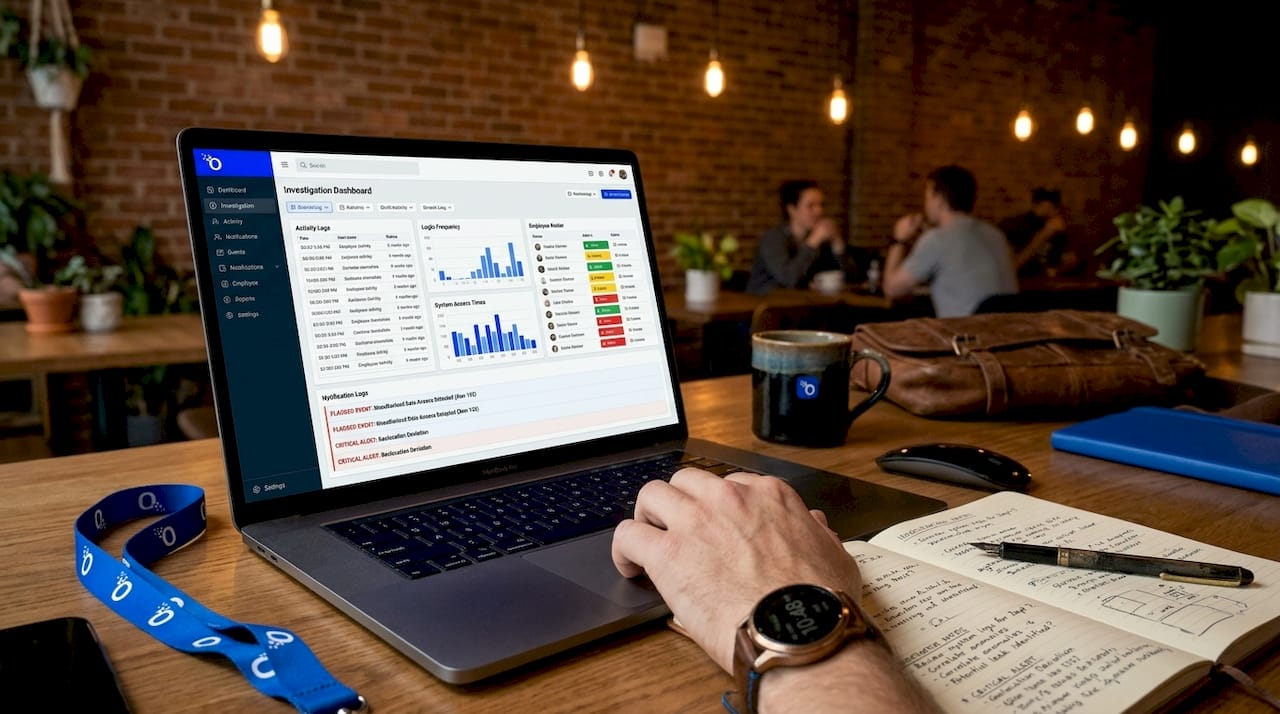
The technical architecture behind most employee monitoring systems follows a consistent pattern. A software agent is installed on company-owned devices. That agent collects data continuously and transmits it to a centralized dashboard where managers and HR professionals can review reports, flag anomalies, and generate productivity scores.
What data does monitoring software collect?
The data types collected vary by platform and organizational policy, but most enterprise-grade monitoring systems capture the following:
- Application usage: Which programs are open, for how long, and during what hours
- Web activity: URLs visited, time spent per site, and categorization by productive or non-productive content
- Keystroke logging: Volume of keystrokes as a proxy for active work, though not always the content of what is typed
- Screenshots: Periodic or event-triggered captures of the employee’s screen
- Time allocation reports: Automated breakdowns of how working hours are distributed across tasks or projects
- Behavioral analytics: AI-generated productivity scores based on aggregated activity patterns
These data streams feed into manager dashboards that display individual and team-level metrics. The goal is to give HR professionals a factual basis for performance conversations rather than relying solely on subjective observation.
Pro Tip: Before selecting a monitoring platform, request a full data dictionary from the vendor. Knowing exactly what data is collected, where it is stored, and who can access it is the first step in building a defensible monitoring policy.
One critical and often overlooked risk is third-party data exposure. Research shows that nine popular monitoring apps shared identifiable employee data with over 145 external domains, including major advertising platforms. Some platforms enable background location tracking even after the application is closed. This means the data your organization collects about employees may not stay within your organization’s control, a fact that carries direct legal and reputational consequences.
What are the legal and privacy considerations in employee monitoring?
Employee monitoring operates inside a complex web of privacy law, and the legal exposure for organizations that get this wrong is substantial. HR professionals must understand the applicable frameworks before deploying any monitoring system.
In the United States, the California Consumer Privacy Act (CCPA) and its amendment, the California Privacy Rights Act (CPRA), treat employee data as regulated personal information. Under CCPA, risk assessments are required when monitoring involves systematic observation, profiling, or AI-generated productivity scores that influence employment decisions. In the European Union, the General Data Protection Regulation (GDPR) imposes stricter requirements, including a lawful basis for processing, a Data Protection Impact Assessment (DPIA) for high-risk monitoring, and strict limits on data retention.
A concrete enforcement example illustrates the stakes. Italy’s data protection authority imposed restrictions on an employer’s email and web log monitoring program, ruling that metadata from employee communications constitutes sensitive personal data subject to retention limits and access controls. Email headers, network logs, and browsing histories are not neutral operational data. They are regulated signals that require governance.
“The proportionality principle requires that monitoring be no more intrusive than necessary to achieve the legitimate aim pursued.” — European Court of Human Rights jurisprudence on workplace monitoring disputes
The proportionality principle is the most practically useful legal concept for HR professionals designing a monitoring program. It means that keystroke logging every employee in a low-risk administrative role is harder to justify legally than monitoring network access for personnel with access to sensitive databases.
To build a legally defensible monitoring program, HR professionals should follow these steps:
- Identify the lawful basis for monitoring under applicable law (legitimate interest, contractual necessity, or legal obligation).
- Conduct a DPIA or CCPA risk assessment before deploying any system that involves profiling or automated decision-making.
- Draft a written monitoring policy that specifies what is monitored, why, how data is used, and how long it is retained. GDPR-compliant programs typically retain monitoring data for 12 to 36 months.
- Communicate the policy to employees before monitoring begins. Covert monitoring is legally indefensible in most jurisdictions and destroys trust when discovered.
- Restrict monitoring scope to work devices and work hours. Extending monitoring to personal devices or off-hours activity creates disproportionate intrusion and significant legal risk.
- Establish employee access rights so that individuals can review data collected about them, consistent with GDPR Article 15 and CCPA access rights.
Pro Tip: If your monitoring system generates AI-driven productivity scores that feed into performance reviews or termination decisions, treat it as automated decision-making under GDPR Article 22. That classification triggers additional transparency and human review requirements.
The absence of a comprehensive federal privacy law in the United States means that workers in most states have limited ability to refuse surveillance without risking their employment. This legal asymmetry places a higher ethical burden on HR professionals to implement monitoring responsibly, not merely legally.
What are the benefits and risks of continuous employee monitoring?
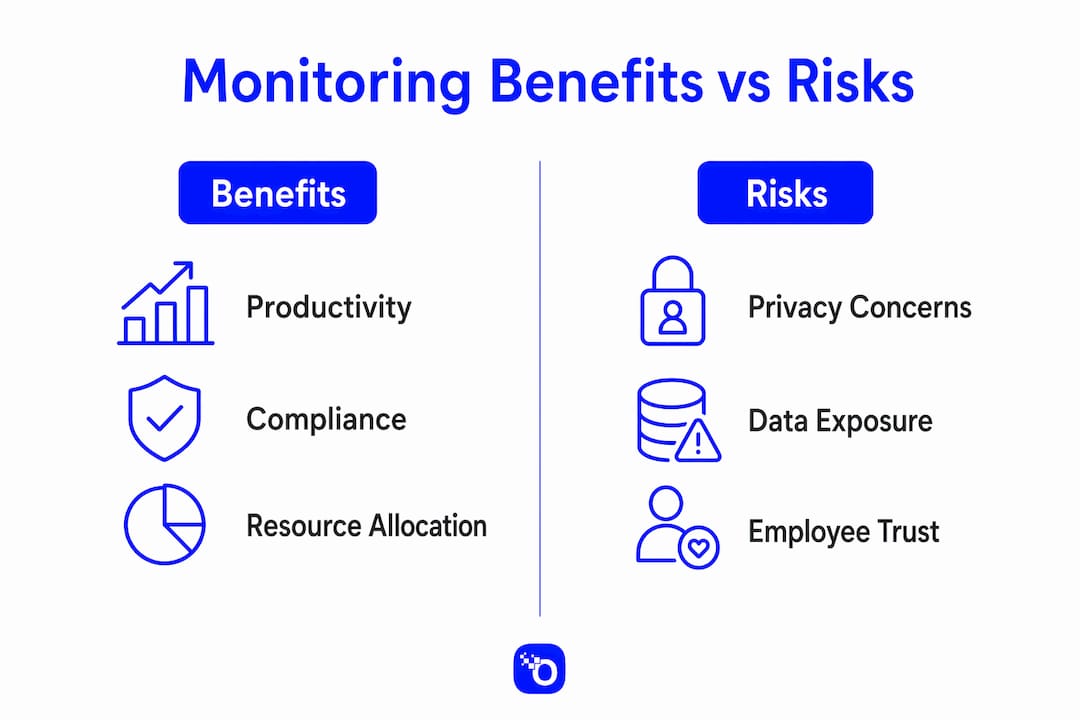
Continuous monitoring in workplaces delivers measurable operational benefits, but those benefits are only realized when the program is designed with clear intent and appropriate safeguards. A poorly designed program produces misleading data and erodes the organizational trust that makes performance management effective.
Benefits of employee monitoring
| Benefit | Practical impact |
|---|---|
| Productivity visibility | Managers identify time allocation gaps and redirect effort to high-value tasks with data rather than assumption. |
| Security enhancement | Monitoring detects insider threats, unauthorized data access, and policy violations before they escalate. |
| Compliance documentation | Activity logs provide an auditable record for regulatory inquiries, litigation holds, and internal investigations. |
| Remote team management | Monitoring gives managers objective performance data for distributed teams where direct observation is not possible. |
| Operational benchmarking | Aggregate data reveals workflow inefficiencies and informs process improvements across departments. |
Risks that HR professionals must manage
The risks of continuous employee monitoring are real and underestimated by organizations that focus only on the productivity upside.
- Trust erosion: Employees who feel surveilled rather than supported report lower engagement and higher turnover intent. Monitoring perceived as punitive undermines the psychological safety that drives discretionary effort.
- Misleading productivity data: Activity metrics measure presence, not output. A key HR responsibility is defining what productivity means organizationally before deploying monitoring tools. Measuring keystrokes in a role where deep thinking produces the most value generates noise, not insight.
- Data misuse: Monitoring data collected for one purpose (security) can be repurposed for another (performance management) without employees’ knowledge, creating legal exposure and ethical violations.
- Third-party data risk: As noted earlier, monitoring platforms frequently share employee data with external vendors. Organizations that have not audited their vendor’s data-sharing practices may be unknowingly creating a shadow record of employee behavior outside their control.
- Disproportionate surveillance: Monitoring that extends beyond what is necessary to achieve the stated business objective fails the proportionality test under both GDPR and European Court of Human Rights standards.
The organizations that extract genuine value from monitoring programs are those that treat monitoring data as one input among many, not as a definitive performance verdict. Aligning monitoring scope with organizational culture and communicating its purpose transparently are the two factors that most consistently determine whether a program builds accountability or breeds resentment.
How can HR professionals implement continuous employee monitoring effectively?
Effective implementation of an employee monitoring program requires deliberate planning before any software is deployed. The sequence matters. Organizations that select a monitoring tool first and build policy around it afterward consistently encounter compliance gaps and employee relations problems.
Follow this structured implementation sequence:
-
Define productivity outcomes, not activity proxies. Before selecting a monitoring system, HR must specify what successful performance looks like in measurable terms. For a dispatch center, that might be call resolution time and accuracy. For a records unit, it might be document processing volume and error rate. Monitoring tools should measure progress toward those outcomes, not substitute for them.
-
Select a monitoring system aligned with your risk profile. Not every organization needs keystroke logging or screenshot capture. Match the monitoring depth to the sensitivity of the data employees handle and the nature of the compliance obligations you face. Public safety agencies managing criminal justice information have different requirements than a general administrative office. Review the monitoring workflow options specific to your agency type before committing to a platform.
-
Audit vendor data practices before signing a contract. Given that many monitoring platforms share data with external domains, require vendors to provide a complete list of third-party integrations, data storage locations, and subprocessor agreements. This step is not optional for organizations subject to CCPA or GDPR.
-
Develop and distribute a written monitoring policy. The policy must specify the scope of monitoring, the data collected, how it will be used, who has access, and the retention period. Employees must receive this policy before monitoring begins, and acknowledgment should be documented.
-
Train managers to interpret monitoring data responsibly. Raw activity data is frequently misread. A manager who sees low application usage during a two-hour block may not recognize that the employee was in a required training session or conducting a field visit. Training managers to contextualize data before drawing conclusions prevents unfair performance actions and reduces legal exposure.
-
Schedule regular program reviews. Monitoring practices that were proportionate and compliant at launch may become disproportionate as roles evolve or as new legal requirements take effect. Build a quarterly or annual review cycle into the program from the start. The employee monitoring checklist developed for 2026 provides a structured framework for these reviews.
Pro Tip: Run a pilot monitoring program with a single team before agency-wide deployment. Pilot programs surface data quality issues, manager training gaps, and employee communication problems at a scale where they can be corrected without organizational disruption.
The shift from niche surveillance tool to mainstream management practice means that HR professionals who have not yet formalized their monitoring programs are increasingly behind the standard of care in their industry. The question is no longer whether to monitor, but how to do it in a way that is legally sound, proportionate, and genuinely useful.
Key takeaways
Continuous employee monitoring delivers productivity and compliance value only when it is built on defined outcomes, transparent policy, and proportionate data collection.
| Point | Details |
|---|---|
| Define outcomes first | Establish measurable productivity goals before selecting any monitoring tool or platform. |
| Legal compliance is non-negotiable | Conduct a DPIA or CCPA risk assessment before deploying systems that involve profiling or automated scoring. |
| Vendor data practices require scrutiny | Audit third-party data sharing before signing contracts, as many platforms share employee data externally. |
| Proportionality limits monitoring scope | Match monitoring depth to the sensitivity of the role and the legitimate business objective being served. |
| Transparency determines program success | Employees who understand what is monitored and why are more likely to accept the program and less likely to challenge it legally. |
Why proportionality is the principle HR leaders keep underestimating
I have reviewed monitoring programs across a range of organizations, and the pattern is consistent. HR teams spend considerable time selecting the right software and drafting the right policy, then deploy a program that monitors far more than the stated business objective requires. They capture keystroke volume for employees whose output is measured in decisions, not documents. They retain activity logs for three years when six months would satisfy every compliance obligation they face. They share data with a monitoring vendor whose subprocessor list runs to forty external companies.
The proportionality principle sounds abstract until you see it applied in an enforcement action or an employment tribunal. At that point, it becomes very concrete. The question the regulator or the judge asks is not whether you had a policy. It is whether the monitoring you conducted was the minimum necessary to achieve the legitimate aim you identified. Most programs I have reviewed cannot answer that question cleanly.
The other underestimated factor is the cultural signal that monitoring sends. In public safety agencies, where personnel are already operating under significant scrutiny from the public and oversight bodies, adding a layer of internal surveillance without clear communication about its purpose can accelerate the attrition of exactly the personnel you most want to retain. The officers, dispatchers, and investigators who have options will leave. The ones who stay may simply learn to perform for the monitoring system rather than for the mission.
The organizations that get this right treat monitoring as an accountability infrastructure, not a control mechanism. They define what good performance looks like, build monitoring that measures progress toward it, and communicate the program as a tool that protects both the organization and the individual. That framing is not naive. It is strategically sound, and it is the only framing that survives legal scrutiny over time.
— Matt
How Omniintel supports continuous monitoring for public safety agencies

Omniintel is built specifically for the monitoring and screening demands of public safety agencies, where the stakes of a personnel failure extend beyond organizational risk to community safety. The platform integrates pre-employment screening services with post-hire continuous activity monitoring, giving HR professionals a single, compliance-oriented system that covers the full personnel lifecycle. Omniintel’s investigator-driven approach applies law enforcement investigation principles to both background checks and ongoing monitoring, producing records that meet FCRA compliance standards and hold up under regulatory review. Whether you are managing a law enforcement agency, a fire and EMS department, or a dispatch center, Omniintel provides the monitoring infrastructure your agency needs to protect its reputation and fulfill its public safety mission.
FAQ
What is continuous employee monitoring?
Continuous employee monitoring is the near-real-time tracking of employee activity during work hours using software that records application usage, web activity, keystrokes, and behavioral patterns. Its primary purposes are productivity management, security enforcement, and regulatory compliance.
How does employee monitoring work technically?
A software agent installed on company devices collects activity data and transmits it to a centralized dashboard where managers can review reports and productivity scores. Some platforms also use AI-driven behavioral analytics to generate automated performance assessments.
Is employee monitoring ethical?
Employee monitoring is ethical when it is proportionate to the business objective, transparently communicated to employees, and limited to work devices and work hours. Covert monitoring or surveillance that extends beyond what is necessary to achieve a stated legitimate aim fails both legal and ethical standards.
What are the legal requirements for monitoring employees?
Under GDPR, organizations must establish a lawful basis, conduct a DPIA for high-risk monitoring, and define data retention periods, typically between 12 and 36 months. Under CCPA, a risk assessment is required when monitoring involves profiling or automated decision-making that affects employment.
What are the main risks of continuous employee monitoring?
The primary risks include trust erosion among employees, misleading productivity conclusions from poorly defined metrics, legal exposure from disproportionate data collection, and uncontrolled third-party data sharing by monitoring vendors. Each risk is manageable with deliberate program design and transparent communication.