

What Is Credential Verification for Public Safety HR
Credential verification is defined as the formal process of authenticating a candidate’s professional licenses, educational degrees, and certifications by confirming them directly with the original issuing authorities. For public safety agencies, this process is not administrative formality. It is the compliance control surface that separates defensible hiring decisions from catastrophic liability. Whether you are staffing a law enforcement agency, a fire department, an EMS unit, or a dispatch center, the credential validation process determines whether the person carrying a badge, a radio, or a medical kit is actually qualified to do so. The stakes in public safety hiring are categorically higher than in most sectors, and the verification standard must reflect that reality.
What methods are used for credential verification in public safety hiring?
Credential verification methods fall into three primary categories: primary-source verification, digital cryptographic verification, and third-party credential verification organizations (CVOs). Each method carries different reliability profiles, timelines, and compliance implications. Understanding the differences is the first step toward building a defensible hiring workflow.
Primary-source verification
Primary-source verification confirms qualifications directly with the original issuing entity, whether that is a university registrar, a state licensing board, or a certification body. For public safety agencies, this method supports audit defensibility and reduces the risk of expired or altered credentials passing through undetected. The Joint Commission defines this as the gold standard for credentialing in safety-sensitive roles, and that standard applies equally to law enforcement and emergency services hiring.

The process requires contacting each issuing authority independently, which means a single candidate with multiple licenses and certifications may trigger several parallel verification requests. The Educational Commission for Foreign Medical Graduates (ECFMG) illustrates the operational rigor this demands: ECFMG deems credentials complete only after directly receiving confirmation from the original issuing institution, not from the applicant. That model sets the benchmark for what “verified” actually means in high-stakes credentialing.
Digital verifiable credentials and cryptographic signatures
Digital verifiable credentials use cryptographic signatures to confirm that a credential was not tampered with and genuinely originated from the claimed issuer, without requiring direct contact between the issuer and the verifying party. This works through a public and private key system: the issuer signs the credential with a private key, and the verifier checks authenticity using the corresponding public key. The result is a tamper-evident record that can be checked instantly.
This approach is not simply about faster document uploads. Cryptographic verification pipelines must handle status validation, revocation checks, and trust list management to be genuinely compliant. An agency that accepts a digital credential without running those checks has not verified anything. It has accepted a document.
Third-party credential verification organizations
CVOs act as intermediaries that manage the verification process on behalf of hiring agencies. They maintain relationships with licensing boards and educational institutions, run parallel verification tasks, and deliver consolidated reports. For public safety HR teams managing high-volume recruiting cycles, CVOs reduce administrative burden without sacrificing rigor.
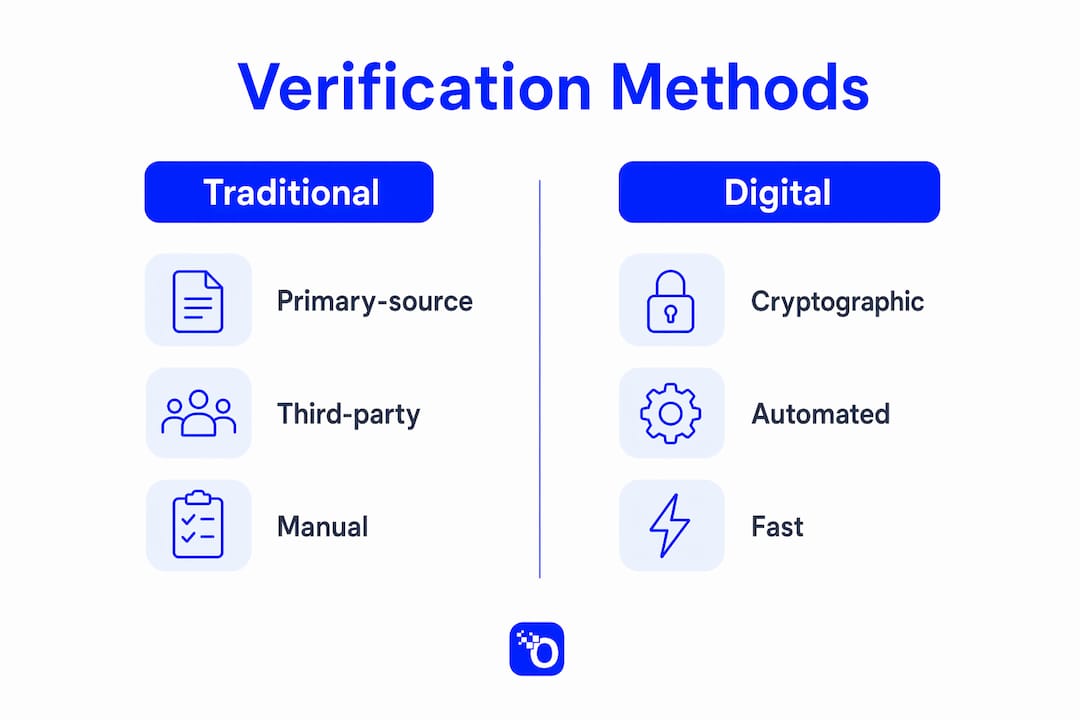
Comparison of credential verification methods
| Method | Speed | Compliance strength | Best use case |
|---|---|---|---|
| Primary-source verification | Slower (days to weeks) | Highest | Audit-sensitive, regulated roles |
| Digital cryptographic verification | Near-instant | High, if pipeline is complete | Tech-enabled agencies with digital credential systems |
| Third-party CVO | Moderate | High, if CVO is accredited | High-volume hiring with multiple license types |
Pro Tip: Never rely on a single verification method for public safety roles. Combine primary-source confirmation for core licenses with CVO support for secondary certifications to reduce timeline without sacrificing defensibility.
Why is credential verification essential for public safety agencies?
Credential verification is not optional in public safety hiring. It is the mechanism through which agencies demonstrate that their personnel meet documented qualification standards, satisfy regulatory requirements, and pose no foreseeable risk to the communities they serve. The consequences of skipping or shortcutting this process are legal, operational, and reputational.
Here are the four core reasons credential verification is non-negotiable for public safety HR:
-
Audit defensibility. Regulatory bodies and oversight agencies expect documented proof that credentials were verified at the time of hire. Verification documentation must show credential status, issue and expiration dates, and the specific verification event. Simply noting “website checked” fails compliance. Agencies that cannot produce authoritative verification evidence during an audit face findings, sanctions, and potential liability.
-
Regulatory compliance. Public safety agencies operate within layered compliance frameworks. The Joint Commission requires that organizations verify and document credentials aligned with explicit job description requirements. FBI CJIS guidance integrates credential verification into broader statutory background check requirements for personnel with access to criminal justice information systems. Failing to meet these standards is not a procedural gap. It is a legal exposure.
-
Operational safety. A law enforcement officer with a falsified firearms certification, a paramedic with a lapsed EMT license, or a dispatcher without verified training credentials represents a direct threat to public safety. Credential checking at the pre-employment stage is the primary control that prevents unqualified personnel from entering safety-critical roles.
-
Public trust. Communities grant public safety agencies extraordinary authority. That authority is contingent on the public’s confidence that personnel are qualified and vetted. A single high-profile incident involving an unqualified hire can erode institutional trust that took decades to build.
“Verification is not mere paperwork; it confirms that candidates meet documented education and experience requirements relevant to the job.” — Joint Commission International
The importance of credential verification in public safety hiring extends beyond the individual hire. It shapes the integrity of the entire agency.
How to implement an effective credential verification process
An effective credential validation process is built on clear requirements, documented workflows, and disciplined evidence management. The following steps give public safety HR teams a structured path from job posting to verified hire.
-
Define credential requirements at the job description stage. Every position should carry an explicit list of required licenses, certifications, and educational credentials. These requirements must align with the actual duties of the role and any applicable regulatory standards. Vague job descriptions produce vague verification targets and create gaps that are difficult to defend during audits.
-
Map your verification workflow before recruiting begins. Identify which credentials require primary-source verification, which can be handled through a CVO, and which may be supported by digital credential systems. Multi-step verification workflows require contacting multiple authoritative sources for a single candidate, so planning parallel processing tasks in advance prevents bottlenecks that delay hiring timelines.
-
Collect and store authoritative verification evidence. For each credential verified, document the credential status, the issue and expiration dates, the verification method used, and the date the verification was completed. This evidence must be tied directly to the verification event, not stored as a general candidate file note. Digital document management systems that timestamp and log verification activities are far more defensible than paper-based records.
-
Decide between in-house verification and external services. Smaller agencies with limited HR capacity often benefit from partnering with an accredited CVO or a background screening platform that includes credential verification as part of its pre-employment investigation package. Larger agencies with dedicated HR staff may run primary-source verification in-house for core credentials while outsourcing secondary certifications. The decision should be driven by volume, timeline requirements, and available compliance expertise.
-
Build in re-verification triggers for post-hire monitoring. Credential verification does not end at hire. Licenses expire, certifications lapse, and disciplinary actions can result in revocation. Agencies that verify candidate integrity only at the point of hire create a blind spot that grows over time. Automated re-verification alerts tied to expiration dates close that gap.
Pro Tip: Set calendar-based re-verification triggers at 90 days before any credential expiration date. This gives HR enough time to confirm renewal without creating a compliance gap or forcing an operational disruption.
Timing is a frequently underestimated factor. Credential verification for public safety roles can take days to weeks depending on the responsiveness of issuing institutions. Building verification timelines into the recruiting schedule, rather than treating them as a post-offer afterthought, prevents conditional offers from stalling and reduces candidate attrition during the hiring process.
What are the latest technologies shaping credential verification?
Digital credential verification is reshaping the speed and reliability of the credential assessment process, but the technology introduces its own compliance requirements that HR teams must understand before adopting it.
How digital credential verification works
Cryptographically verifiable credentials allow automated consistency checks without relying on trust in the presenting individual or manual document review. The issuer embeds a cryptographic signature into the credential at the time of issuance. When the credential is presented to a verifier, the system checks the signature against the issuer’s public key, confirms the credential has not been revoked, and validates that it falls within its active date range. This entire process can occur in seconds.
The compliance implications are significant. A digital verification pipeline that checks only the cryptographic signature but skips revocation status or trust list validation is incomplete. Agencies adopting digital credential systems must confirm that their verification tools run the full pipeline, not just the document authenticity check.
Key advantages and considerations for public safety agencies
- Digital credentials eliminate the manual document review step, reducing human error in authenticity assessment.
- Cryptographic verification produces a machine-readable audit trail, which is more defensible than handwritten verification logs.
- Offline verification capability means credentials can be checked even when network connectivity is limited, a relevant factor for field-based public safety operations.
- Integration with applicant tracking systems (ATS) and HR information systems (HRIS) allows verification status to flow directly into the candidate record without manual data entry.
- Not all issuing institutions currently support digital credential issuance, which means hybrid workflows combining digital and primary-source verification will remain necessary for the foreseeable future.
Digital vs. traditional verification: a practical comparison
| Feature | Traditional verification | Digital cryptographic verification |
|---|---|---|
| Speed | Days to weeks | Seconds to minutes |
| Audit trail | Manual logs, paper records | Machine-readable, timestamped |
| Revocation detection | Requires re-contact with issuer | Automated status check |
| Issuer availability dependency | High | Low (offline capable) |
| Current adoption in public safety | Widespread | Emerging |
The trajectory is clear. As more licensing boards and certification bodies adopt digital credential issuance, the credential verification process will shift toward cryptographic validation as the primary method. Agencies that build familiarity with these systems now will be better positioned to meet future compliance expectations without disrupting their hiring operations.
Key takeaways
Credential verification is the foundational compliance control in public safety hiring, and agencies that treat it as a checkbox rather than a documented, evidence-based process expose themselves to legal liability, regulatory findings, and operational risk.
| Point | Details |
|---|---|
| Primary-source verification is the compliance standard | Confirm credentials directly with issuing authorities to produce audit-defensible evidence. |
| Documentation must be tied to the verification event | Record credential status, dates, and method used at the time of verification, not as a general file note. |
| Digital credentials require full pipeline checks | Cryptographic verification must include revocation status and trust list validation to be compliant. |
| Re-verification is required post-hire | Set expiration-based alerts to catch lapsed licenses before they create operational or legal gaps. |
| Method selection should match agency capacity | Combine primary-source verification with CVO support or digital tools based on volume and compliance requirements. |
Why credential verification deserves more than a checkbox in public safety HR
I have reviewed enough public safety hiring workflows to say with confidence that the most common failure point is not malicious intent. It is process design. Agencies often have a general understanding that credentials need to be checked, but they lack a documented, repeatable workflow that specifies who checks what, how evidence is collected, and where it is stored. That gap is where liability lives.
The shift toward digital verifiable credentials is genuinely promising, but I would caution HR teams against treating it as a shortcut. A digital credential that has not been run through a complete cryptographic pipeline, including revocation checks, is not a verified credential. It is a digital document. The distinction matters enormously when an agency is defending a hiring decision in front of an oversight board or in litigation.
What I find most underappreciated in this space is the value of combining traditional and digital methods rather than replacing one with the other. Primary-source verification for core licenses, supported by digital credential checks for supplementary certifications, gives agencies both the depth of direct issuer confirmation and the speed of automated validation. That combination is not redundant. It is layered defense.
The agencies that handle this best treat credential verification as an ongoing program, not a pre-hire event. They build re-verification triggers into their HR systems, they train their investigators on documentation standards, and they review their verification workflows annually against updated regulatory guidance. That level of discipline is what separates agencies that are genuinely protected from those that only believe they are.
— Matt
How Omniintel supports credential verification for public safety agencies

Omniintel is built specifically for the credential verification and background investigation demands of public safety agencies. The platform’s pre-employment screening services include investigator-driven credential checks, primary-source verification workflows, and FCRA-compliant documentation practices designed to hold up under regulatory scrutiny. Whether your agency is hiring law enforcement officers, EMS personnel, dispatchers, or private security staff, Omniintel delivers verification results that are thorough, documented, and defensible. The platform also supports post-hire monitoring to flag credential expirations and emerging compliance issues before they become operational problems. For public safety HR teams that need to move quickly without cutting corners, Omniintel provides the structure and expertise to do both.
FAQ
What is credential verification in simple terms?
Credential verification is the process of confirming that a job applicant’s claimed licenses, degrees, and certifications are authentic and current by checking directly with the issuing authorities. It is the formal mechanism that separates documented qualification from unverified self-reporting.
How long does the credential verification process take?
Primary-source verification typically takes several days to several weeks, depending on the responsiveness of issuing institutions. Digital cryptographic verification can return results in seconds, but only when the issuing body supports digital credential issuance.
Why does credential verification matter specifically for public safety hiring?
Public safety roles carry legal authority and direct responsibility for community welfare, which means an unqualified hire poses risks that extend far beyond the agency itself. Regulatory frameworks including Joint Commission standards and FBI CJIS requirements mandate documented credential verification as part of compliant hiring practice.
What documentation is required for defensible credential verification?
Defensible verification documentation must include the credential status, issue and expiration dates, the verification method used, and the date the verification was completed, all tied to the specific verification event rather than stored as a general candidate note.
Can digital credentials replace traditional primary-source verification?
Digital credentials can supplement and in some cases replace primary-source verification when the issuing institution supports cryptographic issuance and the verifying agency runs a complete validation pipeline including revocation and trust list checks. For most public safety agencies today, a hybrid approach combining both methods remains the most reliable and compliant option.