

Understanding candidate monitoring: a public safety HR guide
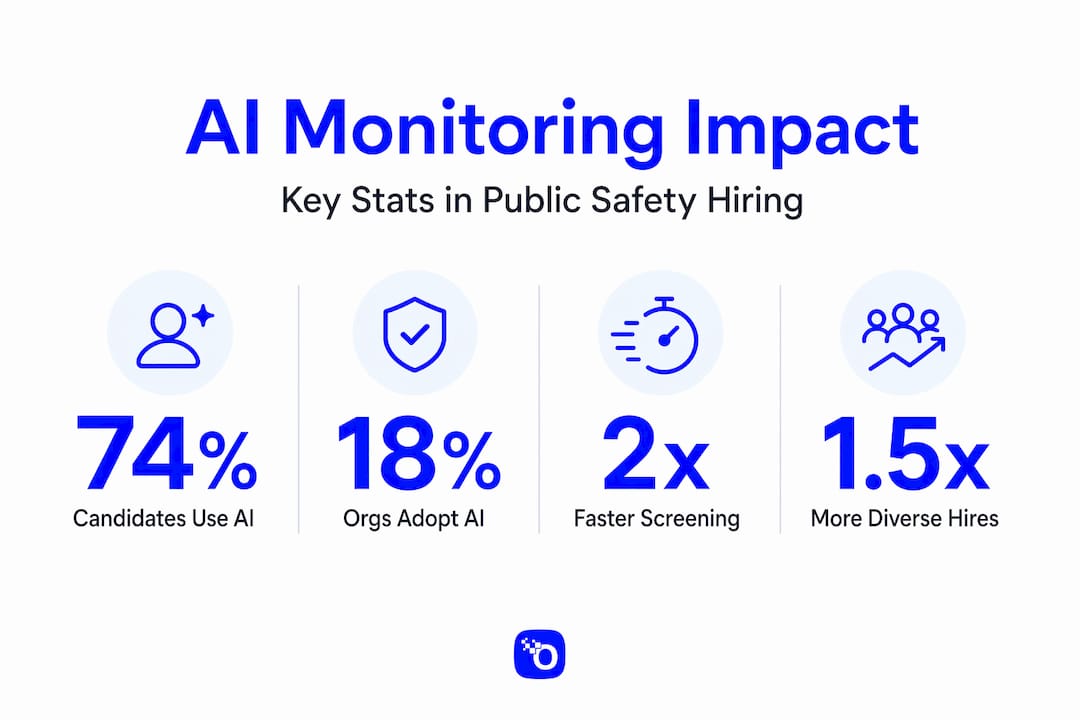
A striking gap defines public safety recruitment today: 74% of candidates use AI in their job searches while only 18% of organizations have deployed AI broadly across their hiring processes. For public safety agencies, understanding candidate monitoring is not an administrative detail. It is the structural backbone of a compliant, defensible, and community-protective hiring program. This guide gives HR professionals and hiring managers in law enforcement, fire, EMS, dispatch, and related fields a clear framework for modern candidate monitoring, covering compliance requirements, AI-driven workflows, and post-hire risk management.
Table of Contents
- The fundamentals of candidate monitoring in public safety recruitment
- How AI transforms candidate monitoring and screening for public safety agencies
- Legal and ethical considerations in AI-powered candidate and employee monitoring
- Continuous candidate and employee monitoring: tools and best practices for risk management
- Balancing AI advantages with ethical vigilance in candidate monitoring
- Advanced public safety screening and monitoring solutions from OMNI Intel
- Frequently asked questions
Key Takeaways
| Point | Details |
|---|---|
| Comprehensive candidate monitoring | Track key candidate data fields regularly to avoid lost candidates and improve hiring efficiency. |
| AI enhances monitoring | Artificial intelligence automates screening and communication, accelerating public safety recruitment processes. |
| Compliance is critical | Ensure AI monitoring tools comply with laws and maintain transparency to mitigate bias and privacy risks. |
| Continuous risk management | Implement ongoing AI-driven employee monitoring with privacy safeguards to manage risks after hiring. |
| Balance tech and ethics | Use AI to support, not replace, human judgment with strong ethical oversight in public safety hiring. |
The fundamentals of candidate monitoring in public safety recruitment
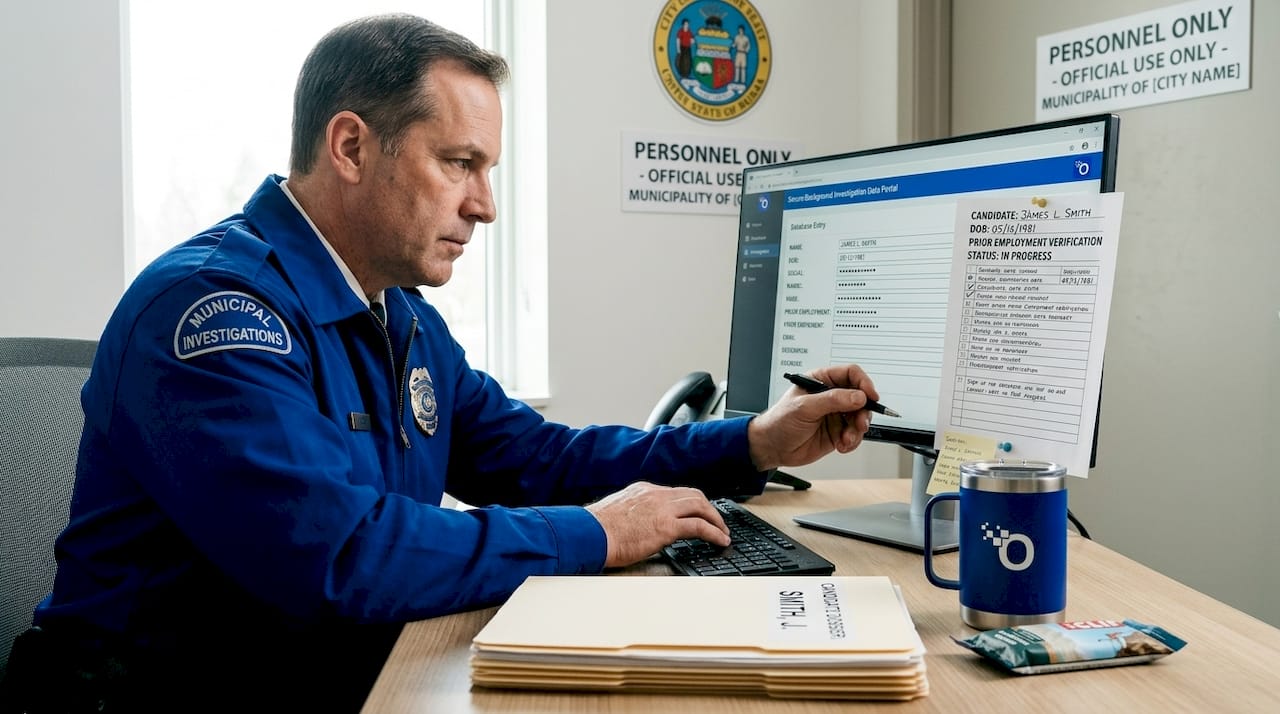
Understanding candidate monitoring begins with a precise definition. Candidate monitoring means systematically tracking each applicant’s status, communications, documentation, and required next steps through every stage of the hiring funnel. In public safety contexts, this is not optional process hygiene. It is a compliance and mission-critical function. A police officer or paramedic who slips through an incomplete vetting process represents a direct risk to public trust and community safety.
The employee monitoring process in public safety agencies must begin before the badge is issued. The tracking infrastructure built during recruitment becomes the baseline against which post-hire behavior is measured. Agencies that build disciplined candidate tracking from day one are better equipped to identify emerging risk signals later in an employee’s career.
What monitoring job applicants actually requires
Minimum viable candidate tracking in 2026 requires monitoring at least 12 fields per candidate, with weekly audits flagging any record that has not been updated in over seven days. In practice, that means every applicant file should capture the following core data points:
- Candidate name and contact information
- Application source (job board, referral, agency website)
- Current pipeline stage (applied, screened, interviewed, background check, offer)
- Stage owner (which recruiter or investigator is responsible)
- Last contact date and method
- Next required action and its due date
- Resume and document status (received, verified, pending)
- Background investigation status (initiated, in progress, cleared, flagged)
- Physical and psychological exam results (pass, pending, fail)
- Compliance notes (FCRA authorization received, consent forms signed)
- Disqualifying flags (prior decertification index hits, criminal history, integrity concerns)
- Offer and onboarding status
Weekly audits are not bureaucratic overhead. They are a talent retention tool. A qualified candidate who receives no communication for ten days frequently withdraws, accepts a competing offer, or forms a negative impression of the agency. In law enforcement, where qualified applicant pools are already constrained, losing a strong candidate to administrative neglect carries real operational cost.
The numbered framework for a compliant tracking workflow
A structured, numbered approach makes candidate tracking auditable and reproducible across hiring teams of any size.
- Open a candidate record on first contact, capturing source, date, and initial qualifications.
- Assign stage ownership immediately, so no candidate file sits unattended.
- Log every communication touchpoint, including emails, calls, and interview notes, within 24 hours.
- Run a weekly pipeline audit that surfaces every record with no update in the prior seven days.
- Document disqualifying decisions with specific factual grounds to support FCRA-compliant adverse action procedures.
- Archive completed files in a format accessible for post-hire compliance reviews and legal holds.
This sequence sounds straightforward. Most agencies that struggle with candidate drop-off and compliance findings are missing steps two and three consistently.
How AI transforms candidate monitoring and screening for public safety agencies
AI adoption in talent acquisition is growing, but only 18% of organizations use it broadly across hiring processes, with screening as the most widely adopted application at 58%. For public safety agencies still relying on spreadsheets and manual email chains, the gap between current practice and available capability is significant.
AI does not replace the investigator-driven checks that define quality public safety screening. It removes the low-value administrative burden that consumes recruiter capacity and slows the pipeline. The result is more time for the work that actually requires human judgment: reference interviews, polygraph preparation, psychological evaluations, and integrity assessments.
Core AI capabilities in candidate monitoring workflows
- Automated resume screening that filters for minimum qualifications, certifications, and disqualifying criteria before a human reviewer touches the file.
- Candidate communication automation that sends status updates, document requests, and scheduling prompts on a defined cadence, reducing the manual follow-up burden.
- Interview scheduling tools that integrate with recruiter calendars and candidate availability, eliminating back-and-forth that typically adds days to the process.
- Real-time pipeline dashboards that give hiring managers visibility into stage distribution, bottlenecks, and at-risk candidates without pulling reports manually.
- Bias mitigation through standardized assessment scoring, which reduces the influence of subjective first impressions on structured screening decisions.
AI in public safety recruitment offers a concrete operational result. Research shows AI saves recruiters 23 hours per week and can reduce time-to-hire by up to 75% in law enforcement and related public safety roles, while also providing insights that support community-reflective hiring.
“The agencies that move fastest on qualified candidates win. AI monitoring tools create the real-time visibility that transforms a reactive recruiting team into a proactive one.”
Pro Tip: When evaluating AI background checks for your agency, prioritize platforms that provide an auditable decision log for every automated action. In a civil service or union environment, the ability to show why a candidate advanced or was flagged is as important as the outcome itself.
The diversity dimension deserves specific mention. Standardized AI assessments, when properly validated, reduce the unstructured interviewer discretion that historically disadvantages candidates from underrepresented communities. For public safety agencies under consent decrees or community pressure to build workforces that reflect the populations they serve, this is a meaningful structural benefit, not just a compliance checkbox.
Understanding AI’s impact on hiring in depth helps agencies make informed decisions about which capabilities to adopt first and how to phase implementation without disrupting active recruitment cycles.
Legal and ethical considerations in AI-powered candidate and employee monitoring
AI’s efficiency gains carry a corresponding set of legal and ethical obligations that no public safety HR team can afford to underestimate. 80% of the ten largest U.S. companies now use employee tracking software, and the legal landscape governing that practice is actively evolving under ADA, Title VII, and a growing body of state-level privacy statutes.
For public safety agencies, the stakes are higher than in the private sector. A discriminatory hiring process does not just create litigation exposure. It undermines agency legitimacy in the communities that agencies serve and protect.
Key legal risks in AI-driven candidate monitoring
AI-driven monitoring risks include invisible algorithmic biases that may violate the ADA and the National Labor Relations Act, particularly because most employment laws predate the era of algorithmic appraisal. The following risks require structured mitigation:
- Disparate impact on protected classes through automated screening criteria that correlate with race, gender, disability status, or national origin.
- Lack of transparency about what data is collected during the application process and how automated decisions are made.
- Inadequate consent processes that fail to disclose AI involvement in screening or monitoring to candidates and employees.
- Unvalidated assessment tools that have not been tested for adverse impact across demographic groups before deployment.
- State privacy law violations, particularly in California, Colorado, and Illinois, which impose disclosure and opt-out requirements that exceed federal minimums.
A compliance framework for ethical AI monitoring
The following numbered process reduces legal exposure while preserving the operational benefits of AI-assisted candidate monitoring.
- Audit every AI tool for adverse impact before deployment, using validated statistical testing across protected class categories.
- Publish a written AI use policy that discloses to candidates what automated tools are involved and how their data is used.
- Obtain written consent from all applicants and employees before initiating any AI-assisted monitoring or data collection.
- Assign a designated compliance owner responsible for reviewing AI outputs for bias signals on a quarterly schedule.
- Maintain a human review requirement for any adverse action, ensuring that no disqualification is issued based solely on algorithmic output.
- Document all AI-assisted decisions in a format suitable for FCRA adverse action procedures and Equal Employment Opportunity Commission review.
Understanding background check laws for agencies and maintaining governed applicant monitoring compliance are not separate workstreams. They are two sides of the same obligation. Treating them as integrated requirements, rather than siloed functions, is where most compliant agencies succeed and non-compliant ones fail.
“Transparency is not just an ethical value. In public safety hiring, it is a legal requirement and a community trust investment.”
Agencies should also review data privacy protocols in public safety hiring as part of any AI tool onboarding process, particularly when tools involve third-party data vendors who access applicant records.
Continuous candidate and employee monitoring: tools and best practices for risk management
The most consequential oversight error many public safety agencies make is treating candidate monitoring as a pre-hire-only function. The risk does not end when the offer letter is signed. It evolves. Behavioral changes, criminal activity, social media conduct, and financial stress all emerge over the course of employment, and none of them are visible without a structured post-hire monitoring framework.
Post-hire continuous surveillance via AI tools such as OMNIView provides daily alerts on criminal activity and online behavior, supported by privacy-compliant frameworks designed to prevent the kind of reputational crisis that follows a preventable critical incident.
Best practices for ongoing employee risk management
- Daily alert monitoring for criminal justice activity, including arrests, charges, and civil judgments linked to active employees.
- Social media and online behavior review for conduct that could compromise public trust or violate agency policy.
- Financial stress indicators that may signal vulnerability to corruption, coercion, or misconduct.
- Routine audit schedules for reviewing monitoring data completeness and acting on flagged alerts within defined response windows.
- Defined ownership for each monitoring record, ensuring that alerts do not sit unreviewed.
- Integration with HR case management workflows so that monitoring findings trigger structured responses rather than ad hoc reactions.
Employee monitoring best practices for public safety require a different standard than general corporate HR. Officers, dispatchers, and EMS personnel hold authority and access that creates elevated risk when personal circumstances deteriorate. A patrolman experiencing severe financial distress carries a different risk profile than a software engineer in the same situation.
Pro Tip: Build your employee monitoring workflow around tiered alert levels, not just binary flag or no-flag outcomes. A low-level alert (minor civil judgment) warrants a supervisor note. A high-level alert (felony charge) warrants immediate administrative action. The difference in response saves agencies from both overreaction and dangerous underreaction.
Continuous monitoring tool comparison
| Monitoring feature | Manual process | AI-assisted platform |
|---|---|---|
| Criminal activity alerts | Weekly or monthly batch review | Daily automated alerts |
| Social media review | Periodic manual searches | Continuous keyword monitoring |
| Financial stress signals | Annual credit check | Ongoing alert integration |
| Audit trail | Manual log entries | Automated, timestamped records |
| Response time to flags | Days to weeks | Hours to one business day |
| Compliance documentation | Manually compiled | Auto-generated for FCRA and EEO review |
The difference in response time alone justifies investment in AI-assisted platforms. In public safety, a critical incident that occurs between a known flag and a delayed agency response creates both legal liability and irreversible community harm.
Balancing AI advantages with ethical vigilance in candidate monitoring
Having spent years working at the intersection of law enforcement hiring and background investigation standards, the most consistent mistake observed across agencies of all sizes is the same: treating AI adoption as a technology decision rather than an institutional values decision. The tools matter far less than the governance structures surrounding them.
AI is a powerful force in modern candidate and employee monitoring. It is not, however, a substitute for the experienced investigator who reads between the lines of a polygraph result, or the HR director who recognizes that a candidate’s explanation for a past termination does not hold together under careful questioning. The power and pitfalls of AI in public safety hiring are inseparable. You cannot have one without accepting the other.
What many articles on this subject avoid saying directly is this: agencies that adopt AI without investing equally in transparency infrastructure will eventually face the harms they were trying to prevent. A biased algorithm that screens out qualified candidates from minority communities does more damage to a department’s recruitment pipeline and community relationships than the manual process it replaced. That is not a theoretical risk. It is a documented pattern already visible in early AI hiring deployments across the public sector.
Ethical vigilance in this context means three concrete commitments. It means auditing AI outputs regularly with demographic analysis, not just celebrating efficiency metrics. It means communicating openly with candidates about how their data is used, which builds the kind of institutional trust that makes high-quality applicants choose your agency over a competitor. It means maintaining human judgment as the final decision authority in every consequential hiring action, even when the algorithm says otherwise.
Ignoring these obligations does not just expose an agency to litigation. It compounds the reputational damage that follows any high-profile hire who should not have passed through the process. In public safety, those incidents do not stay internal. They become headlines.
The agencies best positioned to benefit from AI-driven candidate monitoring are those that treat it as one layer of a multi-layered integrity system, not as a replacement for institutional standards.
Advanced public safety screening and monitoring solutions from OMNI Intel
For HR professionals and hiring managers who recognize the critical importance of structured, compliant, and AI-enhanced candidate monitoring, the next step is a platform built specifically for the demands of public safety recruitment.

OMNI Intel’s pre-employment screening services are designed from the ground up for law enforcement, fire, EMS, dispatch, and related agencies, incorporating the compliance requirements, investigative depth, and monitoring capabilities that general HR platforms simply do not provide. OMNIScreen™ delivers in-depth background investigations that protect agencies from the hiring risks that standard checks miss. OMNIHire™ simplifies your applicant screening workflow, cutting time-to-hire without cutting corners on compliance. Whether your agency needs pre-employment vetting, post-hire continuous monitoring, or both, OMNI Intel provides the technology and the investigative expertise to run a defensible, audit-ready hiring program.
Frequently asked questions
What is candidate monitoring in public safety hiring?
Candidate monitoring entails systematically tracking each applicant’s progress, communications, and required actions through the recruitment process to ensure compliance and efficiency. Minimum viable candidate tracking requires 12 fields per candidate, including stage, owner, last touch date, and next action.
How does AI improve candidate monitoring for public safety agencies?
AI automates resume screening, candidate communications, and interview scheduling, which speeds the hiring process and reduces dropout. Research shows AI can reduce time-to-hire by 75% in public safety recruitment while supporting bias reduction and pipeline diversity.
What legal risks should public safety HR consider when using AI monitoring?
HR teams must ensure AI tools comply with ADA, Title VII, and applicable state privacy laws, avoid hidden algorithmic biases, maintain full transparency, and obtain informed consent from candidates and employees. AI-driven monitoring risks invisible biases that can violate the ADA and NLRA, particularly because most employment law predates algorithmic decision-making.
What are best practices for continuous employee monitoring in public safety?
Best practices include daily monitoring alerts for criminal activity and behavioral concerns, privacy-compliant data handling, defined ownership for each monitoring record, routine compliance audits, and tight integration of monitoring findings into HR case management workflows. Post-hire AI monitoring with privacy-compliant frameworks provides the real-time visibility needed to prevent reputational crises before they occur.