
Governed applicant monitoring: ensuring HR integrity and compliance
TL;DR:
- Governed applicant monitoring incorporates documented decision criteria, human oversight points, and continuous compliance checks for legal defensibility. It transforms basic tracking into a structured, accountable process that reduces legal risks and ensures hiring integrity. Implementing comprehensive governance safeguards agencies from bias, drift, and audit failures throughout the hiring lifecycle.
Tracking applicants through a hiring pipeline feels like compliance. It is not. Public safety agencies that rely on basic applicant tracking systems often believe that logging status updates and storing records constitutes a defensible hiring process, but this assumption carries serious risk. Without documented decision criteria, human oversight checkpoints, and continuous compliance checks, even a well-intentioned system becomes an opaque, undocumented pipeline that exposes agencies to legal challenge, discrimination claims, and audit failures. Governed applicant monitoring is the structured answer to that gap, and understanding its components is essential for any public safety HR professional who values integrity over assumption.
Table of Contents
- Why applicant monitoring alone isn’t enough
- What is governed applicant monitoring? Key elements and principles
- Building effective governance: Process, triggers, and audit evidence
- Governed monitoring in action: Compliance, risk reduction, and real-world scenarios
- Why governed applicant monitoring changes the game for public safety HR
- Get started with governed applicant monitoring for your agency
- Frequently asked questions
Key Takeaways
| Point | Details |
|---|---|
| Governance is essential | Applicant monitoring only strengthens compliance if governance controls are built in. |
| Audit trails matter | Tracking decisions, criteria, and overrides makes hiring processes defensible during audits. |
| Continuous reviews required | Ongoing fairness and adverse-impact checks must be routine—not one-time. |
| Human oversight is key | Automated systems must always flag and route edge cases to human reviewers. |
Why applicant monitoring alone isn’t enough
Basic applicant monitoring, in its most common form, is little more than recordkeeping and status tracking. It tells you where candidates are in the pipeline, which positions have been filled, and how long the average process takes. That information is useful for operational planning. It is not sufficient for legal defensibility or hiring integrity.
The problem surfaces when decisions are challenged. Whether it is a discrimination complaint, an EEOC inquiry, or an internal audit, the question that agencies struggle to answer without governance is: why was this candidate advanced or rejected? If the answer lives in a reviewer’s memory rather than a documented system, the agency is already exposed.
Traditional monitoring systems fail in several predictable ways:
- Lack of transparency: Decision criteria are not documented, so reviewers apply different standards without accountability.
- No audit trails: Without versioned logs of who decided what, and when, agencies cannot reconstruct their decision history for legal or compliance review.
- Missing compliance checks: Systems do not flag when selection rates between demographic groups begin to diverge, meaning adverse impact accumulates invisibly over time.
- Decision opacity: Automated or semi-automated screening tools make recommendations without recording the inputs, outputs, or rationale behind each decision.
- No fairness triggers: There is no mechanism to pause the process when a pattern suggests potential bias or when a candidate requires accommodation under the ADA or similar statute.
- Legal vulnerability: When compliance and defensibility in applicant tracking are not built into the system design, challenges become difficult to rebut.
“Governed” is the differentiator: applicant monitoring without governance becomes an opaque, undocumented pipeline, increasing legal defensibility risk.
That single distinction changes everything. Monitoring records what happened. Governance explains why it happened, verifies that it was fair, and produces the evidence needed to stand behind those decisions under scrutiny. For public safety agencies, where every hire carries a direct community impact, the difference between monitored and governed is not a technical detail. It is a foundational commitment to accountability.
What is governed applicant monitoring? Key elements and principles
In a recruiting and HR context, governed applicant monitoring refers to applicant tracking and monitoring conducted under explicit governance controls: documented decision criteria, defined human oversight points, audit logging, and continuous checking for both funnel performance and compliance risks such as adverse impact. It is a structured operating model, not a software feature.
Understanding the core components is the first step toward assessing whether your agency’s current system meets this standard.
Core components of governed applicant monitoring:
- RACI/ownership map: Every decision point in the hiring workflow has a documented owner. Someone is Responsible, Accountable, Consulted, and Informed. This prevents ambiguity when decisions are challenged.
- Documented decision criteria: Selection standards are written, versioned, and applied consistently. Reviewers do not improvise based on instinct.
- Human-in-the-loop triggers: Defined conditions exist under which an automated decision must be reviewed by a qualified human before it proceeds. These are not optional escalations. They are structured governance checkpoints.
- Stage-specific dashboards: Hiring data is monitored at each stage of the funnel, not just at the final hire or rejection point. This allows agencies to detect where disparities begin to emerge.
- Adverse impact checks: Periodic statistical reviews compare selection rates across demographic groups to identify potential disparate impact before it becomes a legal problem.
- Audit logs: Every action, every decision, every override, and every system change is logged with a timestamp, a user identifier, and a reason code where applicable.
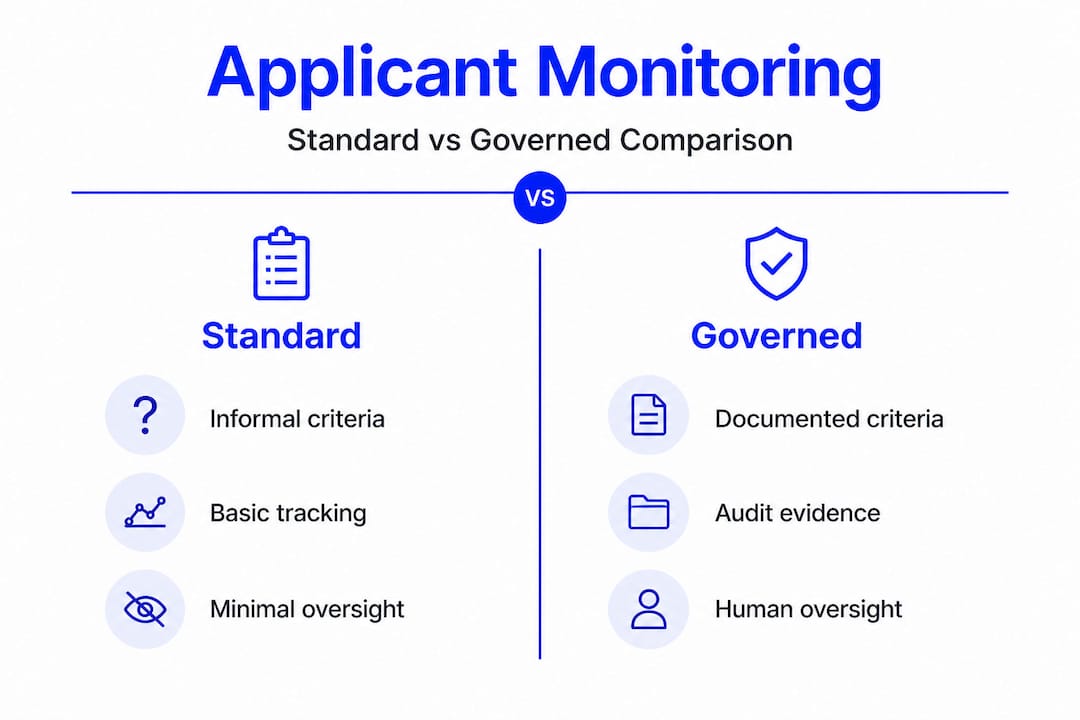
The following table illustrates the difference between a standard monitoring setup and a governed one:
| Feature | Standard applicant monitoring | Governed applicant monitoring |
|---|---|---|
| Decision criteria | Informal or variable | Documented, versioned, consistent |
| Human oversight | Ad hoc | Structured triggers with defined roles |
| Audit trail | Partial or absent | Complete, versioned, timestamped |
| Adverse impact checks | Not performed | Continuous and stage-specific |
| Accommodation tracking | Unrecorded | Logged with override reasons |
| Compliance posture | Reactive | Proactive and defensible |
Pro Tip: Versioning your audit logs is not just a technical practice. It creates a legal record showing that your criteria and process have not been retroactively altered. If a decision made in January is challenged in October, you need to show what the system looked like in January, not what it looks like today. Platforms that support applicant screening integration should offer version-controlled documentation as a baseline feature.
Identifying whether your current system is governed is straightforward. Ask these questions: Can you produce a written record of why a specific candidate was rejected at a specific stage? Can you show that selection rates across demographic groups were reviewed at defined intervals? Do your reviewers know exactly when they are required to escalate a borderline decision to a human supervisor? If the answer to any of these is uncertain, your system is monitored but not governed. Reviewing your screening workflow best practices is a logical starting point for closing those gaps.
Building effective governance: Process, triggers, and audit evidence
Governance is not an abstract policy. It is an operational structure built into every stage of the hiring process. Agencies that want to move from monitored to governed applicant monitoring need to operationalize it through a clear, repeatable process.
Step-by-step governance implementation:
- Establish and document selection criteria. Before any candidate enters the pipeline, define the criteria that will be used at every stage. Document these in writing, assign a version number, and ensure all reviewers have access to the current version.
- Define human oversight points. Identify which decisions require a qualified human reviewer before they can be finalized. This includes borderline screening scores, accommodation requests, and any automated output flagged as low-confidence.
- Configure governance triggers. Set system-level conditions that automatically pause a decision or escalate it for review. These triggers should be tied to specific data thresholds, not to reviewer discretion.
- Log every decision with supporting rationale. Every advance, hold, or rejection should be recorded in the audit log with the criteria applied, the reviewer’s identity, and any notes on non-standard factors considered.
- Run periodic adverse impact and drift reports. At minimum, review selection rate data by demographic group at each major hiring stage. For agencies using AI-assisted screening tools, also check for AI bias and fairness monitoring indicators that signal whether the tool’s performance has changed over time.
- Document accommodation decisions and overrides separately. Whenever a standard criterion is waived, modified, or overridden to accommodate a candidate’s needs or circumstances, that decision must be recorded with the reason, the reviewer, and the outcome.
For HR-AI and ATS usage, governance monitoring is operationalized as continuous fairness and adverse-impact monitoring, paired with traceable audit trails that capture model and tool versions, criteria, inputs, decision outputs, and human overrides. This is the operational standard that agencies should measure themselves against.
The following table identifies common governance triggers and the evidence or artifacts each one requires:
| Trigger | Description | Required artifact |
|---|---|---|
| Borderline screening score | Automated output near the pass/fail threshold | Human review log with rationale |
| Demographic rate divergence | Selection rates diverge by more than 4/5ths rule threshold | Adverse impact analysis report |
| Accommodation request | Candidate requests adjustment under ADA or similar statute | Override record with reason and reviewer |
| Model/tool update | Screening tool version changes | Updated criteria documentation and re-validation log |
| Unusual rejection spike | Abnormal drop in pass rate at a specific stage | Stage-level audit report with supervisor sign-off |
Audit evidence and human oversight are not administrative burdens. They are the foundation of an agency’s ability to defend its decisions when challenged, whether by a candidate, a regulatory body, or an internal review board.

Pro Tip: Do not overlook edge cases in your governance design. Accommodation decisions and override reasons must be tracked with the same rigor as standard decisions. An agency that documents its routine decisions well but fails to log the reasons for exceptions is creating exactly the kind of gap that plaintiffs’ attorneys and auditors are trained to find. Use your step-by-step screening process documentation to explicitly address how non-standard situations are handled.
Governed monitoring in action: Compliance, risk reduction, and real-world scenarios
The value of governed applicant monitoring becomes concrete when you examine the types of compliance events and risk scenarios it is specifically designed to address. Public safety agencies face a distinct set of challenges that standard monitoring systems simply are not built to manage.
Types of compliance and risk events governed monitoring addresses:
- Adverse impact accumulation: Selection rates across racial, gender, or age groups gradually diverge without triggering any review because no one is checking the data at each funnel stage.
- AI or model drift: A screening tool’s performance changes over time as the underlying data or candidate pool shifts, producing systematically different outcomes than it did at deployment.
- Accommodation complaints: A candidate with a disability alleges that their request for accommodation was ignored or inconsistently applied, and the agency has no documentation to dispute the claim.
- Decision inconsistency: Two candidates with nearly identical qualifications receive different outcomes because different reviewers applied different criteria, and there is no record showing what criteria were in effect.
- Regulatory audit exposure: A federal or state agency requests documentation of the hiring process, and the agency cannot produce a coherent, timestamped record of decisions and criteria.
- Candidate notice failures: In jurisdictions that require automated decision notices to candidates, the agency fails to produce evidence that notices were sent, triggering regulatory penalties.
Governed systems respond to these scenarios through pre-built triggers rather than after-the-fact remediation. Consider a realistic scenario at a mid-sized fire department: an AI-assisted screening tool is used to rank candidates after the initial application review. Six months into deployment, adverse impact data shows that the tool’s pass rate for female applicants has dropped below the 4/5ths threshold relative to male applicants. A governed system flags this automatically, pauses the automated ranking for human review, logs the trigger, and generates a report for the HR director. An ungoverned system produces no alert. The disparity continues through the entire hiring cycle, and the department faces an EEOC complaint six months later with no documentation to support its defense.
The importance of continuous monitoring, rather than one-time checks, cannot be overstated. A single bias audit at the time of tool deployment is not governance. It is a snapshot. Real governance requires ongoing review because conditions change.
“Edge cases that governance is designed to catch include data and model drift over time (one-time bias checks aren’t enough), low-confidence and borderline outputs that require a human reviewer, and when automated decisions must support accommodations and candidate notices.”
This insight from EEOC HR compliance research reflects a widely misunderstood aspect of governed monitoring: the most serious risks are not the obvious ones. They are the gradual drifts, the borderline cases, and the accommodation situations that fall between the defined rules of a standard process.
The measurable advantage of governed monitoring:
Agencies that implement governed monitoring report meaningful improvements across three dimensions. First, audit readiness: when documentation is continuous and structured, responding to an inquiry takes hours rather than weeks. Second, defensibility: documented criteria and override logs provide concrete evidence that decisions were made fairly and consistently. Third, hiring integrity: when reviewers know that decisions are logged and reviewed, the standards applied in practice align more closely with stated policy.
For public safety agencies specifically, post-hire monitoring extends these principles beyond the hiring decision itself. Governance does not end at the offer letter. Continuous monitoring of employee conduct, credential status, and regulatory compliance maintains the same standards of accountability that governed the hiring process. This is particularly critical in HR regulatory compliance environments where personnel decisions carry public safety implications.
The agencies most at risk are those that believe their current system is adequate because it has not yet been challenged. Governance is not reactive infrastructure. It is proactive protection.
Why governed applicant monitoring changes the game for public safety HR
There is a common pattern in how public safety agencies approach hiring compliance: they build processes around avoiding obvious mistakes, and then they wait to see if anything goes wrong. Governed applicant monitoring challenges that pattern directly, and it does so by reframing what accountability actually means in this context.
The agencies that lead with integrity do not simply avoid violations. They build systems that are transparently defensible at every stage, regardless of whether they are ever audited. That distinction matters because it shapes the entire culture of the hiring function. When reviewers know that every decision is documented, that adverse impact data is reviewed continuously, and that borderline cases are escalated rather than quietly resolved, the quality of decisions improves organically. The governance structure is not just a compliance mechanism. It is an integrity mechanism.
What most HR professionals and agency leaders miss is that defensibility is equally a function of audit evidence and human oversight as it is of technology. An agency can invest in the most sophisticated AI-assisted screening platform available and still lack governance if no one has defined the oversight triggers, documented the criteria, or structured the audit logs. Technology without governance is not a solution. It is a liability with better marketing.
The future of public safety hiring will require deeper integration between human judgment and adaptive monitoring. As AI tools become more sophisticated and their use in public safety recruitment becomes more widespread, regulatory expectations around documentation and oversight will increase, not decrease. Agencies that build governed systems now will be positioned to meet those expectations. Agencies that do not will face the same risks they face today, compounded by the additional scrutiny that comes with AI-assisted decision-making. Understanding AI’s impact on public safety hiring is essential for any HR leader planning the next generation of their agency’s recruitment infrastructure.
Governed applicant monitoring is not the endpoint of a compliance journey. It is the operating standard that makes the journey sustainable.
Get started with governed applicant monitoring for your agency
For public safety HR professionals ready to move from basic tracking to structured, defensible governance, OMNI Intel provides the tools and framework to make that transition concrete.

OMNI Intel’s background screening platform is built specifically for law enforcement, fire and EMS, dispatch centers, and related public safety agencies, with governance and compliance embedded in the process rather than bolted on as an afterthought. From pre-employment screening services designed around investigator-driven standards, to continuous post-hire monitoring that maintains accountability beyond the offer letter, every feature is designed to support audit-ready documentation and transparent decision-making. Whether your agency needs to avoid hiring risks or build a governed monitoring infrastructure from the ground up, OMNI Intel’s team brings the law enforcement investigative rigor that public safety hiring demands.
Frequently asked questions
What makes applicant monitoring “governed”?
Governed monitoring uses documented criteria, human oversight checkpoints, versioned audit logs, and continuous compliance checks to ensure that every decision in the hiring pipeline is traceable and defensible. It is defined by the presence of explicit governance controls, not by the sophistication of the technology used.
Why is governance critical for public safety hiring?
Without governance, hiring systems accumulate risk invisibly: bias builds in the data, decisions become inconsistent, and agencies lack the documentation to defend themselves when challenged. An undocumented pipeline creates legal defensibility risk that compounds over every hiring cycle.
Which elements must be tracked in a governed applicant monitoring system?
You should track documented selection criteria, tool and model versions, decision inputs and outputs, human override records, accommodation requests, and periodic adverse-impact analysis results. Continuous fairness monitoring paired with traceable audit trails is the operational standard for governed systems.
How often should compliance checks and audit trails be reviewed?
Compliance checks should run continuously at each hiring stage, with structured periodic reviews at defined intervals such as monthly, quarterly, or at the close of each hiring cycle. A governance model built on stage-specific dashboards and adverse-impact drift checks provides the most consistent protection.
What are common triggers for human oversight in governed systems?
The most common triggers include borderline automated screening scores, requests for accommodation, indicators of model or data drift, and decision output patterns that diverge from expected demographic baselines. These edge cases are the scenarios governance is specifically designed to catch before they become compliance events.
Recommended
- Monitor post-hire activity: Step-by-step guide for public safety HR
- Enhancing integrity in public safety hiring: a guide
- Employee Monitoring Process Guide for Public Safety HR
- 6 Essentials for an Employee Monitoring Checklist 2026
- Step by Step Drug Screening Workflow for HR Managers
- Recruiting transparency: Why it matters and how to demand it