

Why compliance in public safety hiring matters: 14x risk
TL;DR:
- Non-compliance in public safety hiring risks lawsuits, data breaches, and loss of federal database access.
- Thorough, documented screening reduces misconduct risk and builds community trust.
- Cultivating a compliance-focused culture ensures lasting hiring integrity and operational efficiency.
When an agency skips a critical step in its pre-employment screening process, the consequences rarely stay quiet. A single non-compliant hire in law enforcement can trigger a negligent hiring lawsuit, expose sensitive Criminal Justice Information to unauthorized personnel, or even cause the agency to lose FBI database access under the CJIS Security Policy. Many hiring managers assume that basic screening checks are enough for public safety roles, but that assumption is costly. This guide breaks down the real compliance risks agencies face in 2026, the legal and financial consequences of falling short, and the practical steps that protect your agency, your workforce, and the communities you serve.
Table of Contents
- The high stakes: Compliance in public safety hiring
- Legal liabilities: The true costs of non-compliance
- How compliance builds a responsible and effective workforce
- Practical steps for maintaining compliance in agency hiring
- The real challenge: Shifting from checklists to culture
- Take compliance from obligation to advantage
- Frequently asked questions
Key Takeaways
| Point | Details |
|---|---|
| Compliance is mandatory | Agencies must comply with laws like CJIS to maintain access to vital law enforcement databases. |
| Non-compliance is costly | Legal settlements and operational losses can reach millions for hiring mistakes or missed screenings. |
| Screening predicts risk | Evidence shows compliant processes reduce misconduct and increase workforce reliability. |
| Proactive culture wins | Moving beyond checklists to a compliance-focused culture protects both agencies and communities. |
| Expert partnership matters | Partnering with FCRA/CJIS-compliant providers streamlines hiring and ensures ongoing compliance. |
The high stakes: Compliance in public safety hiring
Compliance in public safety hiring is not a bureaucratic formality. It is a foundational requirement that governs who can legally access sensitive criminal justice systems, serve in positions of public trust, and represent an agency in the field. The CJIS Security Policy mandates strict personnel screening for anyone who accesses Criminal Justice Information (CJI), the data flowing through systems like the National Crime Information Center. Non-compliance with CJIS requirements risks database access being revoked, a consequence that can functionally cripple an agency’s investigative capacity overnight.
The scope of mandatory screening in public safety is broad by design. These roles carry extraordinary authority and access, which is precisely why abbreviated or informal vetting is not acceptable. The screenings that are generally considered non-negotiable for public safety personnel include:
- Criminal history checks at both the state and federal level, including fingerprint-based searches
- Employment and reference verification, confirming past conduct and separation reasons
- Education and credential verification, especially for specialized roles like paramedics or dispatchers
- Financial history review, which can flag conflicts of interest or vulnerability to corruption
- Driving record checks, relevant to any role involving vehicle operation or emergency response
Consider what CJIS documentation outlines about the standard for personnel with access to sensitive systems:
“The agency must ensure that all personnel who have access to CJI undergo a fingerprint-based background check prior to access, and that results are reviewed in accordance with applicable federal and state law.”
This standard exists because the stakes extend far beyond the individual hire. When an officer, dispatcher, or civilian employee is improperly vetted and later found to have a disqualifying history, every piece of CJI they accessed becomes potentially compromised. Every case they touched is subject to legal challenge.
The gap between private sector hiring and public safety hiring is significant. Private employers face FCRA requirements and some industry-specific regulations, but they rarely operate systems where a single bad hire can invalidate prosecutions or endanger lives. Public safety agencies operate in that reality every day. Reviewing data security requirements specific to law enforcement contexts reveals how tightly personnel vetting is woven into data access policy. The convergence of personnel integrity and information security is what makes compliance in this sector uniquely demanding, and uniquely consequential when ignored.
The privacy compliance parallels seen in other regulated industries, such as legal services, offer a useful frame. When privacy or personnel standards slip, the institutional liability that follows is rarely proportional to the original oversight. A missed step becomes a headline.
Legal liabilities: The true costs of non-compliance
The financial consequences of non-compliant hiring are not hypothetical. They are documented, recurring, and growing. Non-compliance leads to multimillion-dollar lawsuits when agencies fail to screen properly or violate FCRA procedures during the hiring process. The Barnes & Noble FCRA case, in which the company faced class-action exposure for improper background check disclosures, illustrated how procedural errors, not just substantive screening failures, create massive liability.

In law enforcement specifically, the exposure is even more severe. A 10 million dollar settlement in Sangamon County arose directly from negligent hiring practices, where an officer’s problematic background was not adequately investigated before appointment. Cases like this are becoming more common as courts apply higher standards of due diligence to agencies hiring personnel with arrest authority.
The most common non-compliance outcomes agencies face fall into three categories:
| Non-Compliance Type | Likely Outcome | Severity |
|---|---|---|
| Skipped criminal background check | Negligent hiring lawsuit, settlement costs | High |
| FCRA procedural violation | Class-action exposure, regulatory fines | High |
| CJIS non-compliant personnel | Loss of database access, federal sanctions | Critical |
| Inadequate employment verification | Undisclosed misconduct, civil liability | Medium to High |
| Missing audit documentation | Inability to defend hiring decisions in court | Medium |
To reduce exposure, agencies should take the following steps before, during, and after each hire:
- Document every stage of the background investigation with timestamped records
- Issue proper FCRA disclosure and authorization forms before any screening begins
- Follow adverse action procedures precisely if a candidate is disqualified based on background findings
- Ensure all screening vendors are formally FCRA-compliant and can produce compliant audit trails
- Review and update screening policies at least annually as regulations evolve
- Train HR staff and hiring supervisors on legal obligations during the process
Pro Tip: Before contracting with any background screening provider, request documentation of their FCRA compliance program and their CJIS alignment for law enforcement clients. Vendors without this cannot protect your agency in a legal challenge. The FCRA compliance essentials specific to public safety HR provide a strong baseline for evaluating vendor qualifications.
The link between legal risk and agency mission is direct. When a compliance essentials guide is followed rigorously, it does not just protect against lawsuits. It protects the integrity of every investigation the agency conducts and every officer it deploys. The cost of non-compliance is ultimately paid by the community, not just the agency’s legal budget. A solid compliance practical guide can help agencies operationalize these protections from day one.
How compliance builds a responsible and effective workforce
Compliance is often framed as a constraint. In practice, it functions as a filter that improves workforce quality in measurable ways. Research shows that pre-hire red flags such as prior terminations, use-of-force complaints, financial instability, and incidents of violence predict future misconduct in law enforcement at rates up to 14 times higher than candidates without those indicators. That is not a minor statistical note. It means an agency that screens thoroughly is dramatically less likely to face the operational, legal, and reputational damage that follows officer misconduct.
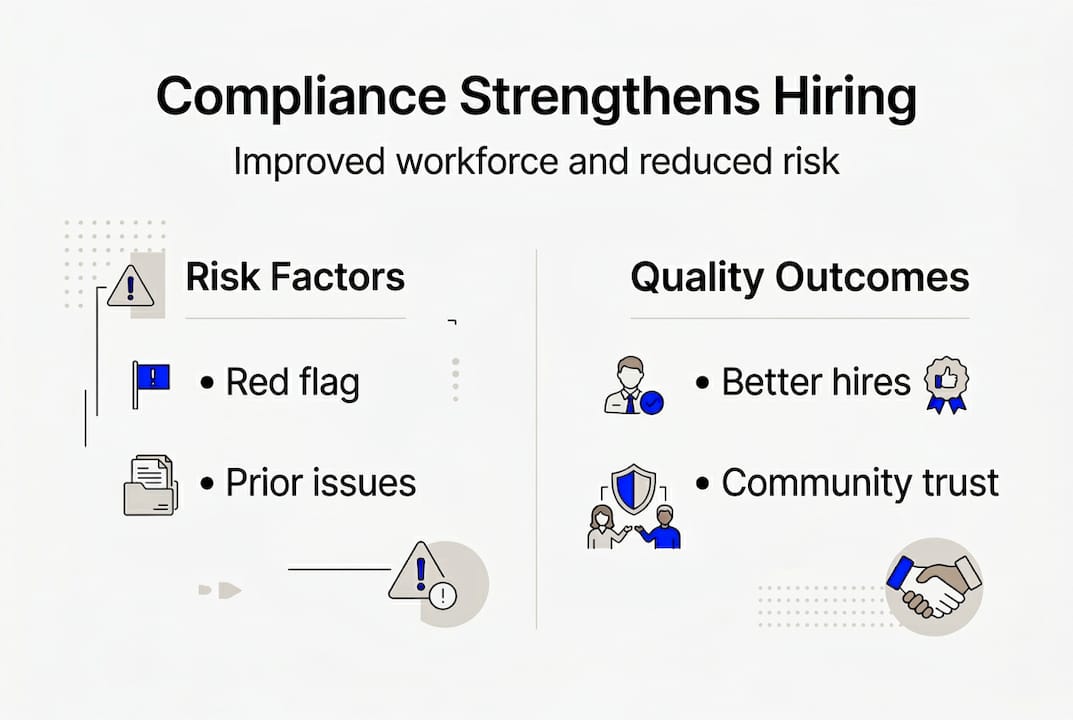
The data connecting pre-hire indicators to post-hire outcomes is becoming harder to ignore:
| Pre-Hire Red Flag | Associated Risk Increase | Impact on Hiring Decision |
|---|---|---|
| Prior termination for cause | Up to 14x higher misconduct risk | Strong disqualifier |
| Documented use-of-force complaints | Significantly elevated reoffense rate | Requires investigation |
| Serious financial distress | Elevated corruption vulnerability | Flagged for review |
| History of violence or restraining orders | High risk of future incidents | Generally disqualifying |
| Falsification on application | Integrity failure indicator | Immediate disqualifier |
States that have moved toward clarifying negligent hiring standards have seen measurable reductions in recidivism and repeated conduct violations among law enforcement personnel. The policy logic is straightforward: when agencies are held accountable for who they hire, they invest more carefully in finding out who that person actually is before handing them a badge and authority.
The comprehensive screening benefits for agencies extend well beyond legal protection. Agencies that screen thoroughly and compliantly report the following workforce improvements:
- Lower rates of on-duty misconduct, including use-of-force complaints and citizen grievances
- Higher retention rates, as compliant hiring tends to surface candidates who are genuinely qualified and mission-aligned
- Stronger public trust, particularly in communities where police-community relationships are under scrutiny
- Fewer internal investigations, reducing the operational burden on supervisors and internal affairs units
- More defensible hiring decisions, because documented, evidence-based processes hold up in court and in public review
Compliance is not just about filtering out bad candidates. It is about building the kind of workforce that communities rely on and agencies are proud to deploy.
Practical steps for maintaining compliance in agency hiring
Building a compliant hiring process for a public safety agency requires deliberate structure from the moment a position is posted through the day a new employee begins duty. Gaps at any stage of the workflow create legal and operational exposure that can be difficult to close after the fact.
A compliant hiring workflow should follow this sequence:
- Write the job posting with legally reviewed qualification standards, avoiding language that creates disparate impact liability
- Collect applications using standardized forms that request only permissible information at each stage
- Conduct initial interviews focused on job-relevant criteria, documented consistently across candidates
- Issue FCRA-compliant disclosure and authorization before initiating any background investigation
- Run multi-source background checks, including criminal history, employment records, military discharge documents (DD214 for veterans), reference interviews, and credit review where permissible
- Review findings against written, legally defensible disqualification criteria
- Follow adverse action procedures if a finding leads to disqualification, including pre-adverse and final adverse action notices
- Maintain complete audit trails of every step, document, and decision throughout the process
- Onboard with role-specific CJIS access reviews where CJI access is required
Multi-source checks and compliant screening providers are considered essential because single-source searches routinely miss criminal records, prior employment issues, and identity discrepancies that only surface when multiple databases and direct verifications are combined. Relying on a single database query is one of the most common and consequential shortcuts agencies take.
Pro Tip: Assign a designated compliance officer or role within HR who is responsible for tracking regulatory changes at both the state and federal level. Employment law and screening regulations evolved significantly in 2025 and 2026, and what was permissible eighteen months ago may now create liability. Partnering with FCRA/CJIS-compliant vendors ensures audit trails are automatically generated and defensible.
Common pitfalls to avoid include:
- Using screening vendors who cannot document their CJIS alignment or FCRA program
- Applying disqualification criteria inconsistently across candidate pools
- Skipping the adverse action notice process when declining candidates based on background findings
- Failing to review and update screening policies as state ban-the-box and fair chance laws evolve
- Neglecting post-hire monitoring, which is critical for ongoing CJIS compliance
For agencies building this infrastructure, ensuring hiring compliance requires more than good intentions. It requires documented systems. A structured compliance checklist specific to public safety hiring can anchor that system and provide consistency across every hire.
The real challenge: Shifting from checklists to culture
After reviewing the risks, the legal frameworks, and the operational steps, a harder truth emerges. Most agencies that face compliance failures were not unaware of the rules. They had checklists. What they lacked was a culture that treated compliance as a core organizational value rather than a procedural obstacle.
Compliance handled as paperwork becomes a liability the moment anyone in the chain decides it is inconvenient. When a supervisor fast-tracks a candidate because of personal familiarity, or when a hiring manager waves through an incomplete background report because the position needs to be filled quickly, no checklist prevents the consequences that follow.
The agencies that consistently avoid compliance failures share a common characteristic. Their leaders treat the integrity of the hiring process with the same seriousness they apply to officer conduct in the field. They recognize that the values the agency claims to hold must be visible in how it selects its people, not just in how it trains them afterward.
The unexpected benefit of building a genuine compliance culture is that it actually streamlines hiring over time. When standards are clear, consistently applied, and internally supported, the process moves faster because there is less improvisation, fewer legal challenges, and stronger candidate pipelines from sources that trust the agency’s professional standards. Reviewing hiring process best practices reveals that agencies with documented, culture-aligned hiring workflows report fewer vacancies and stronger applicant quality. Compliance, done right, is a recruitment advantage, not just a legal shield.
Take compliance from obligation to advantage
Every section of this guide points to the same conclusion: the gap between agencies that manage compliance well and those that struggle is not primarily a resource gap. It is a systems and support gap. Agencies that delay building compliant hiring infrastructure do not avoid the cost. They defer it, with interest, in the form of lawsuits, turnover, and reputational damage.

OMNI Intel provides pre-employment screening services designed specifically for the compliance demands of public safety agencies. From FCRA-aligned disclosure workflows to CJIS-compatible investigator-driven checks and complete audit trail documentation, OMNI Intel’s platform supports every stage of the hiring process. Our background checks for agencies are built to the evidentiary standard law enforcement hiring requires, not repurposed from commercial templates. If you are ready to make compliance a genuine operational advantage, explore our safe hiring investigations or schedule a consultation with our team to see how tailored screening solutions fit your agency’s specific needs.
Frequently asked questions
What is the CJIS Security Policy and why does it matter in hiring?
The CJIS Security Policy sets strict screening requirements for any personnel accessing Criminal Justice Information, and agencies that fail to meet those standards risk losing access to critical federal and state law enforcement databases entirely.
What are the most common consequences of non-compliance in public safety hiring?
Agencies face lawsuits, multimillion-dollar settlements, and the loss of FBI and state crime database access. Non-compliance leads to these outcomes when screening procedures are incomplete, improperly documented, or conducted by non-compliant vendors. The CJIS Security Policy also specifies that agencies risk access revocation for personnel screening failures.
How do compliant hiring practices reduce future workforce risks?
Compliant screening processes identify candidates with documented red flags early, removing high-risk individuals before they reach the field. Red flags predict misconduct at rates up to 14 times higher than the baseline, making early identification through thorough screening a direct workforce risk reduction tool.
What steps should public safety agencies take to maintain compliance?
Agencies should use multi-source background checks, partner with FCRA and CJIS-compliant screening providers, maintain complete audit trails, and review screening policies at least annually. Multi-source checks combined with compliant vendors are considered essential to avoiding negligent hiring liability.
Is compliance just about following checklists?
Compliance that exists only on paper provides limited protection. Lasting compliance requires an agency culture where leaders enforce integrity standards in hiring as consistently as they enforce conduct standards in the field, treating thorough vetting as a core organizational value rather than an administrative step.
Recommended
- Why compliance matters in public safety hiring: A guide
- Compliance In Hiring: Essential Guide For Public Safety HR
- How to ensure hiring compliance for public safety agencies
- Essential Compliance Checklist For Agencies: Step-by-step Hiring Guide
- Security compliance: why it matters and how to master it | News | BeyondSensor
- Understanding compliance in facilities management: key strategies