
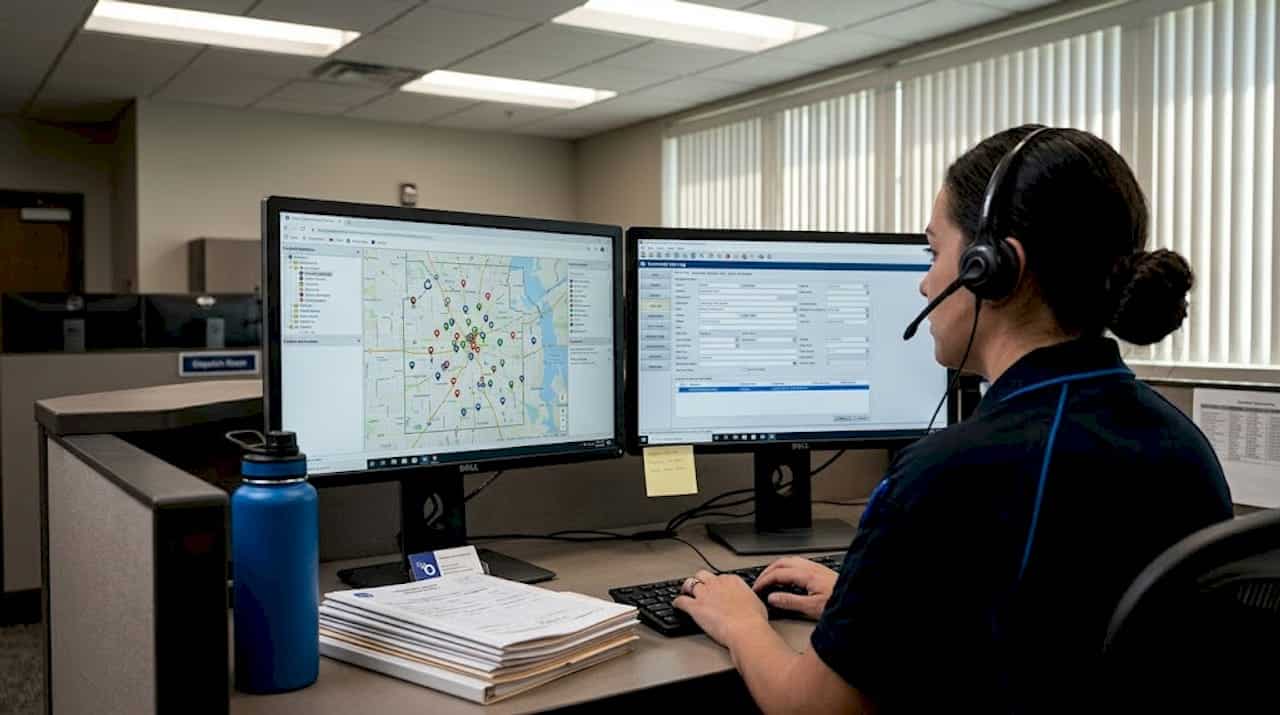
Optimize dispatch center recruitment for reliable staffing
TL;DR:
- Dispatch centers experience high turnover due to the job’s emotional and cognitive demands. Using modern, role-specific assessments and structured recruitment processes improves candidate selection and retention. Simulation-based evaluations measuring resilience under stress are now considered the gold standard for predicting long-term success.
Dispatch centers lose new hires at alarming rates, often within the first year, and the cost of each failed placement extends far beyond the budget line. The role demands simultaneous management of radio traffic, computer-aided dispatch systems, and caller emotions, all under life-or-death pressure. Traditional tests alone rarely predict dispatch success, which is why agencies that rely solely on written exams continue to cycle through candidates without building stable teams. This guide walks HR managers and recruitment leads through every critical stage: understanding what makes dispatch hiring uniquely difficult, preparing a compliant and structured process, executing modern assessments, and verifying outcomes to continuously improve. The result is a recruitment pipeline that delivers reliable personnel and reduces costly turnover.
Table of Contents
- Understanding the unique demands of dispatch center recruitment
- Preparing your agency for an effective recruitment process
- Executing modern assessments for dispatch candidates
- Verifying and reviewing recruitment outcomes
- A fresh perspective: Why simulation-based assessments are the new gold standard
- Take the next step with specialized recruitment solutions
- Frequently asked questions
Key Takeaways
| Point | Details |
|---|---|
| Benchmark resilience early | Simulation-based assessments identify candidates who handle stress, reducing early turnover in dispatch centers. |
| Prioritize compliance | Always ensure recruitment processes meet current legal and privacy standards for public safety hiring. |
| Data drives decisions | Use assessment scores and feedback loops to continually optimize recruitment strategies. |
| Modern tools increase efficiency | AI-driven and simulation-based tools help streamline candidate screening and improve retention rates. |
Understanding the unique demands of dispatch center recruitment
Dispatch work is not simply answering phones. It is a high-stakes cognitive performance role where a single lapse in judgment can delay emergency response and cost lives. Candidates must process multiple simultaneous audio streams, enter accurate data under time pressure, prioritize calls by urgency, and maintain emotional composure throughout an entire shift. These demands place dispatch recruitment in a category that is fundamentally different from most other public safety hiring.
Unlike patrol officer recruitment, which emphasizes physical fitness and field decision-making, dispatch hiring centers on cognitive endurance, emotional regulation, and technical accuracy. Many agencies make the mistake of treating dispatch positions as entry-level administrative roles, attracting candidates who are unprepared for the psychological weight of the work. This misalignment between candidate expectations and job reality is one of the leading drivers of early attrition.
The most common pitfalls in dispatch recruitment include:
- Relying on interviews alone without structured skills testing, which allows candidates to self-report competencies they may not actually possess
- Underestimating emotional demands, leading to hires who perform well in testing but burn out quickly under real operational stress
- Failing to assess multitasking capacity in a realistic environment, which is the core cognitive requirement of the job
- Neglecting background investigation depth, which can result in hires who later demonstrate integrity or behavioral issues under pressure
- Using generic public safety assessments that are not calibrated to the specific demands of communications center work
Modern dispatch recruitment addresses these gaps through purpose-built assessment tools. Tests like CritiCall assess multitasking, typing, data entry, memory recall, and decision-making in ways that mirror actual dispatch conditions. These tools produce measurable, objective data on candidate capability rather than relying on subjective impressions.
The table below illustrates how dispatch recruitment differs from other public safety hiring in key dimensions:
| Recruitment dimension | Dispatch center | Patrol officer | Fire and EMS |
|---|---|---|---|
| Primary assessment focus | Cognitive multitasking | Physical fitness and judgment | Physical fitness and medical knowledge |
| Emotional regulation testing | High priority | Moderate priority | Moderate priority |
| Technical skills testing | Data entry, typing, radio | Weapons handling, driving | Medical procedures, equipment |
| Background investigation depth | High | High | High |
| Simulation-based assessment | Increasingly standard | Field scenario-based | Scenario and medical drills |
Using dispatch screening tools that are purpose-built for communications center roles gives HR managers a structured, defensible basis for candidate selection. The goal is not simply to find someone who can pass a test. It is to identify individuals who will perform reliably under sustained pressure, month after month, without compromising the quality of emergency response.
With the context established, the next section details how to prepare your agency for a recruitment drive.
Preparing your agency for an effective recruitment process
A well-executed recruitment process does not begin with posting a job listing. It begins with internal preparation: defining exactly what you need, building the infrastructure to evaluate it, and ensuring every step complies with applicable legal and privacy standards. Agencies that skip this preparation phase tend to make reactive hiring decisions and repeat the same mistakes across recruitment cycles.
Follow these steps to build a structured and compliant dispatch recruitment process:
- Define the role requirements precisely. Document the specific cognitive, technical, and behavioral competencies required for your dispatch environment. Include typing speed minimums, multitasking benchmarks, and any agency-specific technology platforms candidates must learn.
- Audit your current screening materials. Review existing job postings, application forms, and interview guides for outdated language, legally problematic questions, or gaps that allow unqualified candidates to advance.
- Select and configure your assessment tools. Choose platforms that are validated for dispatch-specific competencies and confirm they meet your jurisdiction’s equal employment opportunity requirements.
- Establish a compliant data handling protocol. Define how candidate data will be stored, who can access it, and how long records will be retained. This is not optional. Testing compliance and data privacy are critical in digital recruitment, particularly when assessments are conducted on digital platforms that capture sensitive performance data.
- Train your hiring team. Ensure every person involved in candidate evaluation understands the scoring criteria, legal boundaries, and documentation requirements before the process begins.
The table below outlines key preparation elements and their purpose:
| Preparation element | Purpose | Compliance consideration |
|---|---|---|
| Role requirements document | Defines objective selection criteria | Supports equal opportunity defense |
| Assessment tool validation | Confirms job-relatedness of tests | Required under EEOC guidelines |
| Data privacy protocol | Protects candidate information | Aligns with FCRA and state privacy laws |
| Hiring team training | Ensures consistent evaluation | Reduces bias and legal exposure |
| Audit trail documentation | Records each decision point | Supports compliance review and appeals |
Thoughtful dispatcher background checks are a non-negotiable part of this preparation phase. Background investigations for dispatch personnel should include criminal history, employment verification, reference checks, and where applicable, credit history review, since dispatchers often have access to sensitive law enforcement databases.

Pro Tip: Build your candidate screening checklist before you open applications. Defining your minimum thresholds for typing speed, assessment scores, and background criteria in advance prevents subjective judgment from creeping into decisions later, and makes your process far easier to defend if challenged.
Understanding data privacy in hiring requirements specific to public safety agencies is equally important. Agencies operating across state lines or using third-party assessment vendors must confirm that their data practices align with both federal standards and any applicable state-level regulations. Preparation sets the stage; next, learn how to execute and refine the assessment stages.
Executing modern assessments for dispatch candidates
Assessment execution is where preparation translates into actionable candidate data. The quality of your assessment process determines the quality of your hiring decisions, and agencies that invest in modern, validated tools consistently outperform those relying on outdated or generic testing.
Here is a step-by-step approach to running an effective dispatch assessment process:
- Schedule CritiCall or an equivalent platform as the first formal assessment gate. Administer it in a controlled environment that mirrors actual dispatch conditions, including background noise calibration if your center operates in a high-noise setting.
- Brief candidates thoroughly before testing. Explain what the assessment measures, how long it takes, and what accommodations are available. Transparency at this stage reduces test anxiety and produces more accurate results.
- Score and rank results against your pre-defined benchmarks, not against other candidates in the same cohort. Cohort-relative scoring can mask the fact that an entire applicant pool falls below your minimum operational standard.
- Layer in simulation-based assessments for candidates who pass initial cognitive testing. These scenarios present realistic dispatch situations and measure how candidates respond under time pressure and emotional load.
- Apply AI-driven benchmarking tools to analyze patterns in candidate responses that correlate with long-term retention and emotional regulation capacity.
AI-driven simulations benchmark emotional regulation and stress tolerance; simulation-based assessments modeled on EMS and ATC measure resilience, reducing turnover. This is a significant shift from traditional testing, which measures what a candidate knows at a single point in time. Simulation-based tools measure how a candidate behaves when conditions deteriorate, which is precisely what dispatch work demands.
“The most predictive assessments are those that replicate the actual stress conditions of the job, not just the technical skills required to perform it. Emotional regulation under pressure is the competency that separates dispatchers who thrive from those who leave within six months.”
Review pre-employment screening best practices to ensure your assessment sequence aligns with current industry standards. Agencies that follow a structured, multi-stage assessment model report stronger first-year retention and fewer performance-related separations.
Pro Tip: Use simulation scenarios drawn from your agency’s actual call history. Candidates who perform well on generic simulations may still struggle with the specific call volume, call types, or radio protocols your center uses. Real-world scenarios produce the most predictive results.
For a broader view of available tools, the dispatch screening tools overview covers platforms currently in use across public safety communications centers, including their scoring methodologies and integration capabilities. Once candidates have completed assessments, it is crucial to verify and review results before final decisions.
Verifying and reviewing recruitment outcomes
Assessment scores are data points, not decisions. The verification and review stage is where HR managers interpret that data, confirm compliance, and build the feedback loops that make each recruitment cycle more effective than the last.
When reviewing assessment outcomes, focus on these key areas:
- Score interpretation in context. A candidate who scores at the 70th percentile on multitasking may be acceptable for a lower-volume center but insufficient for a high-volume urban dispatch environment. Apply your agency-specific benchmarks, not national averages.
- Pattern recognition across the applicant pool. If a large percentage of candidates fail at the same assessment stage, that signals either a problem with your sourcing strategy or a need to recalibrate your minimum thresholds.
- Compliance audit for each candidate file. Confirm that every assessment was administered consistently, that accommodations were documented, and that no protected class information influenced scoring decisions.
- Background investigation cross-reference. Align assessment results with background investigation findings. A candidate who scores well on cognitive testing but has a history of integrity violations presents a composite risk profile that scores alone would not reveal.
Emerging tools and feedback loops help verify candidate suitability and predict retention, giving agencies a more complete picture of each hire’s likely trajectory. Feedback loops are particularly valuable when built into the post-hire period. Tracking new hire performance at 30, 90, and 180 days and comparing those outcomes to pre-hire assessment scores reveals which assessment components are most predictive for your specific agency.
The table below summarizes key outcome review takeaways and recommended actions:
| Outcome finding | What it indicates | Recommended action |
|---|---|---|
| High failure rate at cognitive testing | Sourcing pool lacks qualified candidates | Revise job posting and sourcing channels |
| Strong test scores, poor 90-day retention | Assessment not measuring real-world fit | Add simulation-based assessment stage |
| Compliance gaps in candidate files | Process inconsistency | Retrain hiring team, audit documentation |
| Background issues post-hire | Investigation was insufficiently thorough | Deepen background investigation scope |
Review your hiring compliance guide to confirm that your documentation practices meet current standards. Agencies that maintain clean, complete audit trails are far better positioned when hiring decisions are challenged or reviewed by oversight bodies.
For agencies looking to strengthen the investigation component of their process, pre-employment investigation tips provide practical guidance on expanding the depth and reliability of background checks for dispatch personnel. With results verified, agencies can adopt a more strategic, future-focused perspective on dispatch recruitment.
A fresh perspective: Why simulation-based assessments are the new gold standard
The dispatch recruitment field has spent decades optimizing for the wrong predictors. Typing speed matters. Data entry accuracy matters. But neither of those metrics tells you whether a candidate will still be performing at a high level after six months of overnight shifts, traumatic calls, and chronic understaffing. That requires a fundamentally different kind of measurement.
Traditional hiring approaches miss candidates with high resilience precisely because resilience does not show up on a typing test. It shows under pressure, in ambiguous situations, when the correct answer is not obvious and the clock is running. Agencies that continue to rely exclusively on cognitive and technical assessments are selecting for a skill set that represents only part of the job.
Simulation-based pre-hire assessments modeled on ATC and EMS measure resilience, reducing turnover. This is not a theoretical claim. It reflects a measurable shift in how high-performing agencies are approaching the problem of dispatch attrition. When you assess candidates in conditions that mirror the actual job, you get predictive data. When you assess them in a quiet room with a standardized test, you get a snapshot of their best-case performance.
The practical advice for managers is straightforward: prioritize emotional regulation and decision-making under stress as primary selection criteria, not secondary considerations. Build your assessment sequence so that simulation comes before the final interview, not after. Use dispatch screening best practices that reflect what the research and the field are telling us about what actually predicts long-term success in communications center work.
Pro Tip: When designing simulation scenarios, include at least one scenario where the candidate must manage an emotionally escalated caller while simultaneously updating a CAD record. This specific combination of tasks is where many candidates reveal their true capacity under operational stress.
Take the next step with specialized recruitment solutions
Building a reliable dispatch center team requires more than good intentions. It requires a structured process, validated tools, and a screening infrastructure that keeps pace with the complexity of the role.

OMNI Intel’s dispatch screening services are designed specifically for public safety communications centers, integrating FCRA-compliant background investigations with the kind of investigator-driven rigor that generic HR platforms cannot replicate. Whether you are running a single-agency PSAP or managing recruitment across a regional consortium, OMNI Intel gives your team the compliance infrastructure and candidate intelligence to make evidence-based decisions with confidence. Explore background checks for dispatch personnel that go beyond surface-level screening, and get started with OMNI Intel to see how a purpose-built platform accelerates your recruitment cycle while protecting your agency’s integrity.
Frequently asked questions
What is the CritiCall test and how long does it take?
CritiCall is a dispatch pre-employment test that evaluates multitasking, typing speed, data entry accuracy, and decision-making under pressure. The test lasts approximately 2.5 hours and is widely used by public safety communications centers as a primary cognitive screening tool.
How do simulation-based assessments improve dispatch recruitment?
Simulation-based assessments measure resilience and stress tolerance in conditions that mirror real dispatch work, producing more accurate predictions of on-the-job performance and reducing early turnover compared to traditional testing alone.
What legal considerations apply to dispatch center recruitment?
HR managers must comply with equal employment opportunity requirements, FCRA regulations for background investigations, and applicable state-level data privacy standards throughout every stage of the candidate screening process.
How can agencies improve retention among new dispatch hires?
Agencies that use AI-driven simulation tools to benchmark emotional regulation and resilience during pre-hire assessment consistently report stronger long-term retention, because those tools identify candidates who are genuinely suited to the psychological demands of the role.