

How to Strengthen Integrity in Fire Department Recruitment
TL;DR:
- Integrity is critical for public trust, legal liability reduction, and organizational cohesion in fire departments.
- Behavioral indicators like honesty, accountability, and consistency help identify trustworthy candidates during screening.
- Implementing layered assessments, ongoing monitoring, and leadership modeling sustains a culture of integrity beyond hiring.
Technical aptitude has long dominated fire department hiring conversations, with physical fitness scores and certification levels often treated as the primary filters for candidate selection. That assumption, while understandable, leaves agencies exposed to a risk far more damaging than an undertrained recruit: a firefighter who lacks integrity. Personnel misconduct, dishonesty under pressure, and ethical failures do not just affect individual careers; they erode public trust, invite legal liability, and fracture the organizational culture that fire departments depend on to function. This guide outlines evidence-backed frameworks, practical red-flag identification tools, and structured assessment practices to help HR and recruitment leaders build hiring processes where integrity is not an afterthought but the foundation.
Table of Contents
- Why integrity matters in fire department hiring
- Key markers and red flags for integrity in candidates
- Best practices for assessing and verifying integrity
- Integrating integrity frameworks into your recruitment process
- Why the hardest part is sustaining integrity—what the data tells us
- Partner with integrity-focused screening solutions
- Frequently asked questions
Key Takeaways
| Point | Details |
|---|---|
| Integrity is foundational | A focus on integrity is crucial for reducing risk and enhancing community trust in fire department hiring. |
| Assessment needs structure | Use multiple methods—interviews, checks, and references—to reliably assess integrity in candidates. |
| Frameworks ensure consistency | Embedding integrity evaluations throughout the hiring process standardizes decisions and safeguards organizational culture. |
| Long-term integrity requires follow-through | Ongoing leadership, monitoring, and transparent practices are as vital as initial evaluations. |
Why integrity matters in fire department hiring
Fire departments operate in environments where split-second decisions carry life-or-death consequences. When a firefighter or officer lacks integrity, the damage extends far beyond a single incident. It ripples through the chain of command, undermines team cohesion, and can expose the agency to costly litigation. Understanding why integrity holds such foundational importance is the first step toward building a recruitment process that prioritizes it with the same rigor applied to physical and technical qualifications.
Personnel misconduct linked to integrity failures creates measurable organizational liability. Fire department personnel with high integrity are less likely to engage in misconduct, reducing liability and public trust issues. This is not simply a matter of ethics in the abstract; it is a direct operational concern. Departments that experience repeated integrity violations face increased insurance costs, civil claims, and the significant administrative burden of internal investigations.
The relationship between trust and community standing is equally critical. Fire departments rely on public cooperation during emergencies, and that cooperation is built on the assumption that responders are honest, accountable, and acting in the community’s best interest. When integrity lapses become public, that trust dissolves quickly and rebuilding it takes years. A single high-profile misconduct case can reshape how an entire agency is perceived, regardless of the exemplary conduct of the majority of its personnel.
Real-world consequences illustrate this clearly. Departments that have faced personnel scandals tied to dishonesty, falsified training records, or unethical conduct during emergency responses have seen measurable declines in recruitment quality, budget support from local governments, and community cooperation. These are not hypothetical risks. They are documented outcomes that HR leaders and recruitment teams must treat as operational threats.
Shared responsibility across the organization is essential. Integrity in hiring is not the exclusive domain of the HR department. Leadership sets the tone, recruitment teams design the process, and supervisors reinforce the standards daily. When these groups operate in silos, integrity gaps emerge. A coordinated approach, supported by responsible recruitment practices, ensures that every touchpoint in the hiring process reflects the agency’s commitment to ethical standards.
Key reasons integrity must be central to fire department hiring include:
- Reduces the probability of misconduct that leads to civil liability and reputational damage
- Builds and sustains community trust that fire departments depend on operationally
- Supports a culture where accountability is modeled from leadership down
- Decreases long-term costs associated with disciplinary actions, terminations, and re-hiring
- Strengthens team cohesion in high-pressure, high-stakes environments
“Integrity in public safety hiring is not a soft metric. It is a structural requirement for agencies that cannot afford the cost of getting it wrong.”
Key markers and red flags for integrity in candidates
With a clear understanding of why integrity is non-negotiable, the next practical challenge is knowing what to look for and what to watch out for during the screening and interview phases. Identifying integrity in candidates is both a science and a skill, and it requires structured tools rather than gut instinct alone.
Markers of integrity in strong candidates tend to cluster around a few consistent behavioral patterns. Truthfulness about past errors is a reliable indicator. Candidates who acknowledge mistakes, describe what they learned, and explain how they changed their behavior demonstrate the kind of self-awareness that correlates with ethical conduct under pressure. Consistency across interviews and background documentation is equally telling. When a candidate’s account of their employment history, reasons for leaving previous roles, and descriptions of past incidents align across multiple touchpoints, that consistency signals honesty.
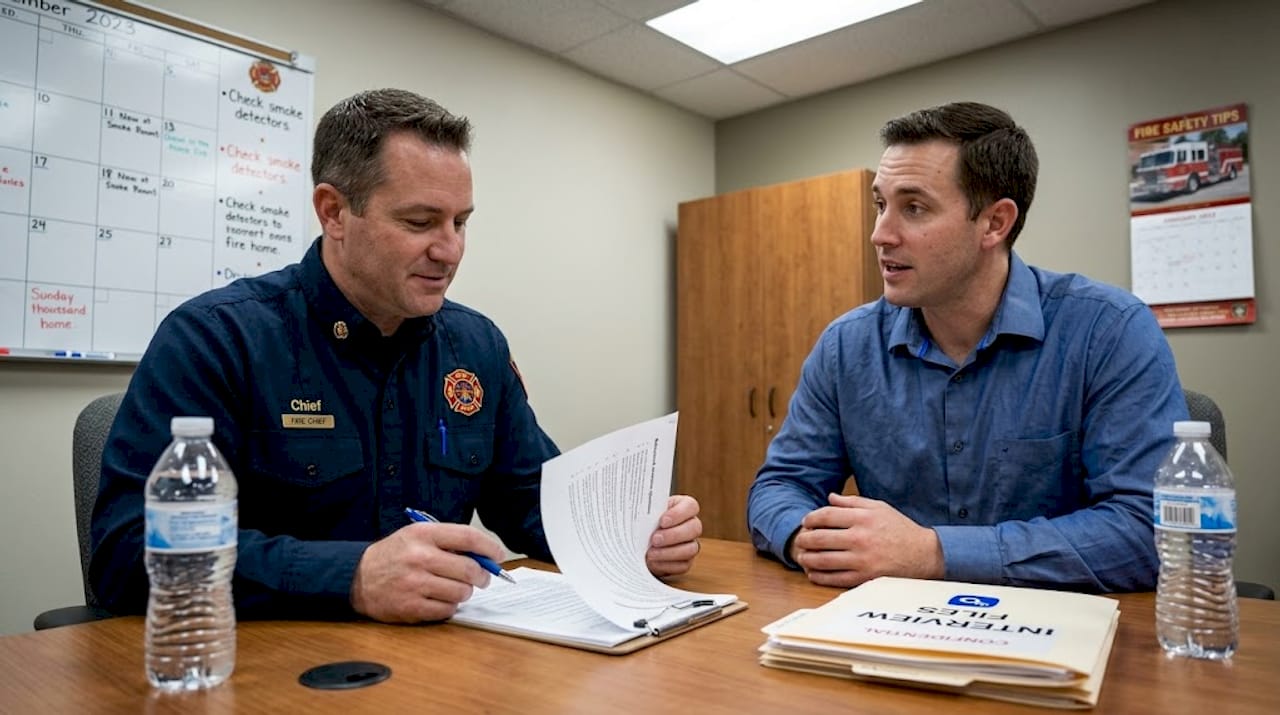
Openness to admitting mistakes without excessive defensiveness is another strong marker. Candidates who deflect all responsibility, reframe every negative outcome as someone else’s fault, or become evasive when asked about difficult situations are displaying behavioral patterns that warrant closer scrutiny. These patterns do not automatically disqualify a candidate, but they require follow-up.
Red flags during the background check and interview phases include:
- Discrepancies between self-reported history and verified records in background investigations
- Evasive or inconsistent answers when asked about past disciplinary actions or terminations
- Inability to articulate personal accountability in past professional situations
- Gaps in employment history that are poorly explained or contradicted by reference checks
- Evidence of prior dishonesty in official documents, certifications, or application materials
Background investigations and structured integrity assessments are effective in identifying high-risk candidates before they are placed in positions of public trust. This is why relying solely on a resume review or a single interview round is insufficient for fire department hiring.
Behavioral interview questions designed to surface integrity include prompts such as: “Describe a time when you witnessed a colleague acting unethically. What did you do?” and “Tell me about a situation where you made a decision that was unpopular but that you believed was right.” These questions reveal not just what candidates say but how they reason through ethical complexity.
Data on terminations in public safety agencies consistently shows that a significant proportion are linked to integrity failures rather than competency gaps. Candidates who pass technical assessments but fail integrity evaluations represent a well-documented category of costly mis-hires. Reviewing integrity screening frameworks helps agencies understand how to structure these evaluations systematically.
Pro Tip: Use scenario-based questions that place candidates in realistic ethical dilemmas specific to fire service contexts, such as situations involving falsifying incident reports or covering for a colleague’s error. Candidates who reason through these scenarios with clarity and accountability are demonstrating the integrity profile you are looking for.
Best practices for assessing and verifying integrity
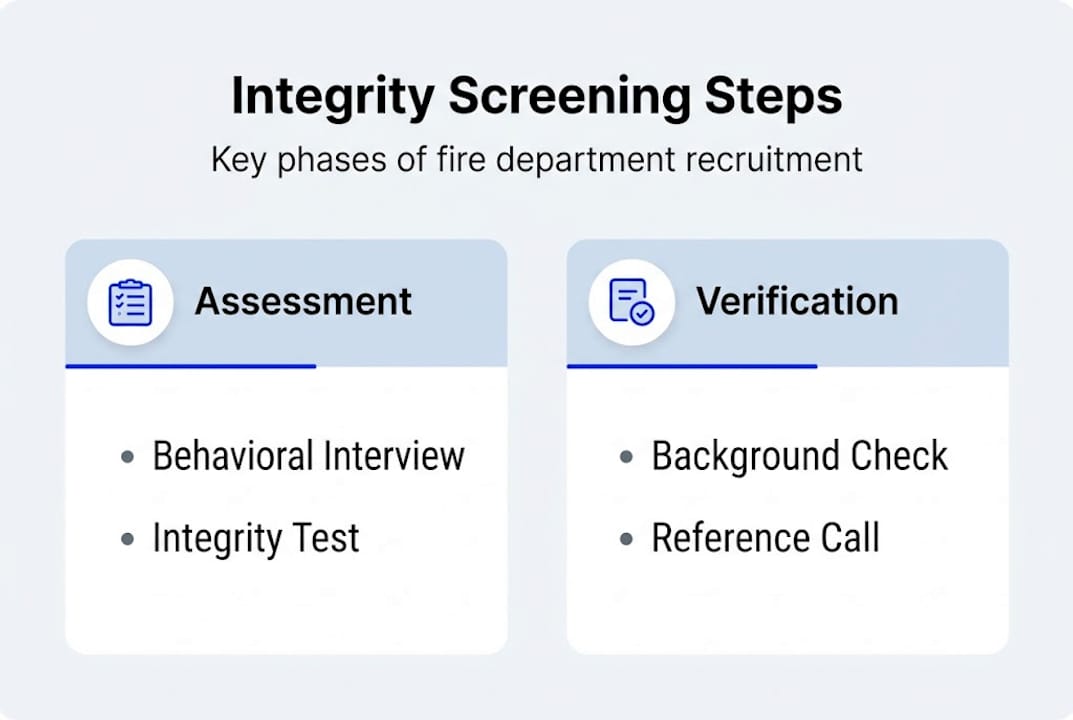
Recognizing integrity markers is only valuable when paired with a structured, legally sound process for assessing and verifying them. Best-in-class agencies use layered approaches that combine formal assessments, structured reference checks, and thorough background screenings.
| Assessment method | What it measures | Strengths | Limitations |
|---|---|---|---|
| Integrity assessments | Honesty, ethical reasoning, accountability | Standardized, predictive validity | Requires trained administration |
| Traditional background checks | Criminal history, employment verification | Legally established, widely accepted | Does not capture behavioral patterns |
| Reference interviews | Past conduct, peer and supervisor perceptions | Contextual and behavioral insight | Subject to bias and incomplete disclosure |
Thorough background screenings that include integrity-focused components reduce mis-hires in public safety agencies. This is particularly important for fire departments that also recruit volunteers, where the same integrity standards must apply even without the formal employment relationship.
Guidelines for legal and ethical integrity validation are essential. Assessments must comply with the Fair Credit Reporting Act (FCRA), applicable state employment laws, and Equal Employment Opportunity Commission (EEOC) guidance. Any integrity evaluation tool used in hiring must be validated for the role it is applied to, and agencies must be prepared to demonstrate that their assessments do not have adverse discriminatory impact on protected classes.
Structured reference check scripts go significantly further than informal calls. Rather than asking whether a candidate is “reliable” or “a good worker,” structured scripts ask specific behavioral questions: “Can you describe a situation where this candidate had to make a difficult ethical decision?” and “Were there ever concerns about this individual’s honesty or accountability?” These questions, delivered consistently across all references, yield far more actionable data.
Transparency throughout the process also matters. Candidates who understand that integrity is a core evaluation criterion are more likely to engage honestly, and agencies that communicate this clearly signal their organizational values from the first point of contact. Reviewing transparency in hiring practices can help agencies formalize this communication.
Pro Tip: Combine at least three assessment methods for every candidate: a structured integrity assessment, a comprehensive background investigation, and a scripted reference check. No single method captures the full picture, and the intersection of findings across all three provides the most reliable integrity profile.
Privacy and compliance are not optional considerations. Agencies that collect sensitive information during integrity assessments must have clear data handling policies, secure storage systems, and defined retention schedules. Failure to manage this data responsibly creates legal exposure that undermines the very risk-reduction goals the screening process is designed to achieve.
Integrating integrity frameworks into your recruitment process
Assessment best practices only deliver results when they are embedded systematically into every stage of the hiring journey. Integrity cannot be evaluated at a single checkpoint; it must be a consistent thread from the job posting through post-hire monitoring.
Building integrity into all stages of hiring starts with the job posting itself. Position descriptions that explicitly reference ethical conduct, accountability, and community trust signal to candidates what the agency values before they even apply. This self-selection mechanism filters out candidates who are not aligned with those values at the earliest possible stage.
Sample interview rubric items that evaluate integrity include scored criteria such as: clarity and consistency of responses to ethical scenario questions, willingness to acknowledge past mistakes without deflection, and the quality of reasoning applied to value-based dilemmas. Rubrics standardize evaluation across interviewers and reduce the influence of unconscious bias.
| Hiring stage | Integrity touchpoint | Method |
|---|---|---|
| Job posting | Explicit integrity language in description | Written communication |
| Application review | Disclosure questions about past conduct | Structured application form |
| Initial screening | Consistency check across application data | Background investigation |
| Interview | Behavioral and scenario-based questions | Structured interview rubric |
| Reference check | Behavioral reference script | Structured reference interview |
| Post-hire monitoring | Ongoing activity and conduct review | Continuous monitoring tools |
Departments with written integrity frameworks experience fewer disciplinary incidents and greater public trust. This data point underscores that formalization matters. Informal commitments to integrity are not sufficient; written policies, documented processes, and measurable standards create the accountability structure that sustains ethical conduct over time.
Continual monitoring and feedback loops extend integrity evaluation beyond the hiring decision. Post-hire monitoring tools allow agencies to identify emerging conduct concerns before they escalate into formal disciplinary matters. Regular performance feedback that includes integrity-related criteria reinforces the message that ethical conduct is evaluated throughout a career, not just during recruitment.
Steps to create a culture that reinforces integrity include:
- Establish written integrity standards that are communicated to all personnel at onboarding
- Incorporate integrity criteria into annual performance evaluations
- Create clear, confidential reporting channels for integrity concerns
- Recognize and reward demonstrated integrity through formal acknowledgment programs
- Ensure leadership models accountability visibly and consistently
Reviewing law enforcement hiring best practices offers additional structural guidance that translates effectively into fire service contexts, particularly for agencies managing both sworn and civilian personnel.
Why the hardest part is sustaining integrity—what the data tells us
Hiring for integrity is a significant achievement, but it is only the beginning. The harder, less-discussed challenge is sustaining a culture of integrity after the hire decision is made. Many agencies invest heavily in pre-employment screening and then allow those standards to erode once personnel are onboarded. That erosion is where the real risk lives.
Ongoing evaluation and leadership engagement are just as important as initial integrity screening. This finding challenges the common assumption that a rigorous hiring process is sufficient protection. It is not. Without continuous reinforcement, even personnel who demonstrated strong integrity during hiring can drift toward conduct that reflects the prevailing culture rather than the stated values.
Leadership modeling is the most powerful variable in this equation. When supervisors and senior officers hold themselves to the same accountability standards they expect from line personnel, integrity becomes self-reinforcing. When leadership creates exceptions for itself, those exceptions become the actual standard, regardless of what any policy document says.
Building feedback loops into the organizational structure is a practical way to sustain integrity long-term. Anonymous reporting systems, regular ethics discussions in team briefings, and structured post-incident reviews that include conduct components all create opportunities to identify and address integrity concerns before they become crises. Agencies that have formalized law enforcement integrity screening and extended those principles into ongoing monitoring report measurably better outcomes.
Rewarding integrity openly is equally important. When personnel see that ethical conduct is recognized and that accountability is valued rather than penalized, the organizational culture shifts in a lasting way. Maintaining transparency in hiring and throughout the employment lifecycle signals to every team member that integrity is not a phase but a permanent standard.
Partner with integrity-focused screening solutions
Building a recruitment process that consistently identifies, verifies, and sustains integrity requires more than good intentions. It requires purpose-built tools, investigator-driven methodologies, and partners who understand the unique demands of public safety hiring.

OMNI Intel specializes in pre-employment screening services designed specifically for fire departments, EMS agencies, and other public safety organizations. Our platform combines FCRA-compliant background investigations with integrity-focused assessment components, structured reference verification, and post-hire monitoring tools that keep your standards in place long after the hiring decision is made. Whether you are building a new screening framework from the ground up or strengthening an existing process, OMNI Intel provides the investigative depth and compliance infrastructure your agency needs to hire with confidence.
Frequently asked questions
What are the main components of an integrity screening for fire department candidates?
Integrity screening combines behavioral interviews, background checks, and reference verification focused on ethical behavior, providing a layered view of a candidate’s honesty and accountability across multiple data sources.
How can fire departments reduce the risk of hiring personnel with integrity issues?
Using structured assessment tools and comprehensive background investigations reduces integrity-related hiring risks by systematically identifying discrepancies, behavioral red flags, and prior conduct concerns before a hire decision is finalized.
Are there legal considerations when assessing integrity?
Yes, integrity assessments must comply with employment laws and privacy regulations to prevent discrimination, and all tools used must be validated for the specific role and consistently applied across all candidates.
What ongoing practices support integrity after hiring?
Ongoing monitoring and leadership engagement are vital, along with clear reporting channels and performance evaluations that explicitly include integrity criteria as a scored component of annual reviews.