
EMS Background Checks Cut Negligent Hiring 40% in 2026
Implementing comprehensive background checks reduces negligent hiring risk by up to 40% in EMS agencies. Patient safety and public trust depend on hiring providers with verified credentials, clean criminal histories, and proven integrity. This guide covers federal regulations, AI screening tools, common red flags, and post-hire monitoring strategies tailored specifically for EMS departments in 2026.
Table of Contents
- Introduction: Why Background Checks Matter In EMS Hiring
- Regulatory Frameworks Governing EMS Background Checks
- Techniques And Tools In Comprehensive EMS Background Screening
- Common Findings And Their Implications In EMS Screening
- Common Misconceptions About EMS Background Checks
- Integrating Background Checks Into EMS Hiring Workflows
- Post-Hire Monitoring And Risk Mitigation Strategies
- Conclusion: Strengthening EMS Hiring Through Robust Background Checks
- Optimize EMS Hiring With OMNI Intel Screening Solutions
- Frequently Asked Questions
Key Takeaways
| Point | Details |
|---|---|
| Risk Reduction | Comprehensive background checks cut negligent hiring risks by 40% in public safety roles. |
| Regulatory Compliance | Federal and state laws mandate Level 2 fingerprint checks and criminal history reviews for EMS hiring. |
| AI Efficiency | AI-driven screening platforms reduce hiring cycle times by 30% while improving candidate quality. |
| Red Flag Impact | DUI convictions and violent offenses increase job-related incident risk by 2.5 times. |
| Continuous Monitoring | 70% of employment risks emerge post-hire, making ongoing monitoring essential for agency safety. |
Introduction: Why Background Checks Matter in EMS Hiring
EMS professionals hold lives in their hands every shift. They enter homes during crises, administer medications, and make split-second decisions that determine patient outcomes. This access and authority demand unwavering integrity.
Negligent hiring exposes agencies to lawsuits, reputational damage, and patient harm. Background checks in public safety roles help detect past criminal behavior, substance abuse, and falsification of credentials, which directly correlates to higher patient safety and reduced agency liability. Screening uncovers disqualifying histories that applicants often conceal.
Effective screening reduces unsafe hire risk by up to 40%. Federal and state regulations mandate specific checks, yet many agencies struggle with compliance complexity. Understanding these requirements protects your department legally while strengthening community trust.
Key screening priorities include:
- Nationwide criminal history through FBI fingerprint databases
- Credential and license verification to prevent fraud
- Drug testing to identify substance abuse risks
- Driving record reviews to assess ambulance operation safety
Pro Tip: Prioritize screening that targets EMS-specific risks like credential verification to protect patient safety. Generic employment checks miss critical red flags unique to emergency medical roles.
Regulatory Frameworks Governing EMS Background Checks
Federal and state laws establish minimum screening standards for EMS hiring. Level 1 checks cover state criminal databases, while Level 2 background checks include FBI fingerprint submission and nationwide criminal history reviews. Most EMS positions require Level 2 screening due to patient access and controlled substance handling.
Federal EMS background check requirements mandate fingerprinting for agencies receiving federal grants or operating interstate transport. These checks search across all 50 states and U.S. territories, capturing records that state-only searches miss. Over 90% of EMS agencies comply with these baseline standards.
State regulations add layers of complexity. California requires LiveScan fingerprinting, while Texas mandates DPS background checks. Florida enforces Jessica Lunsford Act provisions for certain EMS roles. Each state maintains different disqualifying offense lists and review timelines.
Compliance challenges include:
- Tracking changing state rules across multi-jurisdiction operations
- Integrating federal and state requirements into unified workflows
- Managing fingerprint submission delays that extend hiring timelines
- Interpreting gray area offenses that regulations don’t explicitly address
Many administrators mistakenly assume EMS background standards are uniform nationwide. Federal and state regulatory EMS screening requirements vary significantly, creating confusion around minimum acceptable checks. Working with specialized screening providers helps navigate this patchwork of rules while maintaining consistent hiring standards.
Techniques and Tools in Comprehensive EMS Background Screening
Law enforcement-grade investigative methods go beyond standard employment checks. These techniques cross-reference multiple databases, verify identity documents, and flag inconsistencies that automated systems miss. Experienced investigators review findings contextually rather than applying rigid disqualification rules.
AI-driven background screening platforms improve detection accuracy and reduce hiring cycle times by up to 30% compared to manual checks. Machine learning algorithms identify patterns across criminal records, credit reports, and public records that human reviewers might overlook. Natural language processing extracts relevant data from unstructured court documents automatically.
Credential verification guards against unlicensed providers and certification fraud. EMS background checks tools cross-check candidate certifications directly with issuing bodies like the National Registry of Emergency Medical Technicians. This process catches forged certificates and expired credentials that applicants misrepresent as current.
| Feature | Standard Commercial Checks | Law Enforcement-Grade EMS Screening |
|---|---|---|
| Database Scope | State criminal records only | FBI fingerprint database plus 50-state search |
| Credential Verification | Self-reported validation | Direct registry confirmation with issuing authority |
| Investigative Depth | Automated name searches | Manual cross-referencing and investigator review |
| Post-Hire Monitoring | Not included | Continuous alerts for new arrests or license issues |
| Compliance Support | Generic templates | EMS-specific federal and state regulation guidance |
Key comprehensive EMS screening techniques include:
- Biometric fingerprinting through AFIS databases for accurate identification
- National Sex Offender Registry searches to protect vulnerable patients
- Professional license database queries across all states where candidate worked
- Motor vehicle record reviews covering minimum 7-year history
- AI analytics flagging discrepancies between application data and verified records
Pro Tip: Integrate AI screening tools early in the hiring workflow to maximize efficiency. Automated preliminary reviews let your team focus investigative time on complex cases requiring human judgment.
Common Findings and Their Implications in EMS Screening
Criminal records create the most significant hiring obstacles. DUI convictions correlate with increased risk for patient harm and liability, necessitating strict exclusion policies. Violent offenses like assault raise red flags about candidate temperament under stress. These histories increase job-related incident likelihood by 2.5 times.

Substance abuse findings demand immediate disqualification. Failed drug tests indicate active addiction that compromises patient care and controlled substance security. Prior convictions for drug possession or distribution suggest ongoing risk, even after probation completion. EMS agencies face DEA scrutiny over narcotic access, making zero tolerance policies essential.
Credential falsification presents malpractice and liability exposure. Applicants who claim paramedic certification while holding only EMT-Basic credentials create dangerous care gaps. Unlicensed candidates operating as licensed providers generate catastrophic legal vulnerability. These misrepresentations appear in approximately 8% of EMS applications.
Handling negative EMS background findings requires documented decision frameworks. Agencies must balance public safety against fair hiring practices for rehabilitated individuals. Clear policies around lookback periods, offense severity tiers, and appeal processes protect both communities and legal compliance.
Serious findings requiring careful evaluation:
- Felony convictions within the past 10 years, especially violent crimes
- Multiple DUI offenses or recent impaired driving charges
- Theft or fraud convictions indicating integrity issues
- Domestic violence charges suggesting anger management problems
- License suspensions or revocations from other states or certifying bodies
Impact of criminal history in EMS extends beyond individual hires to agency reputation. One negligent hire incident can destroy community trust built over decades. Comprehensive screening provides documentation that your agency exercised reasonable care in vetting, crucial for liability defense.
Common Misconceptions About EMS Background Checks
Many administrators believe thorough background checks guarantee perfect candidates. Clean screening results indicate no discovered red flags, not absolute proof of integrity. Candidates conceal information, records contain errors, and databases lag behind recent events. Background checks are risk reduction tools, not crystal balls predicting future behavior.
EMS background requirements vary dramatically by jurisdiction. What Florida mandates differs substantially from Oregon’s rules. Agencies operating across state lines face conflicting standards that complicate uniform hiring policies. This misconception leads to compliance gaps when administrators apply one state’s rules universally.
Credential verification matters even when criminal history is spotless. Importance of post-hire monitoring becomes clear when licensed providers let certifications lapse after hiring. Approximately 70% of employment risks emerge post-hire through new arrests, expired credentials, or behavioral changes that initial screening couldn’t detect.
Three widespread misconceptions and corrections:
- Myth: Passing a background check means the candidate is trustworthy forever. Reality: Ongoing monitoring catches post-hire risks like new criminal charges or credential lapses that occur after initial screening.
- Myth: All EMS agencies follow identical federal background check standards. Reality: State regulations add requirements beyond federal minimums, creating significant variation in screening scope and disqualifying offenses.
- Myth: Credential verification is redundant if the candidate has no criminal history. Reality: Clean criminal records don’t validate certifications; direct registry verification is the only way to confirm legitimate credentials and current status.
Understanding these limitations helps agencies build layered screening approaches. Initial background checks provide the foundation, but continuous monitoring and periodic reverifications maintain safety throughout employment tenure.
Integrating Background Checks into EMS Hiring Workflows
Streamlining background checks into recruitment processes requires systematic planning. Define screening criteria aligned with federal and state regulations before posting positions. This clarity helps HR teams communicate requirements to candidates upfront, reducing wasted time on disqualified applicants.
Five key implementation steps:
- Establish disqualifying offense lists based on your state’s regulations and agency risk tolerance, documenting rationale for each category.
- Integrate AI-driven background screening platforms with your applicant tracking system to automate preliminary reviews and flag priority cases.
- Build credential verification into conditional offer letters, requiring candidates to authorize direct registry checks before final hiring decisions.
- Create review committees including HR, legal counsel, and operational leaders to evaluate borderline findings consistently and document decisions.
- Implement tracking systems monitoring screening turnaround times and identifying bottlenecks that delay quality hires.
Benefits include faster hiring cycles, improved candidate quality, and reduced liability exposure. EMS hiring workflow integration cuts average time-to-hire by 25% while maintaining thorough vetting. Automated status updates keep candidates engaged during background processing.
Case studies demonstrate measurable improvements. A mid-sized fire department reduced negligent hiring incidents by 60% after implementing AI screening tools. Their average screening completion time dropped from 45 days to 28 days. Another agency caught 12% more credential falsifications through direct registry verification compared to their previous applicant self-reporting process.
Background check integration techniques must balance thoroughness with candidate experience. Communicate timelines clearly, provide status updates weekly, and explain any delays. Top candidates often have multiple offers, so efficient processing protects your agency’s competitive position.
Pro Tip: Foster collaboration between HR, legal, and operational teams to align screening workflows. Operations leaders know field realities that inform risk assessment, while legal counsel ensures compliance with evolving regulations.
Post-Hire Monitoring and Risk Mitigation Strategies
Continuous monitoring detects emerging risks that initial screening missed. New arrests, license suspensions, or certification lapses occur after hiring. Post-hire monitoring tools provide automated alerts when employees appear in criminal databases or licensing boards issue disciplinary actions. This early detection enables intervention before incidents occur.
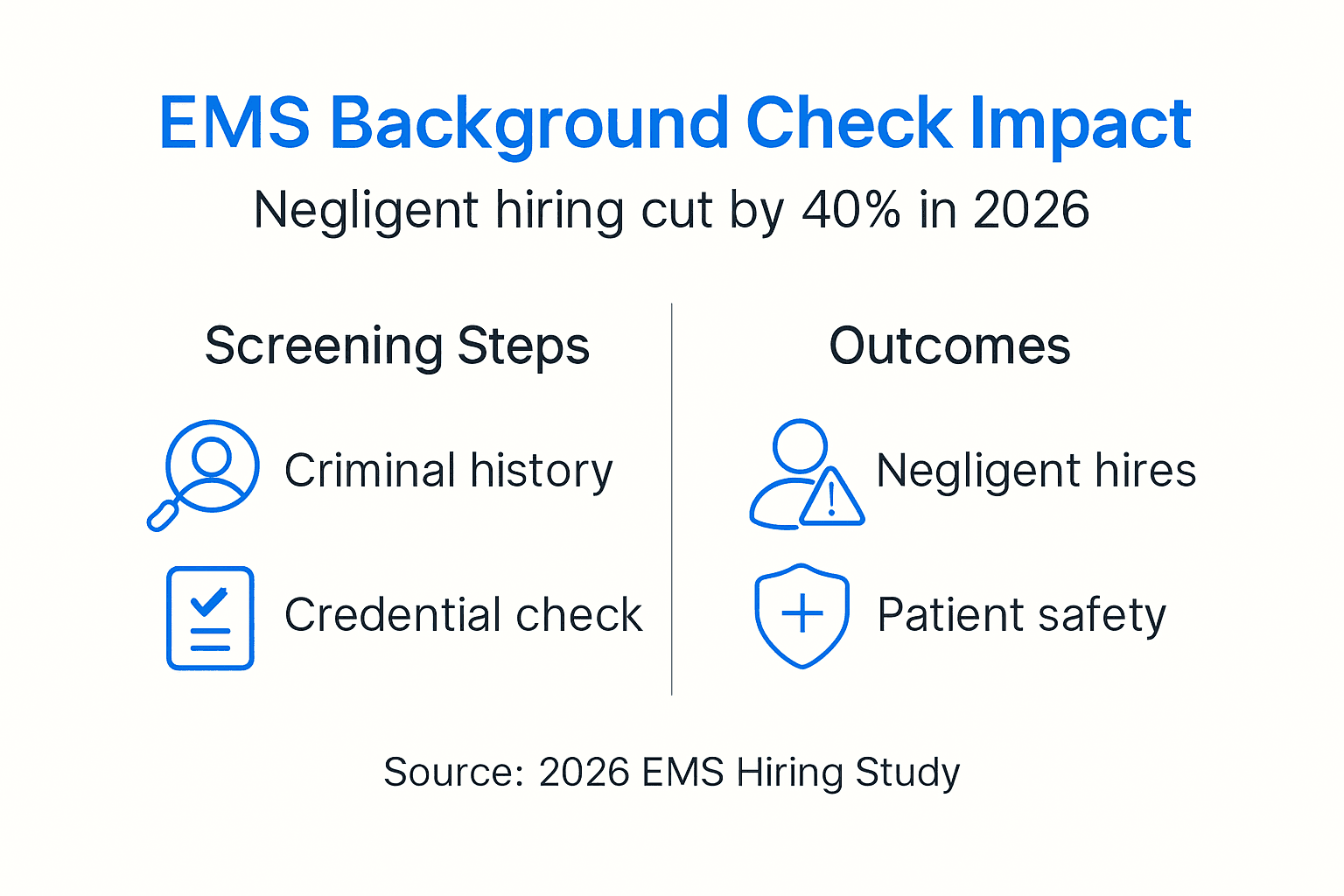
Ongoing screening reduces insider threats from employees who develop substance abuse issues or engage in criminal activity during employment. Financial stress, personal crises, or gradual ethical erosion create risks that weren’t present at hire. Monitoring catches these changes through credit report flags, arrest notifications, and professional license updates.
Post-hire risk mitigation helps maintain compliance with evolving regulations. States periodically update disqualifying offense lists or change certification requirements. Continuous monitoring ensures your current workforce remains qualified under new rules, preventing compliance lapses that trigger penalties.
Critical post-hire monitoring measures and benefits:
- Monthly criminal database searches across national and state systems, catching arrests within 30 days versus annual manual checks discovering issues a year late
- Professional license status verification quarterly, identifying expired or suspended credentials before patients are exposed to unqualified care
- Sex offender registry monitoring to detect employees who appear on these lists post-hire, protecting vulnerable patient populations
- Credit report reviews for positions handling agency finances, flagging financial distress that correlates with theft risk
- Driving record updates for ambulance operators, catching DUI charges or excessive violations that disqualify safe vehicle operation
Available platforms offer configurable alert thresholds tailored to agency risk tolerance. You determine which findings trigger immediate suspension versus further investigation. Integration with HR systems automates compliance documentation for audits and regulatory reviews.
Conclusion: Strengthening EMS Hiring Through Robust Background Checks
Comprehensive background checks form the foundation of safe EMS hiring. Reducing negligent hiring risk by 40% protects patients, shields agencies from liability, and strengthens community trust. Every disqualified applicant with a violent criminal history or falsified credentials represents a potential tragedy prevented.
Compliance with federal and state regulations provides legal protection and operational consistency. Level 2 fingerprint checks, credential verification, and drug testing establish baseline standards. Layering AI-driven tools accelerates processing while improving detection accuracy, cutting hiring cycles by 30% without sacrificing thoroughness.
Post-hire monitoring completes the risk management lifecycle. 70% of employment risks emerge after initial screening, making continuous surveillance essential. Automated alerts catch new arrests, expired certifications, and license suspensions before they create emergencies.
Technology is transforming EMS hiring safety in 2026. AI analytics, automated credential verification, and real-time monitoring platforms give agencies capabilities that were impossible five years ago. Agencies adopting these tools gain competitive advantages in recruiting quality candidates while protecting their communities more effectively.
Optimize EMS Hiring with OMNI Intel Screening Solutions
EMS agencies need screening partners who understand public safety’s unique demands. OMNI Intel delivers law enforcement-grade background investigations specifically designed for emergency medical services. Our platform combines FBI database access, direct credential registry verification, and AI-driven analytics that traditional employment screening services can’t match.

Public safety pre-employment screening through OMNI Intel reduces hiring cycle times while improving candidate quality. Our automated workflows handle fingerprint submission, multi-state criminal searches, and credential verification simultaneously. You get comprehensive results faster, letting you secure top candidates before competitors.
Background checks for public safety agencies are just the beginning. Our post-hire employee monitoring solutions provide continuous surveillance that catches emerging risks throughout employment tenure. Automated alerts notify you immediately when employees face new arrests or license issues, enabling proactive intervention.
Schedule a demo to see how OMNI Intel streamlines EMS recruitment while strengthening patient safety and regulatory compliance. Our team will customize screening protocols to your agency’s specific requirements and state regulations.
Frequently Asked Questions
What is included in a standard EMS background check?
Standard EMS checks include FBI fingerprint-based criminal history searches covering all 50 states, professional credential verification directly with registries like NREMT, drug screening for controlled substances, and motor vehicle record reviews. Some states require additional components like sex offender registry searches or child abuse clearances.
How often should EMS agencies conduct post-hire monitoring?
Continuous monitoring provides real-time alerts when employees appear in criminal databases or licensing boards issue actions. Monthly automated searches catch most issues within 30 days. Annual manual reverifications should supplement continuous monitoring to ensure comprehensive coverage of all risk categories.
Can AI tools replace manual review in EMS hiring?
AI accelerates preliminary screening and flags potential issues, but human review remains essential for context and judgment. Experienced investigators interpret ambiguous findings, assess rehabilitation evidence, and make nuanced decisions that algorithms can’t handle. The optimal approach combines AI efficiency with human expertise for complex cases.
How do state regulations affect EMS background check requirements?
Each state establishes minimum screening standards, disqualifying offense lists, and processing procedures that vary significantly. California requires LiveScan fingerprinting, while Texas uses DPS checks. Florida enforces stricter volunteer screening under Jessica Lunsford Act provisions. Agencies operating across state lines must comply with the strictest applicable standard.
What are the key red flags to disqualify a candidate?
DUI convictions within the past 10 years, violent felonies, drug-related offenses, theft or fraud convictions, and falsified credentials are top disqualifiers. Recent arrests for serious crimes, multiple misdemeanors showing patterns, and license suspensions from other states also warrant automatic disqualification or intensive secondary review before considering employment.