

25% Vacancy Threatens U.S. 911 Response. What Managers Must Do in 90 Days
The 911 dispatcher shortage is real, not anecdotal, and the numbers back it up: national surveys put average telecommunicator vacancy rates near a quarter of all budgeted positions, with many centers running above 30%. The immediate priority is twofold. Protect call-answer times now with scheduling and hiring fixes, then push the policy changes, reclassification and dedicated funding, that fix the problem for good.
TL;DR:
- Vacancy rates average around 25 percent, with some centers exceeding 30 percent, leading to slower call response times and increased system vulnerability.
- Causes include burnout from stressful schedules, wage and benefits shortfalls due to classification issues, high training attrition, and competition from other jobs offering better hours and pay.
- Implementing operational fixes like limiting mandatory overtime, bulk hiring with pod training, and deploying remote work can improve staffing levels within 90 days.
- Reclassifying dispatchers as protective service workers and increasing federal NG911 funding are essential policies to sustainably address the workforce shortage long-term.
- Improving screening processes tailored to dispatch work can significantly reduce hiring timelines and help agencies retain qualified staff amid high burnout and turnover.
Table of Contents
- How Big Is the 911 Dispatcher Shortage, Really?
- Why Dispatch Centers Can’t Keep Seats Filled
- What Happens When a Dispatch Center Runs Short-Staffed
- Operational Fixes Centers Can Deploy This Quarter
- The Policy Fixes That Actually End the Shortage
- Where AI Helps, and Where It Doesn’t
- Hiring and Retention Tactics That Actually Move the Needle
- Why Targeted Screening Shortens the Hiring Runway
- The Shortage Hits Rural and Urban Centers Differently
- Where Legislation and Policy Stand Right Now
- The Mental Health Cost Nobody Budgets For
- What the Data Actually Tells Us to Do First
- How OMNI Intel Helps Dispatch Centers Hire Faster Without Cutting Corners
- Sources
- FAQ
How Big Is the 911 Dispatcher Shortage, Really?
The IAED/NASNA staffing survey report is the closest thing the industry has to a national census, and its findings are stark. Average vacancy rates across responding centers sit around 25%, but that average hides the real emergency: a substantial share of centers report vacancy rates above 30%, meaning some communications centers are trying to run 911 operations with roughly a third of their console seats empty.
The same survey documented two trends that compound the vacancy problem. New-hire training failure rates are climbing, meaning agencies are losing recruits before they ever answer a live call. Experienced-employee exits are rising too, so centers are hemorrhaging institutional knowledge at both ends of the career pipeline.
By the Numbers: Average vacancy rate across surveyed 911 centers: approximately 25%, with many individual centers exceeding 30%, per the IAED/NASNA 2023 staffing survey.
The 2025 NENA “Pulse of 9-1-1” report adds texture to the vacancy math. Burnout topped the list of workforce concerns among emergency communications centers (ECCs) surveyed, ahead of pay in some responses. The report also flagged a rise in system outages, a signal that thin staffing and aging infrastructure are now feeding each other.
What changed since 2020? Three things happened at once: pandemic-era call volume spikes strained already-lean staffing models, a broader labor market shift pulled workers toward remote and higher-paying jobs, and a wave of veteran dispatchers hit retirement eligibility. The result is a shortage that built gradually for a decade and then accelerated sharply starting around 2021 and 2022.
Why Dispatch Centers Can’t Keep Seats Filled
The causes of the shortage aren’t mysterious. They cluster into four categories, and each one demands a different fix.
- Occupational stress and broken scheduling. Mandatory overtime, skipped breaks, and rotating shifts that never stabilize push telecommunicators toward exhaustion within a few years of hire.
- Wage and benefits shortfalls. Because most jurisdictions still classify 911 telecommunicators as clerical or administrative workers rather than protective service employees, pay scales, retirement benefits, and hazard-duty recognition lag far behind police, fire, and EMS.
- Training attrition. Console work demands multitasking under acute pressure, and a rising share of new hires wash out before certification, a trend the IAED/NASNA survey documented directly.
- Labor-market competition. Warehouses, call centers, and remote customer-service jobs now compete for the same candidate pool, often with better hours and less psychological weight.
The classification issue deserves special attention because it’s structural, not cultural. A dispatcher coordinating an active shooter response or a cardiac arrest is doing work with life-safety consequences, yet in the federal occupational framework, that role sits in the same broad category as receptionists. Pay grades, pension formulas, and hiring competitiveness all flow from that classification, which means culture fixes alone can’t outrun it.
What Happens When a Dispatch Center Runs Short-Staffed
Understaffed centers don’t fail quietly. The consequences show up in measurable, dangerous ways.
- Slower call-answer and dispatch times. Fewer console operators means longer queue times during peak call volume, and in medical or violent-crime emergencies, seconds matter.
- Loss of training capacity. Veteran telecommunicators who would normally mentor new hires instead get pulled onto the floor to cover gaps, which slows certification for the next cohort.
- Burnout cascading into turnover. Mandatory overtime and canceled leave push tenured staff toward resignation, which reopens the same vacancy the agency just tried to fill.
- System fragility. The NENA Pulse report links rising outages and cyber incidents to centers already stretched thin on staff who would otherwise catch problems early.
By the Numbers: Burnout ranked as the top workforce concern in the 2025 NENA Pulse of 9-1-1 report, surpassing pay and benefits complaints among surveyed emergency communications centers.
The public-safety risk here isn’t theoretical. A center running at 70% staffing during a mass-casualty event or a regional weather emergency has fewer operators to triage simultaneous calls, which means longer holds, missed details, and slower unit dispatch when response time is the single biggest variable in survival outcomes.
Operational Fixes Centers Can Deploy This Quarter
Policy reform takes years. Centers need moves that work in the next 90 days, and several are already proven.
- Cap mandatory overtime and enforce real breaks. Scheduling software that flags consecutive shift limits reduces the burnout spiral before it starts.
- Adopt bulk hiring paired with pod training. One documented implementation raised one-year retention from roughly 36% to 58% by hiring cohorts together and training them in pods with rotating experienced mentors, according to the IAED Journal.
- Build a temporary staffing pool. Part-time hires and cross-trained personnel from adjacent public-safety roles can cover gaps without overloading full-time staff, provided reassignment safeguards keep certified operators on live consoles.
- Pilot secure remote work where feasible. Kitsap County, Washington, averted a staffing crisis by equipping select dispatchers with hardware kits and redundant connectivity rather than generic remote-desktop setups, a model detailed by Fast Company.
- Speed up compliant background screening. Slow, generic screening workflows lose candidates to faster-hiring employers; a pre-employment screening checklist tailored to dispatch roles cuts weeks off time-to-offer without skipping steps.
Pro Tip: Track time-to-certification separately from time-to-hire. A center that hires fast but certifies slowly is just moving the bottleneck, not removing it.
The Policy Fixes That Actually End the Shortage
Operational triage buys time. It doesn’t fix the underlying economics. Three structural reforms do.
- Reclassify telecommunicators as protective service workers. Proposed federal legislation would move 911 dispatchers out of the “office and administrative support” category and into “protective service,” aligning them with police, fire, and EMS for pay scales and benefit eligibility, per Route Fifty’s policy analysis.
- Fund Next Generation 911 (NG911) modernization. Legacy infrastructure is part of why outages spike under staffing stress. Federal dollars directed at NG911 upgrades reduce technical failure points that otherwise fall on already-thin staff to manage manually.
- Align pay, benefits, and career ladders with the reclassification. Reclassification only pays off if states and municipalities update pay bands and retirement formulas to match, creating a visible career path instead of a dead-end entry job.
Congress has taken up this exact question. Bills addressing telecommunicator reclassification and 911 funding are tracked on Congress, and the parallel 911.gov reclassification project is documenting the occupational-standards case for the change. For policymakers deciding where to direct limited funding, the ROI metric that matters most is retention at the one-year and three-year marks, not just applications received. A hiring surge that doesn’t survive first-year burnout hasn’t solved anything.
Where AI Helps, and Where It Doesn’t
AI-driven call triage is already live in some centers, and it’s solving a real problem: routine, non-emergency calls eating console time that should go to genuine emergencies. Reporting from TechCrunch documents centers deploying AI voice assistants to handle non-urgent reports, automatically routing anything ambiguous or escalating to a human telecommunicator.
That’s the right design pattern: AI absorbs volume, humans keep judgment authority over anything with life-safety stakes. Centers considering this technology should insist on:
- Human-in-the-loop escalation for any call the system can’t classify with high confidence.
- Quality metrics tracked separately from volume metrics, since a system that answers more calls but misroutes emergencies has failed at its core job.
- NG911 compatibility, since media-capable calls (text, video, location data) and cross-jurisdictional transfer resilience matter more as call complexity rises.
By the Numbers: The 2025 NENA Pulse report found growing openness among ECCs toward AI and cloud-based tools as part of broader modernization, alongside rising concern about outages and cyber threats.
Procurement teams should also weigh AI governance and compliance frameworks before signing any AI vendor contract, particularly around data retention and audit trails for call recordings.
Hiring and Retention Tactics That Actually Move the Needle
Recruiting for dispatch roles fails most often at speed, not sourcing. Candidates who wait three weeks for a background check often accept a faster offer elsewhere.
- Diversify sourcing channels beyond job boards. Adjacent public-safety fields (former 911 volunteers, military communications specialists, retail and healthcare call-center veterans) often adapt faster than expected.
- Run FCRA-compliant background checks tuned specifically to dispatch work, including employment-history verification for shift reliability rather than generic criminal-record-only screening.
- Structure onboarding as pod training with modular certification milestones, tracking KPIs like time-to-independent-console rather than just completion dates.
- Build wellness support into the schedule, not around it. Structured incident-closure debriefs after traumatic calls and visible recognition programs reduce the quiet attrition that happens when staff feel unseen, a pattern documented by FireRescue1.
Pro Tip: Ask every departing telecommunicator one specific question in the exit interview: “At what point did you decide to leave?” The answer usually points to a fixable scheduling or culture failure, not an unfixable pay gap.
Why Targeted Screening Shortens the Hiring Runway
Generic background checks slow dispatch hiring without improving safety. Screening built for the role, verifying employment history for shift reliability, running FCRA-compliant criminal and life-course checks tuned to console work, catches risk without adding weeks to the timeline.
- Integrate screening directly with your applicant-tracking system to eliminate re-entry delays.
- Use AI-assisted candidate triage to flag qualified applicants faster, not to replace human review.
- Require any vendor contract to spell out FCRA adverse-action procedures and data-retention limits before signing.
The Shortage Hits Rural and Urban Centers Differently
A center in a mid-sized city with three competing agencies can often poach staff or offer marginally better pay to close a gap. A rural county running a single dispatch center with no backup agency nearby has no such lever, and a single resignation can push that center from strained to critical overnight.
Regional disparity in the 911 dispatcher shortage tracks closely with population density and tax base. Rural and small-county centers often carry the highest vacancy rates because they compete for the same limited local labor pool against retail, healthcare, and manufacturing employers who can offer comparable pay without the psychological weight of the job. States with strong NG911 grant programs and centralized regional consolidation, where several small county centers merge into one larger regional hub, tend to weather staffing shocks better because they can shift call load across a bigger operator pool during a crisis.
Consolidation isn’t universally popular. Some communities resist losing a local dispatch center tied to local knowledge of streets and landmarks. But the staffing math increasingly favors regional models: a consolidated center of forty positions can absorb five vacancies without a service-level collapse, while a standalone center of eight positions cannot. Policymakers evaluating funding allocation should weight vacancy severity, not just raw headcount, when deciding where federal or state 911 funding goes first.
Where Legislation and Policy Stand Right Now
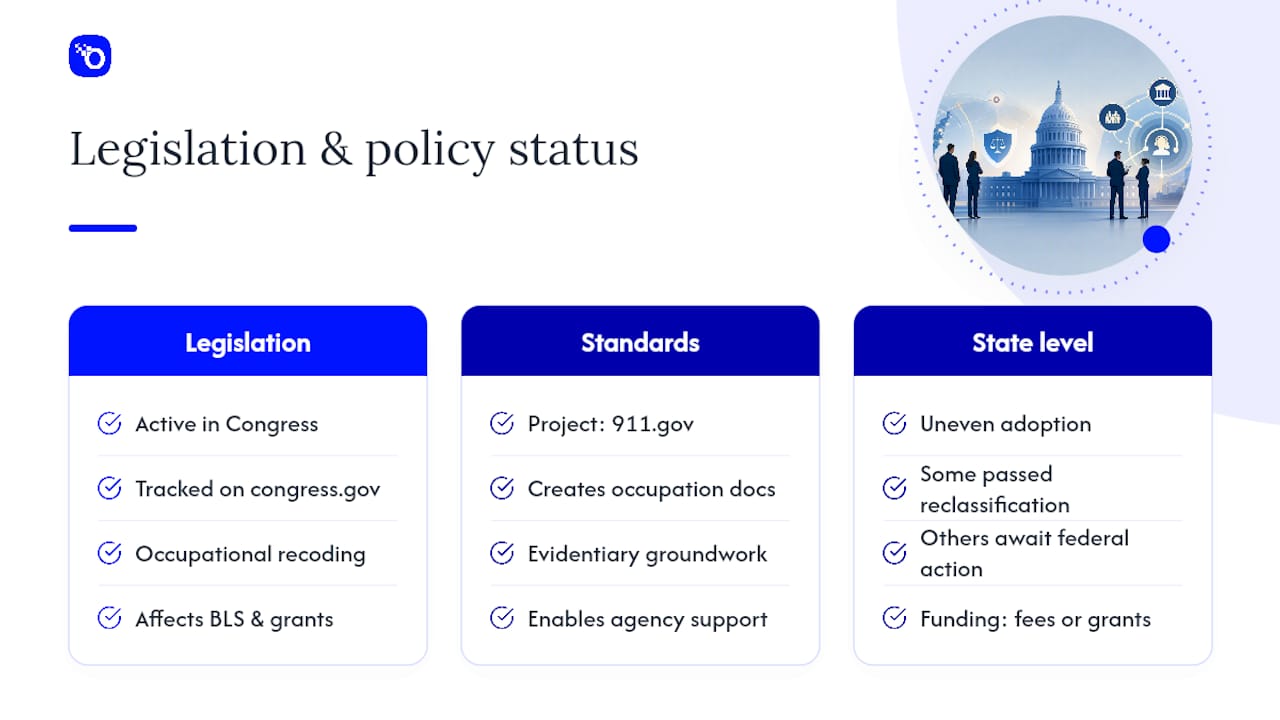
Federal action on the 911 dispatcher shortage centers on two levers, and both are currently active in Congress. Reclassification legislation would move telecommunicators from the “office and administrative support” occupational code into “protective service,” a change tracked directly through bill text on congress.gov. That single coding change carries real weight: it affects Bureau of Labor Statistics occupational data, federal grant eligibility tied to protective-service categories, and in many states, pension and disability benefit structures.
Parallel to legislation, the 911.gov telecommunicator job reclassification project is building the occupational-standards documentation federal agencies need to formally support the change, essentially the evidentiary groundwork that turns a bill into an enforceable classification update.
At the state level, activity is uneven. Some states have already passed their own reclassification measures independent of federal action, while others are waiting to see which way Congress moves before committing state pension funds to the change. NG911 funding follows a similar pattern: some states have dedicated 911 fee revenue streams funding modernization directly, while others rely entirely on competitive federal grants, which creates the regional disparity described above.
The Mental Health Cost Nobody Budgets For
Burnout isn’t a soft complaint in this field. It’s an occupational hazard with the same seriousness as the one facing the police officers and paramedics dispatchers support. Telecommunicators absorb secondhand trauma from calls involving deaths, violence, and suicides, often multiple times per shift, without ever leaving their chair. The NENA Pulse report ranking burnout as the top workforce concern, ahead of pay, should reframe how agencies allocate their limited retention budgets.
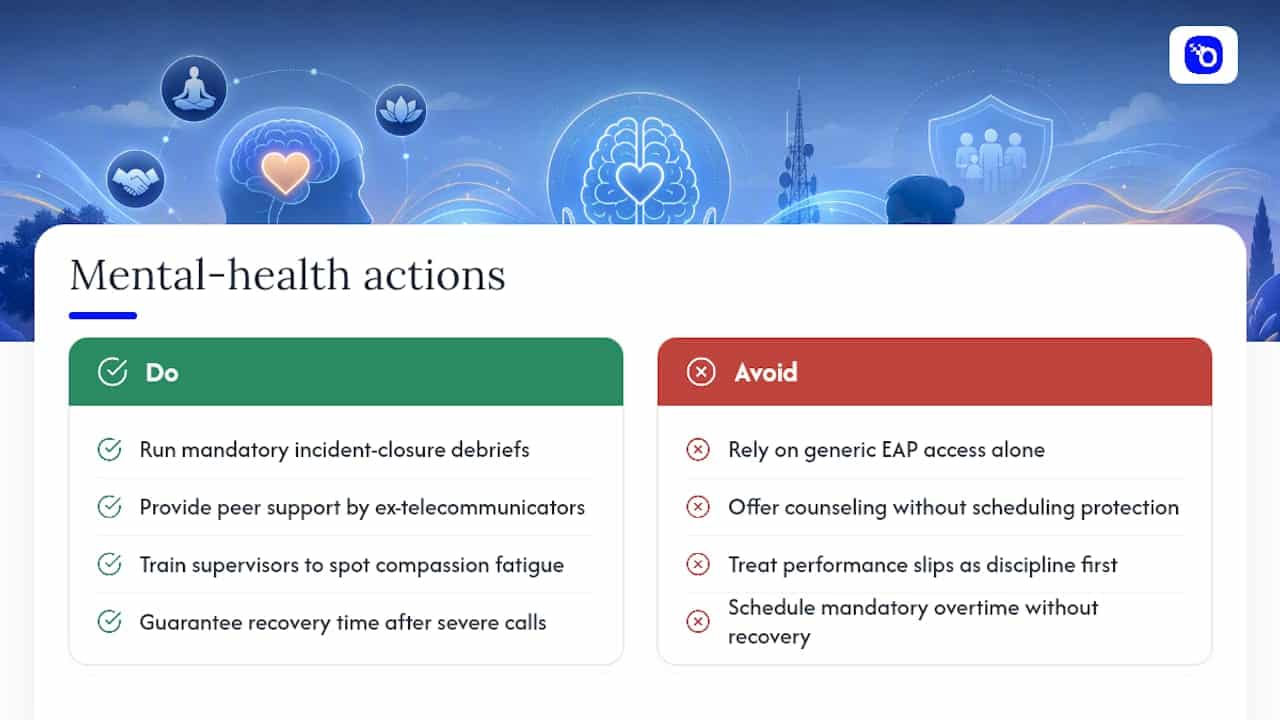
Effective support isn’t generic employee-assistance-program access that nobody uses. It’s structured, mandatory incident-closure debriefs after high-severity calls, peer-support programs staffed by former telecommunicators who understand the specific weight of the job, and supervisors trained to recognize the early signs of compassion fatigue rather than treating a slipping performance metric as a discipline issue.
Shift design matters just as much as counseling access. A telecommunicator working mandatory overtime after a mass-casualty call, with no recovery window before the next shift, is being set up to fail regardless of how strong the wellness program looks on paper. Centers that pair scheduling protections (guaranteed recovery time after severe calls) with peer support see better retention than centers that offer counseling access alone. The lesson for managers: wellness programs without scheduling protection are treating a symptom, not the cause.
What the Data Actually Tells Us to Do First
The conventional advice on this topic leans heavily on recruitment marketing: better job ads, career fairs, social media campaigns. That’s not wrong, but it’s treating a leaking bucket by adding more water. The IAED/NASNA survey makes clear that training failures and experienced-staff exits are rising simultaneously, which means agencies are losing people at both entry and exit points faster than recruitment campaigns can refill them.
The reform that actually changes the math is reclassification, because it touches pay, pension, and recruitment competitiveness in one legislative move rather than three separate fights. Everything else, wellness programs, pod training, AI triage, is genuinely valuable, but it’s damage control until the occupational classification catches up with the job’s actual risk profile.
For hiring managers reading this looking for something to do Monday morning, prioritize screening speed over screening volume. A background-check process tuned specifically to dispatch roles, rather than a generic criminal-history template borrowed from retail hiring, closes offers faster and loses fewer qualified candidates to competitors who move quicker. That’s a fixable problem this quarter, unlike reclassification, which depends on Congress.
— Matt
How OMNI Intel Helps Dispatch Centers Hire Faster Without Cutting Corners
Every fix in this article competes with the same constraint: hiring managers need speed and thoroughness at the same time, and most generic screening vendors force a choice between the two. OMNI Intel’s pre-employment screening is built specifically for public safety roles, including 911 dispatch, which means the checks that matter for console work, employment-history verification for shift reliability, targeted criminal-record queries, FCRA-compliant reporting, run without the delays generic HR screening platforms add when they treat a dispatcher application the same way they’d treat a retail cashier’s.

That specificity is what shortens time-to-offer. OMNI Intel integrates directly with applicant-tracking systems so screening doesn’t stall in a separate queue, and its applicant screening integration keeps compliance documentation attached to each candidate record automatically, reducing the manual re-entry that eats days in a typical hiring cycle. Agencies wrestling with reclassification timelines and burnout can’t wait on Congress to fix their current vacancy rate. Download the pre-employment screening checklist or request a demo to see how a dispatch-specific screening workflow fits your center’s current hiring pipeline.
Sources
- Third Annual “Pulse of 9-1-1” Report – NENA
- 911 centers are so understaffed they’re turning to AI to answer calls – TechCrunch
- Combating The 911 Staffing Crisis – IAED Journal
FAQ
Is there a shortage of 911 operators in the United States?
Yes. National surveys from IAED and NASNA show average vacancy rates near 25%, with many individual centers exceeding 30%.
Which state pays 911 dispatchers the most?
Pay varies widely by state and even by county based on local classification and union agreements, and no single national dataset in current federal reporting ranks every state consistently; agencies in high-cost states with strong protective-service classifications tend to offer the most competitive pay.
What state calls 911 the least?
Call volume tracks population and tourism density more than any single state policy, so lower-population rural states generally register the fewest total 911 calls, though no authoritative national ranking breaks this out precisely.
Will AI replace 911 dispatchers?
No. Current deployments, as reported by TechCrunch, use AI to triage non-emergency calls and free up human dispatchers for genuine emergencies, keeping humans in control of life-safety decisions.
How does background screening affect dispatcher hiring timelines?
Screening tuned specifically to dispatch roles, rather than generic templates, verifies shift reliability and criminal history without adding unnecessary delay, and FCRA-compliant, dispatch-specific screening helps agencies close offers before candidates accept competing jobs.