

Why Data Privacy Matters: Protect Your Personal Information
Data privacy is the right to control who accesses your personal information and how it is used. Without that control, your digital identity becomes a resource others can exploit, sell, or weaponize without your knowledge. The importance of data privacy extends far beyond keeping secrets. It determines whether you can move through the digital world with autonomy, safety, and trust. Whether you are a private citizen, a job applicant, or a public safety professional, understanding why data privacy matters is the first step toward protecting yourself and the people who depend on you.
Why data privacy matters more than most people realize
Data privacy, formally called information privacy, is the principle that individuals should determine how their personal data is collected, stored, and shared. It sits at the intersection of civil rights and digital security. Regulators like the Federal Trade Commission and frameworks like the General Data Protection Regulation (GDPR) treat it as a legal obligation. Technologists at organizations like the Signal Foundation treat it as a design standard. The gap between those two positions is where most people get hurt.
The core problem is scale. Over 1.35 billion people globally were affected by data breaches in 2024. That number represents not just stolen passwords but stolen identities, drained bank accounts, and damaged reputations. When personal data is exposed at that scale, the harm is rarely abstract.
Data brokers make the problem worse. These companies consolidate location data, purchase history, social media activity, and public records to build detailed personal profiles that individuals cannot easily detect or erase. A single data point seems harmless. Combined with dozens of others, it creates a portrait that can be used to manipulate, discriminate, or defraud.

What are the real risks of poor data protection?
The consequences of inadequate data protection fall into three categories: financial harm, reputational damage, and loss of personal autonomy.
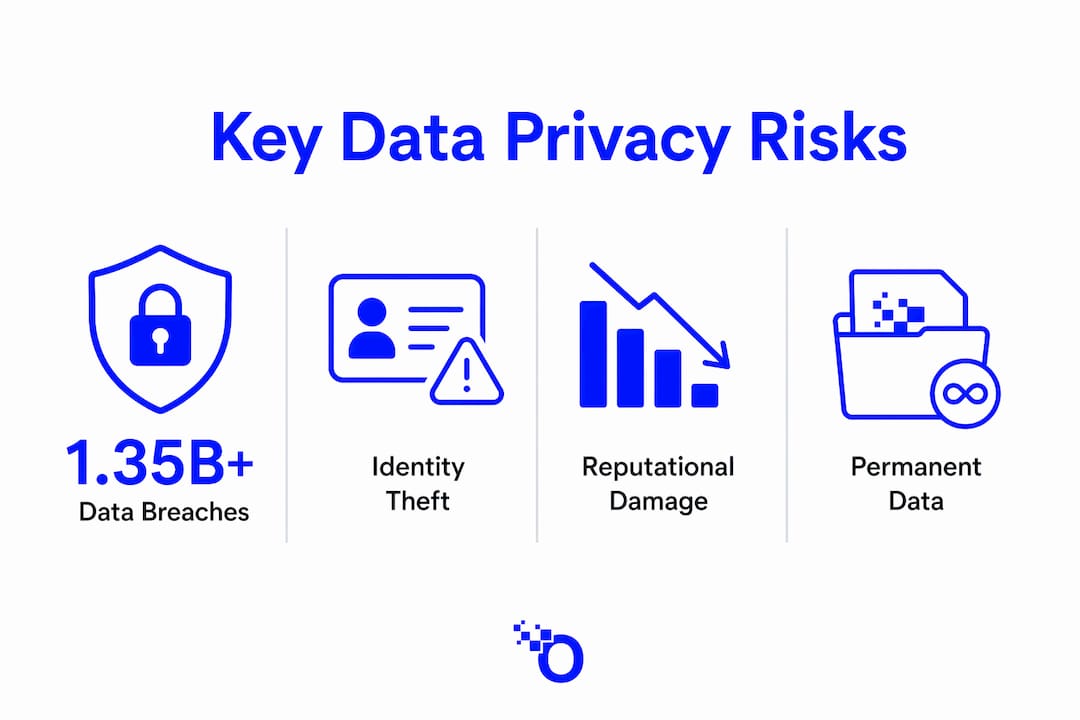
Financial harm is the most visible. Identity theft costs victims time, money, and credit standing. Fraudsters use stolen Social Security numbers, addresses, and financial account details to open credit lines, file false tax returns, and drain savings. The recovery process takes months or years.
Reputational damage is harder to quantify but equally serious. Leaked medical records, private communications, or behavioral data can affect employment decisions, insurance rates, and personal relationships. Once that information circulates, it is nearly impossible to contain.
Loss of autonomy is the most underappreciated risk. When others control your data, they influence your choices. Targeted advertising, algorithmic content filtering, and price discrimination all depend on personal data. You may not notice the manipulation, but it shapes your decisions.
Several specific threats deserve attention:
- Identity theft: Criminals use stolen data to impersonate victims for financial gain.
- Phishing and social engineering: Detailed personal profiles make targeted attacks more convincing.
- Discrimination: Health, financial, or behavioral data can be used to deny housing, employment, or insurance.
- Surveillance: Location and communication data can be used to monitor individuals without consent.
- Reputational exposure: Private information shared in one context can surface in damaging ways in another.
One of the most underestimated risks is data permanence. Data shared once is nearly impossible to fully retract because it can be copied, sold, or embedded in AI training models. Requesting deletion from one platform does not remove copies held by third parties or data brokers. That permanence means every sharing decision carries long-term consequences.
The privacy paradox compounds this problem. People consistently report concern about privacy but then accept terms of service without reading them, sign into apps with their Google or Apple accounts, and trade personal data for minor conveniences. Platform design exploits this gap. Dark patterns, such as pre-checked consent boxes and buried opt-out settings, are engineered to push users toward less private choices.
Pro Tip: Before signing into any new app or service with your Google or Apple account, ask whether the convenience is worth granting that platform access to your profile data. Creating a separate account with a dedicated email address limits cross-platform data aggregation.
How does data privacy connect to power and personal freedom?
Privacy is not just about hiding information. It is about who holds power over your life. This distinction matters because the most common dismissal of privacy concerns, “I have nothing to hide,” misunderstands what privacy actually protects.
Meredith Whittaker, president of the Signal Foundation, frames the issue precisely. Privacy protects individuals from those in power who could misuse intimate information, including preferences, vulnerabilities, and relationships, to control, coerce, or discriminate. The problem is not guilt. The problem is exposure to those with more resources and fewer constraints.
“Privacy is a power issue. The question is not whether you have something to hide. The question is who gets to decide what is done with what they know about you.”
— Meredith Whittaker, Signal Foundation
The Dobbs v. Jackson Women’s Health Organization decision in 2022 made this concrete. After the Supreme Court overturned Roe v. Wade, legal experts and privacy advocates warned that location data, search history, and app usage records could be subpoenaed to prosecute individuals in states with abortion restrictions. Period tracking apps, map searches, and clinic visit records suddenly carried legal risk. That is not a hypothetical. It is a documented consequence of intimate data existing in commercial databases.
Freedom of thought depends on privacy. When people know they are being watched, they self-censor. Research on the chilling effect shows that surveillance changes behavior even when no wrongdoing occurs. People search for different topics, avoid certain associations, and moderate their speech. Privacy is the condition under which genuine intellectual and political freedom can exist.
The data privacy and security connection runs deep in public safety contexts as well. Law enforcement applicants, for example, have sensitive personal histories that must be handled with strict confidentiality during background investigations. Mishandling that data does not just violate privacy. It exposes agencies to liability and erodes the trust of the communities they serve.
What are the benefits of prioritizing data privacy?
Strong data privacy practices produce measurable advantages for individuals and organizations alike. The benefits are not limited to avoiding harm. They include building trust, gaining competitive advantage, and creating more resilient systems.
- Consumer trust: 94% of consumers prefer to engage with companies that prioritize data privacy. That preference translates directly into customer retention and brand loyalty.
- Regulatory compliance: U.S. businesses must navigate at least 20 different state-level privacy laws. Organizations with mature privacy programs adapt faster and face fewer penalties.
- Competitive differentiation: Companies that treat privacy as a product feature attract privacy-conscious customers who are willing to pay more and switch less.
- Reduced breach costs: Organizations with strong data governance spend less on incident response, legal fees, and regulatory fines when breaches occur.
- Long-term resilience: Strong privacy practices build organizational resilience and competitive advantage that outlasts short-term compliance costs.
For individuals, the benefits of protecting personal information are equally concrete. Limiting data exposure reduces the attack surface for identity theft. Reading privacy settings carefully prevents unwanted data sharing. Choosing privacy-respecting tools reduces the volume of data collected about you in the first place.
The privacy-by-design concept formalizes this at the system level. Privacy-by-design makes the safe choice the default, reducing the burden on individuals to configure protections themselves. When a platform collects only the data it needs, stores it securely, and deletes it on schedule, users benefit without having to take any action. That is the standard individuals should demand from the services they use.
Pro Tip: When evaluating a new digital service, check whether it offers a privacy-first account option, such as no third-party data sharing, before signing up. Services that bury this option or do not offer it at all are signaling their priorities.
How can you protect your data privacy in everyday digital life?
Protecting personal data does not require technical expertise. It requires consistent habits and deliberate choices about which services you trust.
The most effective steps focus on reducing data exposure before a breach occurs, not responding after one:
- Minimize what you share. Provide only the information a service genuinely needs. Avoid filling optional fields in forms and profiles.
- Use strong, unique passwords. A password manager like Bitwarden or 1Password generates and stores credentials so you do not reuse passwords across accounts.
- Enable two-factor authentication. Apps like Authy or Google Authenticator add a second layer of verification that stops most account takeover attempts.
- Review app permissions regularly. Revoke location, microphone, and contact access for apps that do not need them.
- Use a privacy-focused browser and search engine. Firefox with uBlock Origin or Brave blocks trackers by default. DuckDuckGo does not build a search profile on you.
- Opt out of data broker databases. Services like DeleteMe submit opt-out requests to major data brokers on your behalf.
The following table compares common privacy tools by function, cost, and protection level:
| Tool | Function | Cost | Protection level |
|---|---|---|---|
| Bitwarden | Password management | Free / paid | High |
| Brave Browser | Tracker and ad blocking | Free | High |
| DuckDuckGo | Private search | Free | Medium |
| ProtonMail | Encrypted email | Free / paid | High |
| DeleteMe | Data broker opt-out | Paid | Medium |
| Signal | Encrypted messaging | Free | High |
One critical habit is reading privacy policies selectively rather than skipping them entirely. You do not need to read every word. Focus on three questions: What data does this service collect? Does it sell or share that data with third parties? How long does it retain your data? Those three answers tell you most of what you need to know.
The limits of data deletion are especially relevant in high-stakes contexts like employment screening. Once a background check is run, the data collected enters a chain of custody that must be managed carefully. FCRA-compliant screening processes include strict rules about data retention, access, and disposal precisely because the consequences of mishandling that information are severe.
Key Takeaways
Data privacy is a fundamental right that protects personal autonomy, financial security, and freedom, and its protection requires both individual habits and systemic design standards.
| Point | Details |
|---|---|
| Data breaches affect billions | Over 1.35 billion people were affected by data compromises in 2024, making personal exposure a near-universal risk. |
| Permanence makes sharing irreversible | Data shared once cannot be fully retracted, so every disclosure decision carries long-term consequences. |
| Privacy is a power issue | Those who control your data can influence your choices, opportunities, and freedoms without your awareness. |
| Consumer trust follows privacy | 94% of consumers prefer companies that prioritize data privacy, making it a direct business advantage. |
| Privacy-by-design shifts the burden | Systems built with privacy as the default protect users without requiring constant individual vigilance. |
The privacy problem is bigger than your settings menu
The conversation about data privacy tends to focus on individual behavior: use a VPN, read the terms of service, cover your webcam. That framing is not wrong, but it places an unrealistic burden on individuals. The architecture of most digital platforms is designed to extract data. Asking users to opt out of that extraction one setting at a time is like asking people to individually negotiate the terms of their electricity contracts.
What I have observed over years of working in public safety and background investigations is that the organizations most serious about privacy do not treat it as a compliance checkbox. They treat it as an operational standard. They collect only what they need. They store it securely. They delete it on schedule. They train their staff to handle sensitive data with the same care they would apply to physical evidence.
The individuals who fare best in the current environment are not necessarily the most technically sophisticated. They are the ones who ask the right questions before sharing data, who choose services with a track record of privacy protection, and who understand that convenience and privacy are often in direct tension. That tension does not resolve itself. You have to choose a side.
The systemic solution is privacy-by-design, and it is gaining ground. Regulations like the GDPR in Europe and the California Consumer Privacy Act in the United States are pushing companies toward privacy-first defaults. That progress is real. But until privacy is the default everywhere, the individuals who understand these dynamics will be better protected than those who do not.
— Matt
How OMNI Intel approaches data privacy in public safety screening

Public safety agencies handle some of the most sensitive personal data in existence. Background investigations for law enforcement, fire, EMS, and dispatch personnel require collecting detailed financial, criminal, psychological, and employment records. That data must be gathered accurately, stored securely, and used only for its intended purpose.
OMNI Intel builds data privacy and FCRA compliance into every stage of its pre-employment screening services. Its investigator-driven process follows strict data governance standards, limiting access to authorized personnel and maintaining clear audit trails. For agencies that need to protect both their candidates and their communities, that standard of care is not optional. Explore how OMNI Intel’s background investigations for public safety can support your agency’s hiring integrity and data security obligations.
FAQ
What is data privacy and why does it matter?
Data privacy is the right to control how your personal information is collected, used, and shared. It matters because misuse of personal data causes identity theft, financial fraud, discrimination, and loss of personal autonomy.
How do data breaches affect individuals?
Data breaches expose personal information to criminals and unauthorized parties, leading to identity theft, financial loss, and reputational harm. Over 1.35 billion people were affected by data compromises in 2024.
What is the privacy paradox?
The privacy paradox describes the gap between people’s stated concern about privacy and their actual behavior, where they routinely trade personal data for convenience or accept default settings that reduce their privacy.
What is privacy-by-design?
Privacy-by-design is a framework where data protection is built into systems from the start, making the safest option the default rather than requiring users to configure protections themselves.
How does data privacy apply to background checks?
Background checks collect sensitive personal data that must be handled under strict legal standards, including FCRA compliance, to protect applicants’ rights and prevent misuse of confidential information.