

Private Security Screening – Why Compliance Matters
Hiring for private security roles means facing pressure few other industries experience. Your team is trusted with access to sensitive areas, valuable assets, and high-profile clients, making thorough evaluation more than just a best practice. Federal guidelines have set the tone for what reliable background screening should include, focusing on collecting information about where candidates have lived, worked, and their criminal history to ensure trustworthiness. This article breaks down the core elements of effective, compliant private security screening tailored to your unique risk environment.
Table of Contents
- Defining Private Security Screening Basics
- Categories of Security Checks and Methods
- Methods Used in Security Screening
- Legal Requirements and Regulatory Oversight
- What the Law Requires
- Common Pitfalls in Screening and Compliance
- Mitigating Risks and Enhancing Reliability
Key Takeaways
| Point | Details |
|---|---|
| Importance of Thorough Screening | Comprehensive screening is essential for hiring reliable security personnel, impacting both safety and firm reputation. |
| Risk-Based Screening Approach | Tailor screening methods to job sensitivity, ensuring appropriate checks for each role to optimize resources. |
| Compliance with Legal Requirements | Adhere to federal and state laws during the screening process to avoid legal ramifications and protect candidate rights. |
| Ongoing Monitoring and Training | Implement post-hire monitoring and regular training for staff to maintain compliance and adapt to evolving standards. |
Defining Private Security Screening Basics
Private security screening is the systematic process of evaluating candidates before they join your security team. It goes beyond a simple background check to assess reliability, trustworthiness, and fitness for duty in roles handling sensitive assets, restricted areas, or vulnerable populations.
Unlike hiring for standard retail or office roles, private security positions demand heightened scrutiny. Your guards may interact with executive clients, access high-security facilities, or respond to critical situations where poor judgment creates liability. The screening process directly impacts your firm’s reputation and your clients’ safety.
What exactly does screening involve? Federal agencies establish the foundational framework for these evaluations. Background checks and security clearances require collecting personal information about where individuals have lived, worked, and their criminal history to assess trustworthiness. Different levels of investigations are conducted based on job sensitivity and risk.
For private security firms, public safety screening explained typically includes the following components:
- Criminal records checks across federal, state, and local databases
- Employment history verification to confirm previous work and reasons for separation
- Reference interviews with former supervisors and colleagues
- Financial background review to identify debt, bankruptcy, or fraud patterns
- Driving records for roles requiring vehicle operation
- Drug screening and medical evaluations where applicable
- Fingerprinting and biometric data for law enforcement database access
The screening questionnaire is your starting point. Candidates complete detailed forms covering education, employment gaps, residency history, and personal conduct. Personnel vetting processes used by federal agencies include specialized questionnaires, fingerprint checks, and interviews to verify candidate history and trustworthiness.
Timing matters. Most screening occurs after a candidate accepts an offer, not before. This prevents premature expense while maintaining due diligence. However, smart recruiters verify employment eligibility and conduct basic criminal checks during the interview phase to avoid moving unqualified candidates forward.
Thorough screening at hire prevents costly terminations, liability claims, and reputation damage later.
The depth of your screening depends on the specific role. A parking attendant requires less rigorous vetting than a executive protection specialist or someone accessing a data center. Risk-based screening tailors investigation intensity to actual job requirements.
Pro tip: Document all screening components completed for each hire and maintain records for at least seven years to demonstrate due diligence if hiring decisions are ever questioned in litigation.
Categories of Security Checks and Methods
Security screening varies significantly based on job risk levels. Your hiring approach should match the sensitivity of the position, not apply the same process to every role. This risk-based approach saves time and resources while protecting your organization effectively.
Security check levels fall into distinct categories. Public Trust investigations are less rigorous and focus on financial responsibility and basic trustworthiness for positions involving public contact or routine access. National security investigations demand extensive personal history documentation, interviews, and fingerprinting for roles with significant access or decision-making authority.
Private security firms typically implement three tiers:
- Basic screening for entry-level positions like parking attendants or facility monitors
- Intermediate screening for armed guards, supervisors, or roles with client interaction
- Advanced screening for executive protection, facility security directors, or positions accessing sensitive client information
Each tier uses different methods to validate information and uncover potential risks.
Here’s how screening tier requirements align with job sensitivity:
| Screening Tier | Typical Role | Investigation Intensity |
|---|---|---|
| Basic | Parking attendant | Minimal background review |
| Intermediate | Armed guard, supervisor | Comprehensive records check |
| Advanced | Executive protection specialist | Deep personal history & interviews |

This summarizes key legal compliance actions required during screening:
| Compliance Step | Required Action | Purpose |
|---|---|---|
| Disclosure & Consent | Written permission from candidate | Legal transparency |
| Accuracy Verification | Thorough information validation | Prevent wrongful decisions |
| Adverse Action Protocol | Provide report, allow dispute | Protect candidate rights |
| Recordkeeping | Maintain audit trails | Demonstrate due diligence |
Methods Used in Security Screening
Database checks form the foundation of most screenings. These include criminal records searches across federal, state, and local repositories, sex offender registries, and terrorist watchlists. Fingerprinting enables law enforcement database access that personal name searches cannot reach.
Financial and background verification examines credit history, bankruptcy filings, and civil judgments. Individuals struggling with financial pressure sometimes commit theft or fraud. This step identifies vulnerability to these risks.
Reference interviews with previous employers or supervisors provide credibility verification. A candidate claiming five years as a security supervisor should list verifiable employers willing to confirm their experience.
Specialized screening methods address specific compliance needs. Restricted Party Screening involves checking individuals against federal restricted parties lists to ensure compliance with U.S. regulations and prevent engagement with prohibited individuals. This becomes critical if your firm works with government contracts or international clients.
The methods you select depend on several factors:
- Job sensitivity and access level
- Client industry and requirements
- Regulatory obligations
- Geographic scope of employment history
- International considerations
The right screening method matches job risk while remaining proportional to role requirements.
Multiple checks working together catch inconsistencies. A candidate passing a criminal check might fail a financial review or reference verification. Integrated screening creates layers of validation rather than relying on any single method.
Pro tip: Use tiered screening to optimize cost and speed, conducting basic checks on all candidates and advanced investigations only on finalists, reducing unnecessary expense while maintaining thorough due diligence.
Legal Requirements and Regulatory Oversight
Private security screening operates within a complex legal framework designed to protect national security, individual privacy, and employment fairness. Understanding these requirements prevents costly violations and protects your firm from liability.

Federal law governs much of what you can and cannot do during screening. The Privacy Act of 1974 restricts how you collect, use, and share personal information. The Fair Credit Reporting Act (FCRA) requires specific disclosures when using third-party background investigators and limits what you can report.
Key federal laws affecting private security screening:
- National Security Act of 1947 establishes frameworks for personnel vetting in sensitive positions
- Privacy Act of 1974 protects individuals from improper data collection and sharing
- Fair Credit Reporting Act governs background check procedures and candidate rights
- Equal Employment Opportunity Commission (EEOC) guidelines prevent discrimination during screening
- State criminal history record laws restrict access to certain records or require specific procedures
Federal personnel vetting policies establish uniform standards for background investigations while protecting privacy through limited information sharing. These frameworks continuously evolve, with initiatives like Trusted Workforce 2.0 improving how agencies conduct and share vetting information.
What the Law Requires
Disclosure and consent come first. You must inform candidates that screening will occur and obtain written permission before investigating. Candidates have the right to know what information you’re seeking and how you’ll use it.
Accuracy obligations demand that you verify information thoroughly. If a background report contains errors, you must follow procedures to correct them. Relying on inaccurate information and terminating an employee based on false data creates legal exposure.
Adverse action procedures apply if you deny employment based on screening results. You must provide the candidate with the report, allow them to dispute findings, and give them reasonable time to respond before making a final decision.
Comprehensive background investigations and oversight ensure compliance with federal laws related to national security, privacy, and employment suitability. Regulatory oversight prevents unauthorized access and maintains security standards across industries.
State laws add another layer. Some states restrict what convictions you can consider, require waiting periods before certain records can be accessed, or limit background checks to recent years only. California, for example, generally prohibits considering arrests without conviction.
Non-compliance with screening regulations results in fines, lawsuits, and reputational damage that far exceed the cost of proper procedures.
Regulatory bodies monitor compliance. If candidates file complaints with the Federal Trade Commission or state labor boards, investigations follow. Documentation of your screening procedures and decisions becomes critical evidence of good faith compliance.
Pro tip: Maintain a compliance checklist for each hire documenting consent obtained, screening methods used, findings reviewed, and decision rationale, creating a paper trail that demonstrates legal due diligence if your hiring practices are ever questioned.
Common Pitfalls in Screening and Compliance
Most screening failures don’t result from malice. They happen when human resources teams skip steps, assume information is accurate, or don’t understand regulatory requirements. Recognizing these pitfalls helps you avoid costly mistakes.
Incomplete candidate information creates the first major problem. Candidates leave employment gaps unexplained, provide vague dates, or omit previous addresses. You then proceed with screening based on incomplete data, missing red flags that thorough questioning would reveal.
Incomplete or inaccurate information provided by candidates leads to flawed risk assessments or security breaches. Ensuring all required forms are fully completed and accurate is critical before proceeding to investigation stages.
Common screening mistakes include:
- Accepting candidate explanations without independent verification
- Failing to contact all listed references or only calling the ones candidates suggest
- Skipping criminal record checks for certain states or counties
- Relying solely on digital databases without confirming findings with originating sources
- Assuming older offenses are irrelevant without reviewing state law guidance
Policy drift represents another critical failure. Your screening procedures match current regulations today, but laws change. Regulations get updated, court rulings create new standards, and industry best practices evolve. Teams that don’t refresh their policies quarterly fall behind compliance requirements.
Verification shortcuts cause significant problems. Calling HR departments who say “we only confirm dates of employment” and accepting that limited response shortcuts the process. Thorough verification and corroboration steps require contacting direct supervisors, requesting documentation, and reconciling information across multiple sources.
Your team may not understand the difference between screening levels either. You apply advanced investigation requirements to entry-level positions while cutting corners on critical roles. Misunderstandings regarding different clearance types and investigation purposes create both wasted resources and compliance gaps.
Inadequate verification shortcuts create security vulnerabilities that appear years later when a problem employee’s background should have excluded them from hire.
Ongoing monitoring failures compound these issues. You screened someone thoroughly at hire, but their circumstances changed. New arrests, financial problems, or substance abuse issues go undetected. Post-hire monitoring catches problems that initial screening cannot predict.
Training gaps undermine everything else. If your hiring managers don’t understand FCRA requirements, they may ask improper questions or fail to provide required disclosures. Investigators without current training miss important red flags or follow outdated procedures.
Pro tip: Conduct annual compliance audits of your screening procedures, comparing them to current federal and state regulations, then provide refresher training to all hiring staff on changes to your process and legal requirements.
Mitigating Risks and Enhancing Reliability
Risk mitigation in security screening requires a multi-layered approach. No single check catches everything. The most effective firms combine thorough processes, modern technology, ongoing training, and continuous monitoring to catch problems others miss.
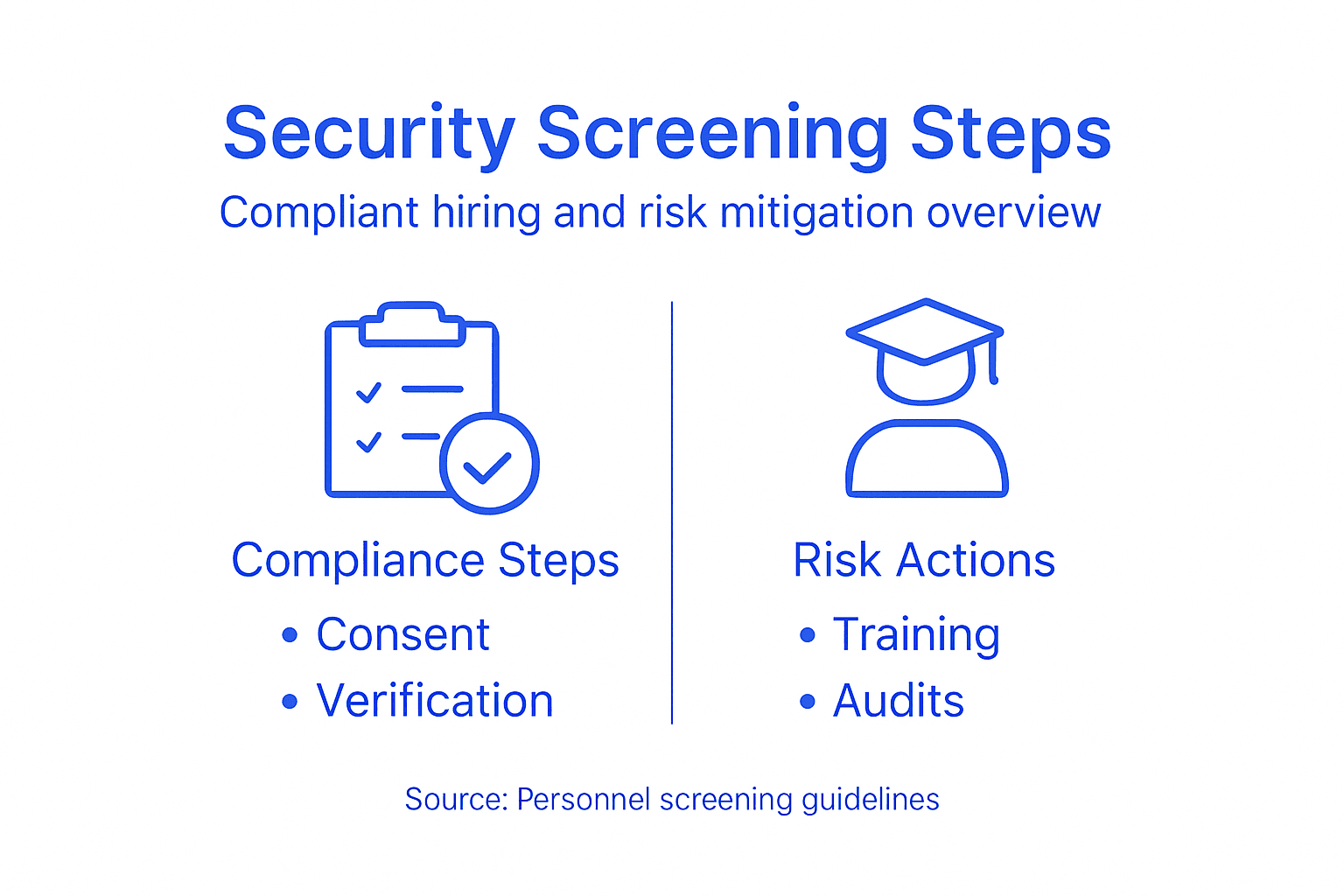
Automation reduces human error. Manual screening processes depend on individual attention and memory. An investigator reviewing fifty files daily will miss details that a systematic process catches consistently. Screening platforms automate checks against multiple databases simultaneously, ensuring nothing falls through gaps.
For firms working with government contracts or international clients, Restricted Party Screening becomes critical. This specialized screening checks individuals and organizations against federal restricted parties lists to ensure compliance with U.S. regulations. Automated tools check names against over 80 different watchlists and sanctions lists, minimizing human error and ensuring up-to-date compliance with export control and security laws.
Implement risk mitigation through:
- Technology integration that automates database checks and alerts investigators to red flags
- Standardized procedures that apply consistently across all hires regardless of who conducts screening
- Documentation protocols that create clear audit trails for every decision
- Cross-verification methods that confirm findings through multiple independent sources
- Regular compliance audits that catch drift before violations occur
Training transforms your team. Your investigators are only as good as their knowledge. Personnel security professionals benefit from ongoing training on current policies, procedures, and investigative techniques. The Defense Counterintelligence and Security Agency provides learning materials on evolving threats, legal mandates, and screening technologies.
Make training mandatory and recurring. Investigators who completed training three years ago operate under outdated standards. Quarterly refreshers on regulatory changes, new investigative techniques, and case studies from recent failures keep your team sharp.
Post-hire monitoring extends protection. Initial screening captures the snapshot at hire. Circumstances change. Regular monitoring catches arrests, financial problems, or substance abuse that didn’t exist during initial vetting. This ongoing vigilance prevents the scenario where a screened employee commits crimes years later that background checks should have predicted.
Reliable screening combines automated technology, trained personnel, clear procedures, and continuous monitoring into a system no single element could achieve alone.
Documentation matters more than you think. When litigation occurs, your procedures and decisions become evidence. Clear records showing what you checked, what you found, and why you made your decision protect your firm and demonstrate good faith compliance.
Pro tip: Implement a quarterly compliance review process where you audit five randomly selected hiring files, verify all screening steps were completed, and document findings to identify training gaps or procedural drift before regulators discover problems.
Strengthen Your Hiring Process with Compliant Security Screening
Understanding the critical importance of thorough and compliant private security screening is just the first step. Your organization faces challenges like ensuring complete candidate information, adhering to complex federal and state regulations, and maintaining ongoing monitoring to protect your reputation and reduce liability. The risks of incomplete verification, policy drift, and inadequate post-hire oversight can lead to costly lawsuits and security breaches.
OMNI Intel is designed to meet these exact challenges with tailored solutions that bring integrity, accuracy, and compliance into every background check. Our platform supports rigorous, risk-based screening methods aligned with legal standards including the Fair Credit Reporting Act and Privacy Act. We help you streamline processes like fingerprinting, reference verification, financial checks, and advanced vetting for sensitive roles — all while safeguarding candidate data. Leverage AI-driven tools to speed recruitment and maintain transparency in decision-making.
Explore proven Hiring Best Practices | OMNI Intel to enhance your screening protocols.

Take control of your recruitment today by implementing a compliant, comprehensive security screening system that mitigates risk and builds confidence in every hire. Get started now with OMNI Intel’s reliable platform at https://omniintel.co/get-started and ensure your team meets the highest standards for public safety and security.
Frequently Asked Questions
What is private security screening?
Private security screening is the process of evaluating candidates for security positions to assess their reliability, trustworthiness, and fitness for duty, going beyond basic background checks.
Why is compliance important in private security screening?
Compliance is crucial as it ensures adherence to legal requirements, protects individual privacy, and prevents potential liabilities. Failure to comply can lead to fines, lawsuits, and reputational damage.
What are the key components of private security screening?
Key components include criminal record checks, employment history verification, reference interviews, financial background reviews, drug screening, and potentially fingerprinting.
How can organizations mitigate risks in the security screening process?
Organizations can mitigate risks by implementing automated screening technology, standardizing procedures, maintaining thorough documentation, and conducting regular compliance audits.
Recommended
- Public Safety Screening Explained: Ensuring Integrity
- 7 Key Benefits of Employee Screening for Public Safety
- Transparency in Screening: Building Trust in Public Safety
- Criminal Record Screening: Ensuring Public Safety Integrity
- Long Beach Workers Reporting Safety Violations: Your Rights – California United Law Group
- Fingerprint Clearance Attorney » Tamou Law Group