

Data Privacy in Hiring for Public Safety
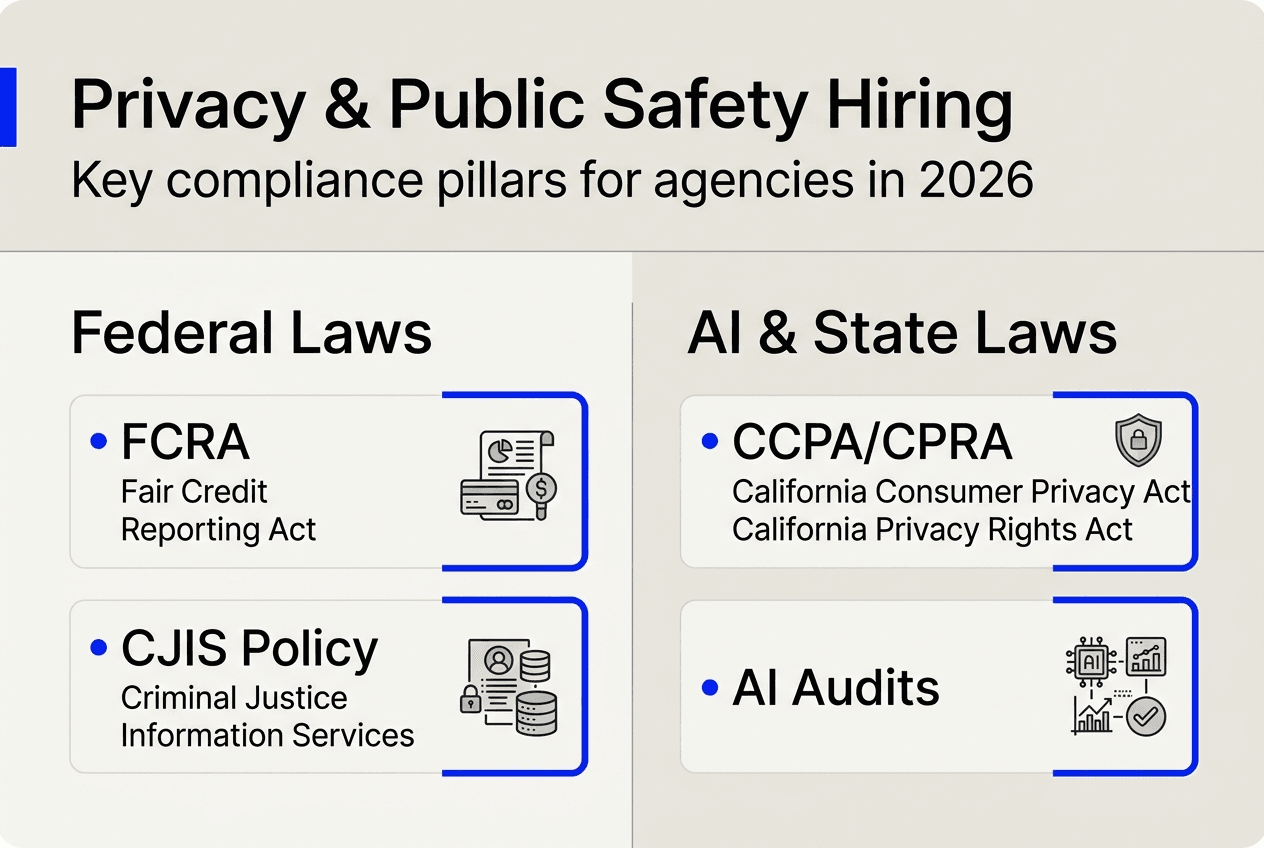
Hiring data privacy violations in public safety can trigger penalties exceeding $1 million per incident, yet many HR managers underestimate the complexity of compliance. Public safety agencies handle uniquely sensitive applicant information, from criminal justice data to biometric records, creating layered regulatory obligations that extend far beyond basic employment law. In 2026, agencies must navigate federal statutes like the Fair Credit Reporting Act (FCRA), specialized requirements such as the CJIS Security Policy, state privacy laws including California’s Consumer Privacy Act (CCPA), and emerging artificial intelligence regulations that reshape automated hiring decisions. This guide delivers actionable strategies to protect candidate data, satisfy legal mandates, and maintain the trust essential to recruiting qualified public safety professionals.
Table of Contents
- Understanding Key Data Privacy Laws In Public Safety Hiring
- Navigating State Privacy Laws And Emerging AI Regulations
- Balancing Privacy With Public Safety Hiring Needs And Fair Chance Act Considerations
- Enhance Your Public Safety Hiring With Expert Screening Solutions
- Frequently Asked Questions
Key takeaways
| Point | Details |
|---|---|
| FCRA compliance is mandatory | Background checks require written disclosures, candidate authorization, and adverse action notices before employment denials. |
| CJIS Security Policy protects law enforcement data | Agencies must implement AES-256 encryption, multi-factor authentication, and strict access controls for criminal justice information. |
| State privacy laws add transparency requirements | CCPA and CPRA demand clear privacy notices, data minimization, and vendor risk assessments for applicant information. |
| AI hiring tools trigger bias audits | New York City Local Law 144, EU AI Act, and EEOC guidelines require validation to prevent algorithmic discrimination. |
| Fair Chance Act influences criminal history timing | Federal hiring generally delays criminal background inquiries until after conditional offers, with public safety exceptions. |
Understanding key data privacy laws in public safety hiring
Public safety agencies operate under a dense regulatory framework that governs every stage of applicant data collection, storage, and use. Two foundational requirements shape compliance strategies: the Fair Credit Reporting Act for background investigations and the Criminal Justice Information Services Security Policy for law enforcement data protection. Mastering these essentials creates the baseline for lawful hiring practices.
The FCRA establishes strict protocols when agencies use consumer reporting agencies for background checks. Data privacy in hiring for public safety agencies requires strict compliance with FCRA for background checks, involving clear disclosures, written authorizations, and adverse action notices before decisions. Before ordering any background report, you must provide candidates with a standalone written disclosure explaining the screening process. This document cannot be buried in application materials or combined with liability waivers. After receiving the disclosure, candidates must provide explicit written consent authorizing the investigation.
When background check results reveal disqualifying information, FCRA mandates a pre-adverse action process. You must provide the candidate with a copy of the report, a summary of FCRA rights, and reasonable time to dispute inaccuracies before finalizing the employment decision. Only after this waiting period can you issue a final adverse action notice. Violations carry penalties from $100 to $1,000 per instance, with class action lawsuits representing the greatest financial risk. Many agencies face legal exposure by skipping pre-adverse action steps or failing to provide proper disclosures.
Law enforcement and related agencies face additional obligations under the CJIS Security Policy mandates encryption, MFA, access controls for CJI in law enforcement hiring and background checks to protect sensitive applicant data. Criminal Justice Information (CJI) includes fingerprints, criminal history records, and investigative data collected during applicant vetting. The policy requires AES-256 encryption for data at rest and in transit, multi-factor authentication for system access, and role-based access controls limiting who can view sensitive records.
Follow these steps to implement FCRA-compliant background check processes:
- Provide standalone written disclosure and authorization form to candidates before ordering reports
- Conduct background investigation through compliant consumer reporting agency
- Review results and initiate pre-adverse action process if disqualifying information appears
- Allow dispute period before final employment decision
- Issue final adverse action notice if position is denied based on report findings
These foundational requirements apply regardless of agency size or jurisdiction. Implementing best hiring practices for public safety means building FCRA and CJIS compliance into every hiring workflow from day one. Documentation proves critical during audits or litigation, so maintain records of all disclosures, authorizations, and adverse action communications.
Navigating state privacy laws and emerging AI regulations
Beyond federal requirements, state privacy statutes and artificial intelligence regulations create additional compliance layers that reshape how agencies collect, process, and retain applicant data. California leads with comprehensive privacy mandates that influence practices nationwide, while AI-specific laws target algorithmic bias in automated hiring decisions.
State privacy laws like CCPA/CPRA apply to HR data in hiring, requiring privacy notices, data minimization, risk assessments for AI/ADMT, and vendor contracts even in public safety. Under these statutes, applicants gain rights to know what personal information you collect, how you use it, and which third parties receive it. Your agency must provide clear privacy notices at or before data collection explaining these practices in plain language. The notices should specify retention periods, security measures, and applicant rights to access or delete information.
Data minimization principles require collecting only information directly relevant to the hiring decision. Avoid requesting social media passwords, genetic data, or other intrusive details unless job duties create legitimate necessity. When deploying automated decision-making tools (ADMT) or artificial intelligence systems, you must conduct privacy impact assessments documenting potential risks and mitigation strategies. These assessments examine how algorithms process protected characteristics, whether proxy variables could enable discrimination, and what safeguards prevent unauthorized access.
Vendor contracts represent another critical compliance point. Third-party background check providers, applicant tracking systems, and AI tool vendors must commit contractually to privacy and security standards matching your obligations. Contracts should specify data handling procedures, breach notification timelines, and liability allocation for privacy violations. Regular vendor audits verify compliance and identify gaps before they trigger regulatory action.

AI in hiring triggers additional compliance: NYC LL144 bias audits, EU AI Act high-risk classification, EEOC validation; LLMs show race/gender disparities in CV evaluations. New York City’s Local Law 144 requires annual bias audits for automated employment decision tools, examining whether algorithms produce disparate impact across race, ethnicity, or gender categories. The EU AI Act classifies hiring systems as high-risk applications subject to rigorous conformity assessments, transparency requirements, and human oversight mandates. Even agencies outside these jurisdictions should anticipate similar regulations spreading as lawmakers respond to algorithmic discrimination concerns.
Large language models and resume screening tools show measurable disparities in how they evaluate candidates from different demographic groups. Research reveals that identical qualifications receive different scores based on perceived race or gender signals in applicant names or backgrounds. These tools can perpetuate historical biases present in training data, creating legal exposure under Title VII and equal employment opportunity laws.
Pro Tip: Regularly update AI audits and vendor contracts as regulations evolve to avoid penalties. Set calendar reminders for quarterly compliance reviews and assign responsibility for monitoring regulatory developments in your jurisdiction.
| Requirement Type | State Privacy Laws (CCPA/CPRA) | AI Hiring Regulations (LL144/EU AI Act) |
|---|---|---|
| Primary Focus | Applicant data transparency and control rights | Algorithmic bias prevention and fairness |
| Key Obligations | Privacy notices, data minimization, vendor contracts | Bias audits, impact assessments, human oversight |
| Enforcement Mechanism | Attorney General actions, private litigation | Agency penalties, certification requirements |
| Compliance Timeline | Ongoing notice and consent requirements | Annual audits, pre-deployment assessments |
Balancing these requirements demands proactive policy development and staff training. Agencies that treat compliance as a checklist exercise rather than an integrated practice face greater risk. Build privacy and fairness considerations into procurement decisions, technology evaluations, and hiring process design from the outset. This approach prevents costly retrofitting when regulations tighten or enforcement actions target your sector.
Balancing privacy with public safety hiring needs and Fair Chance Act considerations
Public safety agencies face a unique tension between protecting applicant privacy and conducting the thorough background investigations essential to community safety. Criminal history screening, a cornerstone of public safety hiring, intersects with Fair Chance Act restrictions that delay inquiries until later hiring stages. Navigating this balance requires understanding statutory exceptions, documentation practices, and policy justifications.
Fair Chance Act delays criminal history inquiries until conditional offer in federal civil service hiring, balancing privacy with public safety needs. The statute prohibits federal agencies from requesting criminal history information before extending a conditional employment offer, with the goal of reducing discrimination against individuals with records. This timing requirement applies broadly across federal hiring but includes carve-outs for positions with statutory or regulatory disqualifications based on criminal conduct.
Public safety roles frequently qualify for these exceptions. Law enforcement officer positions, roles requiring security clearances, and jobs involving access to vulnerable populations often have explicit statutory bars for certain convictions. When these exceptions apply, you can inquire about criminal history earlier in the hiring process. However, you must document the specific legal authority justifying the exception and apply it consistently across all candidates for that position type.
Even with exceptions, transparency remains critical. Candidates deserve clear communication about what background information you will collect, when you will collect it, and how it influences hiring decisions. Provide written notice of criminal history inquiries and explain the relationship between conviction types and job duties. This transparency builds trust and reduces legal challenges alleging discriminatory application of background check policies.
Contrasting views exist between privacy regulations and public safety needs. Privacy laws like CCPA push data minimization and transparency, while public safety imperatives demand comprehensive background investigations including Criminal Justice Information access under CJIS authority. These competing pressures create operational challenges. Collecting detailed criminal history, financial records, and personal associations serves legitimate safety interests but conflicts with minimization principles.
Data minimization does not mean avoiding necessary inquiries. It means collecting information proportionate to the risk and responsibility of the position. A patrol officer role justifies more extensive investigation than an administrative support position. Tailor your background check scope to job-specific requirements and document the rationale connecting each data element to essential job functions. This documentation proves invaluable during privacy audits or discrimination complaints.
Artificial intelligence introduces another dimension to this balance. AI tools promise efficiency gains by rapidly screening large applicant pools and identifying qualified candidates. However, these same tools risk encoding bias or making opaque decisions that candidates cannot meaningfully challenge. The efficiency benefits must be weighed against fairness risks and transparency obligations. Agencies should maintain human oversight of AI recommendations and preserve candidate rights to understand and contest automated decisions.
Navigating privacy and safety demands requires clear policies and ongoing training to avoid legal pitfalls. Agencies must articulate defensible standards for what information they collect, when they collect it, and how they use it in hiring decisions.
Pro Tip: Document your agency’s rationale for timing of criminal history inquiries to mitigate risk. Create written policies explaining which positions qualify for Fair Chance Act exceptions and the legal authority supporting early criminal background checks.
Key steps to comply with Fair Chance Act while ensuring safety:
- Delay criminal history checks until after conditional offers for positions without statutory disqualifications
- Obtain conditional offer before conducting sensitive background inquiries for covered roles
- Maintain clear candidate communication about background check timing, scope, and decision criteria
- Analyze statutory exceptions and document legal authority for early criminal history screening in public safety roles
These practices protect both candidate privacy rights and your agency’s ability to conduct necessary safety screening. The goal is not choosing between privacy and safety but integrating both values into coherent, defensible hiring processes. Agencies that achieve this integration reduce legal exposure while maintaining rigorous standards for personnel quality.
Consider developing tiered background check protocols based on position sensitivity. Entry-level administrative roles might follow standard Fair Chance Act timing, while sworn officer positions invoke statutory exceptions for immediate criminal history review. Document these tiers in written policy and train hiring managers on proper application. Consistency across similar positions demonstrates good faith compliance and defeats allegations of discriminatory practice.
Regular policy review ensures your approach keeps pace with evolving regulations and case law. Assign compliance responsibility to specific personnel and establish review cycles tied to regulatory update schedules. This proactive stance prevents reactive scrambling when enforcement priorities shift or new laws take effect.
Enhance your public safety hiring with expert screening solutions
Navigating the complex intersection of data privacy regulations, public safety screening requirements, and emerging AI compliance demands specialized expertise and purpose-built tools. Generic background check services lack the nuanced understanding of CJIS requirements, Fair Chance Act exceptions, and law enforcement hiring standards that public safety agencies require.

OMNI Intel offers specialized pre-employment screening services tailored for public safety agencies facing these unique challenges. Our platform ensures compliance with FCRA disclosure and adverse action requirements, implements CJIS Security Policy encryption and access controls, and adapts to state privacy laws including CCPA transparency mandates. We minimize your legal risk while delivering the thorough investigations essential to hiring qualified, trustworthy personnel.
Integrated applicant screening solutions streamline hiring workflows by connecting background investigations directly to your recruitment systems. This integration reduces manual data entry, accelerates time-to-hire, and maintains audit trails documenting compliance with privacy and fairness requirements. Our background checks public safety services leverage law enforcement investigation principles to uncover information that generic consumer reporting agencies miss.
Partner with OMNI Intel to confidently hire qualified public safety professionals while safeguarding sensitive data and maintaining regulatory compliance. Our expertise in public safety recruitment best practices helps you balance thorough vetting with candidate privacy rights, implement defensible AI tools, and adapt to evolving regulations without disrupting hiring operations.
Frequently asked questions
What are the most critical data privacy laws affecting public safety hiring?
The Fair Credit Reporting Act (FCRA) governs background check disclosures and adverse actions, while the CJIS Security Policy mandates encryption and access controls for criminal justice information. State laws like CCPA and CPRA add transparency and data minimization requirements. AI regulations including NYC Local Law 144 and the EU AI Act require bias audits for automated hiring tools.
How does the Fair Chance Act impact criminal history checks in public safety recruitment?
The Fair Chance Act generally delays criminal history inquiries until after extending conditional employment offers in federal hiring. However, public safety positions with statutory disqualifications based on criminal conduct often qualify for exceptions allowing earlier background checks. Agencies must document the legal authority supporting these exceptions and apply them consistently.
What steps can public safety agencies take to prevent AI bias in hiring?
Conduct regular bias audits examining whether algorithms produce disparate impact across protected demographic categories. Comply with local AI regulations like NYC LL144 requiring annual assessments. Maintain transparency about automated decision tools and preserve human oversight of AI recommendations to ensure fairness.
How should agencies handle vendor contracts to comply with data privacy laws?
Ensure contracts include explicit data protection obligations matching your regulatory requirements, specify breach notification timelines, and allocate liability for privacy violations. Require vendors to implement security controls equivalent to CJIS standards when handling sensitive applicant information. Conduct regular audits verifying vendor compliance with contractual privacy commitments.