

Duty of Care Explained: Legal Standards and Employer Obligations
In U.S. tort law, a duty of care is a legal obligation to act with reasonable care so your conduct does not cause foreseeable harm to others. Courts treat the existence of that duty as a question of law, not fact, which means a judge decides whether a duty exists before a jury ever weighs in on whether it was breached. That single determination can end a negligence case before it starts.
What this means right now:
- If you were injured: Preserve every piece of evidence immediately. Photograph the scene, collect witness contact information, seek medical attention, and request a copy of any incident report. Your attorney will need to show a duty existed and was breached.
- If you are an employer: Review your OSHA obligations under Section 5(a)(1), audit your internal safety policies, and confirm your hiring and supervision documentation is current. A gap in records is a gap in your defense.
Key Takeaways
Duty of care is the foundational legal obligation in U.S. negligence law, and whether you are a plaintiff preserving a claim or an employer building a defense, documentation is the decisive factor.
| Point | Details |
|---|---|
| Duty is the first element | Courts decide duty as a question of law; no duty means no negligence case, regardless of injury severity. |
| Four elements must all be proven | Negligence requires duty, breach, causation, and damages; a gap in any one element defeats the claim. |
| OSHA imposes statutory duties | Section 5(a)(1) requires a hazard-free workplace; violations carry civil penalties and fuel negligence claims. |
| Documentation is the employer’s defense | Screening records, training logs, and incident reports are what courts examine to assess reasonable care. |
| OMNI Intel supports defensible hiring | OMNI Intel’s investigator-driven screening and post-hire monitoring give public safety agencies an auditable record that meets the reasonable-employer standard. |
Table of Contents
- How Duty of Care Fits into a Negligence Claim
- How Courts Decide Whether a Duty Actually Exists
- What Employers Must Do: Statutory Duties, OSHA, and Practical Controls
- Real-World Examples of Duty of Care in Action
- What Happens After a Breach: Liability, Damages, and Defenses
- How Plaintiffs Prove a Breach and How Employers Reduce Their Exposure
- How Background Screening Helps Employers Satisfy Duty-of-Care Obligations
- An Editorial Perspective on Duty of Care and Institutional Accountability
- OMNI Intel Helps Public Safety Agencies Meet Their Duty-of-Care Standard
- Sources
- FAQ
How Duty of Care Fits into a Negligence Claim
Duty is the first element a court evaluates in any negligence case, and its absence ends the litigation immediately. No duty means no case, regardless of how serious the injury was or how reckless the defendant’s conduct appeared.
Negligence under U.S. law requires proof of all four elements:
- Duty: The defendant owed the plaintiff a legal obligation to act with reasonable care. Courts ask whether the plaintiff was a foreseeable victim and whether a recognized relationship or risk-creation event imposed that obligation.
- Breach: The defendant failed to meet the applicable standard of care. Courts measure conduct against what a reasonable person would have done under the same circumstances.
- Causation: The breach was both the actual cause (“but for” the breach, the harm would not have occurred) and the proximate cause (the harm was a foreseeable result of the breach, not a remote or unrelated consequence).
- Damages: The plaintiff suffered a legally cognizable harm, whether physical injury, property loss, or in some cases economic loss.
Proximate cause deserves particular attention. Courts use foreseeability to draw the line between a defendant’s liability and harms that are simply too remote. If a driver runs a red light and strikes a pedestrian, the pedestrian’s injuries are a foreseeable proximate result. If that same collision somehow triggered a chain of events injuring someone three blocks away, the causal chain may be too attenuated to sustain liability.
How Courts Decide Whether a Duty Actually Exists
Courts use several distinct legal routes to find that a duty exists. Understanding which route applies to your situation determines both the strength of a claim and the defenses available.
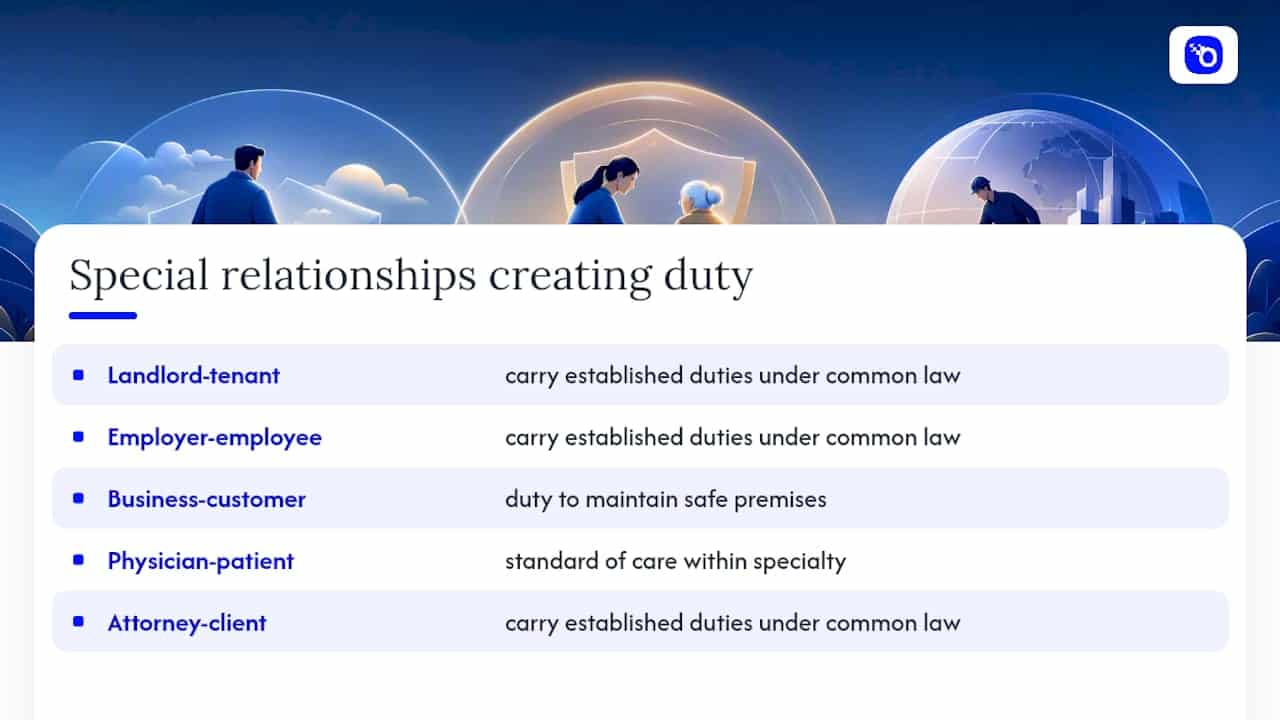
Special relationships
The most common basis for duty is a recognized special relationship between the parties. Landlord-tenant, employer-employee, business-customer, physician-patient, and attorney-client relationships all carry established duties under common law. A grocery store owes customers a duty to maintain safe premises because customers are business invitees. A physician owes patients a duty to meet the standard of care within their specialty.
Creation of risk
A defendant who creates a dangerous condition owes a duty to those foreseeably endangered by it, even without a prior relationship. A contractor who leaves an unmarked excavation adjacent to a public sidewalk has created a risk that imposes a duty toward pedestrians.
Voluntary undertaking
When a party voluntarily assumes responsibility for another’s safety, a duty can arise even without a formal relationship. A bystander who begins administering first aid and then abandons the effort may face liability if their intervention worsened the victim’s condition or discouraged others from helping.
Foreseeability and multi-factor balancing
Many states apply a multi-factor balancing test when the relationship or risk-creation route does not clearly apply. Courts weigh the foreseeability of harm, the degree of certainty the plaintiff suffered injury, the closeness of the connection between the defendant’s conduct and the injury, the moral blame attached to the defendant’s conduct, and the policy consequences of imposing a duty.
The Hand formula
Some courts, particularly in commercial and industrial contexts, use the Hand formula from United States v. Carroll Towing to assess whether a precaution was legally required. Judge Learned Hand expressed it as: if the burden of taking a precaution (B) is less than the probability of harm (P) multiplied by the severity of that harm (L), then failing to take the precaution constitutes a breach.
Municipal and governmental duty: Monell, Canton, and Bryan County
Public agencies face a distinct legal framework. Under Monell v. New York City Dept. of Social Services, a municipality cannot be held liable under 42 U.S.C. §1983 simply because it employed a wrongdoer. Plaintiffs must identify a specific municipal policy or custom that was the moving force behind the constitutional violation. City of Canton v. Harris extended this to failure-to-train claims, requiring proof of deliberate indifference to the rights of persons with whom the police come into contact.
The Supreme Court reinforced these limits in Board of County Commissioners of Bryan County v. Brown, holding that a single hiring decision, without more, rarely establishes the deliberate indifference needed for municipal liability. Plaintiffs in failure-to-screen cases must show the municipality had actual or constructive notice that its screening practices were inadequate and that inadequacy was likely to result in a constitutional violation. That is a demanding standard, and it explains why thorough pre-employment screening is both a legal shield and a practical necessity for public agencies.
The foundational case: Donoghue v. Stevenson
The modern concept of duty of care traces to the 1932 British case Donoghue v. Stevenson, in which the House of Lords held that a manufacturer owed a duty of care to the ultimate consumer of its product, even without a direct contractual relationship. While not binding U.S. precedent, the “neighbor principle” articulated in that case shaped the foreseeability framework that American courts adopted and refined throughout the 20th century.
Pro Tip: If you are evaluating a potential negligence claim, map the relationship between the parties first. Identifying which duty-creation route applies (special relationship, risk creation, voluntary undertaking, or multi-factor balancing) tells you which legal standard governs and what evidence you need to gather before consulting counsel.
What Employers Must Do: Statutory Duties, OSHA, and Practical Controls
Employers in the United States carry two overlapping layers of duty: statutory obligations codified in federal and state law, and common-law duties to act reasonably toward employees, customers, and the public. Neither layer can be ignored.
OSHA Section 5(a)(1), the General Duty Clause, requires every employer to furnish a workplace free from recognized hazards that are causing or likely to cause death or serious physical harm. Section 5(a)(2) requires compliance with all applicable OSHA standards. These obligations are codified at 29 U.S.C. §654 and carry civil penalties, criminal exposure for willful violations, and significant civil liability when a breach causes injury.
OSHA’s employer-responsibilities guidance emphasizes that effective safety and health programs require management leadership, worker participation, and systematic hazard control, not just reactive incident response.
Beyond OSHA, common-law negligence doctrine imposes duties around hiring, supervision, training, and retention. An employer who hires a person with a known violent history and places that person in a position of trust may face a negligent-hiring claim if that person later harms a third party. The same logic applies to negligent supervision (failing to monitor known problematic conduct) and negligent retention (keeping an employee after warning signs emerge).
Employer risk-reduction checklist:
- Conduct a documented hazard identification and risk assessment for every job classification.
- Implement written safety policies and distribute them to all employees with signed acknowledgment.
- Deliver role-specific safety training before employees begin work; document dates, content, and attendees.
- Provide required personal protective equipment and document issuance.
- Run thorough pre-employment background investigations tailored to the role’s risk level.
- Establish a supervision protocol with documented performance reviews and incident follow-up.
- Implement post-hire monitoring for employees in high-trust or public-facing roles.
- Maintain all records, including training logs, incident reports, corrective actions, and screening results, in a format retrievable for litigation or regulatory audit.
For public safety agencies specifically, scholarly analysis of municipal failure-to-screen litigation confirms that agencies with documented, consistent screening protocols are better positioned to defeat deliberate-indifference claims than those relying on informal or ad hoc hiring practices.
Real-World Examples of Duty of Care in Action
Duty of care is not an abstract concept. It surfaces in concrete, recognizable situations every day.
Premises liability
A property owner who knows a staircase railing is loose owes a duty to business invitees to repair it or warn them. If a customer falls and is injured before the repair is made, the owner’s knowledge of the hazard, combined with the failure to act, establishes both duty and a strong basis for breach. The duty owed to a trespasser is generally lower than the duty owed to an invitee, and social guests (licensees) occupy a middle position under most state laws. That distinction matters significantly when a defendant argues the plaintiff had no right to be on the property.
Motor vehicle accidents
Every licensed driver owes a duty of reasonable care to other road users, pedestrians, and cyclists. That duty is well-established by statute and common law in every U.S. jurisdiction. The foreseeability analysis is straightforward: operating a vehicle creates obvious risks to foreseeable third parties. The contested issues in auto negligence cases are almost always breach and causation, not the existence of duty itself.
Medical and professional negligence
Healthcare providers owe patients a duty to meet the standard of care within their specialty and jurisdiction. Attorneys owe clients a duty of competent representation. Accountants owe clients a duty of professional care in preparing financial statements. In each professional context, the duty is elevated above the ordinary reasonable-person standard; courts measure conduct against what a reasonably competent professional in that field would have done under the same circumstances.
Product-related harm
A manufacturer owes a duty of reasonable care to the foreseeable users of its products. This duty extends through the design, manufacturing, and warning stages. A company that sells a power tool without adequate safety guards may face both negligence claims (duty of care) and strict liability claims (liability without proof of negligence). The distinction matters: strict liability does not require proof that the manufacturer failed to act reasonably, only that the product was defective and caused harm.
“In some relationships, the duty of care can be elevated above the ordinary reasonable-person standard, requiring a higher degree of skill, attention, or protection than the law would impose on a stranger.” This principle, recognized in U.S. legal practice, explains why physicians, attorneys, and public safety officers face more demanding duty standards than a private individual would in the same factual situation.
Duty may be limited or absent in certain situations. Pure economic loss without accompanying physical injury is generally not recoverable in negligence under the economic loss rule. Volunteers operating under Good Samaritan statutes may receive limited immunity. Landowners owe no duty, or a very limited one, to undiscovered trespassers in most states.
What Happens After a Breach: Liability, Damages, and Defenses
Once a plaintiff establishes duty, breach, causation, and damages, liability attaches. The practical question then becomes what the plaintiff can recover and what arguments the defendant can raise to reduce or eliminate that recovery.
Types of recoverable damages:
- Economic damages: Medical expenses (past and future), lost wages, lost earning capacity, property damage, and other out-of-pocket losses with a calculable dollar value.
- Non-economic damages: Pain and suffering, emotional distress, loss of consortium, and loss of enjoyment of life. These are harder to quantify and subject to caps in some states.
- Punitive damages: Available in a minority of cases where the defendant’s conduct was willful, wanton, or reckless. Courts impose them to punish and deter, not to compensate. They are relatively rare in standard negligence cases.
Common defenses:
- Comparative negligence: Most U.S. states use some form of comparative negligence, either pure (plaintiff recovers even if 99% at fault, reduced proportionally) or modified (plaintiff is barred from recovery if at or above 50% or 51% at fault, depending on the state). A few states retain contributory negligence, which bars recovery entirely if the plaintiff was even 1% at fault.
- Assumption of risk: A plaintiff who voluntarily encountered a known risk may be barred from recovery. Signing a liability waiver before a recreational activity is a common example, though waivers do not protect against gross negligence.
- Lack of proximate cause: Even if the defendant breached a duty, the defendant can argue the breach was not the proximate cause of the plaintiff’s specific harm.
- Immunity doctrines: Government entities and their employees often enjoy sovereign immunity, qualified immunity (for constitutional claims), or statutory immunity that limits or bars suit. These doctrines are heavily litigated in public-safety contexts.
Insurance coverage, indemnity agreements, and settlement dynamics all shape how duty-of-care claims resolve in practice. Most personal injury cases settle before trial, with the defendant’s insurer evaluating liability exposure against the cost of litigation. Employers with documented safety programs and clean hiring records consistently negotiate from a stronger position than those with gaps in their records.
How Plaintiffs Prove a Breach and How Employers Reduce Their Exposure
Proving a duty-of-care breach requires more than showing something went wrong. Courts need evidence that the defendant’s conduct fell below the applicable standard of care and that this specific failure caused the plaintiff’s specific harm.
For plaintiffs, the documentation collected in the hours and days after an incident is often the most powerful evidence available. For employers, the documentation maintained before an incident occurs is what separates a defensible position from an indefensible one.
Plaintiff documentation checklist:
- Photograph the scene, the hazard, and any visible injuries immediately after the incident.
- Collect the full names and contact information of all witnesses before they leave.
- Seek medical attention promptly; gaps in treatment create arguments that the injury was not serious or was caused by something else.
- Request copies of all incident reports, inspection logs, and maintenance records from the property owner or employer.
- Preserve any physical evidence (defective products, torn clothing, broken equipment) and do not repair or discard it.
- Create a written timeline of events while memory is fresh, noting exact times, locations, and what was said.
- Consult a licensed attorney before giving recorded statements to insurance adjusters.
Employer documentation and prevention checklist:
- Maintain written safety policies with version control and distribution records.
- Document every training session: topic, date, instructor, and attendee signatures.
- Record all hazard assessments and corrective actions with completion dates.
- Keep pre-employment screening results, including what checks were run, who authorized them, and how results were evaluated, in a secure, retrievable hiring file.
- Document all supervisory interventions, performance counseling sessions, and disciplinary actions.
- Conduct and document post-incident investigations with root-cause analysis and corrective measures.
- Review and update all documentation annually or after any significant incident.
Statute of limitations rules vary by state and by the type of claim. Personal injury claims in most states carry a two-year or three-year limitations period from the date of injury or discovery. Claims against government entities often require a notice of claim filed within 60 to 180 days of the incident. Missing these deadlines extinguishes the claim entirely, regardless of its merits. Confirm the applicable deadline with a licensed attorney in your jurisdiction before taking any other step.
How Background Screening Helps Employers Satisfy Duty-of-Care Obligations
Documented, thorough pre-employment screening is one of the most defensible steps an employer can take to demonstrate reasonable care in hiring. Courts evaluating negligent-hiring claims ask whether the employer knew, or should have known, about a characteristic of the employee that made the harm foreseeable. A structured screening process, consistently applied and carefully recorded, directly answers that question.

For public safety agencies, the stakes are higher. Practitioner analysis warns that hiring under pressure without proper vetting creates a compounding liability and operational risk, where one poorly vetted hire can generate misconduct, morale damage, and litigation costs that far exceed the cost of a thorough investigation. The negligent hiring doctrine holds employers responsible when they place an unfit person in a role where harm to others is foreseeable, and public safety roles carry the highest foreseeability threshold of any employment category.
What a defensible screening record looks like:
- A written policy specifying which checks are required for each role classification, who authorizes exceptions, and how results are evaluated.
- Documentation of every check conducted: criminal history, reference verification, credential confirmation, and any role-specific investigation (psychological evaluation, polygraph, background interview).
- A written record of how adverse findings were weighed, including who made the hiring decision and on what basis.
- Signed authorization forms from the applicant, confirming FCRA-compliant consent.
- Post-hire monitoring records showing ongoing review of employee conduct and any flagged activity.
Continuous post-hire monitoring is an often-overlooked component of duty-of-care compliance. An employer who conducts a thorough pre-employment investigation but never reviews employee conduct again may still face a negligent-supervision or negligent-retention claim if warning signs emerge and go unaddressed. Documented monitoring closes that gap.
Pro Tip: When responding to discovery in a negligent-hiring or negligent-supervision lawsuit, organize your screening file chronologically and include a cover sheet summarizing what was checked, when, by whom, and what the results showed. This presentation signals to opposing counsel and the court that your agency applied a consistent, reasonable standard, which is precisely what the “reasonable employer” defense requires.
An Editorial Perspective on Duty of Care and Institutional Accountability
The legal concept of duty of care is often discussed as though it primarily benefits plaintiffs. In practice, it does something equally important for institutions: it gives them a clear, auditable standard to meet. Agencies and employers that treat duty of care as a compliance checkbox rather than an operational discipline consistently find themselves on the wrong side of litigation, not because the law changed, but because their documentation did not reflect the care they claim to have exercised.
The Bryan County decision is instructive here. The Supreme Court did not make it impossible to hold municipalities accountable for bad hiring. It required plaintiffs to show deliberate indifference, a demanding but not insurmountable standard. What that ruling actually did was reward agencies that could demonstrate a systematic, documented approach to screening and supervision. The agencies that struggle most in failure-to-screen litigation are not the ones that made a single poor hiring decision. They are the ones that cannot produce records showing they had a process at all.
The same logic applies in private employment. A company that documents its hazard assessments, training programs, and hiring criteria is not just reducing legal risk. It is building the institutional memory that allows it to learn from near-misses, improve its practices, and demonstrate good faith to regulators, courts, and the public. Duty of care, properly understood, is less a legal trap and more a discipline that separates organizations that take their obligations seriously from those that do not.
OMNI Intel Helps Public Safety Agencies Meet Their Duty-of-Care Standard
Public safety agencies face a duty-of-care standard that is more demanding than virtually any other employment context. One unvetted hire in a law enforcement, fire, EMS, or dispatch role can expose the agency to negligent-hiring liability, civil rights litigation, and the reputational damage that follows a high-profile incident.

OMNI Intel’s pre-employment screening services are built specifically for public safety agencies, delivering investigator-driven background investigations that go well beyond a standard commercial check. The platform integrates directly with your hiring workflow, generates documentation formatted for legal defensibility, and extends into post-hire monitoring so your duty of care does not end at the offer letter.
Agencies that use OMNI Intel’s background investigations gain a complete, auditable record of every check conducted, every result evaluated, and every decision made, precisely the documentation that courts and regulators look for when assessing whether an employer met a reasonable standard of care. Contact OMNI Intel to schedule a consultation and see how the platform fits your agency’s screening requirements.
Sources
The following authoritative sources provide the statutory text, case law, and regulatory guidance referenced throughout this article:
- duty of care | Wex | US Law | LII / Legal Information Institute
- §5 Duties | Occupational Safety and Health Act
- §654. Duties of employers and employees | US Code
This article is general information, not a substitute for advice from a qualified lawyer. Consult a qualified legal professional about your own circumstances before acting on anything here.
FAQ
What is duty of care in simple terms?
Duty of care is a legal obligation to act with reasonable care so your conduct does not cause foreseeable harm to others. Courts treat it as the first element of any negligence claim in U.S. tort law.
How do courts decide whether a duty of care exists?
Courts look for a special relationship between the parties, whether the defendant created the risk, or whether the harm was foreseeable using a multi-factor balancing test. The existence of duty is a question of law decided by a judge, not a jury.
How does duty of care differ from strict liability?
Negligence requires proof that the defendant failed to act with reasonable care; strict liability imposes responsibility for harm regardless of how carefully the defendant acted, typically in product defect or abnormally dangerous activity cases.
When can an employer be held liable for an employee’s harmful conduct?
An employer may face liability for negligent hiring, supervision, or retention when it knew or should have known that an employee posed a foreseeable risk and failed to take reasonable steps to prevent harm. Municipal employers face the additional requirement of proving a policy or custom caused the violation, as established in Bryan County v. Brown.
What is the statute of limitations for a duty-of-care claim?
Limitations periods vary by state and claim type; most personal injury claims carry a two-year or three-year window from the date of injury or discovery, while claims against government entities often require a notice of claim within 60 to 180 days. Confirm the applicable deadline with a licensed attorney in your jurisdiction.
This article provides general legal information, not legal advice. Consult a licensed attorney in your jurisdiction to evaluate your specific situation and confirm current rules.