

What Is a State Agency Hiring Standard for Public Safety?
A state agency hiring standard is a legally mandated set of minimum qualifications and vetting procedures that every public safety candidate must satisfy before appointment. These standards are established by state commissions such as POST (Peace Officer Standards and Training) or state personnel boards, and they carry the force of law. They cover baseline legal, moral, physical, and psychological fitness requirements. Critically, local agencies can set stricter standards than the state minimum under statutes like California Penal Code Section 13510(d), giving departments latitude to raise the bar when their mission demands it.
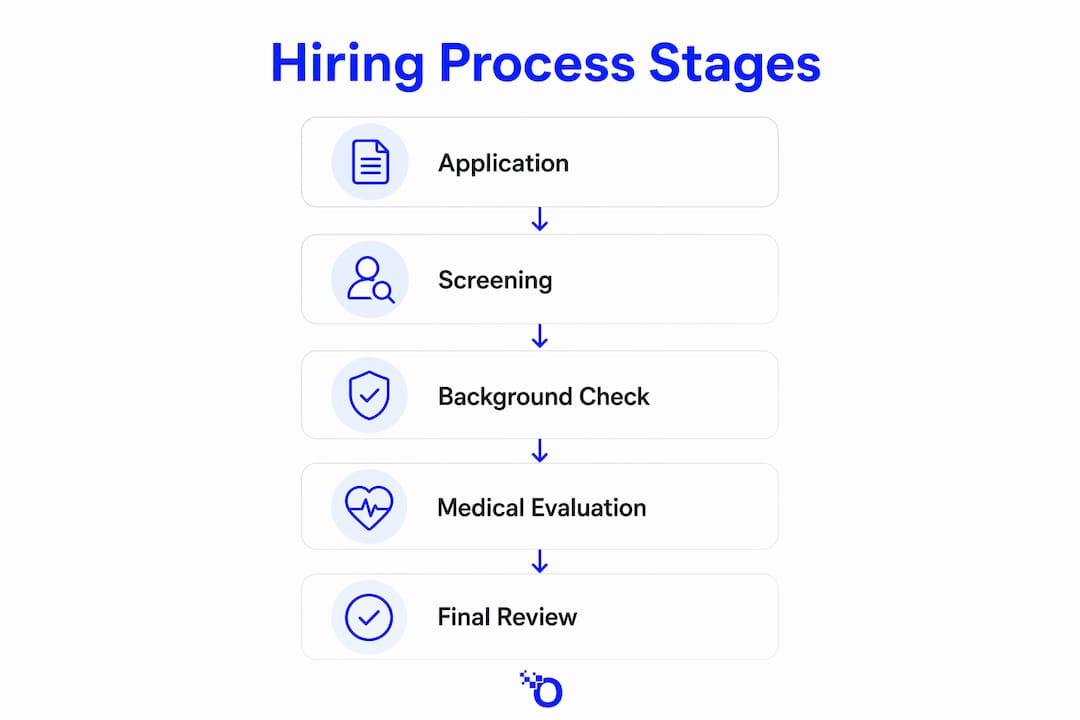
These standards serve two distinct purposes. First, they define professional competency benchmarks that protect the public. Second, they create defensible, uniform vetting processes that shield agencies from negligent hiring liability. Without documented, job-related criteria, an agency that hires an unfit officer has no legal ground to stand on when misconduct occurs.
What state agency hiring standards typically govern:
- Minimum age, citizenship, and residency eligibility
- Educational credentials and valid driver’s license requirements
- Criminal history disqualifications, including felony convictions
- Physical fitness, vision, and hearing thresholds
- Psychological fitness and behavioral stability
- Good moral character determination through background investigation
- Drug use history and substance abuse screening
What are the common mandatory hiring criteria for public safety candidates?
Most state employment guidelines for public safety roles share a recognizable core, even when specific thresholds vary by jurisdiction. Iowa’s administrative code, for example, requires uncorrected vision no worse than 20/100 in both eyes and hearing sensitivity thresholds within 25 dB at 500 Hz, 1,000 Hz, 2,000 Hz, and 3,000 Hz. These are not arbitrary numbers; they reflect the physical demands of field duty.
Common mandatory criteria across states include:
- Age: Minimum 18 years old in many states, 21 for federal roles such as FBI Police Officer positions
- Citizenship: U.S. citizenship or lawful employment eligibility, with residency requirements varying by jurisdiction
- Driver’s license: A valid, non-restricted license with a satisfactory driving record
- Education: High school diploma or GED at minimum; some agencies prefer or require college credits
- Criminal history: No felony convictions; misdemeanor convictions evaluated case by case, particularly those involving domestic violence, DUI, or weapons
- Physical fitness: Passing a standardized physical screening test administered by a qualified trainer
- Vision and hearing: State-specific thresholds, such as Iowa’s 20/100 uncorrected vision standard
- Psychological fitness: Freedom from emotional or mental conditions that could impair judgment or use of force
- Substance use: No history of disqualifying drug use; the Washington State Patrol, for instance, prohibits any heroin use regardless of timeframe
Pro Tip: Document every screening criterion with a job-task analysis before publishing a vacancy announcement. Criteria that cannot be tied to essential job functions are legally vulnerable.
How does the pre-employment background investigation process work?
The background investigation is the most demanding phase of public safety hiring, and for good reason. California Government Code Section 1031 mandates a thorough pre-employment background investigation for every peace officer candidate, with requirements further defined in Commission Regulation 1953. The investigation’s purpose is to verify good moral character and identify any past behavior inconsistent with public safety duties.
Key components of a compliant investigation include:
- Fingerprint-based criminal history checks at local, state, and national levels, including FBI database searches
- Employment history verification covering all prior employers, including law enforcement units that may have rejected the applicant
- Reference checks that specifically address integrity, reliability, and behavior under stress
- National Decertification Index review: New Jersey now requires checking this index to detect officers previously decertified for misconduct, directly addressing the “wandering officer” problem
- Social media review to assess whether the applicant’s online conduct is consistent with licensure requirements
- Credit and driving history reviewed for patterns that indicate financial irresponsibility or risk-taking behavior
- Psychological evaluation including at least two validated written tests and a structured clinical interview, conducted by a qualified psychologist or psychiatrist
- Medical examination by a licensed physician to confirm physical fitness for essential job functions
Timeline is a real operational factor. The FBI’s Police Officer Selection System typically takes up to one year to complete. Agencies that underestimate investigation timelines routinely face staffing gaps.
Whether a pretrial diversion appears on a background check is a question investigators encounter regularly; the answer depends on jurisdiction and disposition type, and investigators must document how each finding was evaluated.

What legal and ethical framework governs public safety hiring standards?
Hiring standards in government are not optional policy preferences. They are legally enforceable requirements grounded in state statutes, administrative codes, and federal anti-discrimination law. The New York State Professional Policing Act of 2021 established uniform psychological and background investigation standards for all police officer candidates statewide, precisely to prevent inconsistent vetting across agencies.
The legal framework rests on several pillars:
- Job-relatedness: Every screening criterion must be tied to essential job functions. The Georgia State Personnel Board Rules require that all screening criteria be job-related and define “sensitive government positions” as those where deeper background scrutiny is permitted with proper documentation.
- Non-discrimination: Criteria must comply with Title VII of the Civil Rights Act and applicable state equivalents. Any standard that produces disparate impact must be justified by business necessity.
- Good moral character: This is not a vague standard. California CCR 11-CCR-1953 codifies specific investigative dimensions, including integrity, impulse control, stress tolerance, and bias, that background investigators must document for every candidate.
- Negligent hiring liability: Agencies that skip or shortcut the investigation process face civil exposure when a hired officer causes harm. Documented, dimensional evaluations are the legal defense.
- Diversity and inclusion: Agencies must balance rigorous screening with equitable access. Criteria that screen out protected classes without a documented, job-related justification create legal risk, not safety.
How OMNI Intel supports compliance with public safety hiring standards
OMNI Intel’s pre-employment screening services are built specifically for the compliance demands that public safety agencies face. The platform applies law enforcement investigative principles to every background investigation, covering the full scope of criteria mandated by state commissions and personnel boards.
Key capabilities include:
- Regulation-compliant background investigations that address fingerprint checks, National Decertification Index reviews, social media screening, and employment verification in a single workflow
- AI-assisted candidate screening paired with expert human oversight, reducing the risk of both missed red flags and discriminatory screening patterns
- Integration with agency hiring workflows through OMNIHire™, which connects applicant screening directly to recruitment pipelines to accelerate time-to-hire without sacrificing accuracy
- Continuous post-hire employee monitoring to detect emerging risks after the initial hire, protecting agency integrity over the long term
- Data security and privacy compliance aligned with FCRA requirements and applicable state privacy laws
OMNI Intel’s investigator-driven approach documents behavioral dimensions, not just pass/fail outcomes, giving agencies the defensible records they need if a hiring decision is ever challenged.
What are the stages and timelines of the state agency hiring process?
The public safety hiring process moves through defined stages, and each one has a real time cost. Understanding the sequence helps agencies plan recruitment campaigns without creating gaps in coverage.
Typical stages run in this order:
- Vacancy announcement and application collection (1–4 weeks depending on scope of recruitment)
- Initial eligibility screening against minimum criteria such as age, citizenship, education, and criminal history
- Written examination or skills assessment, where required by civil service rules
- Physical fitness screening test, administered before a conditional offer in most states
- Background investigation, which is the longest phase; the FBI’s POSS process can take up to a year for federal positions, and thorough state-level investigations routinely take 60–120 days
- Conditional offer of employment, extended only after the background investigation confirms good moral character
- Medical and psychological evaluation, conducted post-offer by qualified practitioners
- Final appointment and academy enrollment
Agencies that run background investigations and medical evaluations concurrently, rather than sequentially, often reduce total hiring timelines without violating the conditional-offer requirement. Proper sequencing also protects agencies from ADA exposure by ensuring medical reviews occur only after a conditional offer.
What training and certification prerequisites apply before hiring?
Most state agency job requirements include pre-hire certification or training prerequisites that go beyond academic credentials. These vary by role and state, but several patterns are consistent across jurisdictions.
For sworn law enforcement officers, many states require candidates to complete a POST-certified basic academy either before hire or within a defined probationary window after appointment. California’s POST program, for example, sets Commission Regulations 1950–1955 as the selection standards that must be satisfied prior to hire, including the oral interview and background investigation. Some agencies accept lateral transfers who hold current peace officer certification from another state, subject to equivalency review.
For public safety dispatchers, California POST Regulations 1956–1960 establish parallel certification and background investigation requirements. Dispatchers are not sworn officers, but they handle sensitive information and must meet documented fitness standards.
Additional prerequisites that agencies commonly require beyond the state minimum include:
- College credits or an associate’s degree, even when state law requires only a high school diploma
- Firearms proficiency certification before academy graduation
- Emergency vehicle operation course (EVOC) completion
- First aid and CPR certification at the time of application or hire
- Drug screening, polygraph, or detection of deception examination where permitted by state law
Pro Tip: When your agency raises standards above the state minimum, document the job-task analysis that justifies each added requirement. Undocumented elevated standards are legally indefensible if challenged.
How do state agencies handle candidate appeals and grievances?
Candidates who are disqualified during the hiring process have procedural rights, and agencies that fail to honor those rights face administrative and legal exposure. The appeals process varies by state and agency type, but the general framework is consistent.
When a candidate is rejected on the basis of background investigation findings, the agency must typically provide written notice of the disqualifying factors, though not necessarily the full investigative file. Under FCRA-compliant screening practices, candidates who are rejected based on a consumer report, including a credit or criminal history check, must receive a pre-adverse action notice and a copy of the report before the final decision is made. This gives the candidate an opportunity to dispute inaccurate information.
For civil service positions governed by a state personnel board, candidates generally have the right to appeal a disqualification to the board or a designated hearing officer. The Georgia State Personnel Board Rules, for instance, establish a structured framework for recruitment and selection that includes agency accountability for documented, job-related criteria. An agency that cannot produce documentation showing its criteria were job-related and applied consistently will struggle to defend a disqualification at a hearing.
Psychological disqualifications carry additional procedural complexity. In New York, the candidate must be evaluated on a case-by-case basis by a qualified psychologist or psychiatrist, and the disqualification must be grounded in specific findings, not a general impression. Agencies should retain all evaluation records in a secure, compliant format for the duration required by state law.
How OMNI Intel helps your agency meet every standard
Whether you are building a new hiring program or tightening an existing one, OMNI Intel provides the investigative infrastructure public safety agencies need to hire with confidence.

OMNI Intel’s background investigations platform covers the full spectrum of pre-employment screening requirements, from fingerprint-based criminal history checks and National Decertification Index reviews to psychological evaluation coordination and post-hire monitoring. Every investigation is documented to the dimensional standards that state commissions and personnel boards require.
Start building a defensible hiring process with OMNI Intel today.
Key Takeaways
State agency hiring standards are legally enforceable minimum requirements set by commissions like POST and personnel boards, covering moral character, physical fitness, and psychological fitness before any public safety appointment is made.
| Point | Details |
|---|---|
| Standards are legally mandated | State commissions like POST establish minimum criteria that carry the force of law for all public safety candidates. |
| Local agencies can raise the bar | Under statutes like California Penal Code Section 13510(d), departments may set standards stricter than the state minimum. |
| Background investigations are comprehensive | They include fingerprint checks, National Decertification Index reviews, social media screening, and psychological evaluations. |
| Timelines require planning | Federal-level investigations such as the FBI’s POSS can take up to one year; state investigations typically run 60–120 days. |
| Documentation is the legal defense | Dimensional evaluations of integrity, impulse control, and stress tolerance create the defensible record agencies need if a hire is challenged. |
FAQ
What is a state agency hiring standard in public safety?
A state agency hiring standard is a legally mandated set of minimum qualifications and vetting procedures, established by bodies like POST or state personnel boards, that every public safety candidate must satisfy before appointment.
Can a local agency set stricter hiring standards than the state?
Yes. California Penal Code Section 13510(d) explicitly permits local departments to exceed state minimums, and most states have equivalent provisions, provided the added criteria are job-related and documented.
What does “good moral character” mean in a background investigation?
Good moral character is evaluated through specific behavioral dimensions, including integrity, impulse control, stress tolerance, and bias, as codified in California CCR 11-CCR-1953, rather than through a vague subjective judgment.
How long does a public safety background investigation take?
State-level investigations typically take 60–120 days for thorough completion. The FBI’s Police Officer Selection System can take up to one year from application to final appointment.
What rights does a disqualified candidate have?
Candidates rejected based on a consumer report have FCRA-mandated pre-adverse action rights, including notice and an opportunity to dispute inaccurate findings before a final disqualification decision is issued.