

Why Employment Gaps Matter in Dispatch Screening
Employment gaps are a compliance and integrity signal in dispatch screening, not a default disqualification. California Code of Regulations Title 11, Section 1959 mandates that every public safety dispatcher candidate be the subject of employment history checks that cover at least 10 years of prior employment. That regulatory floor exists because dispatchers occupy a position of extraordinary trust: they coordinate emergency response, access sensitive law enforcement databases, and make split-second decisions that affect lives. A gap in that history is not automatically a problem. It is a data point that requires context, verification, and judgment.
Understanding why employment gaps matter in dispatch screening comes down to three converging pressures: regulatory compliance, suitability assessment, and candidate integrity. Screeners who treat gaps as automatic red flags risk both legal exposure and losing qualified candidates. Those who ignore them risk hiring someone whose history contains unresolved patterns of instability or concealment. The correct approach sits between those extremes, grounded in individualized evaluation and thorough documentation.
Key reasons employment gaps influence dispatch screening outcomes:
- Regulatory mandate. Agencies must account for at least 10 years of employment history, meaning any gap within that window must be explained and documented.
- Integrity signal. How a candidate handles a gap, whether they disclose it openly or attempt to obscure it, tells screeners something concrete about their candor.
- Suitability context. The reason behind a gap (caregiving, education, health, layoff) directly informs whether it is relevant to the candidate’s fitness for a high-trust public safety role.
- Bias risk. Blanket assumptions about gaps can introduce discriminatory patterns into the screening process, creating legal liability under Title VII.
- Pattern recognition. A single gap is rarely the issue. Repeated, unexplained gaps across a 10-year window are a different matter entirely.
How the length of employment gaps affects screening decisions
Duration shapes how a gap is interpreted, but it does not determine the outcome on its own. A three-month gap following a layoff reads very differently from an 18-month unexplained absence in the middle of a candidate’s career. Screeners must resist the impulse to treat length as a proxy for risk without examining the surrounding circumstances.

POST’s Background Investigation Manual for Dispatchers requires that investigators contact employers for at least 10 years of employment history and conduct personal interviews with immediate supervisors and coworkers, not solely rely on personnel files. That standard exists precisely because gaps and discrepancies in employment dates often surface only through direct conversation, not through paperwork.
Research on hiring bias adds another layer of complexity. A ResearchGate study on employment lapses found that positive information about an unemployed applicant’s job performance and social skills can effectively eliminate hiring penalties, though caregivers face more persistent disadvantages. That finding has direct implications for dispatch screeners: the presence of strong performance documentation from prior employers can offset the negative weight a gap might otherwise carry.
Factors that affect how gap length is evaluated:
- Recency. A gap in the last two years warrants closer scrutiny than one from eight years ago, particularly if the candidate has maintained stable employment since.
- Frequency. One gap of six months is categorically different from four gaps of two months each across a decade.
- Role proximity. Gaps immediately preceding a public safety application, especially if the candidate left a prior law enforcement or dispatch role, require direct explanation.
- Documentation. Gaps that a candidate can support with records (medical leave, school enrollment, caregiver documentation) carry far less investigative weight than those with no supporting evidence.
Why the reasons behind employment gaps matter as much as the gaps themselves
Context transforms a gap from a question mark into a data point. A candidate who took 14 months off to care for a terminally ill parent presents a fundamentally different risk profile than one who left three consecutive jobs under unclear circumstances and cannot account for the intervening period. Screeners who fail to probe the reason behind a gap are not being neutral; they are leaving a critical variable unexamined.
Common legitimate reasons for employment gaps in dispatch candidates include family caregiving, pursuit of higher education or certification, personal health recovery, relocation following a spouse’s job transfer, and involuntary layoffs. None of these are inherently disqualifying, and treating them as such creates both legal risk and a narrower candidate pool in an already competitive public safety recruiting environment.
What matters more than the reason itself is whether the candidate discloses it voluntarily and consistently. Research from Harvard Business School, published through the Program on Negotiation at Harvard Law School, found that withholding information on a sensitive attribute causes evaluators to view a candidate more negatively than if the candidate had disclosed the worst possible value on that attribute. A candidate who leaves a gap blank on a Personal History Statement triggers more suspicion than one who explains an unflattering situation directly.
Reasons that tend to raise concern in public safety screening:
- Gaps tied to terminations the candidate did not disclose elsewhere on the application.
- Gaps that coincide with periods under criminal investigation or civil litigation.
- Gaps the candidate explains differently to different interviewers, suggesting rehearsed rather than truthful responses.
- Gaps following departure from a prior law enforcement or dispatch role, particularly if the candidate is vague about the circumstances.
The motivation behind a gap also speaks to character dimensions that POST background investigations are specifically designed to assess, including honesty, reliability, and judgment under pressure. A candidate who handled a difficult personal period responsibly and can articulate that clearly often demonstrates exactly the kind of composure dispatch work demands.
How to verify employment history and references in dispatch background checks
Verification in dispatch screening goes well beyond confirming that a candidate worked somewhere. California Highway Patrol applicant investigation procedures specify that investigators contact all relevant past employers over at least 10 years and conduct personal interviews with immediate supervisors and coworkers, beyond just the personnel office. Telephone contact is the preferred method because it allows investigators to probe inconsistencies in real time.

Standard employment verification confirms job titles, dates of employment, and whether the candidate actually performed the duties listed. Background check verification practices treat large inconsistencies in dates or titles as red flags, and in security-sensitive roles, intentional misrepresentations are a primary basis for rescinding a conditional offer. Small date discrepancies often pass without consequence, but inflated titles or fabricated supervisory roles are a different category of problem entirely.
Pro Tip: Require candidates to complete a signed Personal History Statement before any employer contact begins. Discrepancies between what a candidate writes and what employers report are far easier to identify and document when the candidate’s account is locked in writing before verification starts.
Common pitfalls in employment history verification:
- Contacting only the HR department and accepting a “dates of employment only” response as sufficient.
- Failing to document the date and method of each employer contact, which creates compliance gaps in the investigation file.
- Accepting prior background investigation reports in lieu of fresh employer contact, which POST regulations explicitly flag as insufficient.
- Not pursuing employers who initially decline to provide information. Under Section 1031.1 of the California Government Code, past employers are legally compelled to disclose employment information when a candidate is applying to a law enforcement agency, and investigators should be prepared to cite that statute directly.
Thorough employment history screening also means documenting what was not found. If an employer has closed, records are unavailable, or a supervisor cannot be located, that absence must be noted in the investigation file with a description of the steps taken to obtain the information.
How to evaluate employment gaps effectively in public safety hiring
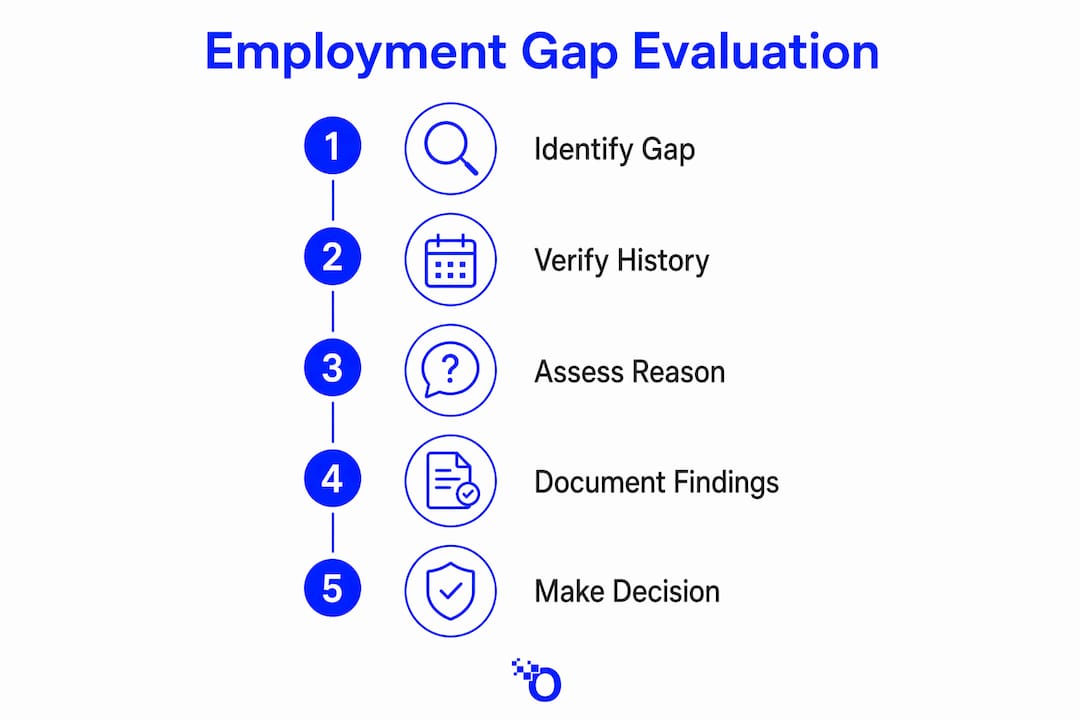
Effective gap evaluation requires a structured framework, not a gut reaction. The EEOC’s guidance on individualized assessments, developed in the context of criminal records, translates directly to employment gaps in safety-sensitive roles. The core principle is that a screener must consider the nature of the gap, the time elapsed, and the specific demands of the position before drawing any conclusion about suitability. Blanket disqualification policies based on gap length alone are both legally vulnerable and factually unsound.
SHRM guidance on evaluating resume gaps notes that hiring officials may weigh gaps against a candidate’s overall qualifications, particularly when the role is difficult to fill. That calculus is especially relevant in dispatch hiring, where qualified candidates are scarce and the cost of a vacant position is measured in operational risk, not just budget.
Pro Tip: When a gap raises questions, conduct a structured follow-up interview focused specifically on that period. Ask the candidate to walk through their daily routine, any professional development they pursued, and how they maintained readiness for re-entry into the workforce. Inconsistencies in that narrative are more informative than the gap itself.
A practical framework for gap evaluation in dispatch screening:
- Apply the individualized assessment standard. Evaluate each gap against the specific duties and integrity requirements of the dispatcher role, not against a generic employment policy.
- Distinguish patterns from isolated events. A single gap with a clear explanation is not a pattern. Repeated gaps with shifting explanations are.
- Weight positive evidence appropriately. Strong performance documentation from prior supervisors, professional references who speak to reliability, and evidence of productive activity during a gap all reduce the investigative significance of the gap itself.
- Document the reasoning. Whatever conclusion the screener reaches about a gap, the rationale must be written into the investigation file. Undocumented decisions create liability.
- Watch for informational bias. Screeners who receive negative information early in a review tend to weight subsequent neutral information more negatively. Reviewing a candidate’s full employment history before drawing conclusions about any single gap reduces that distortion.
- Avoid assumptions tied to protected characteristics. Caregiving gaps disproportionately affect women; health-related gaps may intersect with disability status. The EEOC framework applies here, and screeners must be able to demonstrate that their evaluation criteria are job-related and applied consistently across all candidates.
The dispatch screening process works best when gap evaluation is treated as one component of a comprehensive suitability review, not as a standalone filter. A candidate’s full behavioral history, including how they handled adversity, maintained relationships with prior employers, and demonstrated honesty throughout the application process, provides far more predictive value than any single gap in isolation.
What specialized screening solutions bring to employment gap evaluation
Public safety screening platforms designed specifically for dispatch and law enforcement hiring address employment gap evaluation in ways that general HR tools cannot. The regulatory requirements governing dispatcher background investigations, including the 10-year employment history mandate and the requirement for personal supervisor interviews, demand a workflow built around those standards from the ground up, not adapted from a commercial hiring platform.
Specialized platforms support comprehensive background investigations by structuring the investigation file around regulatory checkpoints, flagging documentation gaps before they become compliance failures, and maintaining audit trails that satisfy POST requirements. When an employer contact is not dated, when a supervisor interview is missing, or when a candidate’s stated employment dates do not align with verified records, a purpose-built system surfaces those anomalies rather than allowing them to pass unnoticed.
AI-assisted review adds another dimension to gap assessment. By cross-referencing a candidate’s Personal History Statement against verified employer records, AI tools can identify date discrepancies, title inconsistencies, and unexplained periods that a manual review might miss under time pressure. That capability is particularly valuable in high-volume dispatch hiring cycles, where screeners may be processing dozens of candidates simultaneously.
Key features that distinguish public safety-specific screening solutions:
- Regulatory compliance mapping. Investigation workflows aligned to POST Commission Regulation 1959 and equivalent state standards, with built-in checkpoints for each required element.
- Employer contact documentation. Structured logging of every employer contact, including date, method, and information obtained, satisfying the documentation requirements that POST audits routinely examine.
- Anomaly detection. Automated flagging of date discrepancies, missing employer contacts, and gaps that fall within the required verification window but lack supporting documentation.
- Supervisor interview tracking. Dedicated fields for recording personal interviews with immediate supervisors and coworkers, distinct from personnel file documentation.
- Continuous post-hire monitoring. Ongoing activity monitoring that extends the integrity verification process beyond the initial hire, protecting the agency if a dispatcher’s circumstances change after employment begins.
- Integration with applicant tracking. Seamless connection between the recruiting workflow and the background investigation process, reducing the administrative burden on screeners and shortening the time between conditional offer and clearance.
OMNI Intel’s pre-employment screening platform is built specifically for public safety agencies, incorporating investigator-driven verification protocols, AI-assisted anomaly detection, and compliance-mapped workflows that address the full scope of dispatcher background investigation requirements. For agencies managing the dual pressure of regulatory compliance and a competitive hiring environment, that level of specificity is what separates a defensible hire from an avoidable liability.

Key Takeaways
Employment gaps in dispatch screening require individualized, documented evaluation against a 10-year verified employment history, with candidate transparency weighted as a direct indicator of integrity.
| Point | Details |
|---|---|
| 10-year verification mandate | Agencies must contact all employers for at least 10 years; gaps within that window require documented explanation. |
| Disclosure reduces suspicion | Withholding gap information triggers more negative judgment than disclosing an unflattering situation, per Harvard Business School research. |
| Individualized assessment required | EEOC guidance supports evaluating each gap against the specific duties and integrity demands of the dispatcher role. |
| Supervisor interviews are mandatory | Investigators must personally interview immediate supervisors and coworkers, not rely solely on personnel files. |
| Patterns matter more than single gaps | Repeated unexplained gaps across a 10-year window carry more investigative weight than any single gap with a clear explanation. |
FAQ
Are job gaps automatically a red flag in dispatch hiring?
No. Employment gaps are not inherently disqualifying; they require individualized evaluation based on the reason, duration, and context of the gap relative to the dispatcher role’s specific demands.
How should candidates explain employment gaps on a background check?
Candidates should disclose gaps directly and consistently on their Personal History Statement. Research from Harvard Business School confirms that withholding gap information causes evaluators to draw more negative conclusions than an honest explanation of even an unflattering situation.
What is the minimum employment history required for dispatcher background investigations?
California Commission Regulation 1959 requires employment history checks covering at least 10 years, with personal contact made to all employers within that timeframe and documentation of every contact on file.
Are job gaps a red flag if the candidate was a caregiver?
Caregiving gaps are a legitimate reason for employment interruption, but research indicates caregivers face more persistent hiring penalties than other gap types. Screeners should apply the same individualized assessment standard and weight positive performance documentation from prior employers accordingly.
What does the 70/30 rule mean in hiring?
The 70/30 principle is not a standardized regulatory framework in public safety hiring. In general hiring practice, it refers informally to spending most of an interview on candidate experience and the remainder on role requirements, though definitions vary and it carries no specific authority in dispatch screening compliance.