

Safe Hiring Practices for Nonprofits: A Compliance Guide
Nonprofits operate on trust, and that trust begins with who you hire. Safe hiring practices for nonprofits are not a luxury reserved for well-funded organizations with full HR departments. They are a legal and operational necessity. The average nonprofit loses approximately $639,000 annually to fraud, much of it tied to inadequate screening and insufficient internal controls. Layer in burnout, rushed hiring decisions, and FCRA compliance gaps, and you have a formula for financial loss, reputational damage, and legal liability. This guide walks nonprofit leaders and HR professionals through the preparatory steps, legal requirements, and ongoing monitoring practices that make hiring safer, more compliant, and more defensible.
Table of Contents
- Key Takeaways
- Safe hiring practices for nonprofits start here
- Conducting FCRA and EEOC-compliant background checks
- Preventing fraud and financial abuse through hiring
- Supporting staff well-being to protect hiring quality
- Verifying hires and maintaining ongoing monitoring
- My perspective on nonprofit hiring culture
- Protect your nonprofit with purpose-built screening
- FAQ
Key Takeaways
| Point | Details |
|---|---|
| Build policy before hiring | Written, board-approved hiring policies prevent inconsistent decisions that expose your organization to legal risk. |
| FCRA compliance is non-negotiable | Skipping pre-adverse action notices can trigger statutory damages of $1,000 per plaintiff and class-action exposure. |
| Fraud prevention starts at hire | Segregating financial duties and running credit checks for finance roles directly reduces internal theft and fraud. |
| Burnout undermines hiring quality | With 70% of nonprofit staff considering leaving, organizations that ignore workload concerns accelerate unsafe, rushed rehiring cycles. |
| Post-hire monitoring closes the loop | Background checks at hire are a starting point. Periodic re-screening and documented investigations protect you long-term. |
Safe hiring practices for nonprofits start here
Most nonprofit leaders treat hiring as a reactive event. A position opens, the team scrambles, and the first qualified candidate who clears a basic check gets the offer. That approach is precisely where risk enters the building. Building a compliant hiring foundation means creating the structures before urgency sets in.
The starting point is a written hiring policy that governs every stage of recruitment, from job posting language to final offer letters. This policy should align with both federal requirements under the Equal Employment Opportunity Commission and state-level fair chance hiring laws. Without a documented process, every hiring decision becomes a judgment call, and judgment calls are difficult to defend when a candidate files a complaint.
Leadership engagement matters as much as documentation. Proactive workforce planning integrated with financial budgeting reduces rushed hires and the turnover those rushed hires inevitably produce. When your board understands hiring as a financial and governance issue rather than an administrative one, they allocate resources to it accordingly.
Here are the foundational elements every nonprofit should establish before opening a single requisition:
- A written, board-approved hiring and background screening policy reviewed annually
- Clearly defined job descriptions that specify required qualifications, duties, and reporting lines
- A designated HR lead or hiring committee responsible for consistent process execution
- A documented adverse action procedure aligned with FCRA requirements
- Separate policies for volunteer screening that reflect the different risk levels and applicable rules
- A workforce planning calendar that connects hiring timelines to budget cycles
Pro Tip: When defining roles, include a physical and psychological demands section if applicable. This helps establish legitimate job-relatedness for background check criteria, which is a key defense against discrimination claims.
Role definition is often where nonprofits underinvest. Vague job descriptions invite mismatched hires and make it nearly impossible to justify screening criteria that a candidate might later challenge. A well-constructed job description is also the foundation of your equity and compliance posture. Every screening requirement you impose should trace back to a documented, legitimate business necessity tied to that specific role.
Conducting FCRA and EEOC-compliant background checks
Background checks are where legal exposure concentrates for most nonprofits. The Fair Credit Reporting Act governs how consumer reporting agencies and employers handle applicant information, and the requirements are specific and unforgiving.
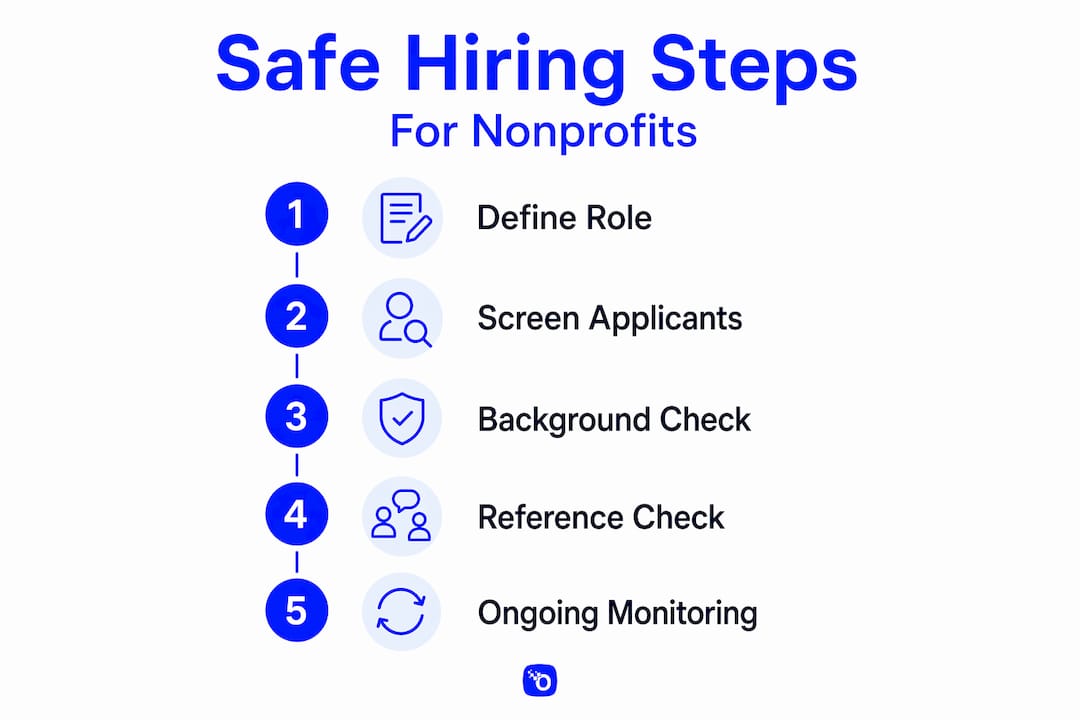
Here is the sequence every nonprofit must follow for a legally sound background check process:
- Provide a standalone disclosure. Before ordering any background check, give the candidate a clear, standalone written disclosure. This document cannot be buried inside an employment application or onboarding packet.
- Obtain written authorization. The candidate must sign a separate written authorization before you access any consumer report. Keep this document in the personnel file.
- Conduct the check through a compliant vendor. Work only with Consumer Reporting Agencies certified under the FCRA. Confirm they pull data from county-level criminal courts, not just aggregated databases.
- Issue a pre-adverse action notice. If findings may affect your hiring decision, send the candidate the pre-adverse action letter along with a copy of the report and the Summary of Rights Under the FCRA.
- Wait the required period. Under FCRA, candidates must receive at least 5 business days to review and dispute the findings before a final adverse action. Jurisdictions like New York City require 10 business days.
- Issue the final adverse action notice. If you proceed with disqualification after the waiting period, send the final notice specifying the reason and the candidate’s right to dispute with the reporting agency.
FCRA violations carry serious financial consequences. Statutory damages run at $1,000 per plaintiff, and class-action settlements in these cases have exceeded $10 million. These are not abstract risks for nonprofits. They are outcomes that have materialized at organizations that assumed they were too small to face legal challenge.
The EEOC adds another compliance layer. Federal guidance is explicit that blanket exclusions for criminal records are discriminatory. Instead, employers must apply individualized assessments using the Green Factors: the nature of the offense, the time elapsed since the conviction, and the relevance of that offense to the specific job. A payroll fraud conviction matters differently for a bookkeeping role than for a program coordinator position.
| Screening component | Staff applicants | Volunteers |
|---|---|---|
| Criminal history check | Required for all roles | Required for roles with vulnerable populations |
| Credit history check | Required for financial roles | Required for finance-facing volunteer roles |
| Sex offender registry | Required for youth-facing roles | Required for all youth-serving programs |
| Reference verification | Required across all hires | Recommended for recurring volunteers |
| Re-screening frequency | Every 2 to 3 years for sensitive roles | Every 2 to 3 years uniformly to reduce legal exposure |
Pro Tip: For volunteer screening, adopt a tiered policy based on role risk level rather than a one-size-fits-all approach. Volunteers working directly with minors or handling cash require the same rigor as paid staff. Using inconsistent standards across your volunteer pool creates both safety gaps and legal exposure.
Volunteer screening often receives inadequate attention. Organizations that screen paid staff thoroughly but wave volunteers through with minimal verification are creating an unprotected gap that bad actors can exploit. Screening costs for volunteers typically range from $20 to $60 per check, which is a small price relative to the liability exposure of an unscreened adult with regular access to children or financial systems.
Preventing fraud and financial abuse through hiring
Internal fraud in nonprofits is not a rare anomaly. The sector collectively loses $40 billion annually to fraud and financial abuse, and the most common perpetrators are insiders with unchecked access. Payroll fraud, expense reimbursement abuse, and unauthorized vendor payments are the leading schemes. All of them are preventable with the right combination of hiring controls and operational oversight.
The hiring side of fraud prevention means being selective and thorough when filling financial roles. Credit checks, where legally permitted, give you a window into a candidate’s financial history and judgment. A pattern of unresolved debt or financial mismanagement does not automatically disqualify a candidate, but it warrants the individualized assessment the EEOC requires and a more thorough reference investigation.

| Control type | Effective for small nonprofits | Notes |
|---|---|---|
| Segregation of duties | Partially. Requires compensating controls. | No single person should authorize and process payments. |
| Dual signature requirements | Yes | Require two authorized signers for checks above a defined threshold. |
| Periodic payroll audits | Yes | Compare payroll registers to HR records quarterly. |
| Board finance committee review | Yes | Finance committees should meet regularly and review financials against budget. |
| Third-party financial audit | Yes, annually | Independent audits create accountability outside the organization. |
Segregation of duties presents a real challenge for lean nonprofits. When you have two finance staff members, full separation of the authorization, recording, and custody functions is not always possible. The compensating control is layered oversight: board finance committee reviews, mandatory vacation policies that force other staff to cover duties temporarily, and periodic internal audits that compare records against source documents.
Pro Tip: Run a payroll reconciliation every quarter that compares your payroll register to your HR records. Ghost employees, terminated staff still drawing pay, and unauthorized pay rate changes are among the easiest frauds to detect with this single control. Most organizations only discover these during external audits, often years too late.
Leadership must not only authorize financial controls but demonstrate commitment to them through regular engagement. Boards that meet annually to approve budgets and then disengage until the next fiscal year create governance voids. Active finance committee participation sends a clear organizational message: this leadership monitors what it authorizes.
Supporting staff well-being to protect hiring quality
The connection between staff burnout and unsafe hiring is more direct than most nonprofit leaders recognize. When employees leave because of unsustainable workloads, organizations resort to the reactive hiring patterns that produce poor-fit, inadequately screened hires. The research makes this cycle concrete: 70% of nonprofit staff are considering leaving due to excessive responsibility and insufficient support.
That statistic should stop any nonprofit leader. Seven out of ten employees mentally exiting is not a morale concern. It is an operational and safety risk. High turnover compresses hiring timelines, which shortcuts screening. Shortcuts in screening increase the probability of problematic hires. Problematic hires increase misconduct incidents, which increase staff stress and accelerate further turnover. The cycle is self-reinforcing.
Breaking it requires structural changes, not motivational messaging. Specific organizational interventions that reduce this risk include:
- Conducting an honest role inventory to identify positions where one person is carrying duties that reasonably require two
- Building actual rest into organizational culture rather than performing it. This means protecting PTO, not approving it while simultaneously messaging that coverage is needed.
- Creating clear career pathways so staff see a future inside the organization rather than treating it as a transitional employer
- Involving staff in workload and capacity discussions rather than presenting decisions as final after leadership has deliberated in private
- Designing onboarding programs that invest in new hires rather than deploying them immediately into full workloads
Leadership modeling is decisive here. When executives and directors visibly take time off, set boundaries on after-hours communication, and acknowledge that the work is hard, they establish norms that protect the staff beneath them. Organizations where leaders routinely work excessive hours signal implicitly that everyone is expected to absorb unsustainable demands.
Retention is directly connected to hiring safety. Experienced staff who understand the organization’s clients, systems, and risks are a protective layer. When they leave, that institutional knowledge leaves with them, and replacements often lack the judgment to recognize warning signs in their own hiring processes or among colleagues.
Verifying hires and maintaining ongoing monitoring
A background check at hire is a point-in-time document. It tells you who the person was at the moment of screening, not who they become over the years of their employment. Staffing safety in nonprofits requires building post-hire verification and monitoring into the regular operational calendar.
Here is a structured approach to ongoing compliance and verification:
- Establish re-screening intervals. Set a policy that triggers re-screening for all staff in sensitive roles every two to three years. For volunteers in youth-serving or financial roles, apply the same standard uniformly. Inconsistent re-screening across similar roles creates legal and safety gaps.
- Audit access controls quarterly. Review which employees and volunteers have access to financial systems, client records, and facility entry. Remove access promptly when roles change or employment ends.
- Conduct workplace investigations with impartiality. When misconduct allegations arise, internal employees investigating those incidents risk real or perceived bias. Engage an external neutral investigator, particularly for allegations against senior staff. The outcomes are more defensible and the process more credible.
- Retain all background screening documentation for a minimum of five years. This includes disclosure and authorization forms, the consumer report itself, pre-adverse and final adverse action notices, and any candidate dispute responses. Retention is your legal protection if a claim surfaces years after hire.
- Integrate monitoring into the organizational calendar. Post-hire oversight should not depend on someone remembering to act. Build re-screening triggers into your HRIS or tickler system so they generate reminders automatically and the process is consistent across all roles.
Workplace investigations deserve specific attention. The instinct in small nonprofits is to assign investigations to the HR lead or a trusted manager. When the accused is a peer or a superior of those investigators, the process is compromised from the start. Even when the outcome is correct, a biased process creates grounds for challenge. External investigators are not a luxury for large institutions. They are a risk management tool that preserves the credibility of your findings.
Documenting these processes comprehensively also prepares your organization for IRS scrutiny and state charitable registration audits. Nonprofits facing regulatory review are expected to demonstrate written policies, consistent implementation, and documented outcomes. Organizations that can produce this evidence have a substantially stronger position than those operating informally.
My perspective on nonprofit hiring culture
In my experience, the organizations that suffer the most painful hiring failures are not the ones that lacked knowledge. They are the ones that lacked consistency. They knew they needed thorough screening, but they created workarounds when a position stayed open too long. They knew the FCRA required a waiting period, but they skipped it once when a great candidate was also considering another offer.
Reactive hiring is not just inefficient. It is how safety risks enter organizations. Every exception to your own policy is a signal to your team that the policy is negotiable. And negotiable policies protect no one when they are challenged.
What I have found actually works is treating compliance as a visible leadership commitment rather than a departmental function. When the executive director can name the organization’s screening policy and articulate why it matters, that signals cultural priority. When the board finance committee reviews financial controls every quarter without fail, that signals accountability. Compliance as a cultural value is not a slogan. It is a behavior pattern demonstrated repeatedly from the top.
The uncomfortable truth is that most nonprofit hiring culture is built around urgency and goodwill. Urgency because the organization is always understaffed and overextended. Goodwill because people enter nonprofit work believing in the mission and extend that belief to candidates. Both are understandable. Neither is a substitute for a documented, consistently enforced hiring process.
The organizations I respect most are the ones that accept the discipline required. They run the same process every time, even when it is inconvenient. They say no to a candidate who cannot produce required documentation. They engage external help when an investigation goes beyond their internal capacity. They see these decisions not as bureaucratic overhead but as acts of stewardship for the people their organization serves.
— Matt
Protect your nonprofit with purpose-built screening
Nonprofit leaders who are serious about reducing hiring risk need more than general-purpose background check services. They need a platform built with the precision and compliance discipline that sensitive hiring demands.

Omniintel was designed specifically for public safety and mission-driven organizations where the stakes of a bad hire are measured in community harm and institutional trust. The platform supports FCRA-compliant screening with county-level criminal record checks, built-in adverse action workflows, and documentation retention tools that protect your organization through audits and legal challenges. Volunteer screening, periodic re-screening triggers, and role-based check packages give HR professionals the specificity they need to apply the right standard to every position. If your nonprofit is ready to move from reactive to structured hiring, explore Omniintel’s pre-employment screening services built for organizations where integrity is not optional.
FAQ
What background checks are required for nonprofit staff?
Nonprofits are not federally mandated to conduct specific background checks, but EEOC and FCRA guidelines govern how checks must be conducted when they are used. Roles involving children, financial management, or vulnerable populations typically require criminal history, sex offender registry, and in some cases credit history checks.
How long must nonprofits retain background check documents?
All background screening documentation, including disclosures, authorizations, consumer reports, and adverse action notices, should be retained for a minimum of five years. This retention period supports legal defense in the event of a candidate or employee claim.
What is the FCRA adverse action process for nonprofits?
When a background check finding may lead to disqualification, the employer must issue a pre-adverse action notice with a copy of the report and allow at least 5 business days for the candidate to dispute findings before issuing the final adverse action notice. Some jurisdictions extend this to 10 business days.
How should nonprofits handle volunteer screening?
Volunteers in roles involving youth or financial responsibility should be screened with the same rigor applied to paid staff in comparable roles. Policies should specify re-screening every two to three years and apply standards uniformly across similar volunteer roles to reduce legal exposure.
What fraud risks does poor hiring create for nonprofits?
Inadequate hiring controls and insufficient oversight allow internal fraud to take hold. Common schemes include payroll fraud, unauthorized expense reimbursements, and vendor payment abuse. The average nonprofit loses $639,000 annually to fraud, much of it preventable with stronger hiring screening and financial controls.