

Why accurate screening matters for public safety hiring
Many agencies treat pre-employment background screening as a procedural box to check, something completed before the first day of work and quickly forgotten. That assumption carries serious risk. A single overlooked conviction, a mismatched identity record, or an unverified credential can place an unqualified or dangerous individual inside a law enforcement agency, fire station, or dispatch center, where the consequences of that mistake extend far beyond the hiring file. This guide examines what accurate screening actually requires, why generic approaches fall short, and how public safety HR professionals can build a process that protects both the community and the agency.
Table of Contents
- The risks of inaccurate screening for public safety
- What drives accuracy in pre-employment screening
- Comparing accurate vs. generic screening approaches
- How to ensure accuracy in your agency’s screening process
- Why accuracy in screening is underestimated and what agencies miss
- Solutions for dependable public safety screening
- Frequently asked questions
Key Takeaways
| Point | Details |
|---|---|
| Accuracy prevents costly errors | Rigorous background screening reduces legal, operational, and reputational risks for hiring agencies. |
| Systematic processes matter | A clear, step-by-step procedure boosts accuracy and reliability in screening workflows. |
| Digital tools improve efficiency | Technology integration minimizes human error and enhances data verification during screenings. |
| Thorough screening builds trust | Public safety agencies that prioritize precision maintain better stakeholder and community relations. |
| Expert solutions are available | Organizations can partner with specialized screening providers to ensure both compliance and safety. |
The risks of inaccurate screening for public safety
Public safety agencies operate in a fundamentally different environment than most employers. Officers, paramedics, dispatchers, and security personnel are trusted with authority over life, liberty, and community welfare. When screening errors occur in this environment, the results are not limited to a bad quarter or an awkward personnel decision. They can be devastating and irreversible.

Legal exposure is immediate and significant
Agencies that conduct inaccurate or incomplete background investigations face direct legal liability under federal and state statutes. The Fair Credit Reporting Act (FCRA) establishes strict requirements around how consumer report information is gathered, used, disputed, and disclosed. Violations can trigger civil penalties, class action lawsuits, and regulatory enforcement actions. Understanding background check laws is not optional for public safety HR teams. It is foundational.
Beyond the FCRA, agencies can face negligent hiring claims when a poorly screened employee causes harm. Courts have consistently held that employers who fail to conduct reasonable due diligence before placing someone in a position of trust or authority bear meaningful legal responsibility for foreseeable harm that employee causes. As one digital forensics authority confirms, precise background checks are critical in legal compliance and risk management, a principle that applies directly to public safety hiring contexts.
Reputational damage runs deep
A single high-profile hiring failure can erode years of community trust. When a law enforcement agency discovers that a hired officer had a prior misconduct history at another department, or when a fire department learns that a new hire falsified credentials, the story becomes public quickly. The damage extends to officer morale, community relationships, and the agency’s ability to recruit qualified candidates in the future.
The public safety screening risks associated with poor vetting practices are well documented. Agencies that have experienced widely reported hiring failures typically face increased civilian oversight, policy mandates from governing bodies, and reduced budgetary flexibility as officials respond to public pressure.
“Accuracy in background investigations is not a luxury reserved for large agencies. It is the minimum standard that public trust demands from every organization entrusted with safety and authority.” — Public Safety Hiring Review, 2024
Operational consequences compound over time
Consider what happens inside an agency when a screening error results in a bad hire. The individual may perform poorly, require intensive supervision, or create friction within teams built on mutual trust. They may engage in misconduct that generates internal affairs investigations, legal claims, or use of force incidents. Each of these outcomes consumes time, budget, and leadership attention that would otherwise support mission-critical operations.
Key operational risks that follow from inaccurate screening include:
- Placement of candidates with undisclosed prior disciplinary records in high-trust roles
- Hiring individuals with falsified credentials into specialized positions such as evidence handling or emergency medical services
- Missing decertification records from prior jurisdictions, allowing officers banned elsewhere to resume law enforcement functions
- Overlooking patterns of civil litigation that signal prior behavioral problems
- Failing to verify employment history gaps that could conceal misconduct, terminations, or criminal activity
Each of these scenarios is preventable through rigorous, systematic investigator-driven checks. The cost of prevention is always less than the cost of remediation.
What drives accuracy in pre-employment screening
Screening accuracy does not happen by chance. It results from deliberate process design, access to comprehensive data sources, and the application of investigative principles that go well beyond running a name through a criminal database. Understanding what actually drives accuracy helps hiring managers evaluate whether their current process is adequate or merely sufficient on paper.
The systematic steps that produce reliable results
Accurate pre-employment screening in public safety follows a structured sequence rather than a checklist of individual searches. Data analysis best practices developed for legal due diligence processes translate directly to the sequential logic that background investigators apply in public safety contexts.
- Identity verification. Confirm that the individual is who they claim to be using government-issued documents, Social Security number validation, and biometric checks where applicable. No other step is meaningful if identity is not established with certainty.
- Criminal history search across multiple jurisdictions. A county-level criminal search in the applicant’s current residence is insufficient. Investigators must search every jurisdiction where the candidate has lived, worked, or studied, including federal records, state repositories, and relevant international sources for candidates with overseas history.
- Employment history verification. Contact every prior employer listed, including those where the applicant claims to have left voluntarily. Discrepancies between stated reasons for departure and employer records are among the most common signals of hidden misconduct.
- Education and credential verification. Degree mills and falsified certifications are a persistent problem in public safety applications. Verify directly with issuing institutions rather than relying on documents the applicant provides.
- Reference interviews with structured questioning. Structured reference interviews, not perfunctory courtesy calls, often surface behavioral patterns that formal records do not capture. Investigators trained in interview techniques extract significantly more usable information than standard HR reference checks.
- Civil records review. Civil litigation history, restraining orders, and civil judgments can indicate patterns of behavior that criminal records alone do not reveal.
- Social media and open-source intelligence (OSINT) review. Consistent with background check data privacy requirements, a structured review of publicly available digital information can reveal conduct that contradicts an applicant’s stated values and character.
- Decertification index check. Every public safety agency should check applicable national and state decertification indexes to confirm a candidate has not been removed from law enforcement eligibility in another jurisdiction.
Understanding how background checks work in the context of these multiple layers is essential for hiring managers who rely on third-party vendors to conduct their investigations.
Pro Tip: When reviewing digital records supplied by applicants, independently verify the issuing institution’s contact information rather than using contact details printed on the document itself. Sophisticated applicants sometimes submit altered records with fraudulent contact information to route verification calls to accomplices.
Data integration and technology’s role
Technology does not replace investigative judgment, but it significantly improves the consistency and speed of data gathering. Modern screening platforms integrate with court record databases, national criminal repositories, employment verification networks, and OSINT tools to reduce the manual gaps that create opportunities for error. Digital forensic screening methods have advanced considerably, enabling investigators to detect altered documents and verify authenticity in ways that were not practical even five years ago.
The following table compares common data sources by their typical accuracy contribution and limitations:
| Data source | Accuracy contribution | Known limitations |
|---|---|---|
| National criminal database | High coverage, fast retrieval | May lag local court updates by weeks or months |
| County-level court records | Most current and complete | Requires manual search per jurisdiction |
| Employment verification networks | Consistent, automated | May miss small employers not in the network |
| Education verification services | Direct institutional contact | Slower turnaround for international institutions |
| Decertification index | Critical for law enforcement | Coverage varies by state participation |
| OSINT and social media review | Behavioral context | Requires trained analysis to interpret accurately |
| Reference interviews | Behavioral depth | Dependent on interviewer skill and question quality |
Comparing accurate vs. generic screening approaches
Many agencies, particularly smaller ones operating under budget pressure, default to generic background check services that offer convenience but sacrifice depth. Understanding the specific gaps this creates helps HR professionals build the case for investment in investigator-driven, public-safety-specific screening.
Accurate screening helps legal professionals and safety agencies maintain compliance with regulations governing personnel decisions, a standard that generic consumer-focused background check products are rarely designed to meet.
The screening for integrity process requires more than database queries. It requires the analytical judgment to interpret what records mean in context, identify inconsistencies across multiple data sources, and escalate findings appropriately before a hiring decision is made.
Side-by-side comparison of screening approaches
| Criterion | Accurate, investigator-driven screening | Generic background check service |
|---|---|---|
| Criminal record coverage | Multi-jurisdictional, manual court review | National database only, potential gaps |
| Identity verification | Biometric and document authentication | Name and SSN match only |
| Employment history | Structured interviews with prior employers | Automated confirmation of dates only |
| Credential verification | Direct contact with issuing institution | Accepts applicant-supplied documents |
| Decertification check | Included as standard | Rarely included |
| OSINT review | Structured, privacy-compliant review | Not included |
| Reference interviews | Structured, investigator-conducted | Not included |
| FCRA compliance support | Built into the process | Variable, often limited |
| Time to complete | 10 to 21 business days | 24 to 72 hours |
| Suitable for public safety | Yes, purpose-built | No, general commercial use |
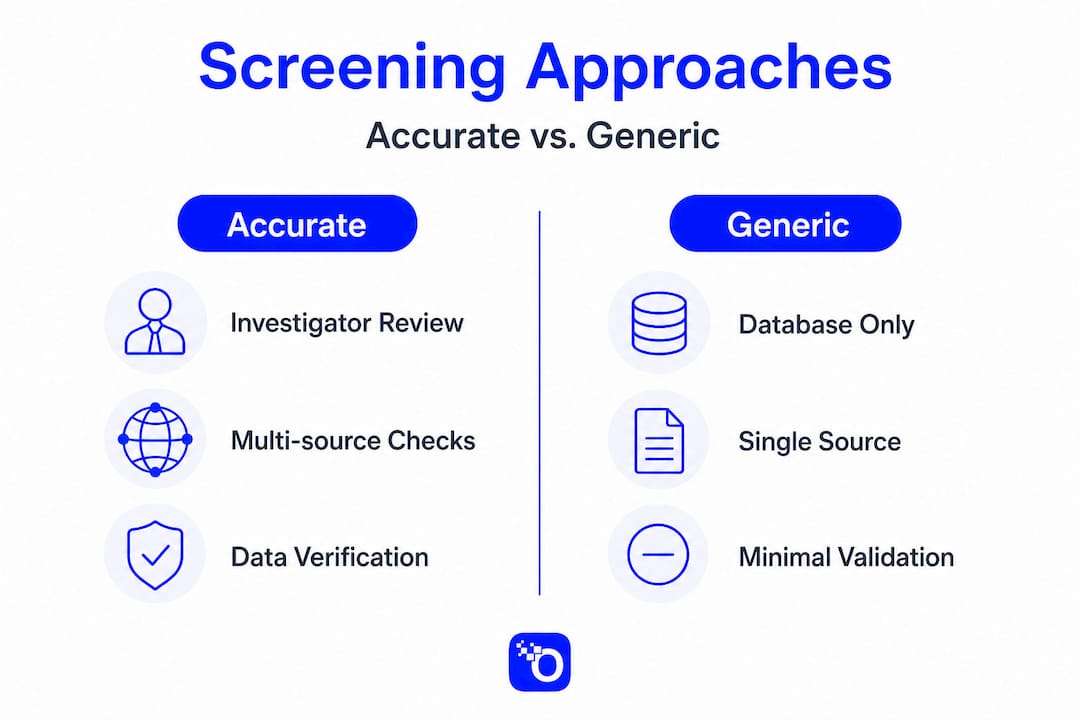
The time difference between approaches is sometimes used to justify choosing generic services, particularly when agencies are understaffed and under pressure to fill positions quickly. That logic is understandable but dangerous. Filling a sworn officer position three weeks faster means nothing if the hire introduces misconduct risk that costs the agency far more in the months that follow.
Key indicators that an agency’s current screening process may be leaving critical gaps:
- Background checks are completed in under five business days without a clear explanation of how depth is maintained
- The agency uses a single national database search rather than multi-jurisdictional court searches
- Employment verification is limited to date confirmation without structured interviews
- No decertification index check is performed for law enforcement applicants
- Digital records such as certifications and diplomas are accepted without third-party verification
How to ensure accuracy in your agency’s screening process
Knowing that accurate screening matters is the first step. Building and maintaining a process that reliably delivers it requires structure, audit discipline, and a commitment to treating screening as an ongoing operational function rather than a pre-hire formality. Accurate screening supports safe hires and, by extension, safer communities.
A practical process for HR professionals and hiring managers
-
Define a standardized screening matrix by role. Not every position requires the same depth of investigation. A sworn law enforcement officer requires a more extensive investigation than a records clerk, but both roles require defined, documented screening standards. Create a matrix that specifies required searches, verification steps, and interview requirements for each role category.
-
Select a screening vendor with documented public safety experience. General consumer reporting agencies are not equipped to conduct the kind of investigator-driven checks that public safety positions demand. Evaluate vendors on their specific experience with law enforcement and public safety hiring, their FCRA-compliance infrastructure, and their capacity to conduct structured reference interviews. Resources on how to conduct employee background checks provide useful evaluation criteria.
-
Train HR staff to interpret screening reports accurately. A criminal record does not automatically disqualify a candidate. The nature of the offense, how much time has passed, evidence of rehabilitation, and the specific duties of the role all factor into a legally defensible hiring decision. HR teams need training in individualized assessment to avoid both negligent hiring and discriminatory disqualification.
-
Build in a supervisor or investigator review step before any offer is extended. For senior or sworn positions, a second review by a trained investigator adds a quality-control layer that catches interpretation errors and ensures that borderline cases are escalated rather than assumed harmless.
-
Establish a regular audit cycle for your screening process. Annually, or after any significant change in legislation, audit a representative sample of completed background investigations to confirm that all required steps were completed, documented, and applied consistently. Background regulations compliance standards evolve, and agencies that treat compliance as a one-time setup rather than an ongoing practice accumulate risk invisibly over time.
-
Implement conditional offer protocols. Background investigations should be conducted after a conditional offer of employment is extended and before the offer is finalized. This sequence supports FCRA compliance and ensures that the significant investment in a full investigation occurs only for serious candidates.
Pro Tip: Maintain a written log of every screening decision, including the rationale for hiring when a record was found. This documentation is your primary defense in a negligent hiring claim and your best tool for demonstrating that the agency applied individualized assessment consistently across candidates.
Statistic: Organizations that implement structured, audited screening processes report up to a 40% reduction in post-hire misconduct incidents compared to those using ad hoc or generic screening approaches, according to workforce risk research compiled across public sector employers.
Preventing the most common accuracy failures
Common mistakes that HR teams can prevent with intentional process design include:
- Failing to re-screen candidates when a hiring timeline extends significantly beyond the original investigation date
- Relying on self-reported information for employment gaps without independent verification
- Treating a cleared background investigation from another agency as transferable without conducting an independent review
- Missing state-specific requirements for certain roles, such as psychological evaluations or polygraph examinations for law enforcement applicants
- Not obtaining proper authorization forms before initiating any investigation, which is an FCRA violation regardless of the accuracy of the information gathered
Why accuracy in screening is underestimated and what agencies miss
The uncomfortable reality is that most agencies do not learn about their screening failures until something goes wrong. The process is largely invisible when it works and spectacularly visible when it does not. That asymmetry creates a systematic tendency to underinvest in screening quality because the return on investment does not show up in any quarterly report until a crisis materializes.
Consider what a single bad hire costs a public safety agency in real terms. Legal defense in a misconduct case can run well into six figures. An internal affairs investigation consumes supervisor time and creates morale disruption across the unit. If the matter becomes public, the agency reputation impact extends the costs further, affecting recruitment appeal, community cooperation, and political relationships with oversight bodies. A poor hire who remains employed for several years before misconduct surfaces may have already caused harm that generated additional liability.
The deeper issue is that agencies often frame screening accuracy as a cost center rather than a risk management investment. When budget cycles tighten, screening quality is a quiet target for reduction, usually framed as moving to a faster, cheaper vendor or reducing the scope of investigations for non-sworn positions. This framing misses the compounding nature of risk. Each less-than-thorough investigation is not a discrete savings. It is a small addition to an invisible liability that grows until it suddenly, and expensively, becomes visible.
The agencies that achieve the most durable operational performance treat screening accuracy as part of their organizational culture, not just their HR workflow. When leadership visibly prioritizes integrity in the hiring process, that standard permeates how officers, paramedics, and dispatchers understand their own accountability on the job. Accurate screening is not simply about keeping unqualified candidates out. It is about signaling to every person in the agency what standards of character and conduct mean in practice.
Long-term data consistently supports this position. Agencies that invest in thorough pre-employment investigations report higher retention rates, fewer use-of-force complaints, and stronger community satisfaction scores. Those outcomes are not coincidental. They reflect the cumulative effect of better hiring decisions, made consistently over time, through a process rigorous enough to be trusted.
“Good enough” is a phrase that has no place in public safety hiring. The community does not receive good enough emergency response, and the agency should not accept good enough vetting of the people responsible for delivering it.
Solutions for dependable public safety screening
Every recommendation in this guide, from building a multi-jurisdictional search process to auditing screening consistency, points toward one foundational requirement: the need for a screening partner that understands public safety at an operational level, not just a compliance level.

OMNI Intel was built specifically for agencies where accuracy is not a preference but a mandate. Our pre-employment screening services apply investigator-driven methodology to every case, covering the full depth of criminal history, employment verification, credential authentication, decertification checks, and OSINT review that public safety roles demand. For HR professionals and hiring managers who need a process they can defend in court and trust in the field, our background checks for agencies deliver the consistency and documentation that generic services cannot. Learn more about how our safe hiring investigations can support your agency’s hiring standards and help you build a team the community can rely on.
Frequently asked questions
How can errors in screening affect public safety agencies?
Small errors can lead to hiring unsuitable candidates, resulting in operational, legal, and reputational risks for agencies. As one authority on forensic documentation confirms, precise background checks are critical in legal compliance and risk management, particularly when authority and public trust are involved.
What is the most important step to boost accuracy in screening?
Implementing systematic procedures and regular audits is the single most effective way to ensure screening accuracy. Data analysis best practices developed for legal due diligence confirm that structured, repeatable methodology consistently outperforms ad hoc approaches in producing reliable results.
Are digital tools necessary for accurate screening?
Digital solutions streamline screening procedures, reduce human error, and help agencies verify candidate records efficiently. The use of digital forensic methods improves accuracy in background screening by enabling authentication of records that manual review alone could not reliably detect.
How does accurate screening protect agency reputation?
Thorough background checks prevent poor hires and assure stakeholders the agency is committed to public safety. Accurate screening helps agencies maintain compliance with regulations and demonstrates to oversight bodies and the public that hiring decisions are made with rigor and accountability.
Where can agencies find dependable screening solutions?
Specialized providers like OMNI Intel offer tailored pre-employment screening and background check services designed specifically for public safety agencies, combining investigator-driven methodology with FCRA-compliant documentation and multi-jurisdictional coverage.