

Master the integrity verification process for public safety hiring
When a mid-sized police department in the Pacific Northwest hired a dispatcher without completing a full integrity verification review, the oversight seemed minor at the time. Eighteen months later, that employee faced termination after an internal investigation revealed a pattern of conduct that a thorough pre-employment background investigation would have flagged. The legal exposure, the departmental reputational damage, and the community trust lost were all preventable. This guide lays out the complete integrity verification process for public safety agencies, covering foundational concepts, compliance requirements, step-by-step workflow, and governance nuances so you can build a hiring practice that protects your agency and the people you serve.
Table of Contents
- Understanding integrity verification in public safety
- Pre-verification requirements and compliance standards
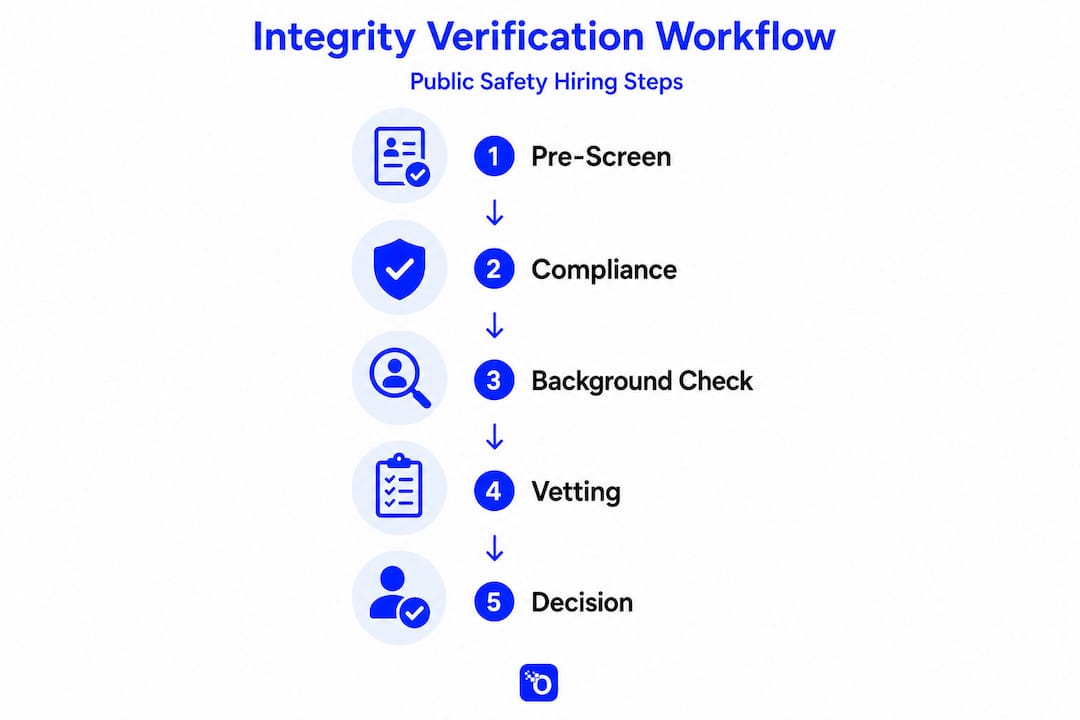
- Step-by-step integrity verification workflow
- Addressing edge cases and governance nuances
- The uncomfortable truth most public safety agencies miss about integrity verification
- Take your integrity verification process further
- Frequently asked questions
Key Takeaways
| Point | Details |
|---|---|
| Use structured frameworks | Structured background investigations are more effective than informal checks for integrity verification in public safety hiring. |
| Follow compliance protocols | Adhering to FCRA and state rules keeps your process legally secure and trustworthy. |
| Monitor bias and equity | Quality assurance and protected characteristic monitoring help reduce bias risks throughout the verification process. |
| Apply data consistently | To prevent future misconduct, agencies must use all available data during candidate assessment. |
| Handle edge cases carefully | Recognize policy nuances like ban-the-box and tailor your approach to complex situations for best results. |
Understanding integrity verification in public safety
Integrity verification in public safety hiring is not simply a checkbox on an application form. It is a structured, investigator-driven process that evaluates whether a candidate’s history, character, and conduct align with the demands of a role that carries significant public trust. When done correctly, it draws on criminal record checks, employment history analysis, reference interviews, psychological evaluations, and polygraph testing where permitted, all organized within a documented framework.
The distinction between informal review and structured vetting matters enormously. An informal review might involve running a candidate’s name through a basic database and checking two personal references. A structured investigation, by contrast, follows a defined procedural sequence with documented decision criteria at each stage. The California POST background investigation manual is a concrete example of how public-safety vetting is operationalized with structured investigation and analysis rather than informal screening, and it reflects the operational depth that serious agencies must pursue. That manual spans hundreds of pages and addresses everything from initial candidate disclosure to the final investigative report.
For agencies looking to build or refine their process, a thorough public safety background check guide can serve as a practical companion to regulatory documents, translating procedural requirements into actionable workflows. Understanding the scope of background checks explained for public safety roles also helps HR managers set realistic timelines and resource expectations from the outset.
One of the more underappreciated challenges in integrity verification is the risk of bias. Research confirms that equity in vetting decisions is a known pressure point, with limited understanding of disproportionality and an ongoing need for better quality assurance on how vetting determinations are made. This is not a theoretical concern. It has real operational, legal, and community relations implications for agencies that fail to address it proactively.
| Feature | Informal review | Structured investigation |
|---|---|---|
| Documentation | Minimal or absent | Detailed at every stage |
| Decision criteria | Subjective | Defined and applied consistently |
| Bias risk | High | Actively managed |
| Legal defensibility | Low | High |
| Depth of data | Surface-level | Multi-source and verified |
| Equity monitoring | Rare | Built into workflow |
The structured approach is not merely a best practice. For many roles in law enforcement, emergency services, and dispatch, it is a professional and sometimes legal obligation. Agencies that treat integrity verification as a formality rather than a rigorous process invite both operational and legal risk. Understanding implicit bias in vetting and its effects on decision-making is a necessary part of building an equitable review protocol.
“Integrity verification is only as strong as the consistency with which it is applied. A process that varies investigator to investigator, or candidate class to candidate class, is not a process. It is a liability.”
Pre-verification requirements and compliance standards
Before your agency initiates a single background inquiry, you must have the right legal and procedural infrastructure in place. Skipping this preparation is one of the most common and costly mistakes HR managers make in public safety recruitment.

The federal Fair Credit Reporting Act governs all background screening conducted through a third-party consumer reporting agency. The FCRA compliance requirements are specific and non-negotiable: agencies must provide candidates with a standalone disclosure form (not buried in an employment application), obtain written authorization before initiating any inquiry, and follow pre-adverse action and adverse action notification procedures if a candidate’s report influences a negative hiring decision. Missing any one of these steps exposes the agency to federal litigation and damages.
State-level requirements add another layer of complexity. Depending on your jurisdiction, you may face restrictions on what records can be considered, how far back you can look, and under what conditions certain types of offenses can be used as disqualifiers. Agencies with operations in multiple states must map out each state’s requirements individually.
The following compliance checklist helps agencies confirm readiness before launching the verification process:
- Written disclosure form, separate from any application document
- Signed authorization from the candidate before any inquiry begins
- Defined scope of inquiry documented in writing
- Third-party consumer reporting agency agreement reviewed for FCRA compliance
- State-specific restrictions mapped and incorporated into decision criteria
- Pre-adverse action notice process documented and assigned to a responsible staff member
- Adverse action notice template reviewed by legal counsel
- Record retention schedule established for all verification documentation
Pro Tip: Treat your compliance documentation as a living record. Federal and state requirements shift, and an annual review by employment counsel ensures your disclosure forms, authorization language, and adverse action procedures remain current and legally defensible.
Understanding the full range of types of background checks available for public safety roles helps HR managers select the right scope for each position. Not every role requires the same depth of inquiry, and calibrating the process to the position’s authority and access level is both cost-effective and legally appropriate. For a detailed breakdown of how to sequence these steps, reviewing established screening process steps specifically designed for public safety hiring provides a practical roadmap.
| Compliance element | Federal (FCRA) | State requirement | Documentation needed |
|---|---|---|---|
| Disclosure form | Standalone required | May vary | Dated, signed copy |
| Written authorization | Required | May be expanded | Retained in file |
| Pre-adverse action notice | Required | May vary | Copy sent to candidate |
| Adverse action notice | Required | May vary | Proof of delivery |
| Record retention | Not specified | Varies by state | Per state schedule |
Step-by-step integrity verification workflow
With compliance prerequisites confirmed, agencies can move into the actual verification workflow. This is where procedural precision becomes the difference between a defensible decision and a legal exposure. Every step must be documented, every decision recorded, and every deviation from standard protocol justified in writing.
-
Issue the standalone disclosure and obtain written authorization. Before any inquiry begins, provide the candidate with a clear, standalone disclosure explaining that a background investigation will be conducted. Obtain signed authorization. Store both documents in a dedicated investigation file.
-
Initiate the structured intake interview. Conduct a formal interview to collect the candidate’s self-reported history, including employment dates, supervisory contacts, residential history, and any self-disclosed incidents. This creates a baseline against which all discovered information will be compared.
-
Order and receive official records. This includes criminal history at the county, state, and federal levels; driving records; credit history where permitted; and professional license verification. Confirm that each record source is current and covers the required geographic and temporal scope.
-
Conduct investigator-driven reference and employment verification. Do not rely solely on written questionnaires. Investigator-led phone or in-person contact with former supervisors surfaces information that written references almost never capture. Document each contact, including the date, duration, interviewer identity, and key statements.
-
Review and cross-reference all data for inconsistencies. Compare self-disclosed information with discovered records. Flag gaps in employment history, discrepancies in dates, or undisclosed incidents. Each inconsistency must be addressed before a determination is made.
-
Monitor for equity and consistency throughout review. Research consistently shows that agencies underuse available data in ways that create modest but real predictive gaps, and that decision-making is not always applied uniformly across candidate groups. Build a review checkpoint specifically to verify that comparable findings are being treated consistently across all applicants.
-
Apply defined, written decision criteria. No hiring decision should rest on an investigator’s unrecorded impression. Criteria for disqualification or further inquiry must exist in writing, be applied uniformly, and align with the role’s specific authority and risk profile. This step directly supports integrity in public safety hiring as a measurable, auditable standard rather than a subjective judgment.
-
Issue pre-adverse action notice if applicable. If discovered information may lead to a negative hiring decision, notify the candidate in writing, provide a copy of the report and the Summary of Rights under FCRA, and allow a reasonable waiting period before finalizing the decision.
-
Conduct final review and close the investigation file. After the waiting period, review any candidate response or dispute, make the final determination, and document the rationale. Issue the adverse action notice if the decision stands.
Pro Tip: Standardize the language your investigators use to describe discovered information. Inconsistent language across investigation reports, particularly when describing similar findings for different candidates, is one of the clearest indicators of potential bias and one of the most common triggers for discrimination claims.
It is worth noting that bias risks in hiring are not abstract. Decision-makers who apply different weights to similar findings based on factors unrelated to job fitness create legal exposure that is both foreseeable and avoidable with consistent protocols.
Addressing edge cases and governance nuances
Even a well-designed integrity verification workflow will encounter situations that do not fit the standard template. Knowing how to handle these edge cases is what separates agencies with resilient hiring practices from those that struggle each time an unusual candidate profile emerges.
Ban-the-box policies represent one of the most significant governance nuances currently affecting public safety hiring. These policies delay criminal history inquiry until after a conditional offer of employment has been extended, with the goal of giving candidates with prior records a fair opportunity to be evaluated on other qualifications first. However, research on ban-the-box outcomes suggests that these policies show little or no association with meaningful progression to conditional offers in studied populations, meaning the intended equity gains may be more limited than advocates expect. Agencies adopting these policies should monitor outcomes data to assess whether implementation is achieving its stated goals.
Common edge cases that require documented decision protocols include:
- Candidates with expunged or sealed records in one jurisdiction and open records in another
- Applicants whose employment gaps correspond to periods of incarceration not visible in standard criminal searches
- Candidates who disclose incidents during the intake interview that do not appear in official records
- Former employees of other agencies where records requests are disputed or delayed
- International employment history that cannot be verified through domestic record sources
- Candidates who provide inconsistent information across multiple stages of the process
Each of these scenarios requires a pre-written protocol so investigators do not improvise decisions that later appear arbitrary or discriminatory. For agencies developing their first formal protocols around candidate integrity verification, building these edge case procedures into the initial documentation saves significant remediation cost later.
Quality assurance deserves particular attention as a governance function. Vetting decision equity research consistently points to the need for supervisory review of investigator decisions, periodic audits of outcomes across demographic groups, and structured feedback loops that identify and correct patterns before they become legal liabilities.
“Quality assurance in integrity verification is not an optional enhancement. It is the mechanism through which agencies confirm that their standards are being applied as written, not as individuals interpret them in the moment.”
Helpful resources from adjacent fields, such as structured onboarding checklist frameworks, illustrate how sequential process control and documentation discipline apply across professional hiring contexts. The underlying principle is the same: process integrity depends on structure, not on the quality of any single decision-maker’s judgment.
The uncomfortable truth most public safety agencies miss about integrity verification
Here is what the research and operational experience together reveal: most agencies do not use the data they already have. Publicly reported research summaries confirm that the predictive gaps in prehire screening data are modest on average, and that agencies routinely fail to apply available information consistently across the candidate population.
This is not primarily a technology problem. Agencies often have access to decertification indexes, prior discipline records obtained through reference checks, driving history, and detailed psychological evaluations. The gap is procedural and cultural, not informational. Investigators receive findings and apply personal judgment in ways that are not governed by documented criteria, creating inconsistency that benefits some candidates and disadvantages others based on factors that have nothing to do with job fitness.
The risks and overlooked opportunities this creates are concrete:
- Candidates with prior documented misconduct at other agencies pass integrity reviews because reference contacts were not pursued aggressively
- Similar criminal history findings are treated as disqualifying for some candidates and as background context for others, with no documented rationale for the difference
- Psychological evaluation findings are inconsistently weighted across candidate classes
- Agencies that conduct thorough prehire investigations fail to implement post-hire monitoring, allowing misconduct patterns to develop without early detection
- Quality assurance audits of vetting decisions are conducted rarely or not at all, so systemic bias in investigator decision-making goes undetected
The path forward requires agencies to build their own evidence-based review frameworks rooted in current studies, documented decision criteria, and periodic outcome audits. The investigation principles guide provides a strong starting point for agencies ready to close the gap between the verification process they think they have and the one their records actually reflect.
Pro Tip: Conduct an annual retrospective audit of your integrity verification decisions from the prior 12 months. Compare findings across candidate demographic groups, identify patterns in how similar facts were handled differently, and use those findings to update your written decision criteria. This single practice does more to reduce bias and legal exposure than any new screening tool.
Take your integrity verification process further
Public safety agencies that have worked through this guide now have a clear picture of what a defensible, equitable, and thorough integrity verification process looks like. Moving from that understanding to consistent execution requires both the right protocols and the right tools supporting them.

OMNI Intel builds screening workflows specifically for agencies like yours, drawing on law enforcement investigation principles to deliver investigator-driven checks that go well beyond standard consumer background reports. Whether your agency needs to strengthen pre-employment screening services, implement structured pre-employment investigations for sworn and civilian roles, or establish a comprehensive background checks for public safety program that integrates compliance, equity monitoring, and post-hire activity tracking, OMNI Intel’s platform is built for that specific operational context. Your agency’s integrity starts before the first day on the job.
Frequently asked questions
What is the integrity verification process in public safety hiring?
It is a structured investigation using background checks and procedural analysis to ensure candidates meet high standards of trustworthiness and compliance. The California POST manual exemplifies how this process is operationalized with documented investigation steps rather than informal screening.
Which laws govern integrity verification during recruitment?
The U.S. Fair Credit Reporting Act is the primary federal framework, requiring specific procedural steps including standalone disclosure, written authorization, and adverse action notices. State laws add additional requirements that vary by jurisdiction.
Do ban-the-box policies change integrity verification outcomes?
Research found that ban-the-box policies show little or no association with meaningful progression to conditional offers or with final background check outcomes, suggesting limited effectiveness in practice without additional equity measures.
How can agencies reduce bias in integrity verification decisions?
Consistent use of written decision criteria, supervisory quality assurance reviews, and monitoring of vetting outcomes across protected demographic groups are the most effective structural safeguards against bias in the screening process.
Why is consistent data use important in integrity verification?
Agencies often underuse available screening data, which means predictive improvements from prehire screening remain modest on average. Consistent application of documented decision criteria is what closes the gap between the data an agency has and the decisions that data should inform.